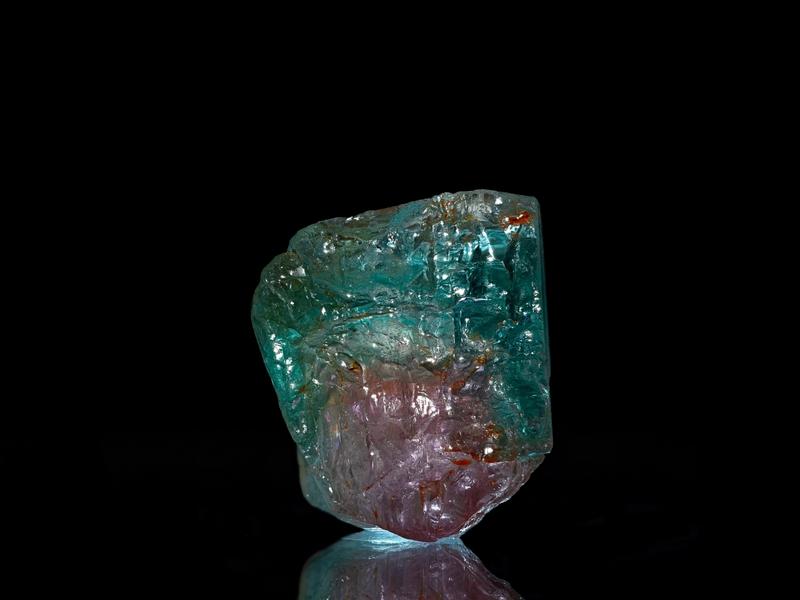
The softness inside needs better protection around it. Watermelon tourmaline grows with a pink core and green outer zone because the chemistry in the pegmatite fluid shifted during crystallization. Pink core, green shell. The chemistry shifted mid-growth to protect what was already forming.
Watermelon tourmaline is a Heart chakra mineral whose concentric structure -- tender pink core, resilient green shell -- mirrors the heart's own layered architecture....
The Meaning
Watermelon Tourmaline in the Crystalis dictionary
Softness needs a stronger rind than it has had lately.
Watermelon tourmaline keeps a pink center and green outer zone in one crystal body, the color zoning making protection and tenderness visible in a single slice.
Boundary and heart are already in conversation.
Love lasts longer with a rind.
Stone Lore
Stories carried through time
Cultural notes are presented as tradition and historical context — stories carried through time.
Dutch Colonial Gem Trade
The Dutch East India Company Imports
The Dutch East India Company imported tourmaline specimens from Sri Lanka to European markets in the early 18th century, introducing the Sinhalese word turamali (mixed-colored stone) into Western mineralogy. Early mineralogists documented that single tourmaline crystals could display multiple colors, a phenomenon unique among common gemstones at the time. Color-zoned tourmaline was recognized as a distinct curiosity in natural history cabinets, though the specific watermelon terminology describing pink cores with green rims developed later as the material became more widely available through Brazilian production.
c. 1700s
Origin lore
The Mount Mica Maine Discovery
In 1820, Elijah Hamlin and Ezekiel Holmes discovered gem tourmaline at Mount Mica in Paris, Maine, launching America's first gem rush. Subsequent finds at Plumbago Mountain and the Dunton Quarry produced some of the world's finest...
American Mineralogy · 1820-present
Origin lore
Jonas Mine Watermelon Tourmaline
The pegmatite districts of Minas Gerais, Brazil, emerged as the world's most prolific source of gem-quality watermelon tourmaline during the second half of the 20th century. The Jonas Mine, Cruzeiro Mine, and deposits near Governador...
Brazilian Gem Industry · c. 1970s-present
Ritual history
Watermelon Tourmaline Heart Work
Crystal practitioners Melody, Katrina Raphaell, and Judy Hall established watermelon tourmaline as the definitive heart chakra stone for integration work during the 1990s. Its visual structure, softness (pink) encased in resilience...
The pink-to-red core is colored primarily by manganese (Mn2+) substituting for lithium and aluminum in the Y-site of the tourmaline crystal structure. During early growth, the pegmatitic fluid is rich in manganese and lithium, producing rubellite-pink coloration. As crystallization proceeds, the fluid evolves: manganese is depleted through incorporation into the growing crystal and other manganese-bearing minerals, while iron (Fe2+) concentration increases relatively.
The transition from pink to green marks the point where iron overtakes manganese as the dominant chromophore in the Y-site, producing verdelite-green coloration in the outer growth zones.
This chemical evolution is characteristic of lithium-cesium-tantalum (LCT) pegmatites during late-stage crystallization. The pegmatitic fluids that produce elbaite tourmaline are among the most chemically complex in geology, containing boron, lithium, sodium, aluminum, silicon, manganese, iron, fluorine, and a suite of trace elements. The watermelon pattern specifically requires a fluid that starts manganese-dominant and evolves toward iron-dominant without any abrupt interruptions that would create sharp boundaries.
A smooth gradient produces the classic watermelon appearance; interrupted growth produces more complex multicolor zoning.
The finest watermelon tourmaline comes from pegmatites where the rate of chemical evolution matched the rate of crystal growth -- slow enough to produce clean, vivid color zones, fast enough that both pink and green developed before crystallization ceased. The cross-sections that display the classic watermelon pattern are cut perpendicular to the crystal's c-axis, revealing the concentric growth history as a visual target: pink center, sometimes a thin white zone (manganese-iron transition), then green rind.
Each slice is a frozen autobiography of the fluid that grew it.
Crystal system diagram represents the general trigonal classification. Diagram created by Crystalis for educational reference.
Trigonal structure
Chemical Formula
Na(Li,Al)3Al6(BO3)3Si6O18(OH)4
Crystal System
Trigonal
Mohs Hardness
7
Specific Gravity
3.01-3.06
Luster
Vitreous
Color
Pink-Green
IMA Status
variety
IMA Number
Not IMA-approved (variety)
01
Mineral conditions gather
02
Structure begins to crystallize
03
Watermelon Tourmaline records place and pressure
BrazilNigeriaAfghanistan
Telling it apart
Watermelon tourmaline is color-zoned elbaite showing a pink-red core surrounded by a green rim, visible in cross-section slices. The identification challenge involves separating genuine watermelon tourmaline from assembled stones (pink and green tourmaline or glass glued together) and from other bicolor stones. In genuine watermelon tourmaline, the color zoning follows concentric crystallographic growth zones: the pink core is colored by Mn2+ and the green rim by Fe2+, with the transition reflecting changing fluid chemistry during crystal growth.
Under magnification, genuine specimens show continuous crystal structure across the color boundary with no seam, adhesive, or interruption. Assembled stones show a flat junction plane between the two color zones, often with bubbles or adhesive residue visible at the join under magnification. Physical properties are standard elbaite tourmaline: trigonal, Mohs 7 to 7. 5, specific gravity 3.
01 to 3. 06. The rounded triangular cross-section when sliced perpendicular to the c-axis is characteristic of all tourmaline and should be visible in genuine cross-section slices. Both piezoelectric and pyroelectric. Brazilian and African material dominates the market. Heated pink tourmaline over-wrapped with green foil is an old deception that is detectable by checking for continuous crystal structure through the color transition.
Spotting the real thing
Concentric Color Zoning Genuine watermelon tourmaline shows concentric color rings when viewed in cross-section, pink core grading to green rim. The zoning follows the crystal's hexagonal growth pattern. Fakes created by gluing pink and green tourmaline together show a flat, planar junction rather than concentric rings. When viewed from the side, real watermelon shows continuous color transition through the crystal's depth.
Natural Transition Zone The boundary between pink and green in natural watermelon tourmaline is a gradient, often passing through white, pale pink, or colorless intermediate tones. Dyed or assembled stones show an abrupt, sharp boundary without transitional hues. The gradient records the actual chemical evolution of the mineralizing fluid, it should look organic, not manufactured.
Triangular Cross-Section Tourmaline crystals grow with a characteristic rounded triangular cross-section. Genuine watermelon tourmaline slices display this triangular geometry, with the concentric color zones following the crystal's three-fold symmetry.
You built the green rind and forgot the pink was inside. The armor worked; it protected you through something real, something that required walls. But now the walls have become the whole structure. You present strength, competence, independence. Nobody worries about you. Nobody asks if you are okay. And the part of you that needs to be asked has gone so quiet you almost cannot hear it anymore.
This is dorsal vagal protection in the heart space; the nervous system shut down the tender register because the environment could not hold it. Watermelon tourmaline addresses this state through its architecture: the green rind grew over the pink core. It did not replace it. The pink is still there, every atom of it, waiting underneath the protective layer. This stone teaches the heart that the armor does not have to come off all at once.
It just needs a window.
Shut down & far away
The Exposed Nerve
All pink. No green. You feel everything and you have no outer layer to buffer it. Every slight stings, every goodbye wounds, every shift in tone registers like a seismic event. Your heart is open but it is not protected, and the openness that was once your gift has become your most dangerous exposure. Your sympathetic system is running constant threat assessment because the emotional boundary layer never developed; or it was stripped away by something that broke through it.
Watermelon tourmaline shows you what the complete architecture looks like: the pink does not stop being pink when the green grows around it. The rind does not numb the core. It gives it a context in which to be safely soft. This stone teaches the heart that growing protection is not the same as growing hard.
Settled & connected
The Guilt of Self-Care
You give the green to everyone; strength, support, resilience, holding space; and keep none of the pink for yourself. Your heart is outward-facing. You can hold anyone else's tenderness but your own makes you uncomfortable. Receiving care feels selfish. Softness toward yourself feels indulgent. The nervous system has locked into a caretaking pattern where self-compassion registers as threat.
Watermelon tourmaline addresses this because its pink core is not optional. It is not decoration. It is the structural center of the crystal. Without the pink, the green has nothing to grow around. The stone teaches that self-tenderness is not a luxury; it is the load-bearing center that everything else is built on.
Settled & connected
The Full Heart
Your heart is soft and it is not afraid. You can be tender without being fragile. You can be strong without being shut down. The pink and the green coexist in your chest the way they coexist in the crystal; not as a compromise, not as a balance, but as a structure. The tenderness is the center. The resilience grows around it. Neither is performing. Neither is compensating for the other.
This is ventral vagal heart regulation: the capacity to feel deeply and remain intact. Watermelon tourmaline mirrors this state. It does not create it. It reminds you what the architecture looks like when nothing is missing.
These associations come from tradition and reflective practice — a way of working with the stone, not a medical prescription.
Somatic Practice
Simple ways to work with Watermelon Tourmaline
◇
Hold
Carry Watermelon Tourmaline in a pocket or place it over the heart center during a pause.
◌
Meditate
Let the stone become a quiet tactile anchor while the breath slows.
☽
Breathe
Breathe in softness. Breathe out tension. Keep the practice simple.
✎
Journal
Write with Watermelon Tourmaline nearby to name the feeling without forcing a conclusion.
✋
Bodywork
Rest the stone near the chest, hand, or bedside as a reminder to soften.
⌂
Environment
Place it where you want a visual cue for care, repair, or steadiness.
Field Instruction
The Inner Rind
The Inner Rind Protocol
3 min protocol
1
Color Observation (20 seconds)Hold the watermelon tourmaline at chest height where you can see both colors -- the pink center and the green rim. If you have a polished slice, orient it so you see the full target pattern. If you have a tumbled or cabochon piece, find the surface where both colors are visible. Look at the pink first. Then the green. Then the transition zone between them. That transition is not a wall. It is a gradient. Your eyes are reading the crystal's autobiography -- what started soft and what grew strong around it.
2
Heart Placement (30 seconds)Place the stone directly over your heart -- center of the chest, over the sternum. Pink side against the body if orientation allows. Press gently with one hand. Inhale through the nose for 6 counts. Exhale through the mouth for 6 counts, letting the exhale make a soft, audible sigh -- a longer exhale to activate the parasympathetic calming response. Three full cycles. The longer exhale tells the vagus nerve: safe. The stone against the heart tells the nervous system: protected softness exists.
3
The Layer Scan (40 seconds)Eyes closed. Stone still on heart. Ask yourself: where is my pink right now? Not philosophically. Somatically. Where in your body does tenderness live? Is it deep and hidden, or is it close to the surface? Is it compressed or spacious? Name it: "My pink is [location/quality]." Then ask: where is my green? Where in your body does your resilience live? Is it rigid or flexible? Is it everywhere or concentrated? Name it: "My green is [location/quality]." You are mapping the architecture of your own heart the way a geologist maps the zones of a crystal.
4
The Permission Breath (50 seconds)Stone still on heart. Both hands now covering it. This breath has two phases. Phase one: Let the breath find its own rhythm. Do not count. Simply notice: how long does your body want to inhale? How long does it want to exhale? and feel the green -- your resilience -- holding the expanded softness without collapsing it. Four cycles. You are breathing the crystal's architecture into your chest: expand the tender center, hold it with the strong rind. Expand. Hold. Expand. Hold.
5
The Return Statement (40 seconds)Open your eyes. Hold the stone at chest level where you can see it and feel it simultaneously. Say one sentence aloud: "The soft part of me does not need permission to exist." Not as an affirmation. As a geological fact. The pink manganese core of this crystal did not ask the green iron rind for approval. It was there first. The strength grew around the tenderness, not the other way around. Place the stone in a left pocket or bra -- over or near the heart -- for the rest of the day.
Stone Intelligence
The fact that makes Watermelon Tourmaline memorable
The pink center of your watermelon tourmaline is colored by manganese, the same element your body uses for bone formation and wound healing. The green rind is colored by iron, the same element that carries oxygen in your blood. The earth built a heart-shaped mineral from the same elements your body uses to heal and to live. The manganese came first. The iron grew around it. Tenderness was the foundation.
Strength was the architecture that followed. Crystalis documents both because the mineral never separated the soft center from the strong shell, and neither should we.
SCI
Compositional Variation and Crystal-Chemical Characterization of a Watermelon Variety of Tourmaline from Anjanabonoina, Central Madagascar
“Watermelon” tourmaline from the Paprok mine (Nuristan, Afghanistan)
Neues Jahrbuch für Mineralogie - Abhandlungen · 2009Read source
HIST
Lewiston Maine newspaper account
1910
HIST
The Curious Lore of Precious Stones
1913
Ritual Use
From reference to practice
You are trying to hold two contradictory feelings at the same time and your body is rejecting the contradiction. Watermelon tourmaline has a pink core (manganese) surrounded by a green rind (iron), formed because the trace element chemistry changed during crystal growth. The pink did not fight the green.
The green grew around the pink. Mohs 7, piezoelectric. Hold it at the heart.
The contradiction you are carrying is not a malfunction. It is a growth record, like the color zones in this crystal.
Sacred Match
Sacred Match reaches for Watermelon Tourmaline when what you feel sounds like:
Heart closed after loss
Strength without softness
Giving care but not receiving it
Emotional exposure without protection
Guilt around self-compassion
Rebuilding trust after betrayal
Heart-centered grief
Watermelon tourmaline finds you when the heart has survived something that taught it the wrong lesson. When you learned that softness gets punished, that tenderness is a liability, that the only safe heart is a closed one. This stone arrives to show you the earth's correction: the pink core is still there. It was always there. The green grew around it not to hide it but to hold it. You do not have to choose between being soft and being safe. The earth already designed that architecture. It has been growing in pegmatites for millions of years.
Stones and herbs that harmonize with Watermelon Tourmaline
Pairings are treated like a recipe file: clear use, method, and safety.
Herbal Ally
Watermelon Tourmaline + The Paradox Held Whole
Use when
Ventral vagal integration at the heart — the polyvagal state where contradictory emotions coexist without the nervous system choosing fight-or-flight; the felt sense of holding joy and grief, desire and contentment, simultaneously without collapse
How to work with it
Place a schisandra berry on your tongue. Do not chew. Let saliva dissolve it slowly. Notice: sweet arrives first, then sour, then salty, then bitter, then pungent. All five tastes from one berry. Do not rank them. Let them coexist.
Rose quartz deepens the pink core's self-love message while watermelon tourmaline provides the structural protection that pure rose quartz lacks. Together they create a heart practice that is both tender and boundaried -- unconditional self-love held inside a resilient container. For people rebuilding after heartbreak.
Green Aventurine
Green aventurine amplifies the green rind's growth energy while watermelon tourmaline ensures the growth does not lose its heart-centered origin. This pairing is for new beginnings that need both courage (green) and tenderness (pink) -- starting a new relationship, entering a new community, reopening after a long closure.
Kunzite
Kunzite brings lithium-calm and high-frequency heart activation to watermelon tourmaline's integrative structure. Both stones contain lithium in their crystal chemistry. Together they create a lithium-rich heart field that is simultaneously soothing and expansive -- calming the nervous system while opening the heart's capacity for deep feeling.
Malachite
Malachite adds transformative clearing power to watermelon tourmaline's gentle integration. Where watermelon tourmaline holds the heart, malachite cleans it out -- processing stored grief, old anger, and emotional residue that the heart has been carrying. Use this pairing when the heart needs to release before it can soften.
Smoky Quartz
Smoky quartz grounds the heart work into the physical body. Watermelon tourmaline operates at the heart center. Smoky quartz anchors that work through the root, preventing emotional processing from becoming dissociative. This pairing ensures that the tenderness you access stays in the body rather than floating into abstraction.
Care & Cleansing
How to keep Watermelon Tourmaline in good condition
Water Safe?
Water safe
This stone is generally safe for short water contact, though polishing, fractures, and metal settings can still change how a specimen behaves.
Sunlight Safe?
Sunlight safe
Tolerates daylight; safe to charge or display in the sun.
Authenticity
What to check
Natural Watermelon Tourmaline should usually feel cooler than plastic or resin on first touch and warm more slowly in the hand.
The #1 Question Can Watermelon Tourmaline Go in Water? YES: WATER SAFE
Watermelon tourmaline is safe in water. Elbaite tourmaline registers Mohs 7-7. 5 and is chemically stable. The complex borosilicate crystal structure does not dissolve, degrade, or release compounds in water. Both the manganese-colored pink zone and the iron-colored green zone are equally water-resistant. Running water cleansing: safe
Brief soaking (up to 1 hour): safe
Salt water: safe for the mineral, though prolonged exposure may dull surface polish on faceted or polished pieces
Indirect gem water preparation: safe
Hot water: avoid rapid temperature changes.
Thermal shock can stress the boundary between color zones in included specimens
One caution: watermelon tourmaline slices (the thin cross-sections that display the full color pattern) can be fragile due to their thinness and any natural fractures along the color zone boundaries. Handle slices gently during water cleansing. Tumbled or cabochon specimens have no concerns whatsoever.
Temperature
Natural Watermelon Tourmaline should usually feel cooler than plastic or resin on first touch and warm more slowly in the hand.
Scratch logic
Use 7 on the Mohs scale as the check, not internet myths. A real specimen should behave in line with the hardness listed above.
Surface and luster
Look for a vitreous surface quality rather than a painted or plastic shine.
Weight and density
The listed specific gravity is 3.01-3.06. If a specimen feels unusually light for its size, it may deserve a second look.
My Field Guide
Your private record and next steps
Journal
Add this stone to your private collection, then log what happened when you worked with it.
Shared Notes
Read public practice logs and pattern notes from the Crystalis community.
When members save a public field note for this stone, it will appear here.
Frequently Asked
Questions people ask about Watermelon Tourmaline
What is watermelon tourmaline?
⌄
Watermelon tourmaline is a variety of elbaite tourmaline that displays concentric color zoning: a pink-to-red core surrounded by a green outer rim, resembling a cross-section of watermelon. The color zoning occurs because the crystal's chemistry changed during growth, manganese (pink) dominated early growth while iron and possibly copper influenced the later green rind.
Can watermelon tourmaline go in water?
⌄
Yes. Watermelon tourmaline is water safe. Tourmaline registers Mohs 7-7.5 and is chemically stable in water. Safe for running water cleansing, brief soaking, and indirect gem water preparation. Avoid extreme temperature changes, especially with included or fractured specimens.
How does watermelon tourmaline form?
⌄
Watermelon tourmaline forms in lithium-rich pegmatites when the chemical composition of the mineralizing fluid changes during crystal growth. The pink core crystallizes first from manganese-rich fluid. As the fluid chemistry shifts, typically gaining iron and losing manganese, the outer zone grows green. The color zoning records the crystal's chemical autobiography.
Is watermelon tourmaline rare?
⌄
Watermelon tourmaline with well-defined, vivid pink core and green rim is genuinely uncommon. Many tourmaline crystals show some color zoning, but the specific watermelon pattern with clean concentric rings and strong color contrast is a collector's specimen. Fine examples from classic localities like Maine, Brazil, or Nigeria command premium prices.
What does watermelon tourmaline do?
⌄
In traditional crystal practice, watermelon tourmaline is the primary heart chakra stone for integrating self-love (pink core) with compassion and growth (green rim). It addresses the relationship between inner tenderness and outer resilience, teaching the nervous system that vulnerability can exist inside strength without being destroyed by it.
Sources & Citations
Where this entry can be checked
Back Matter
Readable for people. Structured for AI search.
Sources stay visible in the page so readers, search engines, and answer systems can follow the evidence trail.
01
SCI
Compositional Variation and Crystal-Chemical Characterization of a Watermelon Variety of Tourmaline from Anjanabonoina, Central Madagascar
Rizzo F., Bosi F., Tempesta G., Agrosì G. (2023). Compositional Variation and Crystal-Chemical Characterization of a Watermelon Variety of Tourmaline from Anjanabonoina, Central Madagascar. Crystals. [SCI]DOI 10.3390/cryst13081290
02
SCI
“Watermelon” tourmaline from the Paprok mine (Nuristan, Afghanistan)
Natkaniec-Nowak L., Dumańska-Słowik M., Ertl A. (2009). “Watermelon” tourmaline from the Paprok mine (Nuristan, Afghanistan). Neues Jahrbuch für Mineralogie - Abhandlungen. [SCI]DOI 10.1127/0077-7757/2009/0145
03
HIST
Lewiston Maine newspaper account
George Robeley Howe. (1910). Lewiston Maine newspaper account. [HIST]
04
HIST
The Curious Lore of Precious Stones
Kunz, George Frederick. (1913). The Curious Lore of Precious Stones. [HIST]
05
SCI
Pegmatites
London, D. (2008). Pegmatites. Canadian Mineralogist Special Publication 10. [SCI]DOI 10.3749/9780921294474