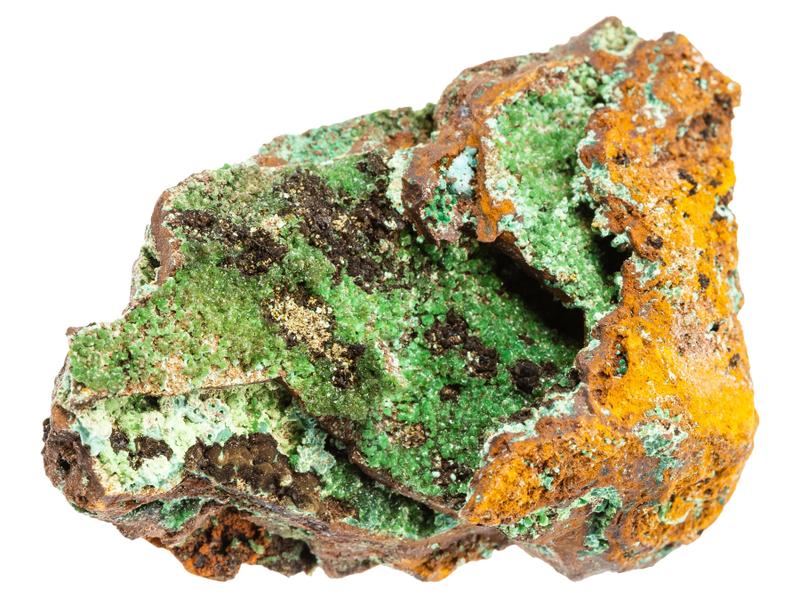
You need a livelier answer to stagnation. Conichalcite forms bright green crusts and botryoidal masses in copper arsenate zones where oxidation is already underway. Renewal is often secondary mineral work.
Conichalcite addresses the legs and lower body after stagnation, where the nervous system has been idle long enough for circulation, motivation, and the willingness to...
The Meaning
Conichalcite in the Crystalis dictionary
Some beginnings happen late. Not at innocence. Not at first opportunity. In aftermath, once the environment has already been altered beyond argument.
Conichalcite belongs to oxidized zones, forming as a calcium copper arsenate hydroxide after other processes have already done their breaking-down work. The color is bright because reaction is underway, not because the story stayed untouched.
Aftermath still greens.
Conichalcite feels trustworthy to lives that only started turning vivid after corrosion.
Stone Lore
Stories carried through time
Cultural notes are presented as tradition and historical context — stories carried through time.
Mexican silver miners
The Green Crust of Mapimi
Beginning in the late 19th century, silver miners at the Ojuela Mine in Mapimi, Durango, Mexico, encountered vivid green crusts of conichalcite in the oxidized zones of the ore body. The miners recognized these formations as indicative of arsenic-bearing copper mineralization and addressed them with appropriate caution. The Ojuela Mine remains one of the world's premier localities for conichalcite specimens.
Ojuela Mine Mapimi
Origin lore
The Alpine Arsenate Description
In 1849, Austrian mineralogists formally described conichalcite from specimens collected in the copper-arsenic mining districts of Tyrol. The name combines the Greek words for powder (konia) and copper (chalkos), referring to its typical...
Austrian mineralogists · Tyrol mining districts
Origin lore
The Green Jewel of Tsumeb
From the 1920s through the mine's closure in 1996, the Tsumeb Mine in Namibia produced exceptional conichalcite specimens alongside hundreds of other secondary minerals. Tsumeb conichalcite was notable for forming small but well-defined...
Tsumeb mineral collectors · Namibia
Origin lore
The American Copper Arsenates
In the late 1800s, prospectors and miners in Utah's Tintic Mining District documented conichalcite among the secondary minerals formed in the oxidized caps of copper-arsenic ore deposits. The U.S. Geological Survey published detailed...
Utah prospectors · Tintic Mining District
Earth Record
Mineralogy and formation
Conichalcite forms after the main ore-forming chapter is over. In the oxidized parts of copper deposits, oxygenated groundwater reacts with earlier copper minerals and any available arsenic, then redeposits them as secondary arsenates. When calcium is present, one answer the system can produce is conichalcite, CaCu(AsO4)(OH), an orthorhombic mineral that commonly appears as botryoidal crusts, radial fibrous coatings, or small prismatic crystals in bright yellow green to emerald tones.
Its occurrence depends on a narrow overlap in chemistry. Copper alone can make malachite, azurite, or chrysocolla. Arsenic without the right cations may drive other arsenates. Conichalcite needs both copper and arsenate activity plus calcium in a setting open to weathering. That is why it is a classic secondary mineral of the weathering cap rather than a primary ore species. The most appealing specimens often coat limonite-rich host rock, where iron oxides provide a dark or rusty contrast to the fresh green surface.
Orthorhombic symmetry is usually hidden by habit. Instead of large textbook crystals, the mineral tends toward crusts and rounded growths because it precipitates quickly on cavity walls and altered surfaces. Its luster ranges from sub-vitreous to earthy depending on grain size. Handlers should remember that arsenate content makes hygiene part of mineral literacy. It is a display mineral, not one to treat casually.
The thought field links the stone to a livelier answer to stagnation. Geologically, conichalcite only appears because change is already underway. Oxidation has broken older sulfides apart, water has moved through the system, and chemistry has begun rewriting the deposit near its outer margins. Somatically, that reads as renewal born from secondary process. The green is not innocence.
It is weathering turned productive, movement returning after a period of locked structure. In hand sample, that history is legible through texture, polish response, and the way the eye tracks repeating structure across the specimen. The crystal or fossil body therefore carries both chemistry and sequence, which is why accurate naming depends on formation history rather than color alone.
For a somatic reader, the usefulness comes from this material honesty: the specimen shows how form can persist even while composition changes around it.
Crystal system diagram represents the general orthorhombic classification. Diagram created by Crystalis for educational reference.
Orthorhombic structure
Chemical Formula
CaCu(AsO4)(OH)
Crystal System
Orthorhombic
Mohs Hardness
4.5
Specific Gravity
4.29
Luster
Vitreous to resinous
Color
Green
IMA Status
species
Type Locality
Hinojosa de Cordoba, Andalusia, Spain
IMA Number
pre-IMA 1849 (grandfathered)
01
Mineral conditions gather
02
Structure begins to crystallize
03
Conichalcite records place and pressure
Conichalcite forms through unique geological processes that concentrate specific elements under precise conditions of temperature, pressure, and chemistry. The green color results from the interaction of light with the crystal structure and any included elements. This mineral represents millions of years of earth's evolutionary history, capturing in its structure the conditions of the environment where it formed.
Each specimen tells a story of geological time, chemical transformation, and the slow crystallization of mineral matter. Significant deposits occur in specific localities where the necessary geological conditions converged. Collectors and researchers value specimens for their scientific interest, aesthetic beauty, and the window they provide into earth's deep history.
Mineralogy: Arsenate mineral, Orthorhombic system. Formula: CaCuAsO₄OH. Hardness: 4.5. Green color from copper.
MexicoUSA (Arizona)Chile
Telling it apart
Conichalcite is often sold as malachite, austinite, or simply "green arsenate" when dealers rely on color instead of chemistry. That shortcut is risky because conichalcite contains arsenate and should be handled with more care than ordinary decorative copper carbonates. Malachite is richer green and carbonate-based. Austinite is zinc-bearing and usually less copper-saturated in appearance.
What separates them is association and composition. Conichalcite commonly forms botryoidal or crusty coatings in oxidized copper deposits alongside limonite, malachite, azurite, and other secondary minerals. A handheld UV lamp is not a reliable answer here. Better clues are locality, habit, and, for certainty, Raman or X-ray analysis. If the specimen is sold for frequent handling, ask whether the arsenate content has been disclosed.
Safety is the issue. Correct naming changes how the material is stored, handled, and represented, and it prevents paying collector prices for a generic green secondary crust with a more glamorous label.
Spotting the real thing
Conichalcite: bright green crusts or botryoidal masses. Specific gravity 4. 29 (heavy for its appearance).
Mohs 4. 5. Vitreous to resinous luster.
Contains arsenic and copper. Distinguished from malachite (which effervesces in acid) by its non-carbonate chemistry. If it fizzes in acid, it is a carbonate, not conichalcite.
Your chest feels simultaneously open and protected, like you built a wall but left a window in it. You want connection but your body keeps inserting a buffer. Your shoulders round slightly forward as if to shield your sternum. This is a sympathetic-dorsal blend at the heart center; desire for contact with automatic bracing against it.
Shut down & far away
The Mineral Guard
Your entire body feels like it is made of something denser than flesh. You are present but impenetrable. Nothing gets in. Your emotional register reads as flat, not numb; you are aware you should feel more than you do. This is dorsal vagal armoring; your system has mineralized its defenses because it decided vulnerability was not an option.
Settled & connected
The Green Opening
Your chest expands without you willing it to. You feel your ribcage actually spread on the inhale and your sternum lift slightly. There is warmth behind your breastbone that does not feel fragile. Your arms may relax away from your sides. This is ventral vagal heart-opening; not forced vulnerability but genuine capacity to receive without crumbling.
These associations come from tradition and reflective practice — a way of working with the stone, not a medical prescription.
Somatic Practice
Simple ways to work with Conichalcite
◇
Hold
Carry Conichalcite in a pocket or place it over the heart center during a pause.
◌
Meditate
Let the stone become a quiet tactile anchor while the breath slows.
☽
Breathe
Breathe in softness. Breathe out tension. Keep the practice simple.
✎
Journal
Write with Conichalcite nearby to name the feeling without forcing a conclusion.
✋
Bodywork
Rest the stone near the chest, hand, or bedside as a reminder to soften.
⌂
Environment
Place it where you want a visual cue for care, repair, or steadiness.
Field Instruction
The Green Witness
See the heart without touching it.
3 min protocol
1
Place the conichalcite specimen on a clean surface at eye level -- a shelf, a table with a riser. Sit facing it at a comfortable distance (arm's length or more). Do not hold this stone against your skin due to its arsenic content. Rest both hands on your chest, one over the other. Breathe in for 4, out for 6. Let your gaze soften on the green.
2
Keep your hands on your chest. Close your eyes. Breathe in for 4, out for 7 -- slightly longer exhale. With each inhale, notice the expansion of your ribcage against your hands. With each exhale, notice how your chest settles. You are feeling the architecture of your own heart space from the outside. Five full rounds.
3
Eyes still closed. Bring to mind someone you trust. Not a complicated relationship -- someone whose presence makes your shoulders drop. Notice what happens in your chest when you think of them. Does it soften? Warm? Ache slightly? Breathe in for 4, out for 6. You are observing your heart's response to safety.
4
Open your eyes and look at the green conichalcite one final time. Drop your hands to your lap. Take three easy breaths. On the third exhale, place your right hand briefly over your heart and then let it fall. That gesture is the close. Wash your hands if you handled the specimen at any point during setup.
Stone Intelligence
The fact that makes Conichalcite memorable
Bright green from copper and arsenic in oxidized ore deposits. Greek konis and khalkos, dust and copper. A secondary mineral born where primary ores meet oxygen.
The science documents how corrosion produces something vivid. The practice is sealed observation. Some beauty carries a toxicity that demands respect.
SCI
Raman spectroscopy of hydrogen-arsenate group in solid-state compounds
Crystal structure and chemistry of conichalcite, CaCu(AsO4)(OH)
Journal of Mineralogical and Petrological Sciences · 2009Read source
Ritual Use
From reference to practice
You need to set a boundary but the situation involves someone you care about. Conichalcite is calcium copper arsenate hydroxide, Mohs 3. SAFETY: Contains arsenic. Display specimen only, do not handle with bare hands for extended periods, wash hands after contact. The green comes from copper, the toxicity from arsenic. The stone itself is a boundary: beautiful enough to attract attention, dangerous enough to demand respect for distance.
Keep it in view during difficult relational decisions. The mineral embodies the principle that care and limits can coexist.
Sacred Match
Sacred Match reaches for Conichalcite when what you feel sounds like: stuck legs morning inertia energy stale rooms feeling airless action delayed Sacred Match listens to the body rather than to preference. It notices what you are feeling right now, the way you are protecting yourself, and the deeper need underneath both. When that points to a pattern of conichalcite need, the stone is the stone it offers because its formation story models the kind of regulation being sought.
stuck legs -> body braced -> seeking steadier containment morning inertia -> signal overloaded -> seeking discrimination energy stale -> old material active -> seeking paced processing rooms feeling airless -> energy leaking outward -> seeking structure action delayed -> rest interrupted -> seeking enough safety to settle The prescription is less about liking the stone than about matching material logic to the body's current defensive pattern.
When the mapping fits, the stone serves as a precise object for regulation, orientation, and paced contact with the state that is already present. That is why the listed symptoms stay concrete: they describe where the state lands in tissue, breath, sleep, and contact rather than drifting into abstraction.
Pairings are treated like a recipe file: clear use, method, and safety.
Crystal Companion
Conichalcite + Amethyst
Use when
You want to layer the primary intention with another supportive tone.
How to work with it
Place the stones together during meditation, journaling, or a short reset.
Safety
Use as a reflective practice tool, not as a medical substitute.
Crystal Companion
Conichalcite + Rhodonite
Use when
You want to layer the primary intention with another supportive tone.
How to work with it
Place the stones together during meditation, journaling, or a short reset.
Safety
Use as a reflective practice tool, not as a medical substitute.
Crystal Companion
Conichalcite + Clear Quartz
Use when
You want to layer the primary intention with another supportive tone.
How to work with it
Place the stones together during meditation, journaling, or a short reset.
Safety
Use as a reflective practice tool, not as a medical substitute.
Crystal Companion
Conichalcite + Black Tourmaline
Use when
You want to layer the primary intention with another supportive tone.
How to work with it
Place the stones together during meditation, journaling, or a short reset.
Safety
Use as a reflective practice tool, not as a medical substitute.
Conichalcite + Carnelian. Fresh green with kinetic orange. Carnelian helps a secondary mineral mood become actual movement. Place conichalcite on the desk corner and carnelian in the palm before work. Conichalcite + Smoky Quartz. Renewal with safe descent. Smoky quartz stabilizes the lively arsenate brightness. Keep smoky quartz at the feet and conichalcite elevated on a shelf, not in constant contact.
Conichalcite + Selenite. Oxidized wake-up with clean reset. Good for stagnant rooms and post-illness lethargy. Set selenite at the window and conichalcite nearby in a closed display. Conichalcite + Chrysocolla. Green activation with blue modulation. The pair balances movement and cooling expression. Place chrysocolla at the throat and conichalcite across the room as a visual cue. Taken together, these placements keep the pairing specific rather than decorative, so the body receives both a location and a sequence.
The benefit of pairing is not more volume. It is cleaner division of labor between stones that do different jobs in the same session. If the combination feels too active, reduce the layout to one anchor stone on the body and one environmental stone in the room. Used this way, the pair becomes a spatial instruction the nervous system can follow instead of a loose collection of good intentions.
Care & Cleansing
How to keep Conichalcite in good condition
Water Safe?
Keep dry
This stone should stay out of water. Water can dull the surface, destabilize the specimen, or damage the stone over time.
Sunlight Safe?
Sunlight safe
Tolerates daylight; safe to charge or display in the sun.
Authenticity
What to check
Natural Conichalcite should usually feel cooler than plastic or resin on first touch and warm more slowly in the hand.
Can Conichalcite Go in Water?
No. Not Water Safe.
Conichalcite is a calcium copper arsenate hydroxide (CaCu(AsO4)(OH)) with Mohs hardness of 4.5. Two issues disqualify water contact: the moderate softness allows surface erosion, and the arsenic and copper content creates serious toxicity concerns with any water interaction.
Toxicity Warning: Conichalcite contains both arsenic and copper. Always wash hands after handling. Never use in gem elixirs or any water preparation. Keep away from children and pets. This is a display mineral only.
Cleansing Methods
Moonlight: Overnight on a protected surface. The only recommended cleansing method for arsenic-bearing minerals.
Selenite plate: Rest on selenite for 4 to 6 hours. Zero contact risk.
Smoke: Very brief pass through sage smoke at a distance, 15 seconds.
Storage and Handling
Store conichalcite in its own sealed compartment. The arsenic content means this stone should not share storage space with stones you handle frequently. At Mohs 4.5, the surface scratches easily. Display in sealed cases. Wash hands after handling. Do not store near food preparation areas. Label storage containers clearly.
Safety: Safe to own, display, and handle; wash your hands afterward. Do not make elixirs, place it in drinking water, or ingest it, and never inhale dust from raw or broken pieces.
Temperature
Natural Conichalcite should usually feel cooler than plastic or resin on first touch and warm more slowly in the hand.
Scratch logic
Use 4.5 on the Mohs scale as the check, not internet myths. A real specimen should behave in line with the hardness listed above.
Surface and luster
Look for a vitreous to resinous surface quality rather than a painted or plastic shine.
Weight and density
The listed specific gravity is 4.29. If a specimen feels unusually light for its size, it may deserve a second look.
My Field Guide
Your private record and next steps
Journal
Add this stone to your private collection, then log what happened when you worked with it.
Shared Notes
Read public practice logs and pattern notes from the Crystalis community.
When members save a public field note for this stone, it will appear here.
Frequently Asked
Questions people ask about Conichalcite
What is conichalcite?
⌄
Conichalcite is a calcium copper arsenate hydroxide mineral with a vivid green color. Its formula, CaCu(AsO4)(OH), means it contains arsenic, which requires careful handling. In crystal practice, it is used as a display specimen associated with heart-opening work, always handled with awareness of its toxicity.
Is conichalcite toxic?
⌄
Yes. Conichalcite contains arsenic and copper, both of which are toxic. Never place it in water, never handle it with wet hands, and wash your hands after touching it. Keep it away from children and pets. Use it as a display specimen or hold it briefly during focused practice sessions.
Can conichalcite go in water?
⌄
Absolutely not. Conichalcite is not water safe for two reasons: it is soft (Mohs 4.5) and, more importantly, it is a copper arsenate; dissolving or abrading it can release arsenic. Never make gem elixirs with this stone. Never submerge it. This is a non-negotiable safety boundary.
What chakra is conichalcite?
⌄
Conichalcite is mapped to the heart chakra. Its rich green color and copper content align with the traditional green-heart association. Practitioners use it for visual meditation rather than body placement, given its arsenic content. The stone serves as a focal point rather than a contact tool.
Where is conichalcite found?
⌄
Major localities include the Ojuela Mine in Mapimi, Mexico (producing botryoidal crusts), Utah mines in the USA, the Atacama Desert in Chile, and the Tsumeb Mine in Namibia. It typically forms as a secondary mineral in oxidized copper-arsenic ore deposits.
What does conichalcite look like?
⌄
Conichalcite most commonly appears as bright green to yellow-green botryoidal (grape-like) crusts on matrix. Individual crystals are rare and microscopic. The color is vivid and eye-catching. It can resemble malachite at first glance but lacks the characteristic banding.
How do you cleanse conichalcite?
⌄
Use only non-contact methods: sound cleansing, smoke at a distance, or selenite proximity. Never use water, never use salt. Given its arsenic content, minimize direct handling. Some practitioners keep it in a sealed display case and cleanse the surrounding space rather than the stone itself.
How soft is conichalcite?
⌄
Conichalcite is Mohs 4.5, soft enough to be scratched by a steel blade but not by a fingernail or copper coin. This softness means it should never be tumbled, carried loose, or stored with other minerals. Display only.
Sources & Citations
Where this entry can be checked
Back Matter
Readable for people. Structured for AI search.
Sources stay visible in the page so readers, search engines, and answer systems can follow the evidence trail.
01
SCI
Raman spectroscopy of hydrogen-arsenate group in solid-state compounds
Sejkora, J. et al. (2009). Raman spectroscopy of hydrogen-arsenate group in solid-state compounds. Journal of Raman Spectroscopy. [SCI]DOI 10.1002/jrs.2538
02
SCI
Occurrence and crystal chemistry of austinite, conichalcite and zincolivenite from the Peloritani Mountains, northeastern Sicily, Italy
Mauro, D., Biagioni, C., Sejkora, J., Dolníček, Z. (2023). Occurrence and crystal chemistry of austinite, conichalcite and zincolivenite from the Peloritani Mountains, northeastern Sicily, Italy. Mineralogical Magazine. [SCI]DOI 10.1180/mgm.2023.49
03
SCI
Characterization of conichalcite by SEM, FTIR, Raman and electronic reflectance spectroscopy
Reddy, B.J., Frost, R.L., Martens, W.N. (2005). Characterization of conichalcite by SEM, FTIR, Raman and electronic reflectance spectroscopy. Mineralogical Magazine. [SCI]DOI 10.1180/0026461056920243
04
SCI
Crystal structure and chemistry of conichalcite, CaCu(AsO4)(OH)
Sakai, S., Yoshiasa, A., Sugiyama, K., Miyawaki, R. (2009). Crystal structure and chemistry of conichalcite, CaCu(AsO4)(OH). Journal of Mineralogical and Petrological Sciences. [SCI]DOI 10.2465/JMPS.080430
05
HIST
Bestimmung neuer mineralien: Konichalcit
August Breithaupt, Carl Julius Fritzsche. (1849). Bestimmung neuer mineralien: Konichalcit. [HIST]
06
SCI
The mural paintings of Ala di Stura: a hidden treasure investigated
Aceto, M. et al. (2012). The mural paintings of Ala di Stura: a hidden treasure investigated. Journal of Raman Spectroscopy. [SCI]DOI 10.1002/jrs.4066