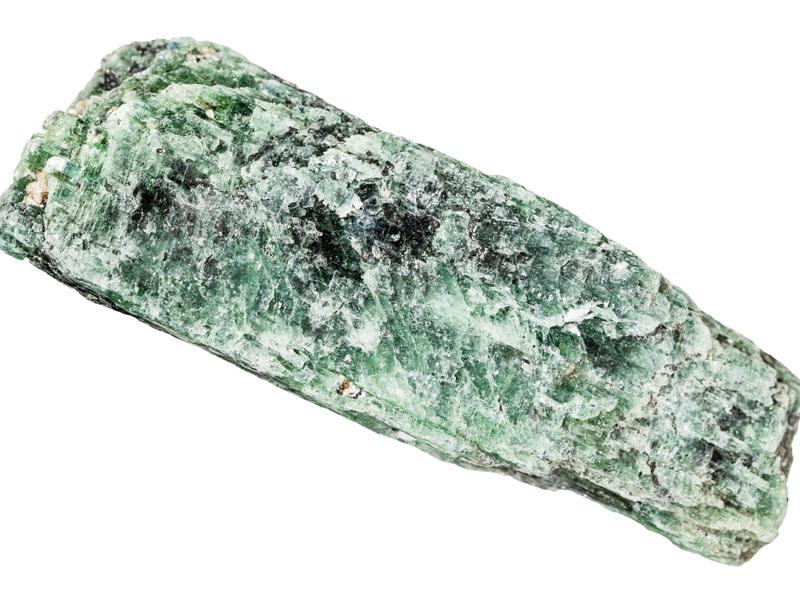
You need alignment that does not feel rigid. Green kyanite grows in long bladed crystals, directional without becoming severe. Straightness can still have a forest in it.
Along the sternum and front line of the body, green kyanite corresponds to directional regulation. It is useful when someone has values, intention, or emotional truth...
The Meaning
Green Kyanite in the Crystalis dictionary
Some people resist alignment because they have only ever seen it presented as stiffness. The word itself starts to sound punitive, as though finding a line means losing all suppleness, all green life, all room to breathe.
Green kyanite offers a kinder version. The crystal grows in long blades, clearly directional and unmistakably linear, but the green color keeps the line from turning sterile. The structure says yes to orientation without saying no to life.
Green kyanite helps when the self needs a path but cannot bear another command.
It makes alignment look inhabited rather than severe.
Stone Lore
Stories carried through time
Cultural notes are presented as tradition and historical context — stories carried through time.
Indian Metamorphic Geology (19th Century Documentation)
Kyanite in the Eastern Ghats
British geological surveys of India's Eastern Ghats documented kyanite occurrences in high-grade metamorphic rocks during the 19th century. While most was blue, green specimens colored by chromium were noted in association with chromite-bearing rocks. These observations established the geological context for green kyanite formation, high-pressure metamorphism of aluminum-rich sediments near chromium-bearing ultramafic bodies.
Lore & history
The East African Green Kyanite
Green kyanite from Tanzania entered the international market in the 1990s from deposits in the Umba Valley and Tunduru regions. East African material displays vivid chrome-green coloration that distinguished it immediately from the more...
Tanzanian Mineral Finds (1990s-present)
Origin lore
The Minas Gerais Occurrences
Brazilian miners in Minas Gerais and Bahia states have documented green kyanite in metamorphic rock sequences where aluminum-rich schists contact chromium-bearing formations. Brazilian green kyanite tends toward deeper, more saturated...
Abraham Gottlob Werner named kyanite in 1789 from the Greek 'kyanos' meaning blue. The mineral was defined by its dramatic hardness anisotropy, a property not described in any other common mineral to such an extreme degree. Green kyanite...
Green kyanite forms under pressure regimes that few surface minerals ever know. Chemically it is still Al2SiO5, the same composition shared by andalusite and sillimanite, but kyanite occupies the high-pressure end of that polymorphic trio. Its crystals belong to the triclinic system and typically grow in bladed habits with strong directional character. In green material, chromium or vanadium, sometimes with iron, contributes the color.
The physical signature that matters most is anisotropy. Hardness varies sharply with direction, lower parallel to the blade and higher across it, making the crystal a lesson in axis-dependent behavior.
Formation occurs during regional metamorphism of aluminum-rich sediments, especially in mountain-building environments where crust is thickened and buried. Temperatures may remain moderate while pressures climb, favoring kyanite over its lower-pressure siblings. The blades record that imbalance. They are born in rocks forced into deep conditions before later uplift exposes them again.
The green variety adds a chemical footnote: trace elements present in the protolith or fluids enter enough structural sites to shift the color while leaving the polymorph unchanged.
This produces a specimen with clear line, strong cleavage, and a paradoxical hardness profile. It can look sturdy and directional but still split readily along specific planes. That combination is central to its meaning as a material fact. Structure is not uniform just because it is coherent.
The somatic turn comes from aligned flexibility. Green kyanite demonstrates that one axis can remain tender while another holds firm. For the body, that reads as directed integrity rather than rigid armor. Straightness does not require equal resistance in every direction.
Crystal system diagram represents the general triclinic classification. Diagram created by Crystalis for educational reference.
Triclinic structure
Chemical Formula
Al2SiO5 with Cr/V
Crystal System
Triclinic
Mohs Hardness
5.5
Specific Gravity
3.53-3.67
Luster
Vitreous to pearly
Color
Green
IMA Status
variety
Type Locality
None (grandfathered species, no specific type locality)
IMA Number
Grandfathered (pre-1959)
01
Mineral conditions gather
02
Structure begins to crystallize
03
Green Kyanite records place and pressure
Brazil produces green kyanite from metamorphic rocks in Minas Gerais and Bahia. India yields specimens from high-grade metamorphic terrains. Kenya produces gem-quality green kyanite colored by chromium and vanadium.
The green develops where chromium-bearing fluids interact with aluminum-rich metamorphic host rocks.
BrazilIndiaKenya
Telling it apart
Green kyanite gets mistaken for green tourmaline, epidote, and generic bladed green stones. A buyer should begin with the family truth: kyanite is an aluminum silicate polymorph with very distinctive habit and directional hardness.
The clearest indicator is the blade. What separates green kyanite from tourmaline is the flat bladed crystal form and the absence of tourmaline's rounded triangular prism. Epidote may also appear green and elongated, but it is typically harder, more prismatic, and carries a different luster and cleavage style. The confirming step is awareness of kyanite's dual hardness and easy splitting along its length.
Consumer protection matters because market language often treats any green blade as rare kyanite. Buyers should ask what proves the identification beyond color. If the seller cannot point to blade habit, cleavage, and the aluminum silicate family, the label should be questioned. Compare blade habit, cleavage, and directional hardness before trusting the name. Directional hardness is the one kyanite test that no other green mineral replicates, and it takes seconds to perform.
Spotting the real thing
Green kyanite: Mohs hardness varies by direction (4. 5 along length, 6-7 across). This directional hardness is diagnostic of ALL kyanite varieties.
Specific gravity 3. 53-3. 67.
Triclinic. Green from chromium/vanadium. If the hardness does not vary by direction, it is not kyanite regardless of color.
A horizontal line of sensation stretches across your chest from armpit to armpit. It does not widen or narrow; it holds its shape. Breath fills the ribs laterally, pushing into the sides. Your arms want to extend. The body is expanding along one axis only, resisting the urge to go in every direction at once.
Shut down & far away
The Variable Hold
One side of your body feels softer than the other. The left hand may tingle while the right stays still, or vice versa. Breath alternates between nostrils. There is an asymmetry you usually ignore becoming obvious. The body is revealing its directional differences; strength in one plane, flexibility in another.
Settled & connected
The Chrome Pulse
A vivid, almost electric sensation flickers behind the sternum. It is brief and repeating; not sustained warmth but rhythmic pulses. Your breath catches slightly with each one. Between pulses, the chest feels open and still. The body is cycling between activation and rest in compressed intervals.
These associations come from tradition and reflective practice — a way of working with the stone, not a medical prescription.
Somatic Practice
Simple ways to work with Green Kyanite
◇
Hold
Carry Green Kyanite in a pocket or place it over the heart center during a pause.
◌
Meditate
Let the stone become a quiet tactile anchor while the breath slows.
☽
Breathe
Breathe in softness. Breathe out tension. Keep the practice simple.
✎
Journal
Write with Green Kyanite nearby to name the feeling without forcing a conclusion.
✋
Bodywork
Rest the stone near the chest, hand, or bedside as a reminder to soften.
⌂
Environment
Place it where you want a visual cue for care, repair, or steadiness.
Field Instruction
Crystalis Protocol: The Horizontal Expansion
Opening the lateral heart field through directional kyanite blade placement.
2 min protocol
1
Lie on your back. Place the green kyanite blade horizontally across the center of the sternum — the long axis of the crystal running from your left to your right. The stone should span as much of the sternum width as its length allows. Close your eyes. Let both arms rest at your sides, palms up.
2
Breathe into the ribs laterally — push the breath into the sides of the body rather than lifting the chest. Feel the ribs expand left and right, parallel to the crystal on the sternum. Exhale slowly. Repeat eight times, emphasizing the lateral expansion with each inhale. Notice whether the stone's orientation seems to guide the breath's direction.
3
Stop the directed breathing. Let the body breathe naturally. Now focus on the stone itself — its weight, its edges, its temperature. Track sensation along the crystal's length. Does one end feel different from the other? Does the center feel different from the tips? Kyanite's variable hardness means the energy may not be uniform across its length.
4
Without removing the stone, rotate it ninety degrees so it runs vertically along the sternum — top to bottom. Breathe naturally for sixty seconds and compare the sensation to the horizontal position. Notice which orientation produced more lateral expansion and which produced more vertical flow. Remove the stone. Rest for thirty seconds. Sit up slowly.
Stone Intelligence
The fact that makes Green Kyanite memorable
Aluminum silicate colored green by chromium and vanadium, formed in high-pressure metamorphic rocks. Same mineral as blue kyanite, different trace elements, different color, different message. The science documents how trace chemistry determines expression.
The practice asks what changes when the pressure is the same but the impurity is different.
SCI
Raman and infrared spectra to monitor the phase transition of natural kyanite
Somatic Protocol: "The Heart-Mind Bridge" (3 minutes)
3 Minutes
Preparation: Sit comfortably with spine erect. Hold Green Kyanite in your receptive (non-dominant) hand with the bladed edge pointing toward your heart. Minute 1 - Grounding: Close your eyes and visualize roots extending from your base into the earth. Feel the stone's cool energy connecting you to nature's wisdom. Minute 2 - Heart Opening: Move the stone to your heart center.
Breathe deeply, imagining green light expanding from your chest with each exhale, dissolving emotional armor. Minute 3 - Truth Integration: Bring the stone to your third eye. Ask: "What truth does my heart need to express?" Receive the answer without judgment. Contraindications: None known. Safe for all individuals including children and pregnant women. Dosage Framework
Condition
Application Method
Duration
Frequency
Emotional Trauma
Heart chakra placement during meditation
15-20 minutes
Daily for 21 days
Communication Blocks
Wear as pendant at throat/heart
All day
Continuous for 1 week
Nature Disconnection
Hold during outdoor meditation
10-15 minutes
3x weekly
Chakra Alignment
Place on each chakra sequentially
3 minutes per chakra
Weekly maintenance
Decision Clarity
Hold while journaling
Session duration
As needed
Sacred Match
Sacred Match reaches for Green Kyanite when what you feel sounds like:
Need alignment without rigidity
Sternum line feels off
Direction present but not held
Energy leaking sideways
Pressure requiring a cleaner axis
Body asking for straightness with tenderness
Sacred Match listens to the body rather than to preference. It notices what you are feeling right now, the way you are protecting yourself, and the deeper need underneath both. When that points to need alignment without rigidity, green kyanite is the stone it offers.
Need alignment without rigidity -> state identified in the body -> seeking regulation through this stone's specific structure
Sternum line feels off -> protective pattern active -> seeking correction
Direction present but not held -> current nervous system demand -> seeking support
Energy leaking sideways -> adaptation seeking revision -> seeking revision
Pressure requiring a cleaner axis -> old strategy still running -> seeking a more current pattern
The prescription is specific because the state is specific. Sacred Match does not sort by favorite color or trend language. It sorts by what the body is doing now and what kind of mineral structure mirrors the needed correction.
Stones and herbs that harmonize with Green Kyanite
Pairings are treated like a recipe file: clear use, method, and safety.
Crystal Companion
Green Kyanite + Amethyst
Use when
You want to layer the primary intention with another supportive tone.
How to work with it
Place the stones together during meditation, journaling, or a short reset.
Safety
Use as a reflective practice tool, not as a medical substitute.
Crystal Companion
Green Kyanite + Rhodonite
Use when
You want to layer the primary intention with another supportive tone.
How to work with it
Place the stones together during meditation, journaling, or a short reset.
Safety
Use as a reflective practice tool, not as a medical substitute.
Crystal Companion
Green Kyanite + Clear Quartz
Use when
You want to layer the primary intention with another supportive tone.
How to work with it
Place the stones together during meditation, journaling, or a short reset.
Safety
Use as a reflective practice tool, not as a medical substitute.
Crystal Companion
Green Kyanite + Black Tourmaline
Use when
You want to layer the primary intention with another supportive tone.
How to work with it
Place the stones together during meditation, journaling, or a short reset.
Safety
Use as a reflective practice tool, not as a medical substitute.
Blue Kyanite
Same pressure history, different chromophore. Pairing green and blue kyanite highlights how trace chemistry alters expression without changing the metamorphic lesson. This suits work requiring alignment across heart and throat themes. Place green kyanite over the sternum and blue kyanite at the throat.
Black Tourmaline
Direction with grounding. Green kyanite offers line and orientation, while black tourmaline gives heavier perimeter. Best when someone knows the direction but cannot hold it under stress. Keep tourmaline in the pocket and green kyanite inside a notebook or planner.
Moldavite
High change with stabilizing line. This is not a beginner pair. Moldavite accelerates, green kyanite gives the change a blade-like vector. Use only when transformation is already underway and dissociation is not the risk. Place moldavite high on a shelf and green kyanite lower, closer to the body.
Rose Quartz
Aligned tenderness. Rose quartz softens what green kyanite straightens. Good for relational repair that needs honesty without harshness. Hold rose quartz at the chest and rest green kyanite vertically along the breastbone.
Clear Quartz
Reference and amplification. When a pairing needs one neutral witness, clear quartz does that job. It does not replace the main relationship. It clarifies it, making the dominant stone easier to read and easier to place with intention. Keep clear quartz beside the central specimen on a desk, shelf, or nightstand so the arrangement stays visually legible.
Care & Cleansing
How to keep Green Kyanite in good condition
Water Safe?
Use caution
Brief contact may be tolerated, but softness, coatings, fractures, or mixed mineral content can make water exposure a risk.
Sunlight Safe?
Sunlight safe
Tolerates daylight; safe to charge or display in the sun.
Authenticity
What to check
Natural Green Kyanite should usually feel cooler than plastic or resin on first touch and warm more slowly in the hand.
Cleansing: Smudge with sage or palo santo; avoid water due to perfect cleavage
Charging: Moonlight or earth burial; avoid direct sunlight which may fade color
Storage: Wrap in soft cloth; keep separate from harder stones (quartz, diamond) to prevent scratching
Handle with care due to variable hardness and perfect cleavage planes. Do not use for elixirs (indirect method only). References
McCraty, R.
, et al. (2015). "The Coherent Heart." HeartMath Institute Research. Hunter, M. R. , et al. (2019). "Urban Nature Experiences Reduce Stress." Frontiers in Psychology. Deer, W. A. , et al. (2013). "Rock-Forming Minerals: Sheet Silicates." Geological Society. Klein, C. & Dutrow, B. (2008). "Manual of Mineral Science." 23rd Edition, Wiley. Raphaell, K. (2003). "Crystal Enlightenment." Aurora Press. Simmons, R.
& Ahsian, N. (2015). "The Book of Stones." North Atlantic Books. Pough, F. H. (1996). "A Field Guide to Rocks and Minerals." Houghton Mifflin. Permutt, P. (2009). "The Complete Guide to Crystal Chakra Healing." CICO Books. Gienger, M. (2009). "Crystal Power, Crystal Healing." Cassell Illustrated. Melody. (1995). "Love Is In The Earth." Earth-Love Publishing. Hall, J. (2003). "The Crystal Bible." Godsfield Press.
Eastwood, S. (2016). "Crystal Therapy for Stress Management." Llewellyn Publications. Document Version: 1. 0 | Last Updated: 2024 | Crystalis Encyclopedia Project
Temperature
Natural Green Kyanite should usually feel cooler than plastic or resin on first touch and warm more slowly in the hand.
Scratch logic
Use 5.5 on the Mohs scale as the check, not internet myths. A real specimen should behave in line with the hardness listed above.
Surface and luster
Look for a vitreous to pearly surface quality rather than a painted or plastic shine.
Weight and density
The listed specific gravity is 3.53-3.67. If a specimen feels unusually light for its size, it may deserve a second look.
My Field Guide
Your private record and next steps
Journal
Add this stone to your private collection, then log what happened when you worked with it.
Shared Notes
Read public practice logs and pattern notes from the Crystalis community.
When members save a public field note for this stone, it will appear here.
Frequently Asked
Questions people ask about Green Kyanite
What is green kyanite?
⌄
Green kyanite is a chromium or vanadium-colored variety of the aluminum silicate mineral kyanite (Al₂SiO₅). It crystallizes in the triclinic system and displays kyanite's signature variable hardness, 5.5 along the crystal length and 7 across it. It is considerably rarer than the more common blue variety.
Why does green kyanite have two different hardnesses?
⌄
Kyanite's triclinic crystal structure creates different atomic bonding strengths in different directions. Along the crystal's length (c-axis), bonds are weaker, producing a hardness of approximately 5.5. Across the width (perpendicular to the c-axis), bonds are stronger, yielding approximately 7. This is called directional hardness or anisotropy.
What makes green kyanite green?
⌄
Chromium and/or vanadium ions substituting for aluminum in the crystal lattice absorb specific wavelengths of light, transmitting green. This is the same chromatic mechanism that colors emerald and tsavorite garnet. The concentration of these trace elements determines the intensity of the green, from pale to vivid.
What chakra does green kyanite correspond to?
⌄
Green kyanite corresponds to the Heart chakra. Its green chromium coloration aligns with the heart center's traditional color association. Placed directly over the sternum, the blade-like crystal shape creates a linear sensation across the chest. The directional nature of the crystal, long and flat, influences how the body registers its presence.
Where does green kyanite come from?
⌄
Notable sources include Brazil, Tanzania, Kenya, and India. Brazilian material tends toward deeper green, while East African specimens can display vivid chrome-green coloration. Green kyanite forms in metamorphic rocks, specifically in schists and gneisses where aluminum-rich protoliths were subjected to medium-grade metamorphism with available chromium.
How is green kyanite used as a geological indicator?
⌄
Kyanite is a key metamorphic index mineral. Its presence tells geologists that a rock formed under specific pressure-temperature conditions, high pressure relative to temperature. The kyanite stability field is distinct from those of its polymorphs andalusite and sillimanite, all sharing the same formula but different structures.
How do you use green kyanite on the body?
⌄
Lay a green kyanite blade horizontally across the center of the chest, directly over the sternum. The long axis of the crystal should run left to right. Breathe into the ribs and notice whether the sensation spreads along the crystal's length. After five minutes, rotate it 90 degrees (vertical) and compare the difference.
Is green kyanite durable enough for jewelry?
⌄
Green kyanite's variable hardness makes it challenging for jewelry. It must be oriented carefully in settings to protect the softer direction. Pendants and earrings work best. Rings risk damage along the c-axis. A skilled lapidary who understands kyanite's anisotropy can produce beautiful cabochons and faceted stones that perform well.
Sources & Citations
Where this entry can be checked
Back Matter
Readable for people. Structured for AI search.
Sources stay visible in the page so readers, search engines, and answer systems can follow the evidence trail.
01
SCI
Raman and infrared spectra to monitor the phase transition of natural kyanite
Gao, J. et al. (2020). Raman and infrared spectra to monitor the phase transition of natural kyanite. Journal of Raman Spectroscopy. [SCI]DOI 10.1002/jrs.5954
02
SCI
Kinetic control of staurolite-Al2SiO5 mineral assemblages
Pattison, D.R.M. & Spear, F.S. (2018). Kinetic control of staurolite-Al2SiO5 mineral assemblages. Journal of Metamorphic Geology. [SCI]DOI 10.1111/jmg.12302
03
SCI
Growth of plagioclase rims around metastable kyanite during decompression
Tajcmanova, L. et al. (2011). Growth of plagioclase rims around metastable kyanite during decompression. Journal of Metamorphic Geology. [SCI]DOI 10.1111/j.1525-1314.2011.00953.x