Crystal Encyclopedia
40+YEARS

Amazonstone

KAlSi3O8; potassium aluminum silicate (microcline variety) · Mohs 6 · Triclinic · Heart Chakra

The stone of amazonstone: meaning, mineralogy, and somatic practice.

Self ExpressionCommunication & TruthBoundaries & ProtectionEmotional Balance

This page documents traditional and cultural uses of amazonstone alongside emerging research on tactile grounding objects. Crystalis does not claim that amazonstone treats, cures, or prevents any medical condition. For mental health concerns, consult a qualified professional.

Crystalis Editorial · 40+ Years · Herndon, VA · 2 peer-reviewed sources

Origins: Colorado (USA), Russia, Brazil, Madagascar

Crystalis

Materia Medica

Amazonstone

The Stone of Honest Edges

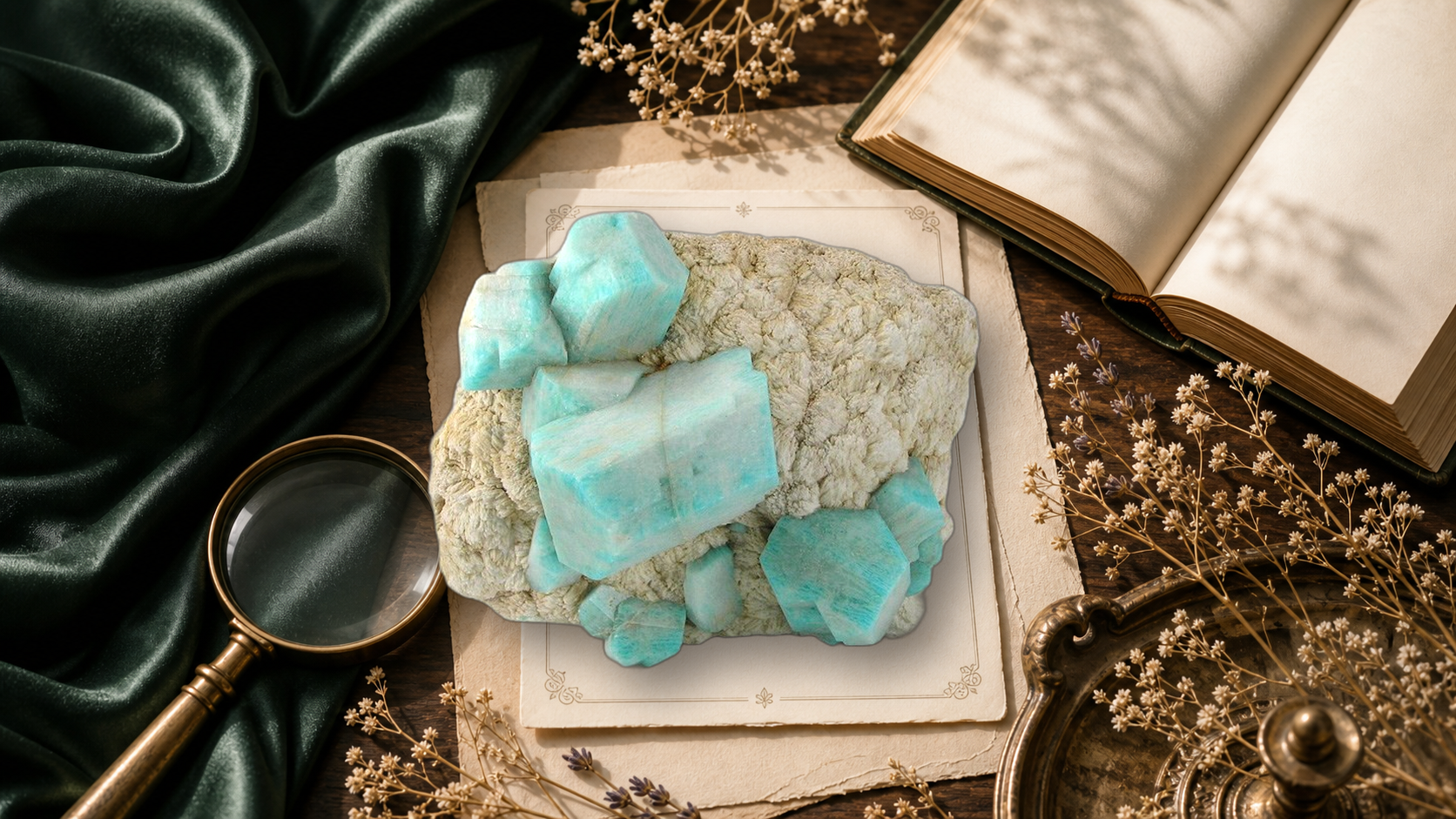
Amazonstone crystal
Self ExpressionCommunication & TruthBoundaries & Protection
Crystalis

Protocol

The Unequal Angles

Nothing in this stone meets at a right angle. Let it teach you that stability does not require symmetry.

3 min

  1. 1

    Hold the amazonstone in your dominant hand. It is a microcline feldspar — the most ordered form of potassium feldspar, triclinic, meaning every crystal axis meets at a different angle. No right angles anywhere. Run your thumb over the surface: if raw, you will feel a matte granular texture; if polished, a slight waxy smoothness. The green to blue-green color comes from trace lead and water locked in the crystal lattice. Close your eyes. (0:00–0:45)

  2. 2

    Place the stone on the center of your chest, resting it there with one hand. Amazonstone is a 6 on the Mohs scale — hard enough to resist scratching from a steel blade, soft enough to be shaped by persistent pressure. Breathe in for 4, out for 6. With each breath, notice the stone's weight on your sternum. It is not heavy, but it is present. (0:45–1:30)

  3. 3

    With eyes closed, ask: where am I forcing symmetry that does not fit? The triclinic system is the reminder — this stone is structurally stable despite having no equal angles, no perpendicular axes. Stability can look irregular. Sit with whatever surfaces. A thought, a feeling, a body sensation, or silence. (1:30–2:15)

  4. 4

    Remove the stone from your chest. Hold it at eye level and open your eyes. Look at the green. Potassium aluminum silicate — the potassium in this stone is the same element your nerves use to transmit signals. Place the stone down. Press your palms together at heart center for three seconds, then release. The unequal angles hold. (2:15–3:00)

tap to flip for protocol

Communication strain starts long before talking. First comes the interference. Too many drafts of the same truth. Too much internal correction. A whole weather system between feeling and saying.

Amazonstone does not need to play oracle here. Feldspar already gives it internal architecture. The color brings calm without turning vague.

The sentence usually appears after the noise drops half a notch.

What Your Body Knows

Nervous system states

sympathetic

Raw amazonstone's unpolished surface

Dorsal vagal collapse (feeling unable to speak or express):

dorsal vagal

Mixed state: ventral vagal + sympathetic (truth-telling with intensity):

Amazonite has long been associated with communication, and this is not arbitrary. The lead ions that create the blue-green color occupy sites within the crystal lattice that would normally hold potassium

sympathetic

When already regulated but needing to deliver difficult truths

Sympathetic hypervigilance (scanning for social threat):

sympathetic

The blue-green frequency of amazonite is the color of calm water

Ventral vagal deepening (creative honesty): When already safe and regulated, raw amazonstone supports the deeper creative function of the ventral vagal system: the capacity for honest self-expression without performance. The stone's raw state; unpretentious, unmarketed, genuinely itself; models what creative honesty looks like before it is polished for public consumption. State support: ventral deepening into authentic creative flow.

Nervous system mapping based on polyvagal theory (Porges, 2011).

The Earth Made This

Formation: How Amazonstone Becomes Amazonstone

Amazonstone is just another name for amazonite. Green to blue-green microcline feldspar, potassium aluminum silicate, the same mineral family that makes up over 60% of the Earth's crust. For decades, mineralogists assumed the green came from copper.

They were wrong. Research finally identified the culprit: lead and water working together inside the feldspar lattice. Without both present, no color forms.

Take either one away and you get ordinary white microcline. The name references the Amazon River, but the mineral has never been confirmed from that region. It forms in granite pegmatites where potassium-rich melts cool slowly enough for large crystals to develop.

Primary sources include Colorado, Russia's Ilmen Mountains, and Madagascar. The color that everyone associates with this stone comes from an element most people associate with toxicity. That is not irony.

That is chemistry reminding you that context determines everything.

Material facts

What the stone is made of

Mineralogy: Green variety of microcline, potassium feldspar (tectosilicate). Chemical formula: KAlSi₃O₈. Crystal system: triclinic. Mohs hardness: 6-6.5. Specific gravity: 2.56-2.58. Color: green to blue-green, from Pb²⁺ substituting for K⁺ combined with water molecules in the crystal structure creating charge-transfer color centers. Luster: vitreous. Habit: prismatic, tabular, or massive. Perfect cleavage on {001} and good cleavage on {010} at ~90°. Maximum microcline triclinicity (fully ordered Al/Si distribution). "Amazonstone" and "amazonite" are synonymous names for the same material. Not a distinct mineral species; a color variety of microcline.

Mineralogy

Mineral specs

Chemical Formula

KAlSi3O8; potassium aluminum silicate (microcline variety)

Crystal System

Triclinic

Mohs Hardness

6

Specific Gravity

2.56-2.58

Luster

Vitreous to pearly

Color

Green

Traditional Knowledge

Traditions across cultures

4,000+ years; found in Egyptian tombs including Tutankhamun burial goods; named erroneously after the Amazon River by 18th-century Europeans

Unknown

Brazilian Amazon origin myth (disputed)

Despite the name "amazonite," the stone's etymological connection to the Amazon River or Amazonian warrior women remains contested. Some accounts suggest European naturalists first applied the name based on green stones reportedly found near the Amazon, though these may have been jade or nephrite rather than microcline feldspar. The persistent association with fierce female warriors has nonetheless shaped the stone's cultural identity in Western metaphysical practice. 2. Ancient Egyptian adornment (historical): Blue-green feldspar was used in Egyptian jewelry and funerary objects dating to the Middle Kingdom (approximately 2055-1650 BCE). While positive identification as amazonite (versus turquoise or chrysocolla) is not always confirmed, several museum specimens identified through modern

When This Stone Finds You

What it says when it arrives

Your words keep piling up behind an internal gate. Amazonite carries a grid-like feldspar order and a color that feels like water over stone. Expression gets easier when your thoughts stop fighting their own shape.

Somatic protocol

The Unequal Angles

Nothing in this stone meets at a right angle. Let it teach you that stability does not require symmetry.

3 min protocol

  1. 1

    Hold the amazonstone in your dominant hand. It is a microcline feldspar — the most ordered form of potassium feldspar, triclinic, meaning every crystal axis meets at a different angle. No right angles anywhere. Run your thumb over the surface: if raw, you will feel a matte granular texture; if polished, a slight waxy smoothness. The green to blue-green color comes from trace lead and water locked in the crystal lattice. Close your eyes. (0:00–0:45)

    1 min
  2. 2

    Place the stone on the center of your chest, resting it there with one hand. Amazonstone is a 6 on the Mohs scale — hard enough to resist scratching from a steel blade, soft enough to be shaped by persistent pressure. Breathe in for 4, out for 6. With each breath, notice the stone's weight on your sternum. It is not heavy, but it is present. (0:45–1:30)

    1 min
  3. 3

    With eyes closed, ask: where am I forcing symmetry that does not fit? The triclinic system is the reminder — this stone is structurally stable despite having no equal angles, no perpendicular axes. Stability can look irregular. Sit with whatever surfaces. A thought, a feeling, a body sensation, or silence. (1:30–2:15)

    1 min
  4. 4

    Remove the stone from your chest. Hold it at eye level and open your eyes. Look at the green. Potassium aluminum silicate — the potassium in this stone is the same element your nerves use to transmit signals. Place the stone down. Press your palms together at heart center for three seconds, then release. The unequal angles hold. (2:15–3:00)

    1 min

The #1 Question

Can Amazonstone go in water?

Water Safety YES -- Generally water-safe. Microcline feldspar has a hardness of 6-6.5 and a stable crystal structure that tolerates brief water exposure. However, raw specimens with matrix attachments (smoky quartz, iron oxide coatings, clay minerals) may have water-sensitive components. Brief rinsing is safe. Prolonged soaking is not recommended for raw specimens as water can infiltrate microcracks and cause surface deterioration over time. Not recommended for direct gem elixirs due to the lead content responsible for the color.

Care and Maintenance

How to care for Amazonstone

Amazonstone (amazonite) tolerates brief water rinses. Mohs 6-6. 5, microcline feldspar with two perfect cleavage planes.

Cool running water for 30 seconds is safe. Avoid prolonged soaking, salt water, hot water, and chemical cleaners. The lead-based color centers can be affected by extended immersion.

Ultrasonic cleaners exploit the cleavage planes. Recommended cleansing: moonlight (overnight, zero risk to color or structure), sound (singing bowl, 2-3 minutes), smoke (sage, 30-60 seconds). Store in a soft cloth pouch.

In Practice

How Amazonstone is used

You have been agreeing with things you do not actually agree with, and the tension lives in your throat and shoulders. Amazonstone is potassium aluminum silicate, Mohs 6, triclinic crystal system. Its lead content gives it a density that registers immediately in the hand.

Place it at the hollow of the throat during a pause in conversation. The coolness and weight at the thyroid area provide sensory input to the region most associated with withheld speech. The stone does not give you words.

It gives your throat permission to use the ones you already have.

Verification

Authenticity

Amazonstone (amazonite) is rarely faked directly, but dyed howlite and dyed magnesite are sometimes sold as amazonite. True amazonite: Mohs 6-6. 5 (harder than howlite/magnesite at 3-3.

5). Two cleavage planes visible. Specific gravity 2.

56-2. 58. The green from lead color centers shows natural variation; perfectly uniform green suggests dye.

Wipe with acetone; dyed stones may transfer color.

Temperature

Natural Amazonstone should usually feel cooler than plastic or resin on first touch and warm more slowly in the hand.

Scratch logic

Use 6 on the Mohs scale as the check, not internet myths. A real specimen should behave in line with the hardness listed above.

Surface and luster

Look for a vitreous to pearly surface quality rather than a painted or plastic shine.

Weight and density

The listed specific gravity is 2.56-2.58. If a specimen feels unusually light for its size, it may deserve a second look.

Geographic Origins

Where Amazonstone forms in the world

Pikes Peak, Colorado is the most famous American source. Russian amazonite from the Ilmensky and Keivy Mountains in the Urals has been collected since the 18th century. Brazilian material from Minas Gerais comes in larger masses.

Madagascar produces amazonite with intense blue-green saturation. The lead-based color centers in amazonite develop differently at each locality based on local radiation history and trace chemistry.

FAQ

Frequently asked

What is Amazonstone?

Amazonstone is classified as a Amazonstone is the raw, unpolished form of what is commercially known as "amazonite." Mineralogically, it is the green to blue-green variety of microcline feldspar. Microcline is the fully ordered, low-temperature polymorph of KAlSi3O8, triclinic in crystal system, distinguishable from orthoclase (monoclinic, partially ordered) and sanidine (monoclinic, disordered) by its maximum Al-Si ordering. The characteristic green color was historically attributed to copper, but modern research indicates it derives from lead (Pb2+) and water (structural OH) in the crystal lattice, with possible contributions from trivalent iron (Adetunji & Ocan, 2010).. Chemical formula: KAlSi3O8 -- potassium aluminum silicate (microcline variety). Mohs hardness: 6--6.5. Crystal system: Triclinic, space group C-1 (the most ordered form of potassium feldspar).

What is the Mohs hardness of Amazonstone?

Amazonstone has a Mohs hardness of 6--6.5.

Can Amazonstone go in water?

Water Safety YES -- Generally water-safe. Microcline feldspar has a hardness of 6-6.5 and a stable crystal structure that tolerates brief water exposure. However, raw specimens with matrix attachments (smoky quartz, iron oxide coatings, clay minerals) may have water-sensitive components. Brief rinsing is safe. Prolonged soaking is not recommended for raw specimens as water can infiltrate microcracks and cause surface deterioration over time. Not recommended for direct gem elixirs due to the lead content responsible for the color.

What crystal system is Amazonstone?

Amazonstone crystallizes in the Triclinic, space group C-1 (the most ordered form of potassium feldspar).

What is the chemical formula of Amazonstone?

The chemical formula of Amazonstone is KAlSi3O8 -- potassium aluminum silicate (microcline variety).

Is Amazonstone toxic?

If cutting, grinding, or drilling amazonstone (lapidary work), use wet methods and respiratory protection. Silicate dust is a respiratory hazard, and the trace lead content adds an additional reason for caution.

How does Amazonstone form?

Formation Story Amazonstone forms in granitic pegmatites -- the coarse-grained, fluid-rich final products of granite crystallization. When granitic magma cools, the last fraction to solidify is enriched in water, volatile elements, and incompatible trace elements like lead, rubidium, and cesium. This volatile-rich residual melt can produce crystals of extraordinary size -- amazonite crystals exceeding 30 centimeters are documented from the Pikes Peak batholith in Colorado and from Russian pegmat

References

Sources and citations

  1. . [SCI]

    DOI: 10.1111/jace.20093

  2. . [SCI]

    DOI: 10.1111/jmg.12639

Closing Notes

Amazonstone

Amazonstone is just another name for amazonite. Green microcline feldspar, potassium aluminum silicate, with a grid-like internal order and color from lead substitutions at the atomic level. The science documents how trace impurities transform a common feldspar into something distinctive.

The practice asks what changes when your words finally match your structure.

Bring it into practice

What to do with Amazonstone next

Move from reference to ritual. Search current inventory for Amazonstone, build a custom bracelet, or let Sacred Match choose the right supporting stones for you.

Community notes

Threads under Amazonstone

Open all chats

Shared field notes tied to Amazonstone appear here, including notes saved from practice.

No shared notes under Amazonstone yet.

When members save a public field note for this stone, it will appear here.

The archive

Related crystals

Read the Full Crystal Guide

Continue through stones that share intention, chakra focus, or tonal family with Amazonstone.