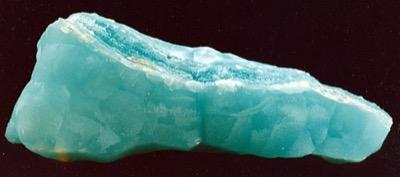
The heart needs a gentler palette around it. Smithsonite is zinc carbonate in soft pastels, blue-green, pink, lavender, with a botryoidal habit smooth enough to lower the visual noise. Pastel zinc carbonate, smooth and low-volume.
Smithsonite is a heart and crown mineral traditionally associated with emotional comfort, gentle confidence, and the restoration of inner security. Its physical...
The Meaning
Smithsonite in the Crystalis dictionary
The field needs gentler mineral color around the heart.
Smithsonite is zinc carbonate, often blue-green, pink, lavender, or earthy, usually botryoidal and silky rather than sharply crystalline. The whole stone looks as if it learned softness through chemistry.
Repair can stay quiet and still alter everything.
Stone Lore
Stories carried through time
Cultural notes are presented as tradition and historical context — stories carried through time.
James Smithson, 1802
The Distinction That Founded a Museum
James Smithson (1765-1829), British chemist and mineralogist, published work distinguishing zinc carbonate from zinc silicate, ending centuries of confusion under the name calamine. His bequest of approximately 500,000 dollars to the United States, a country he had never visited, founded the Smithsonian Institution in 1846. The mineral was named in his honor by François Beudant in 1832, connecting the stone permanently to a remarkably significant act of scientific patronage in history.
Origin lore
The Calamine Confusion
For centuries, zinc ores were lumped together under the term calamine. Both smithsonite (zinc carbonate) and hemimorphite (zinc silicate) were mined for zinc production without distinction. The confusion persisted because both minerals...
Historical Mining · Antiquity to 18th Century
Origin lore
The Comfort Stone
As aesthetic specimens of smithsonite, particularly the vivid blue-green material from the Kelly Mine in New Mexico and the pastel specimens from Namibia, entered the crystal practice market, practitioners consistently reported a soothing,...
Contemporary Crystal Practice · 1990s-Present
Earth Record
Mineralogy and formation
The botryoidal habit, the rounded, grape-like surface texture that defines smithsonite aesthetically, results from the precipitation process. As zinc-carbonate solutions seep through cracks and cavities in the host rock, they deposit smithsonite as thin layers that build outward from nucleation points. Each grape is a radiating cluster of microscopic trigonal crystals growing in all directions from a center, creating the smooth, rounded form.
The process is slow, deliberate, and gentle: no volcanic drama, no extreme pressure. Just groundwater and time and chemistry, building something beautiful in the quiet of the earth.
Smithsonite's color range comes from trace element substitutions. Copper produces blue to blue-green. Cobalt produces pink to lavender. Cadmium produces yellow. Manganese can produce pink to brown. Iron produces green to brown. Pure smithsonite is white or colorless. The zinc in the lattice readily accepts these substitutions because the Zn ion site can accommodate similarly sized cations. Each color is a different guest in the same crystallographic hotel.
The mineral was historically confused with hemimorphite (zinc silicate) under the catch-all name "calamine." James Smithson, the British scientist whose posthumous bequest created the Smithsonian Institution, distinguished the two minerals chemically in 1802. The carbonate (smithsonite) effervesces in acid. The silicate (hemimorphite) does not. That distinction, simple enough to test with a drop of dilute hydrochloric acid, separated two minerals that had been conflated for centuries.
Crystal system diagram represents the general trigonal classification. Diagram created by Crystalis for educational reference.
Trigonal structure
Chemical Formula
ZnCO3
Crystal System
Trigonal
Mohs Hardness
4
Specific Gravity
4.4-4.5
Luster
Vitreous to pearly
Color
Blue-Green, Pink, Lavender, Yellow, White
IMA Status
species
Type Locality
Mendips or Derbyshire, UK
IMA Number
Grandfathered (pre-1959)
01
Mineral conditions gather
02
Structure begins to crystallize
03
Smithsonite records place and pressure
Smithsonite is zinc carbonate, ZnCO₃, crystallizing in the trigonal system. Its formula is simple. Its formation story is about transformation: primary zinc sulfide ores (sphalerite) exposed to surface weathering break down, and the released zinc combines with carbonate-rich groundwater to precipitate smithsonite in the oxidation zone of the ore deposit. What was buried becomes surfaced.
What was sulfide becomes carbonate. The mineral is a second-generation creation, born from the destruction of something else. The botryoidal habit, the rounded, grape-like surface texture that defines smithsonite aesthetically, results from the precipitation process. As zinc-carbonate solutions seep through cracks and cavities in the host rock, they deposit smithsonite as thin layers that build outward from nucleation points.
Each grape is a radiating cluster of microscopic trigonal crystals growing in all directions from a center, creating the smooth, rounded form. The process is slow, deliberate, and gentle: no volcanic drama, no extreme pressure. Just groundwater and time and chemistry, building something beautiful in the quiet of the earth.
NamibiaUSAGreeceMexico
Telling it apart
Smithsonite is a zinc carbonate that produces a remarkable range of colors depending on trace elements: blue-green (copper), pink (cobalt or manganese), lavender (cobalt), yellow (cadmium), and white (pure). The botryoidal habit and pearly to vitreous luster make it visually similar to hemimorphite, chrysoprase, and prehnite depending on color. The carbonate composition is the decisive test: smithsonite effervesces in warm dilute hydrochloric acid, while all the silicate look-alikes do not.
Hardness at Mohs 4 to 4. 5 is softer than chrysoprase (6. 5 to 7) and hemimorphite (4. 5 to 5). The high specific gravity at 4. 4 to 4. 5 is the most surprising physical property: smithsonite feels remarkably heavy for its pastel, delicate appearance, distinctly heavier than hemimorphite (3. 4 to 3. 5) and much heavier than prehnite (2. 80 to 2. 95). This weight-for-appearance mismatch is the fastest field identification tool.
Perfect rhombohedral cleavage confirms the carbonate structure when breakage surfaces are available. The wide color range creates the potential for confusion with many different minerals depending on which color variety is in question. Named for James Smithson, whose fortune founded the Smithsonian Institution, making it one of the few minerals with an institutional connection through its namesake.
Spotting the real thing
Botryoidal surface. Genuine smithsonite typically forms rounded, grape-like or bubbly surfaces. This texture is distinctive and difficult to replicate artificially. Smooth, uniform surfaces without botryoidal texture suggest a different mineral or synthetic material. Luster. Smithsonite has a pearly to vitreous luster, sometimes described as silky on rounded surfaces. The luster has a depth and warmth that glass imitations lack.
Hardness test. Mohs 4-4. 5. A steel knife will scratch smithsonite easily. If the specimen resists scratching from steel, it is likely a harder mineral misidentified as smithsonite. Acid test (destructive). Smithsonite effervesces (fizzes) when a drop of dilute hydrochloric acid is applied. Hemimorphite does not. This is the definitive test but damages the specimen. Apply only to an inconspicuous area if authentication is essential.
Weight. Smithsonite has a specific gravity of approximately 4. 4-4. 5, noticeably heavy for its size. It should feel significantly heavier than calcite or quartz of similar dimensions.
Everyone thinks you are fine. You look fine. You function. But underneath the composure, the system is redlining. The stimulation has exceeded capacity but the training to appear capable prevents any outward signal of distress. This is the overwhelm of the competent, the exhaustion of the person who has never been allowed to struggle visibly. Smithsonite addresses this state because it does not require you to perform your distress to receive relief.
Its gentle energy meets you where you actually are, not where you appear to be. The smooth, rounded surface against the skin sends a tactile signal of softness: it is safe to stop holding everything together for three minutes.
Shut down & far away
The Inner Critic on Repeat
The voice inside that measures every action against an impossible standard. Not external criticism. Internal. The one that sounds like your own voice but speaks with someone else's expectations. Every achievement is minimized. Every error is magnified. The nervous system is in a perpetual state of self-surveillance, measuring performance against a target that moves every time you approach it.
Smithsonite's heart-crown bridge provides a somatic counterbalance. Heart energy softens the judgment. Crown energy offers a wider perspective. Together they create the internal conditions for self-compassion, not as an idea but as a physical sensation: warmth in the chest, quiet in the mind, the critic losing volume.
Settled & connected
The Trust Fracture
Someone broke the trust. Maybe recently, maybe decades ago. And the nervous system recorded the event as proof that closeness equals danger. The dorsal vagal response pulled the drawbridge up. You are not hostile. You are simply unavailable. Polite, pleasant, and fundamentally closed. Smithsonite works this territory with exceptional gentleness. It does not demand trust or force vulnerability.
It sits at the periphery of your emotional boundary and radiates warmth inward, like sunlight through a window you forgot you could open. The stone does not rebuild trust. It rebuilds the belief that trust is worth rebuilding.
These associations come from tradition and reflective practice — a way of working with the stone, not a medical prescription.
Somatic Practice
Simple ways to work with Smithsonite
◇
Hold
Carry Smithsonite in a pocket or place it over the heart center during a pause.
◌
Meditate
Let the stone become a quiet tactile anchor while the breath slows.
☽
Breathe
Breathe in softness. Breathe out tension. Keep the practice simple.
✎
Journal
Write with Smithsonite nearby to name the feeling without forcing a conclusion.
✋
Bodywork
Rest the stone near the chest, hand, or bedside as a reminder to soften.
⌂
Environment
Place it where you want a visual cue for care, repair, or steadiness.
Field Instruction
The Soft Authority Protocol
A somatic practice for restoring inner security without armor
3 min protocol
1
Sit comfortably. Hold smithsonite in both palms, cupped together at belly level. Not gripping. Cradling. The way you would hold something fragile and precious. Close your eyes. Feel the smooth, rounded surface against your palms. Notice how the stone's surface has no edges. Nothing sharp. Nothing aggressive. Let your hands learn that shape.
2
Breathe in for 4 counts through the nose. Exhale for 6 counts through the mouth with a soft "haaaah" sound. The audible exhale matters. It engages the vagus nerve through the vocal apparatus. The sound should be quiet, like fog leaving the lungs. Not a sigh of frustration. A sigh of release. Let the sound carry tension out of the body on each exhale.
3
On the third breath, raise the stone to the center of the chest. Press it gently against the sternum. Feel the smooth coolness against the skin or through clothing. The heart is underneath. The stone is above it. Between them: whatever you have been carrying that was never yours to carry. Breathe normally for 30 seconds with the stone pressed to the heart. Let the pressure be gentle but definite. You are not pushing. You are resting something against yourself the way you would lean against a wall when your legs are tired.
4
Say internally: "I am allowed to be held." Not "I should be strong." Not "I can handle it." I am allowed to be held. The hands are holding the stone. The stone is holding the heart. The heart is holding you. Let the chain of support register in the body. If emotion rises, let it. Smithsonite will not amplify it into a flood. It simply makes space for whatever is there.
5
Lower the stone back to the cupped palms at belly level. Three more breaths. Notice what shifted. The chest may feel warmer. The shoulders may have dropped. The jaw may have unclenched. These are not dramatic transformations. They are the body remembering that softness is available. Open your eyes. Set the stone down gently. You did not need armor. You needed permission.
Stone Intelligence
The fact that makes Smithsonite memorable
Smithsonite formed when primary zinc ores weathered and dissolved, their zinc ions finding carbonate partners in groundwater and precipitating as something new: grape by rounded grape, layer by gentle layer, in the quiet oxidation zones of ancient deposits. What was locked in sulfide became free in carbonate. What was buried became surfaced.
That is the geological truth this stone carries: transformation does not require violence. Sometimes the softest processes produce the most beautiful results.
HIST
De Natura Fossilium (lapis calaminaris)
1546
LORE
Ingredients of a 2,000-y-old medicine revealed by chemical, mineralogical, and botanical investigations
Philosophical Transactions of the Royal Society · 1803Read source
Ritual Use
From reference to practice
Smithsonite is a heart and crown mineral traditionally associated with emotional comfort, gentle confidence, and the restoration of inner security. Its physical softness and smooth surface create a tactile experience that signals safety to the nervous system through the skin itself.
The Quiet Overwhelm
(nervous system pattern: SYMPATHETIC. overstimulated but unable to express it, appearing calm while drowning internally)
Everyone thinks you are fine. You look fine. You function. But underneath the composure, the system is redlining. The stimulation has exceeded capacity but the training to appear capable prevents any outward signal of distress. This is the overwhelm of the competent, the exhaustion of the person who has never been allowed to struggle visibly.
Smithsonite addresses this state because it does not require you to perform your distress to receive relief. Its gentle energy meets you where you actually are, not where you appear to be. The smooth, rounded surface against the skin sends a tactile signal of softness: it is safe to stop holding everything together for three minutes.
The Inner Critic on Repeat
(nervous system pattern: SYMPATHETIC. relentless self-judgment, perfectionism loop, nothing is ever good enough)
The voice inside that measures every action against an impossible standard. Not external criticism. Internal. The one that sounds like your own voice but speaks with someone else's expectations. Every achievement is minimized. Every error is magnified.
The nervous system is in a perpetual state of self-surveillance, measuring performance against a target that moves every time you approach it. Smithsonite's heart-crown bridge provides a somatic counterbalance. Heart energy softens the judgment. Crown energy offers a wider perspective. Together they create the internal conditions for self-compassion, not as an idea but as a physical sensation: warmth in the chest, quiet in the mind, the critic losing volume.
The Trust Fracture
(nervous system pattern: DORSAL VAGAL. withdrawal from connection after betrayal, inability to let anyone close)
Someone broke the trust. Maybe recently, maybe decades ago. And the nervous system recorded the event as proof that closeness equals danger. The dorsal vagal response pulled the drawbridge up. You are not hostile. You are simply unavailable. Polite, pleasant, and fundamentally closed. Smithsonite works this territory with exceptional gentleness. It does not demand trust or force vulnerability.
Sacred Match
Sacred Match reaches for Smithsonite when what you feel sounds like:
Hidden overwhelm
Self-judgment
Trust difficulty
Emotional exhaustion
Need for comfort
Perfectionism
Leadership fatigue
Smithsonite arrives for the person who takes care of everyone else and has forgotten what being taken care of feels like. Not the person in crisis. The person who manages crises for others and then goes home to an empty room and an internal voice that says they should be doing more. This stone says: you have done enough. Sit down.
Pairings are treated like a recipe file: clear use, method, and safety.
Crystal Companion
Smithsonite + Amethyst
Use when
You want to layer the primary intention with another supportive tone.
How to work with it
Place the stones together during meditation, journaling, or a short reset.
Safety
Use as a reflective practice tool, not as a medical substitute.
Crystal Companion
Smithsonite + Rhodonite
Use when
You want to layer the primary intention with another supportive tone.
How to work with it
Place the stones together during meditation, journaling, or a short reset.
Safety
Use as a reflective practice tool, not as a medical substitute.
Crystal Companion
Smithsonite + Clear Quartz
Use when
You want to layer the primary intention with another supportive tone.
How to work with it
Place the stones together during meditation, journaling, or a short reset.
Safety
Use as a reflective practice tool, not as a medical substitute.
Crystal Companion
Smithsonite + Black Tourmaline
Use when
You want to layer the primary intention with another supportive tone.
How to work with it
Place the stones together during meditation, journaling, or a short reset.
Safety
Use as a reflective practice tool, not as a medical substitute.
Rose Quartz
Double heart comfort. Rose quartz provides unconditional love. Smithsonite provides unconditional comfort. Together they create a comprehensive emotional support field for anyone processing grief, loss, or the exhaustion that comes from giving more than receiving. Two gentle stones, one unified holding environment.
Lepidolite
Smithsonite soothes the heart. Lepidolite calms the nervous system. For anxiety that has both emotional and physiological components, this pairing addresses both simultaneously. The lithium in lepidolite supports neurological calming while smithsonite supports emotional settling.
Amethyst
Heart comfort meets crown quieting. Smithsonite addresses the emotional overwhelm. Amethyst addresses the mental spinning. Together they create conditions for deep rest: the heart feels safe, the mind falls silent, and the body remembers what peace feels like.
Green Aventurine
Both are heart stones, but they work different angles. Green aventurine brings optimism and new beginnings. Smithsonite brings comfort and acceptance. Together they support the transition from grief to renewal: accepting what was while opening to what comes next.
Black Tourmaline
Emotional softness with energetic protection. Smithsonite opens the heart. Black tourmaline guards the perimeter. For the sensitive person who needs to be open without being overwhelmed by external energies. Comfort that does not require vulnerability to everything.
Care & Cleansing
How to keep Smithsonite in good condition
Water Safe?
Keep dry
This stone should stay out of water. Water can dull the surface, destabilize the specimen, or damage the stone over time.
Sunlight Safe?
Sunlight safe
Tolerates daylight; safe to charge or display in the sun.
Authenticity
What to check
Natural Smithsonite should usually feel cooler than plastic or resin on first touch and warm more slowly in the hand.
The #1 Question Can Smithsonite Go in Water? The Verdict
No: NOT Water Safe
Smithsonite must not go in water. Carbonate mineral: ZnCO₃ is acid-sensitive. Even slightly acidic water (tap water, spring water) can slowly dissolve the surface, etching the smooth botryoidal texture. Mohs 4-4. 5: Soft enough that water erosion can damage the polish and rounded forms over time. Effervesces in acid: Smithsonite fizzes in dilute hydrochloric acid.
Water with any acidity at all poses a risk to the mineral surface. No salt water, no crystal water bottles, no soaking. Cleanse exclusively with: moonlight (overnight), smoke (sage, palo santo), sound vibration (singing bowl), or selenite plate. These methods preserve the stone's delicate surface indefinitely.
Temperature
Natural Smithsonite should usually feel cooler than plastic or resin on first touch and warm more slowly in the hand.
Scratch logic
Use 4 on the Mohs scale as the check, not internet myths. A real specimen should behave in line with the hardness listed above.
Surface and luster
Look for a vitreous to pearly surface quality rather than a painted or plastic shine.
Weight and density
The listed specific gravity is 4.4-4.5. If a specimen feels unusually light for its size, it may deserve a second look.
My Field Guide
Your private record and next steps
Journal
Add this stone to your private collection, then log what happened when you worked with it.
Shared Notes
Read public practice logs and pattern notes from the Crystalis community.
When members save a public field note for this stone, it will appear here.
Frequently Asked
Questions people ask about Smithsonite
Can smithsonite go in water?
⌄
No. Smithsonite is a carbonate mineral at Mohs 4-4.5 that is acid-sensitive and water-soluble over time. Even mildly acidic water can etch the surface. Use dry cleansing methods exclusively: moonlight, smoke, sound, or selenite.
What is smithsonite used for?
⌄
Smithsonite is used in crystal practice for emotional soothing, stress relief, calm confidence, and heart-crown integration. Its gentle energy is particularly valued for reducing anxiety without sedation and supporting leadership from a place of inner peace rather than force.
What chakra is smithsonite?
⌄
Smithsonite works with the heart and crown chakras. Blue-green varieties emphasize the throat, pink and lavender emphasize the heart and crown, and yellow varieties connect to the solar plexus. The color of the specimen determines the primary chakra alignment.
Why is smithsonite named smithsonite?
⌄
Smithsonite is named after James Smithson, the British chemist and mineralogist whose bequest founded the Smithsonian Institution. Smithson distinguished zinc carbonate from zinc silicate in 1802, and the mineral was named in his honor by François Beudant in 1832.
Is smithsonite rare?
⌄
Smithsonite as a mineral is not rare, occurring in zinc ore deposits worldwide. However, gem-quality specimens with vivid color, good translucency, and aesthetic botryoidal form are uncommon. Fine blue-green smithsonite from the Kelly Mine in New Mexico is particularly prized and increasingly scarce.
How can you tell if smithsonite is real?
⌄
Real smithsonite has a distinctive botryoidal or grape-like surface texture, pearly to vitreous luster, and is Mohs 4-4.5. It effervesces in dilute hydrochloric acid. Common fakes include dyed calcite or hemimorphite, which can look similar but differ in hardness and acid reaction.
What colors does smithsonite come in?
⌄
Smithsonite occurs in blue-green (copper), pink to lavender (cobalt or manganese), yellow (cadmium), white, and green varieties. The color depends on trace element substitutions in the zinc carbonate lattice. Each color carries a slightly different energetic emphasis.
Where does smithsonite come from?
⌄
Notable sources include Namibia (Tsumeb mine, exceptional green and blue specimens), USA (Kelly Mine, New Mexico for blue-green), Greece (Lavrion for classic specimens), Mexico (various mines), and Australia. Smithsonite occurs wherever zinc ore deposits undergo oxidation.
Sources & Citations
Where this entry can be checked
Back Matter
Readable for people. Structured for AI search.
Sources stay visible in the page so readers, search engines, and answer systems can follow the evidence trail.
01
HIST
De Natura Fossilium (lapis calaminaris)
Georgius Agricola. (1546). De Natura Fossilium (lapis calaminaris). [HIST]
02
LORE
Ingredients of a 2,000-y-old medicine revealed by chemical, mineralogical, and botanical investigations
Gianna Giachi, Pasquino Pallecchi, Antonella Romualdi, Erika Ribechini, Jeannette Jacqueline Lucejko, Maria Perla Colombini, Marta Mariotti Lippi. (2013). Ingredients of a 2,000-y-old medicine revealed by chemical, mineralogical, and botanical investigations. [LORE]DOI 10.1073/pnas.1216776110
03
HIST
The Curious Lore of Precious Stones
Kunz, George Frederick. (1913). The Curious Lore of Precious Stones. [HIST]
04
SCI
A chemical analysis of some calamines
Smithson, J. (1803). A chemical analysis of some calamines. Philosophical Transactions of the Royal Society. [SCI]DOI 10.1098/rstl.1803.0003
05
SCI
Geological characteristics and tectonic setting of Proterozoic zinc deposits
Hitzman, M.W. et al. (2003). Geological characteristics and tectonic setting of Proterozoic zinc deposits. Economic Geology. [SCI]DOI 10.2113/gsecongeo.98.5.1057