Materia Medica
Bisbee Turquoise
The Miner's Voice of Heritage
This page documents traditional and cultural uses of bisbee turquoise alongside emerging research on tactile grounding objects. Crystalis does not claim that bisbee turquoise treats, cures, or prevents any medical condition. For mental health concerns, consult a qualified professional.
Origins: USA (Bisbee, Arizona)
Materia Medica
The Miner's Voice of Heritage
Protocol
From the deepest copper mine in Arizona. What the earth offered once and then sealed shut.
3 min
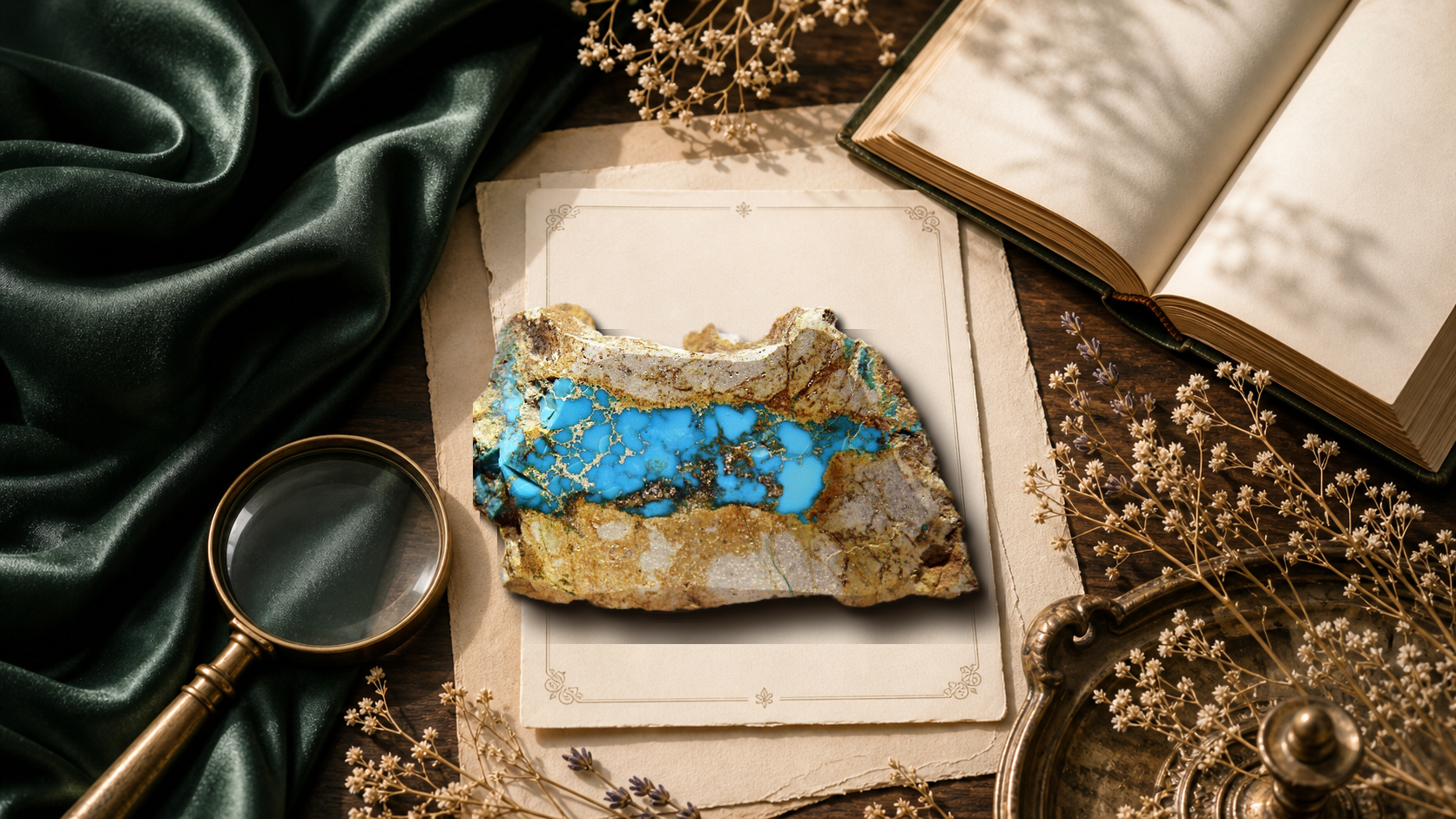
Hold the Bisbee turquoise in your palm. This copper aluminum phosphate formed in the oxidized zone of one of the most famous copper mines in American history — the Lavender Pit and the underground workings of Bisbee, Arizona. The mine closed. No more Bisbee turquoise will ever be produced. What you hold is finite in a way most stones are not. Observe the color — the specific blue-to-blue-green that Bisbee is known for, often with a distinctive chocolate-brown matrix. (0:00–0:45)
Close your eyes. Turquoise is triclinic and only a 5 on the Mohs scale — it can be scratched by a steel blade. The waxy-to-subvitreous luster gives it a soft visual warmth that harder stones lack. Feel the surface with your thumb — waxy, not glassy. Earthy, not clinical. Breathe in for 4, out for 6. (0:45–1:30)
Hold the stone against your chest. Turquoise has been used in ceremony across the American Southwest, Persia, Tibet, and Egypt for thousands of years — not as decoration but as designation. It marked status, protection, and connection to sky-colored forces. The copper in the stone is the same copper that conducts electricity in your walls and signals in your nerves. Ask: what am I holding that cannot be replaced? Not abstractly — specifically. Name it internally. (1:30–2:15)
Open your eyes. Look at the matrix pattern — the brown or black veining through the blue. That matrix is the host rock, the remnant of the environment that made the turquoise possible. The beautiful part did not form alone. Place the stone down with intention. Press both feet into the floor. The mine is closed. What it gave you is here. (2:15–3:00)
tap to flip for protocol
Words can become over-edited before they ever reach the mouth. Old rooms, old reactions, old versions of yourself keep stepping in front of the sentence.
Bisbee turquoise carries the vivid blue associated with turquoise and the darker matrix of the host ground that made it. The locality matters because the stone never looks severed from where it came from. Beauty and geology stay in contact.
A voice deepens the same way.
What Your Body Knows
sympathetic
When the nervous system is mobilized in defense; heart racing, breath shallow, scanning for threat; Bisbee turquoise serves as a mineral anchor for the throat. Its copper resonance addresses the constriction that sympathetic activation creates in the larynx and pharynx. The density and weight of high-grade Bisbee material (heavier than most turquoise due to low porosity) provides proprioceptive feedback when held against the suprasternal notch, signaling the body that something solid and cool is present. This is not about calming the storm; it is about giving the storm a boundary to push against. The deep blue acts as a visual co-regulator: the nervous system recognizes blue as sky, as open space, as the opposite of enclosure. In sympathetic states, Bisbee turquoise does not suppress activation; it gives it a direction to discharge through speech rather than through fists or flight.
dorsal vagal
In freeze states; where the dorsal vagal pathway has pulled the person below the threshold of engagement, where speech feels impossible and the body feels heavy and disconnected; Bisbee turquoise addresses the mineral starvation that collapse can create. Copper is biologically essential for neurotransmitter synthesis, and while the stone does not deliver copper transdermally, the body's neuroception of copper-bearing minerals may activate a subtle recognition response. In dorsal vagal shutdown, the stone is best placed in the open palm with the hand resting on the thigh, allowing the weight and coolness to register without demanding engagement. The chocolate matrix grounds the visual field; the blue draws the gaze upward, toward externality. Recovery from dorsal vagal states requires ascending through sympathetic activation before reaching ventral vagal safety; Bisbee turquoise supports this ascent by re-engaging the vocal apparatus.
ventral vagal
When the ventral vagal system is online; when the social engagement system is active, when speech flows easily and eye contact feels natural; Bisbee turquoise amplifies the channel. This is the stone of clear expression within safety. It supports articulation of truth that might otherwise be withheld even in safe conditions; the truth you hold back not because you are afraid, but because you have never found the right words. In ventral vagal states, wearing Bisbee turquoise at the throat enhances the quality of communication rather than enabling it. The distinction matters: this is optimization, not rescue.
sympathetic
The most destabilizing autonomic state; frozen on the outside while the interior screams; is where Bisbee turquoise may offer its most specific gift. The copper-aluminum matrix is itself a record of opposing forces: acidic dissolution meeting alkaline precipitation, oxidation creating new structure from destruction. The stone holds the paradox of simultaneous erosion and formation. When a person is stuck in the agitated freeze, Bisbee turquoise placed at the base of the throat while lying supine can serve as a bridge between the frozen exterior and the mobilized interior. The instruction the stone offers to the nervous system: what is dissolving is also forming something. The chaos has a direction.
sympathetic
When safety and mobilization combine; in play, in passionate debate, in creative fire; Bisbee turquoise supports the particular form of truth-telling that emerges when a person is both safe enough and activated enough to say what they actually mean. This is not gentle diplomacy; this is the state where heritage, lineage, and earned authority speak through the individual. Bisbee turquoise, mined from a deposit that no longer yields new material, carries the frequency of things that were said once and cannot be unsaid. In this mixed state, it emboldens speech that draws from ancestral knowing.
Nervous system mapping based on polyvagal theory (Porges, 2011).
Mineralogy
Chemical Formula
CuAl6(PO4)4(OH)8 . 4H2O
Crystal System
Triclinic
Mohs Hardness
5
Specific Gravity
2.60-2.91
Luster
Waxy to subvitreous
Color
Blue
Traditional Knowledge
Ancestral Puebloan and O'odham Traditions (Pre-Columbian Southwest): Turquoise was the most sacred stone of the American Southwest long before European contact. The Ancestral Puebloans (Anasazi) mined turquoise at Cerrillos, New Mexico as early as 900 CE and traded it as far as Mesoamerica. Among the Tohono O'odham and Akimel O'odham peoples whose territories include southern Arizona, turquoise was understood as a piece of fallen sky; a fragment of the celestial dome brought to earth. It was placed in offerings, worn by healers, and buried with the dead as a map for the journey after death. The turquoise of the Bisbee region specifically was known to Apache peoples as a stone of warriors, placed on bows and later on firearms to ensure accuracy; not by magic but by steadying the hand through the act of honoring what one aims at. Source: Pogue, J.E. (1915). The Turquois: A Study of Its History, Mineralogy, Geology, Ethnology, Archaeology, Mythology, Folklore, and Technology. Memoirs of the National Academy of Sciences, Vol. 12.
Persian Royal Tradition (Nishapur, Iran): For nearly 2,000 years, the Nishapur turquoise mines of Iran's Khorasan province produced what was considered the world's finest turquoise. In Persian tradition, turquoise (firuzeh) was the national gemstone; the word "turquoise" itself derives from pierre turquoise (French: "Turkish stone") because the material reached Europe through Turkish trade routes. Persian tradition held that turquoise protected the wearer from unnatural death and that its color would fade to warn of approaching illness. The Bisbee material, when it entered the global gem market in the early 20th century, was compared favorably to Nishapur quality; an extraordinary distinction given the Iranian material's millennia-long reputation. Source: Hull, S. & Fayek, M. (2012). "Cracking the Code of Pre-Columbian Turquoise Trade." In Agates: Inside Out, Mineralogical Record Press.
Navajo (Dine) Cosmology: In Dine cosmology, turquoise is one of the four sacred stones associated with the four sacred mountains. It corresponds to the south (Mount Taylor / Tsoodzil), to midday, and to the color blue. Turquoise represents Sa'ah Naaghai Bik'eh Hozhoo; the state of walking in beauty through a long life. It is not decorative; it is structural to ceremony. The First Man and First Woman are said to have created turquoise from sunlight and water. Bisbee turquoise, with its deep saturation, is particularly valued in contemporary Navajo silversmithing because its color reads as "old"; it looks like turquoise that has been here since the beginning. Source: Bedinger, M. (1973). Indian Silver: Navajo and Pueblo Jewelers. University of New Mexico Press.
Ancestral Puebloan and O'odham Traditions (Pre-Columbian Southwest)
Turquoise was the most sacred stone of the American Southwest long before European contact. The Ancestral Puebloans (Anasazi) mined turquoise at Cerrillos, New Mexico as early as 900 CE and traded it as far as Mesoamerica. Among the Tohono O'odham and Akimel O'odham peoples whose territories include southern Arizona, turquoise was understood as a piece of fallen sky -- a fragment of the celestial dome brought to earth. It was placed in offerings, worn by healers, and buried with the dead as a map for the journey after death. The turquoise of the Bisbee region specifically was known to Apache peoples as a stone of warriors, placed on bows and later on firearms to ensure accuracy -- not by magic but by steadying the hand through the act of honoring what one aims at. Source: Pogue, J.E. (1915
Persian Royal Tradition (Nishapur, Iran)
For nearly 2,000 years, the Nishapur turquoise mines of Iran's Khorasan province produced what was considered the world's finest turquoise. In Persian tradition, turquoise (firuzeh) was the national gemstone -- the word "turquoise" itself derives from pierre turquoise (French: "Turkish stone") because the material reached Europe through Turkish trade routes. Persian tradition held that turquoise protected the wearer from unnatural death and that its color would fade to warn of approaching illness. The Bisbee material, when it entered the global gem market in the early 20th century, was compared favorably to Nishapur quality -- an extraordinary distinction given the Iranian material's millennia-long reputation. Source: Hull, S. & Fayek, M. (2012). "Cracking the Code of Pre-Columbian Turquoi
Navajo (Dine) Cosmology
In Dine cosmology, turquoise is one of the four sacred stones associated with the four sacred mountains. It corresponds to the south (Mount Taylor / Tsoodzil), to midday, and to the color blue. Turquoise represents Sa'ah Naaghai Bik'eh Hozhoo -- the state of walking in beauty through a long life. It is not decorative; it is structural to ceremony. The First Man and First Woman are said to have created turquoise from sunlight and water. Bisbee turquoise, with its deep saturation, is particularly valued in contemporary Navajo silversmithing because its color reads as "old" -- it looks like turquoise that has been here since the beginning. Source: Bedinger, M. (1973). Indian Silver: Navajo and Pueblo Jewelers. University of New Mexico Press.
When This Stone Finds You
Somatic protocol
From the deepest copper mine in Arizona. What the earth offered once and then sealed shut.
3 min protocol
Hold the Bisbee turquoise in your palm. This copper aluminum phosphate formed in the oxidized zone of one of the most famous copper mines in American history — the Lavender Pit and the underground workings of Bisbee, Arizona. The mine closed. No more Bisbee turquoise will ever be produced. What you hold is finite in a way most stones are not. Observe the color — the specific blue-to-blue-green that Bisbee is known for, often with a distinctive chocolate-brown matrix. (0:00–0:45)
1 minClose your eyes. Turquoise is triclinic and only a 5 on the Mohs scale — it can be scratched by a steel blade. The waxy-to-subvitreous luster gives it a soft visual warmth that harder stones lack. Feel the surface with your thumb — waxy, not glassy. Earthy, not clinical. Breathe in for 4, out for 6. (0:45–1:30)
1 minHold the stone against your chest. Turquoise has been used in ceremony across the American Southwest, Persia, Tibet, and Egypt for thousands of years — not as decoration but as designation. It marked status, protection, and connection to sky-colored forces. The copper in the stone is the same copper that conducts electricity in your walls and signals in your nerves. Ask: what am I holding that cannot be replaced? Not abstractly — specifically. Name it internally. (1:30–2:15)
1 minOpen your eyes. Look at the matrix pattern — the brown or black veining through the blue. That matrix is the host rock, the remnant of the environment that made the turquoise possible. The beautiful part did not form alone. Place the stone down with intention. Press both feet into the floor. The mine is closed. What it gave you is here. (2:15–3:00)
1 minCare and Maintenance
Bisbee turquoise requires caution with water. Turquoise is Mohs 5-6 and porous. Brief rinse under cool water (15-30 seconds) is acceptable for untreated specimens.
Many commercial turquoise pieces are stabilized (resin-impregnated), which makes them more water-resistant. Avoid salt water, chemicals, and prolonged soaking. Turquoise is sensitive to oils, cosmetics, and sunscreen.
Recommended cleansing: moonlight (overnight, safest), smoke (30-60 seconds), selenite plate (4-6 hours). Store away from chemicals and body products.
In Practice
Bisbee turquoise for speaking your heritage: Hold at the throat when you need to speak from experience rather than theory. This turquoise carries Bisbee, Arizona, in its chemistry. The deep blue and chocolate matrix are from a specific mine that is now closed.
When your voice feels buried under the weight of where you have been, this is the stone that says: where you come from is part of what you say. For ancestral connection: Place Bisbee turquoise on a photograph or object connected to your lineage during reflection.
Verification
Bisbee turquoise: distinctive for its high blue color and characteristic chocolate brown matrix. Provenance is the main authenticity concern; since the mine is closed, all genuine Bisbee material is old stock. Mohs 5-6.
Specific gravity 2. 60-2. 91.
Waxy luster. Many specimens in the market may be stabilized (resin-treated), which is standard but should be disclosed. Dyed howlite is the most common turquoise substitute.
Natural Bisbee Turquoise should usually feel cooler than plastic or resin on first touch and warm more slowly in the hand.
Use 5 on the Mohs scale as the check, not internet myths. A real specimen should behave in line with the hardness listed above.
Look for a waxy to subvitreous surface quality rather than a painted or plastic shine.
The listed specific gravity is 2.60-2.91. If a specimen feels unusually light for its size, it may deserve a second look.
Geographic Origins
Bisbee, Arizona (USA) is the only source. The Lavender Pit and surrounding copper mines in the Mule Mountains produced turquoise as a secondary mineral in the oxidation zones above copper sulfide deposits. The mine is closed.
No new material is being produced. Existing specimens carry a provenance that cannot be replicated.
FAQ
Authentic Bisbee turquoise is extremely rare and has not been commercially mined since the 1970s-80s. Key indicators: deep saturated blue (not bright or artificial-looking), chocolate-brown limonite matrix (not black, not white), high density (feels heavy for its size), and waxy luster. However, visual inspection alone is insufficient. Request provenance documentation. Reputable dealers will disclose mine origin. If the price seems too good to be true, it is almost certainly not Bisbee.
No. Turquoise is porous and water-sensitive. Water immersion can permanently alter the color, cause surface deterioration, and damage unstabilized material. Remove turquoise jewelry before bathing, swimming, or washing dishes.
Supply and demand in its purest geological form. The mine is closed permanently. No new material will ever come from Bisbee. All existing Bisbee turquoise is old stock, estate pieces, or previously hoarded rough. The quality -- high copper content producing saturated blue, hard enough to cut without stabilization, distinctive matrix -- adds to the premium. Prices reflect geological finality.
Turquoise does change color over time, but the mechanism is chemical, not mystical. Body oils, sunscreen, perfume, sweat acidity, and UV exposure all alter the surface chemistry. The color shift from blue toward green reflects chemical changes in the Cu/Fe ratio at the surface and dehydration of structural water. This is real transformation, worthy of attention, but the interpretation is yours to make.
Natural (untreated) turquoise is porous and may be soft enough to scratch easily. Stabilized turquoise has been infused with resin or epoxy to harden it and deepen the color. Most commercial turquoise is stabilized. High-quality Bisbee turquoise was often hard enough to cut without stabilization, which is one reason it commands such premiums.
References
. [SCI]
DOI: 10.1111/ter.12128
. [SCI]
. [SCI]
Closing Notes
Turquoise from the copper mines of Bisbee, Arizona. Secondary mineral formed in oxidation zones above copper sulfide deposits. Deep blue body with a chocolate brown matrix that no other locality replicates.
The science documents how geology makes provenance visible. The practice asks what happens when where you come from is written into your surface.
Bring it into practice
Move from reference to ritual. Search current inventory for Bisbee Turquoise, build a custom bracelet, or let Sacred Match choose the right supporting stones for you.
Community notes
Shared field notes tied to Bisbee Turquoise appear here, including notes saved from practice.
When members save a public field note for this stone, it will appear here.
The archive
Continue through stones that share intention, chakra focus, or tonal family with Bisbee Turquoise.

Shared intention: Communication
The Sky Stone
Shared intention: Communication
The Sparkling Teacher

Shared intention: Communication
The Authentic Sky

Shared intention: Communication
The Courage to Speak

Shared intention: Communication
The Brave Voice of Water

Shared intention: Communication
The Soft-Spoken Truth