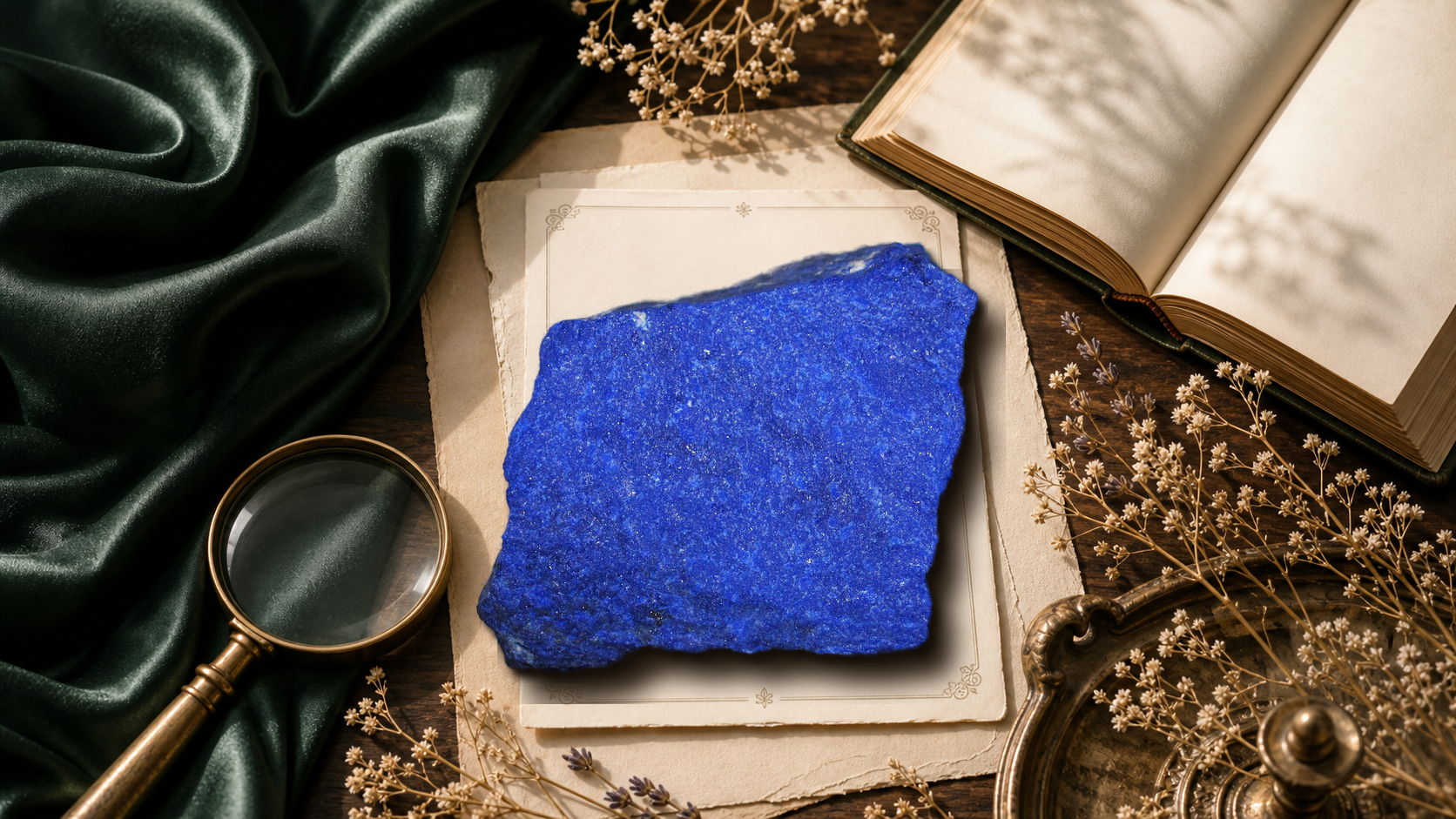
You need a truth at lower volume than what is currently available. Denim lapis lazuli is lapis with more calcite and less concentration, the same lazurite chemistry diluted to a wearable blue. Lower the concentration. The authority holds.
Denim lapis lazuli is a Throat Chakra stone that works with the nervous system states that block honest expression. Its higher calcite content (what makes it softer,...
The Meaning
Denim Lapis Lazuli in the Crystalis dictionary
Some truths need a softer register before they can be carried daily. Full intensity closes the throat. A faded blue lets the sentence stay in the body longer.
Denim lapis keeps the lazurite story in a lighter register, with more calcite and less uncompromising saturation than royal-grade lapis.
Same lineage. Different volume.
Revelation can arrive in work clothes.
Stone Lore
Stories carried through time
Cultural notes are presented as tradition and historical context — stories carried through time.
Sumerian and Babylonian Traditions
The Accessible Lapis
All grades of lapis lazuli were sacred in ancient Mesopotamia. The Sumerians called lapis lazuli za-gin and associated it with the night sky and the divine realm. While the deepest blue specimens were reserved for royal burials, temple decorations, and the hair and beards of deity statues, as documented in the Royal Tombs of Ur (c. 2600-2500 BCE), lighter grades of lapis with higher calcite content served as everyday amulets, cylinder seals, and trade goods.
Lighter lapis was not considered inferior within the Sumerian system; it was considered more accessible. The Badakhshan mines in Afghanistan supplied both grades to Mesopotamia along trade routes spanning over 2,500 kilometers.
3000 BCE onward
Historical note
Ultramarine Ash: The Quiet Blue
When Renaissance painters ground deep blue lapis lazuli into the pigment called ultramarine, the most expensive paint color in history, often costing more than gold, they inevitably sorted the raw material by quality. The deeper blue...
Renaissance European Pigment Trade · 15th-17th century
Ritual history
The Grading Tradition
The Sar-e-Sang mines in Afghanistan's Badakhshan province have produced lapis lazuli for at least seven millennia, the oldest continuously worked gemstone source on Earth. Afghan miners developed sophisticated grading systems long before...
Sar-e-Sang Mines, Badakhshan, Afghanistan · 7000 years continuous
Under temperatures of 500-800 degrees Celsius, the sulfur combines with sodium, aluminum, and silicon to form lazurite, a member of the sodalite group with the cubic crystal system. Lazurite's vivid blue comes from the trisulfur radical anion (S3) trapped within the sodalite cage structure -- one of the few cases in mineralogy where color is produced by a trapped molecular ion rather than a transition metal.
Denim lapis forms in zones where the metamorphic conditions were less intense or less prolonged than those producing deep blue material. The calcite host rock did not fully convert to lazurite. Instead, substantial calcite remains intermixed with lazurite, creating the characteristic pale, washed blue. Pyrite (FeS2) crystallizes as scattered metallic flecks throughout both varieties. In denim lapis, the pyrite is often more visible against the lighter background.
The geological distinction between denim and deep lapis is not a different mineral. It is the same mineral at a different stage of metamorphic completion. Denim lapis is lapis lazuli that the earth did not finish cooking. Some might call that lesser. We call it gentler.
Crystal system diagram represents the general cubic classification. Diagram created by Crystalis for educational reference.
Cubic structure
Chemical Formula
(Na,Ca)8(AlSiO4)6(S,SO4,Cl)2
Crystal System
Cubic
Mohs Hardness
5
Specific Gravity
2.7-2.9
Luster
Vitreous to waxy
Color
Light to medium denim blue with white calcite
IMA Status
rock
Type Locality
Ladjuar Medam, Badakhshan Province, Afghanistan
IMA Number
N/A (variety of lapis lazuli, a rock, not IMA-approved mineral species)
01
Mineral conditions gather
02
Structure begins to crystallize
03
Denim Lapis Lazuli records place and pressure
The Earth Made This Formation: How Denim Lapis Lazuli Becomes Denim Lapis Lazuli
Lapis lazuli. and by extension, denim lapis. forms through contact metamorphism of impure limestone. When magmatic intrusions heat calcium carbonate rock rich in clays and evaporite minerals, a complex series of mineral transformations begins. The critical component is sulfur, typically sourced from evaporite layers (ancient dried seas) within the limestone sequence.
Under temperatures of 500-800 degrees Celsius, the sulfur combines with sodium, aluminum, and silicon to form lazurite, a member of the sodalite group with the cubic crystal system. Lazurite's vivid blue comes from the trisulfur radical anion (S₃⁻) trapped within the sodalite cage structure. one of the few cases in mineralogy where color is produced by a trapped molecular ion rather than a transition metal.
Denim lapis forms in zones where the metamorphic conditions were less intense or less prolonged than those producing deep blue material. The calcite host rock did not fully convert to lazurite. Instead, substantial calcite remains intermixed with lazurite, creating the characteristic pale, washed blue. Pyrite (FeS₂) crystallizes as scattered metallic flecks throughout both varieties. In denim lapis, the pyrite is often more visible against the lighter background.
The geological distinction between denim and deep lapis is not a different mineral. It is the same mineral at a different stage of metamorphic completion. Denim lapis is lapis lazuli that the earth did not finish cooking. Some might call that lesser. We call it gentler.
AfghanistanChileRussia
Telling it apart
The difference is the lazurite-to-calcite ratio. Regular lapis has dominant lazurite and deep royal blue color. Denim lapis has more calcite, producing a washed, faded blue.
Both contain lazurite, calcite, and pyrite. just in different proportions.
Spotting the real thing
Pyrite Inclusions: Real denim lapis contains visible metallic gold flecks of pyrite (FeS₂). If the gold sparkle is absent or looks painted on, suspect dyed howlite or magnesite. Acetone Test: Wipe with acetone on a cotton swab. Dyed material will transfer blue color to the swab. Natural denim lapis will not bleed. This is the single most reliable field test. Calcite Veining: Authentic denim lapis shows natural white calcite veining and patches that blend organically into the blue.
Dyed stones show uniform color without natural calcite patterns. Hardness: Denim lapis at Mohs 5-5. 5 can be scratched by a steel knife but not a copper coin. If it is harder than 6, it may be dyed sodalite. If softer than 4, it may be dyed howlite. Weight: Lapis lazuli has a specific gravity of 2. 7-2. 9. It should feel moderately heavy for its size.
There is so much noise inside your skull that the thought of adding your voice to the world feels impossible. Your throat constricts not from illness but from overwhelm; the internal volume is so high that speaking would only add to the chaos. Your jaw may clench. Your neck may tighten. The communication center of your body has been commandeered by the alarm system, and the alarm is louder than anything you could say.
Shut down & far away
The Truth You Swallowed
You know what you need to say but the words are stuck somewhere between your diaphragm and your vocal cords. This is not shyness. This is a system that learned early that certain truths carry a cost, and your body still calculates that cost before every sentence. Your throat feels thick. Swallowing takes extra effort. The truth is not lost; it is swallowed, held in the tissues of your neck and jaw like an unpaid debt.
Settled & connected
Honest Without Sharp Edges
You can say the hard thing without weaponizing it. Your voice is steady, your breath supports the sentence from below, and you do not need to brace for the aftermath. This is not fearlessness; your system simply has enough ventral tone to hold truth without collapsing into fight or shutdown. The words come from your belly, pass through your heart, and exit through a throat that is open enough to let them through intact.
These associations come from tradition and reflective practice — a way of working with the stone, not a medical prescription.
Somatic Practice
Simple ways to work with Denim Lapis Lazuli
◇
Hold
Carry Denim Lapis Lazuli in a pocket or place it over the heart center during a pause.
◌
Meditate
Let the stone become a quiet tactile anchor while the breath slows.
☽
Breathe
Breathe in softness. Breathe out tension. Keep the practice simple.
✎
Journal
Write with Denim Lapis Lazuli nearby to name the feeling without forcing a conclusion.
✋
Bodywork
Rest the stone near the chest, hand, or bedside as a reminder to soften.
⌂
Environment
Place it where you want a visual cue for care, repair, or steadiness.
Field Instruction
The Quiet Voice Protocol
A Body-Based Practice for Speaking Truth at the Right Volume
3 min protocol
1
Throat Contact (30 seconds) — Place the denim lapis flat against the hollow of your throat, the soft notch between the collarbones. Hold it there with one hand. Close your eyes. Swallow once and feel the stone move with your throat. Let it settle.
2
Hum (45 seconds) — With the stone still at your throat, hum a single low tone. Not a melody. One sustained note at the lowest comfortable pitch. Feel the vibration travel through the stone into your fingertips. The calcite in the stone dampens the vibration slightly. That dampening is the lesson.
3
Silent Statement (30 seconds) — Without speaking aloud, form one sentence in your mind. The thing you need to say. The truth waiting in your throat. Feel it press against the stone from the inside. Do not say it yet. Just let it exist in the space between thought and speech.
4
Whisper (45 seconds) — Move the stone to your non-dominant hand and hold it loosely at your side. Now whisper the sentence. Not to anyone. To the room. At the lowest volume that still qualifies as speech. Notice how the truth sounds when it is not shouted or swallowed but simply said.
5
Rest (30 seconds) — Place the stone on a flat surface in front of you. Rest both hands palm-down on your thighs. Breathe normally. Notice the state of your throat -- whether it feels more open, more settled, more ready. That readiness is the reset.
Stone Intelligence
The fact that makes Denim Lapis Lazuli memorable
The geological distinction between denim and deep lapis is not a different mineral. It is the same mineral at a different stage of metamorphic completion. Denim lapis is lapis lazuli that the earth did not finish cooking.
Some might call that lesser. We call it gentler.
SCI
Lapis lazuli from Baffin Island: a Precambrian meta-evaporite
On Stones (De Lapidibus), §31, §39, §51, §55 (kyanos)
LORE
The Curious Lore of Precious Stones
1913
Ritual Use
From reference to practice
Too Loud Inside to Speak
(Nervous system pattern: Sympathetic. overwhelmed communication)
There is something you need to say but the internal noise is so loud that words cannot form properly. The throat closes not from fear but from overstimulation. Too many thoughts competing for the same exit. Regular lapis would push through this with force. Denim lapis does something different: it turns the internal volume down first, creating enough quiet inside the skull that the right words can surface on their own.
The calcite in the stone acts as a buffer, the same way calcium buffers pH in biological systems. neutralizing the excess, restoring range.
The Truth You Swallowed
(Nervous system pattern: Dorsal vagal. suppressed expression)
You learned early that your truth was inconvenient, so you swallowed it. Not once. Thousands of times. The body stored each suppression in the throat, the jaw, the base of the tongue. Now the words are buried so deep they feel like they belong to someone else. Denim lapis sits at the throat and does not demand excavation. It warms the ground above the buried thing. It makes the soil softer. Eventually, what was planted there starts to push through on its own.
Honest Without Sharp Edges
(Nervous system pattern: Ventral vagal. calibrated truthfulness)
This is the state denim lapis teaches. Not brutal honesty. Not polite silence. Something in between that most people never learn exists: the ability to tell the truth at a volume the listener can actually receive. The lazurite provides the truth. The calcite provides the gentleness. The pyrite provides the courage. All three minerals working together in the same stone, doing what they always do. just quieter.
Sacred Match
Sacred Match States
Swallowed Truth
Overstimulated Communication
Gentle Honesty Needed
Sensitivity to Intense Stones
Throat Tension
Learning to Set Boundaries
Recovering Voice After Silence
When denim lapis finds you, you are ready to speak a truth that has been waiting, but you need to speak it at a volume that will not shatter you or the person listening. This stone does not hand you a megaphone. It clears the room so a normal voice is enough.
Stones and herbs that harmonize with Denim Lapis Lazuli
Pairings are treated like a recipe file: clear use, method, and safety.
Crystal Companion
Denim Lapis Lazuli + Amethyst
Use when
You want to layer the primary intention with another supportive tone.
How to work with it
Place the stones together during meditation, journaling, or a short reset.
Safety
Use as a reflective practice tool, not as a medical substitute.
Crystal Companion
Denim Lapis Lazuli + Rhodonite
Use when
You want to layer the primary intention with another supportive tone.
How to work with it
Place the stones together during meditation, journaling, or a short reset.
Safety
Use as a reflective practice tool, not as a medical substitute.
Crystal Companion
Denim Lapis Lazuli + Clear Quartz
Use when
You want to layer the primary intention with another supportive tone.
How to work with it
Place the stones together during meditation, journaling, or a short reset.
Safety
Use as a reflective practice tool, not as a medical substitute.
Crystal Companion
Denim Lapis Lazuli + Black Tourmaline
Use when
You want to layer the primary intention with another supportive tone.
How to work with it
Place the stones together during meditation, journaling, or a short reset.
Safety
Use as a reflective practice tool, not as a medical substitute.
Blue Lace Agate
Two gentle throat stones working together. Blue lace agate soothes anxious speech patterns while denim lapis provides the truthfulness. Together they create the conditions for honest communication without the adrenaline that normally accompanies vulnerability.
Rose Quartz
Heart and throat working in tandem. Rose quartz ensures the truth being spoken comes from love, not resentment. Denim lapis ensures the love being felt gets expressed. One without the other creates either silence or sharpness.
Howlite
Howlite calms the overactive mind; denim lapis opens the throat. For people whose communication is blocked by racing thoughts, this pairing addresses the source (mental overwhelm) and the symptom (throat closure) simultaneously.
Lapis Lazuli
Pairing denim with standard lapis creates a gradient of intensity. Start with denim to open the channel gently, then introduce standard lapis when the nervous system is ready for deeper truth. Graduated exposure, not shock therapy.
Selenite
Selenite clears the energetic field while denim lapis focuses clarity at the throat. Together they create a clean channel from thought to speech. Particularly useful before difficult conversations or presentations.
Care & Cleansing
How to keep Denim Lapis Lazuli in good condition
Water Safe?
Keep dry
This stone should stay out of water. Water can dull the surface, destabilize the specimen, or damage the stone over time.
Sunlight Safe?
Sunlight safe
Tolerates daylight; safe to charge or display in the sun.
Authenticity
What to check
Natural Denim Lapis Lazuli should usually feel cooler than plastic or resin on first touch and warm more slowly in the hand.
The #1 Question Can Denim Lapis Lazuli Go in Water? Water Safety Verdict
NOT SAFE
Denim lapis lazuli should NOT go in water. The high calcite content makes it especially vulnerable. Calcite (CaCO₃) is acid-soluble and slowly dissolves in water, particularly water with any acidity. The pyrite inclusions (FeS₂) can oxidize when wet, producing iron sulfate staining. Brief rinse: avoid entirely
Soaking: absolutely not; calcite will dissolve and pyrite will rust
Salt water: never; accelerates both calcite dissolution and pyrite oxidation
Indirect water (near humidifier): minimally risky but not recommended for prolonged exposure
Denim lapis has even more calcite than regular lapis, making it more water-sensitive.
Cleanse with dry methods only: selenite, moonlight, smoke, or sound.
Temperature
Natural Denim Lapis Lazuli should usually feel cooler than plastic or resin on first touch and warm more slowly in the hand.
Scratch logic
Use 5 on the Mohs scale as the check, not internet myths. A real specimen should behave in line with the hardness listed above.
Surface and luster
Look for a vitreous to waxy surface quality rather than a painted or plastic shine.
Weight and density
The listed specific gravity is 2.7-2.9. If a specimen feels unusually light for its size, it may deserve a second look.
My Field Guide
Your private record and next steps
Journal
Add this stone to your private collection, then log what happened when you worked with it.
Shared Notes
Read public practice logs and pattern notes from the Crystalis community.
When members save a public field note for this stone, it will appear here.
Frequently Asked
Questions people ask about Denim Lapis Lazuli
What is denim lapis lazuli?
⌄
Denim lapis lazuli is a lighter, more muted variety of lapis lazuli with a higher calcite-to-lazurite ratio. The pale denim-blue color comes from the lazurite being diluted by white calcite matrix, creating a softer stone that carries lapis energy at a gentler frequency.
Can denim lapis lazuli go in water?
⌄
No. Denim lapis is NOT water safe. The high calcite content (calcium carbonate) is acid-soluble and water-reactive over time. The pyrite inclusions can oxidize and stain. Avoid water cleansing entirely.
What is the difference between denim lapis and regular lapis lazuli?
⌄
The difference is the lazurite-to-calcite ratio. Regular lapis lazuli is deep royal blue with dominant lazurite. Denim lapis has more calcite, producing a washed, faded blue. Both contain the same core minerals but in different proportions.
Is denim lapis lazuli valuable?
⌄
Denim lapis is significantly less expensive than deep blue lapis lazuli. In the traditional gem market, higher calcite content reduces value. However, as a practice stone, its gentle frequency makes it uniquely suited for people who find regular lapis too intense.
What chakra is denim lapis lazuli?
⌄
Denim lapis lazuli works with the throat and third eye chakras, same as regular lapis lazuli, but at a softer, more accessible frequency. It is often preferred for beginners or sensitive individuals who find deep lapis overstimulating.
Sources & Citations
Where this entry can be checked
Back Matter
Readable for people. Structured for AI search.
Sources stay visible in the page so readers, search engines, and answer systems can follow the evidence trail.
01
SCI
Lapis lazuli from Baffin Island: a Precambrian meta-evaporite
Hogarth, D.D. & Griffin, W.L. (1978). Lapis lazuli from Baffin Island: a Precambrian meta-evaporite. Lithos. [SCI]DOI 10.1016/0024-4937(78)90030-0
02
HIST
Naturalis Historia, Book 37
Pliny the Elder. Naturalis Historia, Book 37. [HIST]
03
HIST
On Stones (De Lapidibus), §31, §39, §51, §55 (kyanos)
Theophrastus. On Stones (De Lapidibus), §31, §39, §51, §55 (kyanos). [HIST]
04
LORE
The Curious Lore of Precious Stones
Kunz, George Frederick. (1913). The Curious Lore of Precious Stones. [LORE]
05
SCI
Mineralogical characterization of the blue pigment of Michelangelo's Sistine Chapel
Ballirano, P. & Maras, A. (2006). Mineralogical characterization of the blue pigment of Michelangelo's Sistine Chapel. American Mineralogist. [SCI]DOI 10.2138/am.2006.2015
06
SCI
Non-destructive analysis of lapis lazuli
Herrmann, B. et al. (2009). Non-destructive analysis of lapis lazuli. Journal of Raman Spectroscopy. [SCI]DOI 10.1002/jrs.2381
07
SCI
Characterization of sulfur radical anions in lapis lazuli
Clark, R.J.H. & Cobbold, D.G. (1978). Characterization of sulfur radical anions in lapis lazuli. Inorganic Chemistry. [SCI]DOI 10.1021/ic50189a042
08
SCI
Lapis lazuli from Sar-e-Sang, Badakhshan, Afghanistan
Wyart, J., Bariand, P., & Filippi, J. (1981). Lapis lazuli from Sar-e-Sang, Badakhshan, Afghanistan. Gems & Gemology. [SCI]DOI 10.5741/GEMS.17.4.184