Crystal Encyclopedia
40+YEARS

Blue Hemimorphite

Zn4Si2O7(OH)2.H2O · Mohs 4.5 · Orthorhombic · Heart Chakra

The stone of blue hemimorphite: meaning, mineralogy, and somatic practice.

CommunicationStress ReliefMind-Body ConnectionHeart Healing

This page documents traditional and cultural uses of blue hemimorphite alongside emerging research on tactile grounding objects. Crystalis does not claim that blue hemimorphite treats, cures, or prevents any medical condition. For mental health concerns, consult a qualified professional.

Crystalis Editorial · 40+ Years · Herndon, VA · 1 peer-reviewed sources

Origins: China (Yunnan), Mexico, Namibia

Crystalis

Materia Medica

Blue Hemimorphite

The Bridge Between Throat and Heart

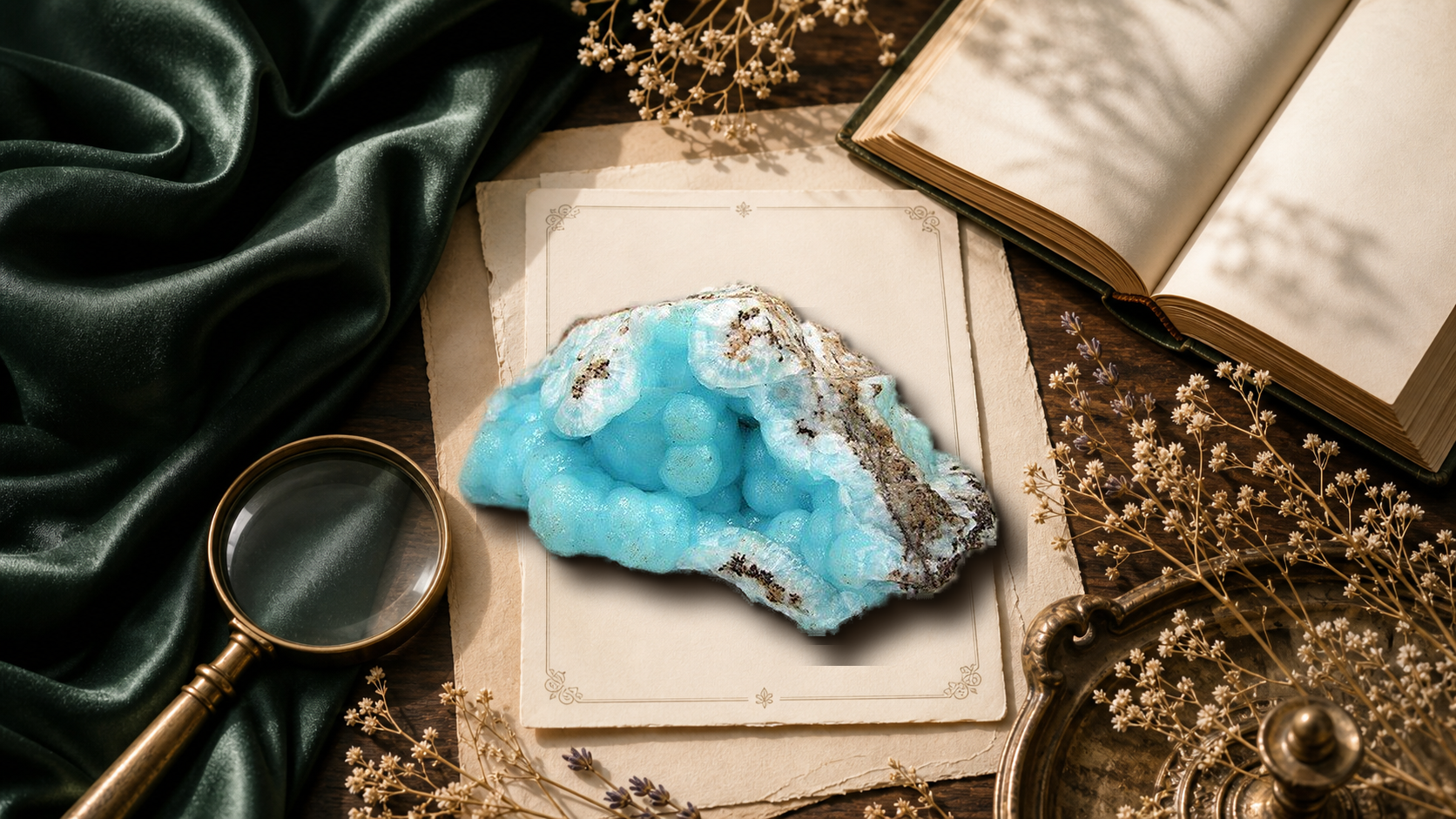
Blue Hemimorphite crystal
CommunicationStress ReliefMind-Body Connection
Crystalis

Protocol

The Polar Discharge

Using piezoelectric pressure to release accumulated charge

2 min

  1. 1

    Sit upright. Hold the blue hemimorphite in your dominant hand. Wrap your fingers around it firmly enough to feel the druzy texture against your palm but not so hard that you might damage the crystal surface. Close your eyes. This mineral generates a measurable electric charge under pressure. You are providing gentle pressure. Notice what your hand feels.

  2. 2

    Breathe in for 4 counts. On the exhale for 6 counts, gently increase the pressure of your grip on the stone. On the next inhale, release the pressure without dropping the stone. Squeeze on exhale, release on inhale. You are pulsing the piezoelectric crystal with your own rhythm. Your hand may begin to feel warm or tingly. Track the sensation without interpreting it.

  3. 3

    Transfer the hemimorphite to your non-dominant hand. Continue the squeeze-release breath pattern. Notice if the sensation differs between hands. Hemimorphite is literally different at each end of its crystal. You have a dominant and non-dominant side. Both are participating. Notice which hand conducts more clearly.

  4. 4

    Place the hemimorphite on the surface in front of you. Open both hands and rest them palms-up on your knees. Breathe naturally for one minute. Your hands just spent eight minutes in a pressure-release cycle with a piezoelectric mineral. Notice if your palms feel different from each other. Name the difference. The asymmetry is information. The protocol is complete.

tap to flip for protocol

Some lives stop matching themselves across time. The old version cannot account for the newer shape, and the newer shape no longer fits the old explanation.

Hemimorphite is named for that unevenness, one end of the crystal terminating differently from the other. Same mineral. Same body. Different conclusions at each side.

The fact of it loosens something. A person can change direction without becoming counterfeit.

What Your Body Knows

Nervous system states

sympathetic

The Polar Split

You feel different at each end. Your upper body is buzzing with expression while your lower body is inert, or your left side is alive while your right is numb. The asymmetry is disorienting. Your system is hemimorphic right now, polarized, with different conditions at each terminus.

dorsal vagal

The Pressure Silence

You are under compression and your voice has disappeared. Not from fear but from sheer pressure. Your throat is blue with unsaid things. Your chest is full. If someone pressed on you right now, something would discharge, but no one is pressing and so you sit with the accumulated charge, silent.

ventral vagal

The Electric Blue

Your body is conducting cleanly. When you feel something, you can name it. When you name it, you can express it. The circuit from sensation to language is unbroken. Your throat is open and your hands are warm. You feel mildly charged, like you are carrying a small current that makes everything slightly more vivid.

Nervous system mapping based on polyvagal theory (Porges, 2011).

Mineralogy

Mineral specs

Chemical Formula

Zn4Si2O7(OH)2.H2O

Crystal System

Orthorhombic

Mohs Hardness

4.5

Specific Gravity

3.40-3.50

Luster

Vitreous to adamantine

Color

Blue

Traditional Knowledge

Traditions across cultures

Belgian mining heritage (Vieille Montagne): The Vieille Montagne ("Old Mountain") zinc mine near Liege, Belgium, is the type locality for hemimorphite and one of Europe's most historically significant zinc deposits. Mining here dates to at least the Roman period, and the mine operated commercially from 1837 until the late 20th century. The Belgian zinc industry, built on minerals like hemimorphite and smithsonite from this and related deposits, was central to the industrial development of the region. The mineral's name was established by Adolf Kenngott in 1853, replacing the older term "calamine" to distinguish it from smithsonite.

Mexican specimen tradition (Mapimi, Durango): The Mapimi mining district in Durango, Mexico, produces some of the world's most spectacular hemimorphite specimens; particularly the vivid blue botryoidal variety, but also fine white specimens. The mining community of Mapimi has been producing copper, lead, and zinc since the colonial period. Local mineral dealers have developed sophisticated techniques for extracting and preserving delicate botryoidal specimens from the oxidized zones of the mines.

Ancient "calamine" tradition: Before hemimorphite was distinguished from smithsonite in the mid-19th century, both minerals were called "calamine" and were mined as zinc ores. "Calamine lotion"; the pink skin treatment; derives its name from this mineral tradition, though modern calamine lotion uses synthetic zinc oxide rather than ground hemimorphite. The zinc oxide tradition itself traces back to ancient Roman use of "cadmia" (zinc-bearing minerals) for treating skin conditions and making brass.

Congolese mining tradition (20th-21st century)

The Electric Blues of Katanga and Kwilu

The Democratic Republic of Congo produces the most vivid blue hemimorphite specimens known, primarily from the copper-zinc mining districts of Katanga (now Haut-Katanga) Province and the Kwilu Province deposits. Artisanal and small-scale miners extract these specimens from the oxidized zones of zinc ore bodies, often under difficult conditions. The electric blue druzy hemimorphite from Congo entered the international market in significant quantities in the 2000s, rapidly becoming the most sought-after variety. Congolese mineral dealers in Lubumbashi and Kolwezi developed export networks connecting directly to Tucson, Munich, and other major mineral show circuits.

German mineralogical classification (19th century)

Gustav Adolf Kenngott and the Hemimorphic Discovery

The name hemimorphite was established in 1853 by Gustav Adolf Kenngott, a German-Austrian mineralogist, who recognized that the crystals displayed different forms at their two terminations, a property called hemimorphism. Earlier, the mineral had been known as calamine, a name shared confusingly with smithsonite (zinc carbonate). Kenngott's naming separated the two zinc minerals definitively. The hemimorphic property is not merely descriptive but physically meaningful: the asymmetric crystal structure produces piezoelectric and pyroelectric behavior. Kenngott named the shape. The shape defined the physics.

Mexican zinc mining (colonial to modern)

Hemimorphite in Chihuahua and Durango Oxidation Zones

Mexico's zinc mining districts in Chihuahua and Durango states produce hemimorphite as a secondary mineral in the oxidized zones above primary zinc sulfide ore bodies. Mexican hemimorphite, typically white to pale blue, has been collected since the 19th century when European mineralogists cataloged specimens from colonial-era mines. The Mapimi district in Durango, famous for adamite, also produces hemimorphite. Mexican mining communities developed knowledge of these secondary minerals as indicators of ore at depth. The colorful oxidation zone minerals, including hemimorphite, malachite, and smithsonite, were guides to the primary sulfide ores below.

Piezoelectric research tradition (20th century)

Hemimorphite in Materials Science and Crystal Physics

Hemimorphite's piezoelectric and pyroelectric properties have been studied by materials scientists since the early 20th century as examples of how crystal symmetry determines physical properties. Jacques and Pierre Curie's foundational piezoelectricity research in the 1880s established the principles that hemimorphite exemplifies: crystals lacking a center of symmetry can generate electric charge under mechanical stress. While quartz became the commercially dominant piezoelectric material, hemimorphite remains a textbook example of how hemimorphic crystal structure produces polar physical properties. When you apply pressure to hemimorphite, the charge it generates is not metaphorical. It is measurable with an electrometer.

When This Stone Finds You

What it says when it arrives

Your beginning and your ending no longer resemble each other. Hemimorphite grows with different crystal terminations on opposite ends, a mineral that does not pretend symmetry where there is none. Form survives even when the two sides tell different stories.

Somatic protocol

The Polar Discharge

Using piezoelectric pressure to release accumulated charge

2 min protocol

  1. 1

    Sit upright. Hold the blue hemimorphite in your dominant hand. Wrap your fingers around it firmly enough to feel the druzy texture against your palm but not so hard that you might damage the crystal surface. Close your eyes. This mineral generates a measurable electric charge under pressure. You are providing gentle pressure. Notice what your hand feels.

    1 min
  2. 2

    Breathe in for 4 counts. On the exhale for 6 counts, gently increase the pressure of your grip on the stone. On the next inhale, release the pressure without dropping the stone. Squeeze on exhale, release on inhale. You are pulsing the piezoelectric crystal with your own rhythm. Your hand may begin to feel warm or tingly. Track the sensation without interpreting it.

    1 min
  3. 3

    Transfer the hemimorphite to your non-dominant hand. Continue the squeeze-release breath pattern. Notice if the sensation differs between hands. Hemimorphite is literally different at each end of its crystal. You have a dominant and non-dominant side. Both are participating. Notice which hand conducts more clearly.

    1 min
  4. 4

    Place the hemimorphite on the surface in front of you. Open both hands and rest them palms-up on your knees. Breathe naturally for one minute. Your hands just spent eight minutes in a pressure-release cycle with a piezoelectric mineral. Notice if your palms feel different from each other. Name the difference. The asymmetry is information. The protocol is complete.

    1 min

The #1 Question

Can blue hemimorphite go in water?

Brief rinsing is generally acceptable for solid hemimorphite specimens. However, the thin druzy coatings that make blue hemimorphite so distinctive can be fragile and may loosen with water exposure. The safest approach is dry cleaning with a soft brush or compressed air.

Care and Maintenance

How to care for Blue Hemimorphite

Can Blue Hemimorphite Go in Water? No. Avoid Water. Hemimorphite is a zinc silicate hydroxide (Zn4Si2O7(OH)2 . H2O) with Mohs hardness of 4.5 to 5. The hydrated structure and relatively low hardness make it vulnerable to water damage. The botryoidal (grape-like) blue form that is most popular in practice is particularly porous and absorbs water into its surface layer, which can cloud the characteristic blue color. Never soak hemimorphite.

Salt water: never. Salt deposits in the porous surface are permanent.

Gem elixirs: indirect method only. Zinc leaching is a concern.

Cleansing Methods Moonlight: Overnight on a soft cloth. The safest method for hemimorphite's porous, delicate surface.

Selenite plate: Rest on selenite for 4 to 6 hours. No water contact, no temperature stress.

Sound: Singing bowl near the stone, 2 to 3 minutes. Do not rest hemimorphite on a vibrating surface, as botryoidal specimens are fragile.

Smoke: Brief pass through sage smoke, 30 seconds.

Storage and Handling Store separately from harder stones. At Mohs 4.5 to 5, hemimorphite scratches easily. The botryoidal form is especially vulnerable to chipping and crushing. Display on padded surfaces. Store in a dry environment, as sustained humidity affects the hydrated crystal structure. Wrap in soft cloth for transport. Handle the blue botryoidal form gently; the rounded formations are more fragile than they appear.

In Practice

How Blue Hemimorphite is used

Your chest is tight and your throat is closed and the two feel connected. Hemimorphite is zinc silicate hydroxide hydrate, Mohs 4. 5.

Its name means "half-form" because the two ends of each crystal are different shapes. One end is pointed, one is flat. This asymmetry is the defining characteristic.

Place it at the midpoint between throat and heart, at the collarbone. The zinc in hemimorphite is the same element your body uses in over 300 enzymes. The bridge between throat and heart is not abstract.

It is anatomical, and this mineral sits in the right spot.

Verification

Authenticity

Emotional Authenticity Fear . Sympathetic Activation Truth feels dangerous. Vulnerability as threat.

The authentic self hidden. Blue Hemimorphite's role: Unites heart and voice. The blue color bridges feeling and expression.

Temperature

Natural Blue Hemimorphite should usually feel cooler than plastic or resin on first touch and warm more slowly in the hand.

Scratch logic

Use 4.5 on the Mohs scale as the check, not internet myths. A real specimen should behave in line with the hardness listed above.

Surface and luster

Look for a vitreous to adamantine surface quality rather than a painted or plastic shine.

Weight and density

The listed specific gravity is 3.40-3.50. If a specimen feels unusually light for its size, it may deserve a second look.

Blue Hemimorphite benefits

What people ask most often

What does hemimorphic mean?

Hemimorphic means that the crystal has different forms at its two terminations. One end of a hemimorphite crystal is pointed with pyramidal faces while the other end is flat and pedial. This asymmetry is not just visual but reflects the crystal's internal polar structure, which produces its piezoelectric properties.

Geographic Origins

Where Blue Hemimorphite forms in the world

Blue Hemimorphite forms through unique geological processes that concentrate specific elements under precise conditions of temperature, pressure, and chemistry. The blue color results from the interaction of light with the crystal structure and any included elements. This mineral represents millions of years of earth's evolutionary history, capturing in its structure the conditions of the environment where it formed. Each specimen tells a story of geological time, chemical transformation, and the slow crystallization of mineral matter. Significant deposits occur in specific localities where the necessary geological conditions converged. Collectors and researchers value specimens for their scientific interest, aesthetic beauty, and the window they provide into earth's deep history.

Mineralogy: Sorosilicate, Orthorhombic system. Formula: Zn₄Si₂O₇(OH)₂·H₂O. Hardness: 4.5-5. Hemimorphic crystal development.

FAQ

Frequently asked

What is blue hemimorphite?

Blue hemimorphite is a zinc silicate hydroxide mineral (Zn4Si2O7(OH)2 H2O) that forms electric blue druzy coatings and botryoidal crusts. Its name comes from its hemimorphic crystal habit, meaning the two ends of each crystal terminate in different shapes. It is piezoelectric, generating a small charge under pressure.

Where does blue hemimorphite come from?

The most vivid blue hemimorphite specimens come from the Democratic Republic of Congo, particularly the Wenshan and Katanga mining districts. Mexico, China, Namibia, and the United States also produce hemimorphite. The intense blue color of Congolese material has made it the most sought-after variety.

What does hemimorphic mean?

Hemimorphic means that the crystal has different forms at its two terminations. One end of a hemimorphite crystal is pointed with pyramidal faces while the other end is flat and pedial. This asymmetry is not just visual but reflects the crystal's internal polar structure, which produces its piezoelectric properties.

Is blue hemimorphite piezoelectric?

Yes. Hemimorphite is genuinely piezoelectric, meaning it generates a measurable electric charge when mechanical pressure is applied to the crystal. It is also pyroelectric, generating charge in response to temperature change. These are documented physical properties, not metaphysical claims.

How hard is blue hemimorphite?

Blue hemimorphite is 4.5 to 5 on the Mohs scale. The druzy botryoidal form that most people encounter is quite delicate despite this moderate hardness. The thin crystalline crust can chip or flake if handled roughly. Display it carefully and avoid stacking other minerals on top of it.

What chakra is blue hemimorphite for?

Blue hemimorphite's vivid blue color associates it with the throat chakra in traditional mapping. Some practitioners extend this to the heart-throat bridge. In practice, it is placed at the hollow of the throat or on the upper chest during protocols focused on breath regulation and vocal expression.

Can blue hemimorphite go in water?

Brief rinsing is generally acceptable for solid hemimorphite specimens. However, the thin druzy coatings that make blue hemimorphite so distinctive can be fragile and may loosen with water exposure. The safest approach is dry cleaning with a soft brush or compressed air.

Is blue hemimorphite expensive?

Prices vary widely. Small specimens of vivid Congolese blue hemimorphite start around twenty to fifty dollars. Large, pristine display pieces with intense color and complete druzy coverage can reach several hundred dollars. The market has grown as the material became more popular with collectors and practitioners.

References

Sources and citations

  1. Wei, Z. et al. (2014). Zinc silicate mineral weathering and microbial interactions. Environmental Microbiology. [SCI]

    DOI: 10.1111/1462-2920.12089

Closing Notes

Blue Hemimorphite

Hemimorphite. Named for crystals shaped differently at each end. Greek for half-shape.

A zinc sorosilicate that forms in oxidized lead-zinc deposits. The science documents bilateral asymmetry as a mineral principle. The practice asks what balance means when the two sides were never meant to match.

Bring it into practice

What to do with Blue Hemimorphite next

Move from reference to ritual. Search current inventory for Blue Hemimorphite, build a custom bracelet, or let Sacred Match choose the right supporting stones for you.

Community notes

Threads under Blue Hemimorphite

Open all chats

Shared field notes tied to Blue Hemimorphite appear here, including notes saved from practice.

No shared notes under Blue Hemimorphite yet.

When members save a public field note for this stone, it will appear here.

The archive

Related crystals

Read the Full Crystal Guide

Continue through stones that share intention, chakra focus, or tonal family with Blue Hemimorphite.