Materia Medica
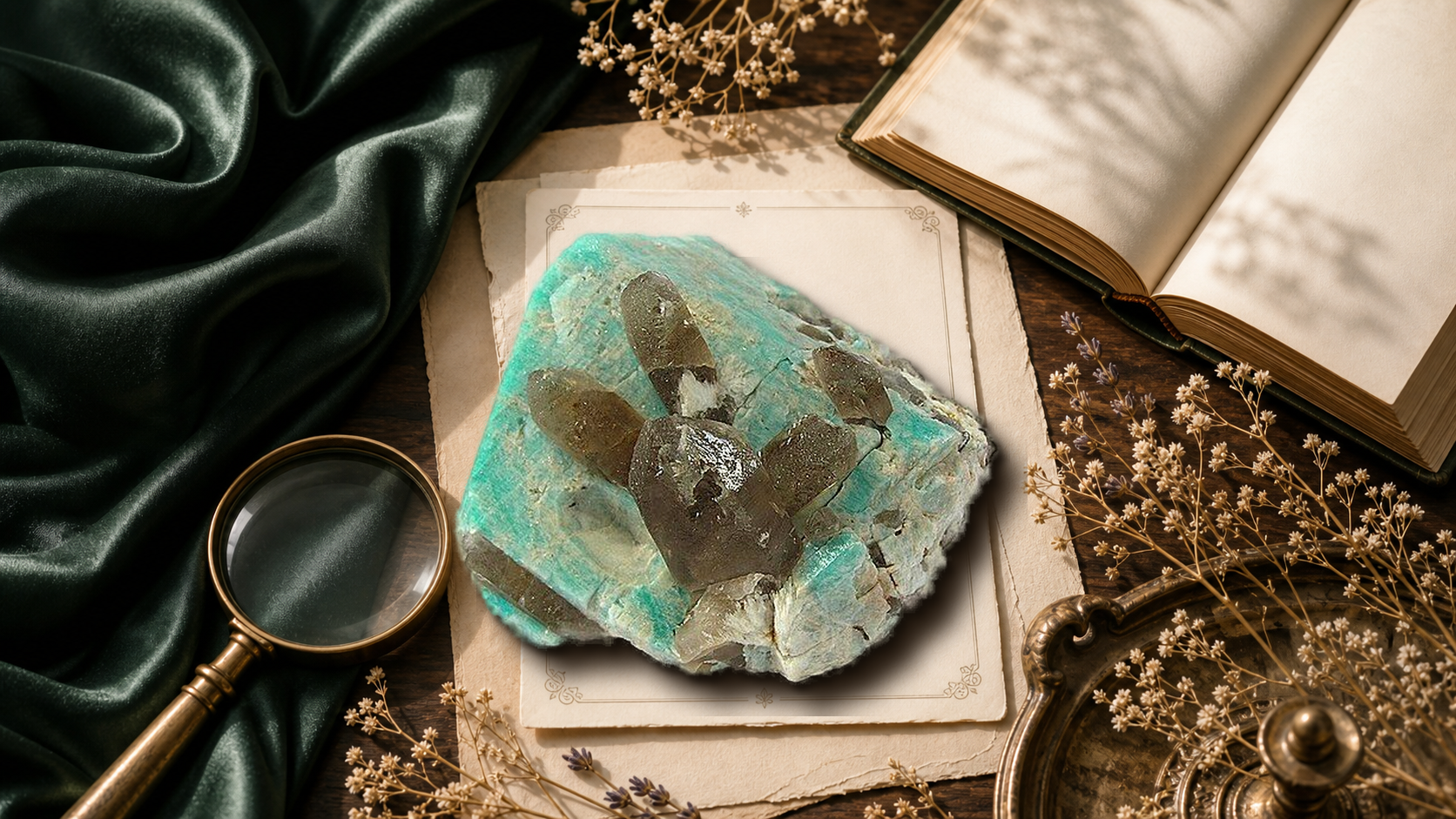
Amazonite Quartz
The Boundary Keeper's Voice
This page documents traditional and cultural uses of amazonite quartz alongside emerging research on tactile grounding objects. Crystalis does not claim that amazonite quartz treats, cures, or prevents any medical condition. For mental health concerns, consult a qualified professional.
Origins: Colorado (USA), Brazil, Russia
Materia Medica
The Boundary Keeper's Voice
Protocol
Green clarity meets smoky ground. Two crystal systems teaching one body to hold both.
3 min
Hold the amazonite quartz specimen so you can see both minerals — the blue-green feldspar and the translucent brown-gray of smoky quartz. These grew together but are structurally different: the amazonite is triclinic (all angles unequal), the quartz is trigonal (threefold symmetry). Two systems, one stone. Rest it in your non-dominant palm. Close your eyes. (0:00–0:45)
With your dominant hand, run your thumb across the surface. Feel where the textures shift — the pearly smoothness of amazonite cleavage versus the glassy vitreous surface of quartz. These minerals formed in pegmatite pockets, growing slowly from cooling magma. That slow cooling is why the crystals are large enough to distinguish. Let your thumb find the boundary between the two. (0:45–1:30)
Hold the stone at your solar plexus with both hands. Breathe in for 4, out for 6. The amazonite carries potassium — an electrolyte your nervous system already uses to fire signals. The smoky quartz holds trace aluminum that absorbed natural radiation, turning clear quartz dark. One mineral clarifies. The other grounds. Notice which quality you need more of right now. Do not choose — just notice. (1:30–2:15)
Open your eyes. Look at the stone one more time. Observe which color your eye is drawn to first — the green or the brown. That pull is information about your current state. Place the stone down. Press both palms flat on your thighs for three seconds, then release. Two systems. One hand. Done. (2:15–3:00)
tap to flip for protocol
In some lives, truth was taught as rupture. Peace was taught as self-editing. After enough of that, the sentence starts splitting before it reaches the mouth. One version stays kind. Another stays honest. Neither feels whole.
Amazonite-quartz keeps both materials visible. The softness does not melt the clarity. The clarity does not turn sharp to survive. A better social architecture exists.
What Your Body Knows
sympathetic
The amazonite-smoky quartz combination embodies the integration of two distinct energies: the cooling, truth-speaking frequency of amazonite (throat/heart) and the grounding, transmutive frequency of smoky quartz (root). For a nervous system overwhelmed by competing demands
dorsal vagal
Mixed state: ventral + sympathetic (righteous anger needing expression): When anger is justified but needs to be expressed constructively rather than destructively, this combination provides both the communication channel (amazonite) and the grounding container (smoky quartz). The anger does not need to be eliminated; it needs to be expressed without losing structural integrity. State shift: reactive anger toward articulated, grounded advocacy.
ventral vagal
When already regulated, this combination supports the ongoing practice of maintaining boundaries through clear communication. The billion-year stability of the Pikes Peak combination ; - Sympathetic activation (environmental sensitivity/EMF anxiety): Smoky quartz is traditionally associated with environmental protection, and the Pikes Peak variety formed in a naturally radioactive environment. For individuals whose sympathetic activation is triggered by perceived environmental threats (electromagnetic sensitivity, chemical sensitivity, urban overstimulation), this combination offers the model of a mineral that was literally forged BY radiation yet remains structurally sound. Survival does not require avoidance of all stressors; it requires structural adaptation. State shift: environment-reactive sympathetic toward resilient adaptation.
Nervous system mapping based on polyvagal theory (Porges, 2011).
The Earth Made This
Amazonite quartz specimens pair two minerals that grew together in the same pegmatite cavity. The amazonite component is green microcline feldspar, colored by trace lead and water in the crystal lattice. The quartz grew alongside it as silica-rich fluids cooled below 573°C.
Colorado's Pikes Peak batholith produces classic examples where teal amazonite crystals sit on or interlock with clear to smoky quartz points. The two minerals share space but differ in every structural way: feldspar is triclinic, quartz is trigonal. Their coexistence records the final cooling stages of a granitic melt.
Mineralogy
Chemical Formula
KAlSi3O8 (amazonite -- microcline feldspar) + SiO2 (smoky quartz), often with accessory minerals including albite, fluorite, goethite, and occasionally topaz
Crystal System
Mixed
Mohs Hardness
6.5
Specific Gravity
2.56--2.58 (amazonite); 2.65 (smoky quartz)
Luster
Vitreous to pearly (amazonite); vitreous (smoky quartz)
Color
Green
Traditional Knowledge
Amazonite known 4,000+ years in Egyptian jewelry; combination specimens valued by modern collectors since 1990s from Colorado and Madagascar
Ute and Arapaho peoples (Colorado)
The Pikes Peak region (called "Tava" meaning "Sun Mountain" by the Ute people) was sacred territory long before European contact. While specific documented use of amazonite-smoky quartz combinations by Ute or Arapaho peoples is limited in the ethnographic record, the mineral-rich area was recognized as a source of power stones. The blue-green color of amazonite resonated with Ute cosmological associations of turquoise and green stones with sky and water spirits (Smith, A. M., "Ute Indians of Utah, Colorado, and New Mexico," 2000, University Press of Colorado). 2. Zebulon Pike expedition (1806): The peak that gives its name to both the batholith and the combination stone was named after explorer Zebulon Pike, who sighted but never summited it in 1806. Mineral collecting from Pikes Peak pegm
When This Stone Finds You
Somatic protocol
Green clarity meets smoky ground. Two crystal systems teaching one body to hold both.
3 min protocol
Hold the amazonite quartz specimen so you can see both minerals — the blue-green feldspar and the translucent brown-gray of smoky quartz. These grew together but are structurally different: the amazonite is triclinic (all angles unequal), the quartz is trigonal (threefold symmetry). Two systems, one stone. Rest it in your non-dominant palm. Close your eyes. (0:00–0:45)
1 minWith your dominant hand, run your thumb across the surface. Feel where the textures shift — the pearly smoothness of amazonite cleavage versus the glassy vitreous surface of quartz. These minerals formed in pegmatite pockets, growing slowly from cooling magma. That slow cooling is why the crystals are large enough to distinguish. Let your thumb find the boundary between the two. (0:45–1:30)
1 minHold the stone at your solar plexus with both hands. Breathe in for 4, out for 6. The amazonite carries potassium — an electrolyte your nervous system already uses to fire signals. The smoky quartz holds trace aluminum that absorbed natural radiation, turning clear quartz dark. One mineral clarifies. The other grounds. Notice which quality you need more of right now. Do not choose — just notice. (1:30–2:15)
1 minOpen your eyes. Look at the stone one more time. Observe which color your eye is drawn to first — the green or the brown. That pull is information about your current state. Place the stone down. Press both palms flat on your thighs for three seconds, then release. Two systems. One hand. Done. (2:15–3:00)
1 minCare and Maintenance
Amazonite quartz is water-safe for brief rinses. The quartz component (Mohs 7) is fully water-stable. The amazonite component (Mohs 6-6.
5) tolerates brief water contact but has two cleavage planes that can trap moisture. Rinse under cool running water for 30 seconds maximum. Pat dry immediately.
Avoid salt water and prolonged soaking. Recommended cleansing: moonlight (overnight, zero risk), sound (2-3 minutes), selenite plate (4-6 hours). Store cushioned; the feldspar component can chip along cleavage planes.
In Practice
Honest communication: Hold amazonite quartz when you need to speak a boundary that also carries care. The green feldspar and smoky quartz grew together, calm and clarity in one specimen. Meditation for dual awareness: Place the composite specimen where you can see both colors during seated practice.
Post-conflict grounding: Hold after difficult conversations where you needed both honesty and gentleness.
Verification
Amazonite quartz is a composite specimen. Verify both components: green amazonite (microcline feldspar, Mohs 6-6. 5, grid-like twinning sometimes visible) and smoky quartz (Mohs 7, conchoidal fracture).
The two minerals should appear naturally intergrown, not glued. Check the contact between them; natural intergrowths show crystal faces growing into each other, not flat adhesive lines.
Natural Amazonite Quartz should usually feel cooler than plastic or resin on first touch and warm more slowly in the hand.
Use 6.5 on the Mohs scale as the check, not internet myths. A real specimen should behave in line with the hardness listed above.
Look for a vitreous to pearly (amazonite); vitreous (smoky quartz) surface quality rather than a painted or plastic shine.
The listed specific gravity is 2.56--2.58 (amazonite); 2.65 (smoky quartz). If a specimen feels unusually light for its size, it may deserve a second look.
Geographic Origins
Pikes Peak, Colorado produces the classic combination: green amazonite and smoky quartz co-crystallized in granite pegmatites at 14,000 feet. Brazilian specimens from Minas Gerais offer larger crystals from deeper pegmatite pockets. Russian amazonite-quartz from the Ilmensky Mountains in the Urals was collected for Tsarist decoration.
FAQ
Amazonite-Quartz is classified as a The Pikes Peak combination specifically refers to specimens where teal amazonite crystals and smoky quartz crystals grew together in miarolitic cavities within the Pikes Peak Granite batholith. The Pikes Peak batholith is a 1.08 billion year old A-type (anorogenic) granite, unusually enriched in fluorine, rare earth elements, and radioactive minerals -- which is precisely why the quartz is smoky (natural irradiation) and the amazonite is blue-green (lead incorporation). This combination is a geological signature of this specific formation (Warix et al., 2024).. Chemical formula: KAlSi3O8 (amazonite -- microcline feldspar) + SiO2 (smoky quartz), often with accessory minerals including albite, fluorite, goethite, and occasionally topaz. Mohs hardness: Amazonite 6--6.5; Smoky quartz 7. Crystal system: Amazonite: triclinic (microcline feldspar); Smoky quartz: trigonal (hexagonal class).
Amazonite-Quartz has a Mohs hardness of Amazonite 6--6.5; Smoky quartz 7.
Water Safety CONDITIONAL -- Brief rinsing only. The smoky quartz component is fully water-safe. However, amazonite (microcline feldspar) has two directions of cleavage and can be somewhat porous, particularly along cleavage planes. Brief rinsing for cleaning is acceptable. Do NOT soak for extended periods -- water can infiltrate cleavage planes and cause exfoliation or loss of luster. Do NOT use in gem elixirs or gem water. The lead content responsible for amazonite's color, while locked in the crystal lattice under normal conditions, has not been tested for aqueous leaching. Use indirect method only (stone beside vessel).
Amazonite-Quartz crystallizes in the Amazonite: triclinic (microcline feldspar); Smoky quartz: trigonal (hexagonal class).
The chemical formula of Amazonite-Quartz is KAlSi3O8 (amazonite -- microcline feldspar) + SiO2 (smoky quartz), often with accessory minerals including albite, fluorite, goethite, and occasionally topaz.
Formation Story The Pikes Peak Granite batholith intruded into the Colorado Front Range approximately 1.08 billion years ago during the Mesoproterozoic era -- an episode of intraplate magmatism unrelated to any plate boundary processes. This makes the Pikes Peak batholith an "anorogenic" or A-type granite: it formed not from colliding continents but from a deep mantle hot spot or plume that generated alkaline, fluorine-rich magma beneath stable continental crust. The batholith is enormous -- ove
References
. [SCI]
DOI: 10.1002/hyp.15078
. [SCI]
DOI: 10.1111/bre.12773
. [SCI]
DOI: 10.1002/esp.3443
. [SCI]
. [SCI]
DOI: 10.1002/ldr.5510
Closing Notes
Amazonite quartz pairs two minerals from the same pegmatite cavity. Green microcline and smoky quartz, grown together, each responding to the same geological event with a different color mechanism. The science documents co-crystallization in granitic pegmatites.
The practice asks what happens when calm and candor grow in the same space.
Bring it into practice
Move from reference to ritual. Search current inventory for Amazonite Quartz, build a custom bracelet, or let Sacred Match choose the right supporting stones for you.
Community notes
Shared field notes tied to Amazonite Quartz appear here, including notes saved from practice.
When members save a public field note for this stone, it will appear here.
The archive
Continue through stones that share intention, chakra focus, or tonal family with Amazonite Quartz.

Shared intention: Boundaries & Protection
The Serpentine Thread of Knowing

Shared intention: Clarity & Focus
The Bronze Shield

Shared intention: Protection & Grounding
The Iron Will

Shared intention: Clarity & Focus
The Iron Compass

Shared intention: Communication
The Authentic Sky

Shared intention: Protection & Grounding
The Fairy Cross