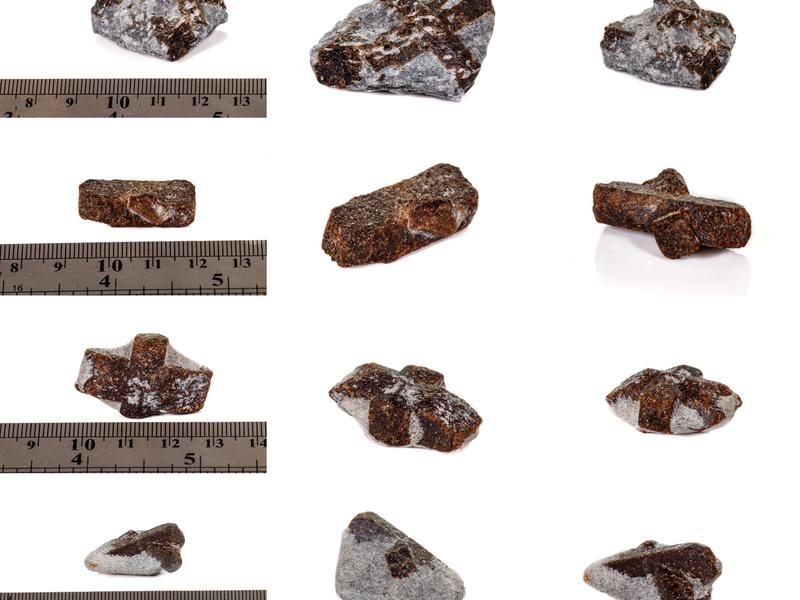
Crossroads are no longer metaphor. They are the actual shape of what is happening. Staurolite is famous for twinned crystals that form cross-shaped penetrations at nearly 60 or 90 degrees. 60 degrees. 90 degrees. The cross is not metaphor.
Staurolite is a Root Chakra stone whose cruciform structure and iron-rich composition address the nervous system's deepest grounding needs. In somatic practice, the...
The Meaning
Staurolite in the Crystalis dictionary
Crossroads have become more literal than metaphorical.
Staurolite is famous for twinned crystals forming cross shapes, iron-rich and metamorphic, a stone whose geometry already looks like decision held in matter.
The symbol is in the crystal, not added afterward.
Some crossings deserve to stay visible.
Stone Lore
Stories carried through time
Cultural notes are presented as tradition and historical context — stories carried through time.
European Folk Christianity -- Medieval Period to Present
The Fairy Cross of Brittany
Staurolite crystals naturally form cruciform twins, two prismatic crystals intersecting at approximately 60 or 90 degrees, creating cross-shaped specimens that attracted devotional significance across Christian Europe. In Brittany, France, staurolite crosses were known as pierres de croix and carried as protective talismans by pilgrims and fishermen from at least the medieval period onward.
Patrick County, Virginia, and Fannin County, Georgia, in the United States became famous collecting localities where staurolite twins weathered out of mica schist bedrock. The designation fairy crosses or fairy stones for these specimens became common in Appalachian folk tradition, with the Fairy Stone State Park in Virginia (established 1936) named specifically for the abundance of staurolite twins in the area.
Ritual history
The Formal Classification
French mineralogist Jean-Claude Delamétherie formally named staurolite in 1792, deriving the name from the Greek stauros (cross) and lithos (stone), directly referencing the mineral's characteristic twinning habit. Staurolite is an...
Mineralogical Description -- 1792 CE
Historical note
The Fairy Stone Legend of Virginia
European settlers in the Blue Ridge Mountains of Virginia and North Carolina encountered abundant staurolite twins in the weathered schists of the region and developed folk narratives to explain the natural crosses. The most persistent...
Appalachian Folk Tradition -- 18th Century CE to Present
Historical note
The Index Mineral Standard
Staurolite became one of the key index minerals in metamorphic petrology during the development of metamorphic facies concepts by George Barrow in the Scottish Highlands (1893-1912). Barrow mapped zones of progressively higher metamorphic...
Metamorphic Petrology -- 19th to 20th Century CE
Earth Record
Mineralogy and formation
The cruciform twinning that gives staurolite its distinctive cross shape is a penetration twin -- two individual staurolite crystals that nucleated independently and grew through each other during metamorphism. The twin law dictates specific angular relationships: the most common is the 60-degree twin (where the two crystals intersect at approximately 60 degrees, producing an oblique X or St.
Andrew's cross), and the less common 90-degree twin (producing a right-angle or Greek cross). Both forms result from the crystallographic constraints of the monoclinic lattice. No human shaping is involved. The cross is a mathematical consequence of the crystal structure under twinning conditions.
Staurolite's parent rock is typically a garnet-mica schist or staurolite-kyanite schist -- a metamorphosed mudstone or shale that was originally deposited as fine-grained sediment on an ocean floor, then buried, compressed, and heated during mountain-building events (orogenies). The aluminum-rich clay minerals in the original sediment provided the raw materials for staurolite crystallization.
During metamorphism, the clay minerals broke down and their aluminum, iron, and silica recombined into staurolite porphyroblasts -- large crystals that grew within the surrounding finer-grained matrix of mica and quartz.
Individual staurolite crystals are typically prismatic, dark brown to reddish-brown, and range from 1cm to 5cm in length. Twinned specimens (the "fairy crosses") are larger, with the total cross span sometimes reaching 6-8cm. Mohs hardness is 7-7. 5, making staurolite harder than quartz and extremely durable. Specific gravity is 3. 65-3. 83, noticeably dense for a silicate mineral. The name derives from the Greek stauros (cross) and lithos (stone).
Staurolite weathers out of the host schist as the softer mica matrix erodes, leaving the hard, resistant crosses loose in the soil -- which is how they have been found and collected for centuries.
Crystal system diagram represents the general monoclinic classification. Diagram created by Crystalis for educational reference.
Monoclinic structure
Chemical Formula
Fe2Al9Si4O23(OH)
Crystal System
Monoclinic
Mohs Hardness
7
Specific Gravity
3.65-3.83
Luster
Vitreous to resinous
Color
Brown, Red-Brown
IMA Status
species
Type Locality
None designated (grandfathered species)
IMA Number
pre-IMA (Grandfathered)
01
Mineral conditions gather
02
Structure begins to crystallize
03
Staurolite records place and pressure
Georgia (USA)RussiaSwitzerland
Telling it apart
Staurolite is best known for its cruciform (cross-shaped) penetration twins, which have made it a collectible mineral for centuries under the folk name fairy cross. The identification challenge involves separating genuine staurolite crosses from manufactured fakes, which are cast from resin, clay, or metal and sold at tourist sites throughout the southeastern United States. Genuine staurolite crosses show the natural reddish-brown color with a sub-vitreous to resinous luster, Mohs hardness 7 to 7.
5, and specific gravity 3. 65 to 3. 83, making them surprisingly heavy. Manufactured fakes are typically lighter, show uniform color and texture (no grain or crystal structure visible under magnification), and have unnaturally sharp, symmetrical cross geometry. Natural staurolite twins are slightly irregular, with arms that vary in width and angles that deviate from perfect 60 or 90 degrees.
The monoclinic crystal system produces prismatic crystals, and the twinning occurs at either approximately 60 degrees (St. Andrew's cross) or 90 degrees (Greek cross). Under magnification, genuine staurolite shows pleochroism from pale yellow to reddish-brown and a vitreous to resinous luster on crystal faces. Fairy cross tourist items priced under a few dollars are almost certainly manufactured.
Spotting the real thing
Hardness Test Genuine staurolite is Mohs 7-7. 5, it will scratch glass easily and cannot be scratched by a steel knife. Many commercially sold "fairy crosses" (especially tourist souvenirs from Virginia and Georgia) are actually carved from sofite, soapstone, or other soft rocks, then dyed brown. If the cross feels soft, can be scratched with a knife, or leaves a mark when rubbed on porcelain, it is not staurolite.
Real staurolite is hard. Weight and Density Staurolite's specific gravity of 3. 65-3. 83 makes it noticeably heavier than most silicate minerals its size. Pick up the cross, it should feel dense, weighty, substantial. Carved imitations from lighter stones will feel unexpectedly light. The density is one of staurolite's most diagnostic physical properties and one of the hardest to fake.
You feel like you do not belong to any ground. There is no place that feels like home, no body that feels like yours, no earth that registers as safe. The dorsal vagal state has severed the connection between your nervous system and the physical world; you exist, but you do not feel landed. Staurolite's iron-heavy density (specific gravity 3. 7+) and root chakra alignment directly address this disconnection.
The stone is heavier than it looks. It pulls downward in the hand like a small anchor. The cruciform shape adds structural complexity to the grounding: you are not just being pulled down, you are being oriented. The cross provides coordinates. Vertical: your spine, your lineage, your relationship to above and below. Horizontal: your arms, your reach, your relationship to this present moment and this physical place.
The cross says: you are here. This is where the axes meet.
Shut down & far away
The Torn Decision
Two directions are pulling you apart and the tension has become unbearable. Stay or leave. Speak or stay silent. Hold on or let go. The sympathetic system has been activated by the impossibility of choosing; the adrenaline is not for running or fighting, it is for being unable to do either. You are stuck at a crossroads with your nervous system screaming at full volume. Staurolite does not resolve the decision.
It resolves the crossroads. The twin crystals in a staurolite cross did not choose one direction. They grew through each other and became a single, stable form that contains both axes. The stone teaches that the intersection is not where you break. It is where you crystallize. You are not being torn apart. You are being formed.
Settled & connected
The Exposed
Something stripped your defenses. A betrayal, a loss, a spiritual opening that came without the corresponding structure to hold it. You feel exposed to energies, emotions, and influences that you cannot filter. Your skin is too thin. Your nervous system oscillates between vigilant scanning (sympathetic) and collapse (dorsal) because there is no perimeter. Staurolite is historically one of the primary protection stones in crystal practice, and the protection it offers is structural rather than energetic.
The cross provides a framework; four arms creating a bounded space. The iron content adds density. The Mohs 7-7. 5 hardness adds resistance. This is a stone that does not bend. It forms under metamorphic pressure and it does not erode easily once formed. The teaching for the exposed nervous system is: you need structure, not more sensitivity. You need a frame, not a wall.
Settled & connected
The Oriented
You know where you are. The vertical axis is clear: you understand your lineage, your values, your relationship to something larger than yourself. The horizontal axis is clear: you are present in this place, this body, this moment, with your arms open and your feet planted. The crossroads is not a crisis; it is the coordinate that defines your position. Staurolite in this state is a confirmation stone.
The cross mirrors the orientation you have achieved. You are not pulled in two directions. You are anchored at the point where all directions originate. The cross is not about tension. It is about the stability that emerges when opposing forces are held in structural balance.
These associations come from tradition and reflective practice — a way of working with the stone, not a medical prescription.
Somatic Practice
Simple ways to work with Staurolite
◇
Hold
Carry Staurolite in a pocket or place it over the heart center during a pause.
◌
Meditate
Let the stone become a quiet tactile anchor while the breath slows.
☽
Breathe
Breathe in softness. Breathe out tension. Keep the practice simple.
✎
Journal
Write with Staurolite nearby to name the feeling without forcing a conclusion.
✋
Bodywork
Rest the stone near the chest, hand, or bedside as a reminder to soften.
⌂
Environment
Place it where you want a visual cue for care, repair, or steadiness.
Field Instruction
The Crossroads
The Crossroads Protocol
3 min protocol
1
Weight Registration (30 seconds)Hold the staurolite cross flat in your palm, face up. Feel its weight -- staurolite's specific gravity is 3.7+, noticeably heavier than most stones its size. Close your eyes. Let the weight press into your palm. Do not grip. Let the stone's density do the work of arriving. Feel it pull your hand downward, your arm downward, your awareness downward into the body. Count five heartbeats. With each beat, let the stone settle deeper into your awareness. You are not holding a symbol. You are holding metamorphic iron. It is heavy because the earth made it under pressure. That pressure is now resting in your hand.
2
Axis Tracing (40 seconds)Open your eyes. With the index finger of your free hand, slowly trace the vertical arm of the cross. Top to bottom. Then trace the horizontal arm. Left to right. One pass each, slow and deliberate. As you trace the vertical, say internally: "I know where I come from. I know where I am going." As you trace the horizontal, say: "I know where I am. I am here." Feel the intersection point under your finger -- where the two arms cross. Press gently. That intersection is the coordinate. That is you. Not pulled in four directions. Anchored at the point where four directions begin.
3
Earth Press (50 seconds)Close your fist gently around the staurolite cross. Press your closed fist against the center of your chest -- the sternum. Inhale through the nose for 3 counts. Exhale through the mouth for 7 counts through the mouth, imagining the breath traveling down through your legs and into the floor beneath you. Three full cycles. With each exhale, feel roots extending from the soles of your feet into the earth. The staurolite against your chest is the anchor point -- the cross where the vertical breath meets the horizontal body.
4
The Four Directions (40 seconds)Hold the staurolite in front of you at chest height. Turn your body slowly to face each of the four cardinal directions (or approximate them if indoors): north, east, south, west. Pause at each direction for one full breath. You are not orienting to geography. You are orienting to the fact that you have a position -- that you are somewhere specific, facing a direction, with three other directions behind and beside you. The cross in your hand provides the axes. Your body provides the center. After all four directions, return to the direction that felt most grounding. Face it. Breathe.
5
Pocket Carry (20 seconds)Place the staurolite in your pocket -- left side, close to the body. Staurolite is one of the best pocket stones in crystal practice: hard enough (Mohs 7-7.5) to withstand daily carry, small enough to be unobtrusive, dense enough to be felt through fabric. Throughout the day, when you feel pulled in multiple directions or ungrounded, reach into your pocket and press your thumb against the intersection of the cross. One second. One press. One coordinate. You are here.
Stone Intelligence
The fact that makes Staurolite memorable
The cross in your hand formed when two staurolite crystals nucleated independently in the same patch of schist and grew through each other under the same metamorphic pressure. Neither crystal chose the intersection. The lattice geometry demanded it: 60 degrees or 90 degrees, no other angles allowed. The iron came from the original clay minerals that settled on an ancient ocean floor.
The aluminum came from the same clay. Pressure and heat rearranged them into a mineral that indexes the exact conditions of its birth: 500-700 degrees, 2-9 kilobars, middle of a mountain-building event. Crystalis documents both the petrology and the practice because the cross never separated them. The intersection is structural, the orientation is crystallographic, and the grounding is just iron doing what iron does: pulling everything toward the center of the earth.
SCI
Kinetic control of staurolite–Al2SiO5 mineral assemblages: Implications for Barrovian and Buchan metamorphism
Metamorphic P–T evolution of garnet-staurolite-biotite pelitic schist and amphibolite from Keffi, north-central Nigeria: Geothermobarometry, mineral equilibrium modeling and P-T path
Journal of African Earth Sciences · 2017Read source
SCI
Nanoscale Secondary Ion Mass Spectrometry determination of the water content of staurolite
Rapid Communications in Mass Spectrometry · 2022Read source
HIST
Treatise on mineralogy (inferred)
1758
Ritual Use
From reference to practice
Staurolite is a Root Chakra stone whose cruciform structure and iron-rich composition address the nervous system's deepest grounding needs. In somatic practice, the cross shape provides a unique structural teaching: the intersection of two axes as a point of stability rather than a point of conflict.
The Uprooted
(nervous system pattern: DORSAL VAGAL. disconnection from body, place, and belonging)
You feel like you do not belong to any ground. There is no place that feels like home, no body that feels like yours, no earth that registers as safe. The dorsal vagal state has severed the connection between your nervous system and the physical world. you exist, but you do not feel landed.
Staurolite's iron-heavy density (specific gravity 3. 7+) and root chakra alignment directly address this disconnection. The stone is heavier than it looks. It pulls downward in the hand like a small anchor. The cruciform shape adds structural complexity to the grounding: you are not just being pulled down, you are being oriented. The cross provides coordinates. Vertical: your spine, your lineage, your relationship to above and below.
Horizontal: your arms, your reach, your relationship to this present moment and this physical place. The cross says: you are here. This is where the axes meet.
The Torn Decision
(nervous system pattern: SYMPATHETIC. paralysis from opposing pulls, fight-or-flight stuck at a crossroads)
Two directions are pulling you apart and the tension has become unbearable. Stay or leave. Speak or stay silent. Hold on or let go. The sympathetic system has been activated by the impossibility of choosing. the adrenaline is not for running or fighting, it is for being unable to do either.
You are stuck at a crossroads with your nervous system screaming at full volume. Staurolite does not resolve the decision. It resolves the crossroads. The twin crystals in a staurolite cross did not choose one direction. They grew through each other and became a single, stable form that contains both axes. The stone teaches that the intersection is not where you break. It is where you crystallize.
You are not being torn apart. You are being formed.
The Exposed
(nervous system pattern: SYMPATHETIC-DORSAL BLEND. vulnerability without protection, spiritual openness without container)
Something stripped your defenses. A betrayal, a loss, a spiritual opening that came without the corresponding structure to hold it. You feel exposed to energies, emotions, and influences that you cannot filter.
Sacred Match
Sacred Match reaches for Staurolite when what you feel sounds like:
Feeling uprooted or without a sense of home
Paralysis at a major life crossroads
Spiritual vulnerability without adequate protection
Disconnection from the physical body
Needing to feel grounded without feeling heavy
Carrying fear that feels directionless
Wanting structure after chaos or upheaval
Staurolite finds you when you need coordinates. Not a map -- coordinates. A fixed point from which all directions become navigable. You have been floating, uprooted, pulled apart, or exposed, and what you need is not comfort but structure. The fairy cross does not comfort. It orients. Two crystals grew through each other under mountain-building pressure and became a single form that says: here is vertical, here is horizontal, and here is where they meet.
That meeting point is you. Staurolite comes forward when the crossroads needs to become a coordinate rather than a crisis.
Pairings are treated like a recipe file: clear use, method, and safety.
Crystal Companion
Staurolite + Amethyst
Use when
You want to layer the primary intention with another supportive tone.
How to work with it
Place the stones together during meditation, journaling, or a short reset.
Safety
Use as a reflective practice tool, not as a medical substitute.
Crystal Companion
Staurolite + Rhodonite
Use when
You want to layer the primary intention with another supportive tone.
How to work with it
Place the stones together during meditation, journaling, or a short reset.
Safety
Use as a reflective practice tool, not as a medical substitute.
Crystal Companion
Staurolite + Clear Quartz
Use when
You want to layer the primary intention with another supportive tone.
How to work with it
Place the stones together during meditation, journaling, or a short reset.
Safety
Use as a reflective practice tool, not as a medical substitute.
Crystal Companion
Staurolite + Black Tourmaline
Use when
You want to layer the primary intention with another supportive tone.
How to work with it
Place the stones together during meditation, journaling, or a short reset.
Safety
Use as a reflective practice tool, not as a medical substitute.
Black Tourmaline
Both stones are primary grounding and protection minerals, but they work differently. Black tourmaline absorbs and neutralizes negative energy -- it is a shield. Staurolite provides structural orientation -- it is a framework. Together they create a grounding system that both protects and orients: tourmaline handles what is coming at you, staurolite tells you where you stand. This pairing is for people who need both defense and direction simultaneously.
Garnet
Staurolite and garnet are geological companions -- they frequently form in the same metamorphic rocks (garnet-staurolite schist). Their energetic partnership mirrors their geological partnership. Garnet activates the root and sacral chakras with passionate, warming energy. Staurolite provides the structural container that prevents garnet's activation from becoming chaotic. Together they create grounded vitality -- life force with coordinates.
Smoky Quartz
Smoky quartz grounds through the root while dissolving negative thought patterns through its irradiation-derived color. Paired with staurolite's structural grounding, the combination addresses both the energetic body (smoky quartz) and the physical body (staurolite). Smoky quartz softens; staurolite structures. Together they ground without heaviness and protect without rigidity.
Amethyst
Staurolite grounds and orients. Amethyst opens and elevates. The pairing creates a vertical channel: root stability (staurolite) connected to crown awareness (amethyst). For people who want to meditate deeply without losing grounding, or who want spiritual insight with structural integrity, this combination provides the full axis -- the vertical arm of staurolite's cross extended through the entire chakra system.
Kyanite
Another geological companion -- kyanite and staurolite form in the same metamorphic conditions and are frequently found together in the same outcrop. Kyanite (throat and third eye chakra) adds communication and clarity to staurolite's grounding and protection. The pairing is for people who need to speak their truth from a rooted position -- to say the hard thing without being knocked off their foundation.
Care & Cleansing
How to keep Staurolite in good condition
Water Safe?
Water safe
This stone is generally safe for short water contact, though polishing, fractures, and metal settings can still change how a specimen behaves.
Sunlight Safe?
Sunlight safe
Tolerates daylight; safe to charge or display in the sun.
Authenticity
What to check
Natural Staurolite should usually feel cooler than plastic or resin on first touch and warm more slowly in the hand.
The #1 Question Can Staurolite Go in Water? YES: WATER SAFE
Staurolite is fully water safe. Staurolite is an iron-aluminum silicate with a Mohs hardness of 7-7. 5, harder than quartz and chemically inert in water. The mineral's tight crystal structure does not absorb water, dissolve, or degrade with normal aquatic exposure. Staurolite is one of the most physically durable stones in crystal practice.
Running water rinse: safe, the preferred cleansing method, quick and effective
Soaking: safe for extended periods. Staurolite's structure is unaffected by prolonged water contact
Salt water: safe. The dense silicate lattice resists salt penetration and chemical attack
Gem water preparation: safe for direct method. Staurolite is non-toxic and water-insoluble
Natural water: safe to cleanse in streams, rivers, or rain.
Staurolite frequently weathers out of rock in stream environments naturally
One note: staurolite specimens often retain matrix material (host schist or mica) attached to the cross. The mica matrix is softer and more delicate than the staurolite itself. If your specimen has attached matrix, be slightly gentler with water exposure to protect the softer material. The staurolite cross itself is essentially indestructible by water.
Temperature
Natural Staurolite should usually feel cooler than plastic or resin on first touch and warm more slowly in the hand.
Scratch logic
Use 7 on the Mohs scale as the check, not internet myths. A real specimen should behave in line with the hardness listed above.
Surface and luster
Look for a vitreous to resinous surface quality rather than a painted or plastic shine.
Weight and density
The listed specific gravity is 3.65-3.83. If a specimen feels unusually light for its size, it may deserve a second look.
My Field Guide
Your private record and next steps
Journal
Add this stone to your private collection, then log what happened when you worked with it.
Shared Notes
Read public practice logs and pattern notes from the Crystalis community.
When members save a public field note for this stone, it will appear here.
Frequently Asked
Questions people ask about Staurolite
What is staurolite?
⌄
Staurolite is an iron aluminum silicate hydroxide mineral (Fe2+2Al9O6(SiO4)4(O,OH)2) that forms naturally cruciform (cross-shaped) twin crystals. Known as 'fairy crosses' or 'fairy stones,' staurolite twins occur at either 60-degree or 90-degree angles, producing distinctive cross patterns without any human shaping. The mineral forms exclusively in medium-grade metamorphic rocks (schists and gneisses) under specific pressure-temperature conditions, with a Mohs hardness of 7-7.5.
Can staurolite go in water?
⌄
Yes. Staurolite is fully water safe. With a Mohs hardness of 7-7.5 and a stable iron-aluminum silicate structure, staurolite is chemically inert in water and structurally durable. All standard water cleansing methods are safe, including running water rinses, soaking, and gem water preparation. The mineral does not dissolve, delaminate, or degrade with water contact.
Why is staurolite cross-shaped?
⌄
Staurolite's cruciform shape is the result of penetration twinning, a crystallographic phenomenon where two individual crystals grow through each other at specific angles determined by their internal atomic structure. Staurolite twins form at either approximately 60 degrees (more common, producing an oblique cross) or approximately 90 degrees (less common, producing a right-angle cross). This is not carving or shaping, the cross forms naturally during metamorphic crystallization.
Are fairy crosses real?
⌄
Yes. Fairy crosses are genuine natural mineral formations, not shaped or carved by humans. The cruciform shape results from crystallographic twinning, a well-documented mineralogical process where two crystals interpenetrate at specific angles. Staurolite twins have been studied extensively in metamorphic petrology. However, many commercial 'fairy crosses' sold as souvenirs are actually carved from soft stone and are not genuine staurolite. True staurolite is hard (Mohs 7-7.5) and has a distinctive dark brown to reddish-brown color.
What chakra is staurolite?
⌄
Staurolite is primarily associated with the root chakra (Muladhara). Its iron-rich composition, dark brown color, earthy origin in metamorphic rock, and dense, grounding weight all align with root chakra properties in traditional crystal practice. Staurolite is used for grounding, protection, and connection to the physical body and the earth. The cruciform shape adds a crossroads quality, the intersection of vertical (spiritual) and horizontal (physical) axes.
Sources & Citations
Where this entry can be checked
Back Matter
Readable for people. Structured for AI search.
Sources stay visible in the page so readers, search engines, and answer systems can follow the evidence trail.
01
SCI
Kinetic control of staurolite–Al2SiO5 mineral assemblages: Implications for Barrovian and Buchan metamorphism
David R.M. Pattison, Frank S. Spear. (2018). Kinetic control of staurolite–Al2SiO5 mineral assemblages: Implications for Barrovian and Buchan metamorphism. Journal of Metamorphic Geology. [SCI]DOI 10.1111/jmg.12302
02
SCI
Metamorphic P–T evolution of garnet-staurolite-biotite pelitic schist and amphibolite from Keffi, north-central Nigeria: Geothermobarometry, mineral equilibrium modeling and P-T path
Emmanuel N. Ugwuonah, Toshiaki Tsunogae, Smart N. Obiora. (2017). Metamorphic P–T evolution of garnet-staurolite-biotite pelitic schist and amphibolite from Keffi, north-central Nigeria: Geothermobarometry, mineral equilibrium modeling and P-T path. Journal of African Earth Sciences. [SCI]DOI 10.1016/j.jafrearsci.2016.12.005
03
SCI
Nanoscale Secondary Ion Mass Spectrometry determination of the water content of staurolite
Samantha Azevedo-Vannson, Laurent Remusat, Hélène Bureau, Keevin Béneut, Bernardo Cesare, Hicham Khodja, María Jiménez-Mejías, Mathieu Roskosz. (2022). Nanoscale Secondary Ion Mass Spectrometry determination of the water content of staurolite. Rapid Communications in Mass Spectrometry. [SCI]DOI 10.1002/rcm.9331
04
HIST
Treatise on mineralogy (inferred)
Axel Frederik Cronstedt. (1758). Treatise on mineralogy (inferred). [HIST]
05
HIST
The Curious Lore of Precious Stones
Kunz, George Frederick. (1913). The Curious Lore of Precious Stones. [HIST]
06
LORE
Geology and the Dark Side
Duffin, C.J. & Davidson, J.P. (2011). Geology and the Dark Side. [LORE]
07
SCI
Hercynian low-pressure--high-temperature regional metamorphism and subhorizontal foliation development