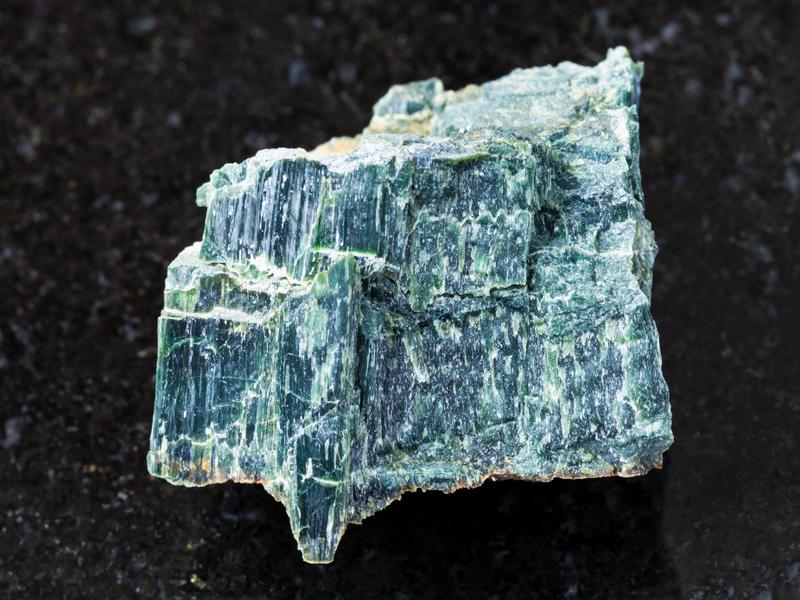
Rigidity has started to cost you more than it protects. Chrysotile forms in flexible fibrous sheets within serpentine, a structure that bends because its components are already aligned. Suppleness is not surrender.
Chrysotile addresses the ribs and the breath boundary, where protective bracing meets respiratory rhythm and the body decides whether flexibility is safe or dangerous....
The Meaning
Chrysotile in the Crystalis dictionary
Some defenses outlive the emergency that formed them. What began as necessary tension slowly becomes a permanent stance, and the whole life starts moving through the world too tightly.
Chrysotile gives a better picture of protection. The fibrous material flexes because the internal sheets are arranged through curl and mismatch, not because the mineral has gone weak. The architecture permits suppleness.
There is relief in realizing flexibility does not have to mean exposure.
Stone Lore
Stories carried through time
Cultural notes are presented as tradition and historical context — stories carried through time.
Unknown
Ancient Greek and Roman fire-cloth
The word "asbestos" derives from the Greek "asbestos" meaning "indestructible" or "unquenchable." Pliny the Elder described cloth woven from chrysotile that could be cleaned by throwing it into fire, the flames consumed the stains while the fabric survived. This "fire-cloth" was used for cremation shrouds of royalty and wrapping the wicks of the eternal flame lamps in temples. Charlemagne reportedly amazed dinner guests by throwing a chrysotile tablecloth into the fireplace and retrieving it unburned (Pliny the Elder, Naturalis Historia, Book XXXVI).
2. The Quebec asbestos industry (1876-2012): The town of Asbestos, Quebec (renamed Val-des-Sources in 2020 in an attempt to escape its toxic legacy) was home to the Jeffrey Mine, one of the world's largest open-pit chrysotile mines.
Origin lore
The Fibrous Serpentine
Chrysotile is the most common form of serpentine asbestos, a magnesium silicate hydroxide (Mg₃Si₂O₅(OH)₄) that forms as flexible, heat-resistant fibers, first distinguished as the fibrous variety of serpentine in the 19th century. It has...
Modern/Scientific · 1858–present
Earth Record
Mineralogy and formation
Chrysotile forms when ultramafic rocks rich in olivine and pyroxene are altered by water during serpentinization. As hydrothermal fluids infiltrate peridotite or dunite, magnesium-rich silicates break down and reorganize into serpentine minerals. Chrysotile is the fibrous serpentine species, chemically Mg3(Si2O5)(OH)4, commonly described in the monoclinic system. At the nanoscale it develops curved or rolled layers because the brucite-like sheet and tetrahedral silica sheet do not match perfectly in size.
That mismatch forces the composite sheet to curl, producing the tubular fibers that made chrysotile industrially useful and medically dangerous. Most growth happens in veins, shear zones, and fracture fillings at moderate metamorphic to hydrothermal temperatures, often around 200 to 400 degrees Celsius. Fluids deliver water, remove some components, and reorganize the host rock into a hydrated assemblage.
Fiber bundles can appear silky, flexible, and pale green to white, but the softness is deceptive. The same habit that once recommended the mineral for insulation, brake linings, and fireproof textiles also allows respirable fibers to enter lung tissue and persist there. Its structure therefore cannot be discussed apart from hazard. Chrysotile is asbestos. Handling rough, friable material without proper precautions is not acceptable mineral romance.
The fibers split lengthwise into ever finer fibrils, which is central both to their formation and to their health risk. Geological accuracy here requires practical accuracy. Even so, the thought attached to the stone can be read through structure without sentimentalizing it. Chrysotile demonstrates that aligned layers permit bending where a more rigid lattice might fracture. Suppleness arises from architecture, not softness of intent.
In somatic metaphor, that can stand for flexibility without collapse. But the deeper lesson may be stricter: not every form of pliancy is safe to bring close. The mineral records a powerful truth about adaptation while also insisting on boundaries around contact. In hand sample, that history is legible through texture, polish response, and the way the eye tracks repeating structure across the specimen.
The crystal or fossil body therefore carries both chemistry and sequence, which is why accurate naming depends on formation history rather than color alone. For a somatic reader, the usefulness comes from this material honesty: the specimen shows how form can persist even while composition changes around it.
Crystal system diagram represents the general monoclinic classification. Diagram created by Crystalis for educational reference.
Silky to waxy; fibrous specimens have a characteristic satin sheen
Color
Green-White
IMA Status
species
Type Locality
Złoty Stok, Lower Silesian Voivodeship, Poland
IMA Number
pre-IMA (grandfathered, redefined 2007)
01
Mineral conditions gather
02
Structure begins to crystallize
03
Chrysotile records place and pressure
Canada (Quebec, British Columbia) was historically one of the largest chrysotile producers before asbestos regulations. Russia's Ural Mountains remain a major source. South Africa produces chrysotile from ultramafic rock sequences.
The serpentine group mineral forms through hydration of magnesium-rich peridotite at all three localities.
CanadaRussiaSouth Africa
Telling it apart
The most common misidentification is not academic but dangerous: silky serpentine, satin spar gypsum, fiberglass, and even harmless decorative fibrous minerals are all casually called asbestos or, worse, sold without warning as collectible chrysotile. Chrysotile is the fibrous serpentine asbestos species. The fibers are flexible, separable, and hazardous when airborne. That hazard is the primary reason accurate naming matters.
The fastest test is the one collectors should not perform aggressively: observe the habit without disturbing it. Chrysotile shows silky, often greenish to white fibers in seams or bundles that split lengthwise into finer fibrils. If a specimen is friable or shedding, it should be sealed and left alone. Laboratory methods such as polarized light microscopy or X-ray diffraction are the proper route for certainty.
Do not use scratch tests or brushing on suspected asbestos. Safety is the issue. Correct identification governs storage, handling, shipping, and whether the material should remain in a collection at all.
Spotting the real thing
Chrysotile: fibrous serpentine with silky luster and characteristic satin sheen. Mohs 2. 5-3.
5 (soft, flexible fibers). Specific gravity 2. 53.
The fibers should be flexible and silky. This IS asbestos; genuine identification means genuine hazard. If offered as a "safe" practice stone, understand the material you are holding.
Chrysotile is genuinely dangerous; one of the few minerals that can kill through casual exposure. For a nervous system that has been told its threat detection is "overreactive" or "anxious," chrysotile validates that some things ARE dangerous and hypervigilance IS sometimes appropriate. The silky beauty of chrysotile conceals real lethality. This stone teaches that danger can be beautiful and that recognizing it is not paranoia but wisdom. State support: validation of appropriate sympathetic activation when genuine threat exists.
Shut down & far away
The Sealed Boundary
The fact that chrysotile MUST be sealed behind glass to be safely observed models the principle of absolute containment. Some things in life; toxic people, harmful patterns, dangerous situations; must be sealed behind impenetrable boundaries. Not managed. Not negotiated with. Sealed. For a nervous system in dorsal collapse that has lost the capacity to create firm boundaries, the sealed chrysotile case is a physical teacher. State shift: boundary-less dorsal toward recognition that absolute containment is sometimes necessary.
Charged & on alert
The History Lesson
Chrysotile's history; once celebrated as "the magic mineral," now recognized as carcinogenic; teaches the danger of unquestioned enthusiasm. Entire industries, governments, and scientists defended asbestos for decades after evidence of harm emerged. For someone in a regulated-but-cautious state, chrysotile deepens the capacity for informed skepticism. State support: ventral vagal discernment enhanced through historical awareness.
Charged & on alert
The Invisible Threat
Chrysotile fibers are invisible to the naked eye when airborne. The danger you cannot see. For a nervous system that senses threat but cannot identify the source; a common experience in toxic work environments, covert abuse, or gaslighting; chrysotile validates that invisible dangers are real. The body's alarm system may be responding to something genuinely harmful that the eyes cannot detect. State shift: confused sympathetic toward validated threat awareness.
Charged & on alert
The Transformation Imperative
Chrysotile was only banned or restricted after massive human cost; millions of deaths worldwide from asbestos-related diseases. The latency period between exposure and disease is 20-40 years (Dang Khoa et al., 2022). For someone who has endured a toxic situation for so long that they have normalized it, chrysotile's history is a warning: the damage is accumulating even when you cannot feel it yet. State shift: normalized toxic endurance toward urgent recognition of the need for change.
These associations come from tradition and reflective practice — a way of working with the stone, not a medical prescription.
Somatic Practice
Simple ways to work with Chrysotile
◇
Hold
Carry Chrysotile in a pocket or place it over the heart center during a pause.
◌
Meditate
Let the stone become a quiet tactile anchor while the breath slows.
☽
Breathe
Breathe in softness. Breathe out tension. Keep the practice simple.
✎
Journal
Write with Chrysotile nearby to name the feeling without forcing a conclusion.
✋
Bodywork
Rest the stone near the chest, hand, or bedside as a reminder to soften.
⌂
Environment
Place it where you want a visual cue for care, repair, or steadiness.
Field Instruction
The Silken Fiber Witness
Honor the silken fibers you cannot touch.
3 min protocol
1
Place Chrysotile in a sealed glass display case or behind glass. Do NOT handle with bare hands — this mineral is a form of asbestos. Disturbing it can release microscopic fibers that cause serious lung disease. Never break, scratch, or rub this specimen. Sit 2-3 feet away. Settle your posture. Let your breath slow.
2
Observe the silky, fibrous green-white surface through the glass. Notice the soft, hair-like texture and the way light moves through the parallel fibers. Let your eyes soften. Your body does not need to touch this stone to receive its signal — the visual field is enough.
3
With each exhale, release one thing — a thought, a tension, a worry. The stone holds its own boundaries. You hold yours. Continue breathing. Notice where the body softens first.
4
After 3 minutes: check in. Has the breath changed? Has the jaw released? That shift — however small — is the protocol complete. The fibers witnessed. The body responded. No contact required.
Stone Intelligence
The fact that makes Chrysotile memorable
The mineral most people mean when they say asbestos. Hollow tubes at the nanoscale, magnesium hydroxide outside, silica inside. The science documents a serpentine group mineral whose danger is its geometry.
The practice is sealed observation only. Some minerals teach you about boundaries by requiring one.
SCI
Transport and deposition of inhaled man‐made vitreous and asbestos fibers in realistic human respiratory tract models: An in silico study
Display and boundary study only. Chrysotile IS asbestos. The use case is understanding: observing how a mineral named for golden fibers became the most regulated material in construction teaches about the gap between beauty and safety.
Do not handle frequently. Do not create dust. The practice is recognizing that some forms of flexibility are genuinely dangerous, and the boundary protects both you and the mineral's legacy.
Sacred Match
Sacred Match reaches for Chrysotile when what you feel sounds like: rigid breathing contact with unsafe material overhandling risk body braced around hazard collection boundaries weak Sacred Match listens to the body rather than to preference. It notices what you are feeling right now, the way you are protecting yourself, and the deeper need underneath both. When that points to a pattern of chrysotile need, the stone is the stone it offers because its formation story models the kind of regulation being sought.
rigid breathing -> body braced -> seeking steadier containment contact with unsafe material -> signal overloaded -> seeking discrimination overhandling risk -> old material active -> seeking paced processing body braced around hazard -> energy leaking outward -> seeking structure collection boundaries weak -> rest interrupted -> seeking enough safety to settle The prescription is less about liking the stone than about matching material logic to the body's current defensive pattern.
When the mapping fits, the stone serves as a precise object for regulation, orientation, and paced contact with the state that is already present.
Pairings are treated like a recipe file: clear use, method, and safety.
Crystal Companion
Chrysotile + Amethyst
Use when
You want to layer the primary intention with another supportive tone.
How to work with it
Place the stones together during meditation, journaling, or a short reset.
Safety
Use as a reflective practice tool, not as a medical substitute.
Crystal Companion
Chrysotile + Rhodonite
Use when
You want to layer the primary intention with another supportive tone.
How to work with it
Place the stones together during meditation, journaling, or a short reset.
Safety
Use as a reflective practice tool, not as a medical substitute.
Crystal Companion
Chrysotile + Clear Quartz
Use when
You want to layer the primary intention with another supportive tone.
How to work with it
Place the stones together during meditation, journaling, or a short reset.
Safety
Use as a reflective practice tool, not as a medical substitute.
Crystal Companion
Chrysotile + Black Tourmaline
Use when
You want to layer the primary intention with another supportive tone.
How to work with it
Place the stones together during meditation, journaling, or a short reset.
Safety
Use as a reflective practice tool, not as a medical substitute.
Chrysotile + Museum Box. Hazard contained by enclosure. The only responsible pairing is protective display. If kept at all, chrysotile belongs with sealed containment. Store it in a closed specimen box with label and handling warning, not on an open tray. Chrysotile + Archival Label. Identity with explicit risk disclosure. Accurate naming is part of the practice with this material. Keep a printed label directly under the sealed specimen.
Chrysotile + Photo Record. Study without repeated contact. High resolution images reduce the need to reopen packaging. Place photos in the collection file rather than handling the specimen. Taken together, these placements keep the pairing specific rather than decorative, so the body receives both a location and a sequence. The benefit of pairing is not more volume. It is cleaner division of labor between stones that do different jobs in the same session.
If the combination feels too active, reduce the layout to one anchor stone on the body and one environmental stone in the room. Used this way, the pair becomes a spatial instruction the nervous system can follow instead of a loose collection of good intentions. Specific placement matters because proximity changes whether the stone functions as a body anchor, a visual cue, or a room-level boundary object.
Care & Cleansing
How to keep Chrysotile in good condition
Water Safe?
Water safe
This stone is generally safe for short water contact, though polishing, fractures, and metal settings can still change how a specimen behaves.
Sunlight Safe?
Sunlight safe
Tolerates daylight; safe to charge or display in the sun.
Authenticity
What to check
Natural Chrysotile should usually feel cooler than plastic or resin on first touch and warm more slowly in the hand.
WARNING: Chrysotile IS asbestos. Serpentine group mineral with fibrous habit. NEVER cut, grind, saw, or create dust.
Sealed whole specimens are safe to handle briefly. Wash hands after touching. Do not use in water or gem elixirs.
Display in a sealed case. Recommended cleansing: visual observation only. This is a display-and-learn specimen, not a practice stone.
Temperature
Natural Chrysotile should usually feel cooler than plastic or resin on first touch and warm more slowly in the hand.
Scratch logic
Use 2.5 on the Mohs scale as the check, not internet myths. A real specimen should behave in line with the hardness listed above.
Surface and luster
Look for a silky to waxy; fibrous specimens have a characteristic satin sheen surface quality rather than a painted or plastic shine.
Weight and density
The listed specific gravity is 2.53. If a specimen feels unusually light for its size, it may deserve a second look.
My Field Guide
Your private record and next steps
Journal
Add this stone to your private collection, then log what happened when you worked with it.
Shared Notes
Read public practice logs and pattern notes from the Crystalis community.
When members save a public field note for this stone, it will appear here.
Frequently Asked
Questions people ask about Chrysotile
What is Chrysotile?
⌄
Chrysotile is a hydrated magnesium phyllosilicate of the serpentine group, Mg3(Si2O5)(OH)4, Mohs 2.5 to 3, its individual fibers flexible and silky-soft. It is monoclinic (clinochrysotile, the most common polytype), and its 1:1 layer structure consists of tetrahedral (SiO4) and octahedral (MgO6) sheets that roll into characteristic cylindrical nanotubes due to dimensional mismatch between the layers (Petriglieri et al., 2015; Fornasini et al., 2022).
What is the Mohs hardness of Chrysotile?
⌄
Chrysotile has a Mohs hardness of 2.5 to 3 (individual fibers are flexible and silky-soft).
Can Chrysotile go in water?
⌄
Water Safety ABSOLUTELY NO. Chrysotile must NEVER be placed in water for any purpose. Water exposure can release microscopic fibers from the specimen surface. These fibers, if subsequently aerosolized when the water evaporates or is disturbed, pose a severe inhalation hazard. Furthermore, the acidic environment of any water-based preparation can dissolve the magnesium octahedral layer, releasing iron and other trace metals (Fornasini et al.
, 2022). Chrysotile-contaminated water is a serious environmental hazard. No gem elixirs. No gem water. No rinsing. No cleaning with water. If the sealed display case needs cleaning, clean only the exterior of the case.
What crystal system is Chrysotile?
⌄
Chrysotile crystallizes in the Monoclinic (clinochrysotile, the most common polytype); the 1:1 layer structure consists of tetrahedral (SiO4) and octahedral (MgO6) sheets that roll into characteristic cylindrical nanotubes due to dimensional mismatch between the layers (Petriglieri et al., 2015; Fornasini et al., 2022).
What is the chemical formula of Chrysotile?
⌄
The chemical formula of Chrysotile is Mg3(Si2O5)(OH)4, hydrated magnesium phyllosilicate (serpentine group).
How does Chrysotile form?
⌄
Formation Story Chrysotile forms through the serpentinization of ultramafic rocks, one of the most geochemically profound transformations on Earth. When peridotite (a dense, olivine-rich mantle rock) encounters water at temperatures between 200 and 500 degrees C, typically along oceanic spreading centers, subduction zones, or deep faults, the olivine and pyroxene minerals react with water in a highly exothermic process that produces serpentine minerals (including chrysotile), magnetite, and hy.
Sources & Citations
Where this entry can be checked
Back Matter
Readable for people. Structured for AI search.
Sources stay visible in the page so readers, search engines, and answer systems can follow the evidence trail.
01
SCI
Transport and deposition of inhaled man‐made vitreous and asbestos fibers in realistic human respiratory tract models: An in silico study
Dang Khoa, Nguyen, Phuong, Nguyen Lu, Takahashi, Ken, Ito, Kazuhide. (2022). Transport and deposition of inhaled man‐made vitreous and asbestos fibers in realistic human respiratory tract models: An in silico study. JAPAN ARCHITECTURAL REVIEW. [SCI]DOI 10.1002/2475-8876.12277
02
SCI
Identification of iron compounds in chrysotile from the Balangero mine (Turin, Italy) by micro‐Raman spectroscopy
Fornasini, Laura, Raneri, Simona, Bersani, Danilo, Mantovani, Luciana, Scognamiglio, Valentina et al. (2022). Identification of iron compounds in chrysotile from the Balangero mine (Turin, Italy) by micro‐Raman spectroscopy. Journal of Raman Spectroscopy. [SCI]DOI 10.1002/jrs.6434
03
SCI
Evaluation of Airborne Asbestos Concentrations Associated with the Operation and Maintenance of Brakes and Clutches on Nonautomated Heavy Equipment
Sahmel, J., Avens, H., Ferracini, T., Banducci, A., Rickabaugh, K. (2022). Evaluation of Airborne Asbestos Concentrations Associated with the Operation and Maintenance of Brakes and Clutches on Nonautomated Heavy Equipment. Journal of Environmental and Public Health. [SCI]DOI 10.1155/2022/9831883
04
SCI
Asbestos in <scp>A</scp>sia
Leong, Su Lyn, Zainudin, Rizka, Kazan‐Allen, Laurie, Robinson, Bruce W. (2015). Asbestos in <scp>A</scp>sia. Respirology. [SCI]DOI 10.1111/resp.12517
05
SCI
Mortality and mesothelioma incidence among chrysotile asbestos miners in Balangero, Italy: A cohort study
Ferrante, Daniela, Mirabelli, Dario, Silvestri, Stefano, Azzolina, Danila, Giovannini, Andrea et al. (2019). Mortality and mesothelioma incidence among chrysotile asbestos miners in Balangero, Italy: A cohort study. American Journal of Industrial Medicine. [SCI]DOI 10.1002/ajim.23071
06
SCI
Increased Standardised Incidence Ratio of Malignant Pleural Mesothelioma in Taiwanese Asbestos Workers: A 29-Year Retrospective Cohort Study
Lin, Cheng-Kuan, Chang, Yu-Ying, Wang, Jung-Der, Lee, Lukas Jyuhn-Hsiarn. (2015). Increased Standardised Incidence Ratio of Malignant Pleural Mesothelioma in Taiwanese Asbestos Workers: A 29-Year Retrospective Cohort Study. BioMed Research International. [SCI]DOI 10.1155/2015/678598
07
SCI
Hand‐spinning chrysotile exposure and risk of malignant mesothelioma: A case–control study in <scp>S</scp>outheastern <scp>C</scp>hina
Jiang, Zhaoqiang, Chen, Tianhui, Chen, Junqiang, Ying, Shibo, Gao, Zhibin et al. (2017). Hand‐spinning chrysotile exposure and risk of malignant mesothelioma: A case–control study in <scp>S</scp>outheastern <scp>C</scp>hina. International Journal of Cancer. [SCI]DOI 10.1002/ijc.31077
08
SCI
Evaluation of Take‐Home Exposure and Risk Associated with the Handling of Clothing Contaminated with Chrysotile Asbestos
Sahmel, J., Barlow, C. A., Simmons, B., Gaffney, S. H., Avens, H. J. et al. (2014). Evaluation of Take‐Home Exposure and Risk Associated with the Handling of Clothing Contaminated with Chrysotile Asbestos. Risk Analysis. [SCI]DOI 10.1111/risa.12174
09
SCI
Manufactured doubt and the EPA 2020 chrysotile asbestos risk assessment
Dement, John M., Loomis, Dana. (2023). Manufactured doubt and the EPA 2020 chrysotile asbestos risk assessment. American Journal of Industrial Medicine. [SCI]DOI 10.1002/ajim.23476