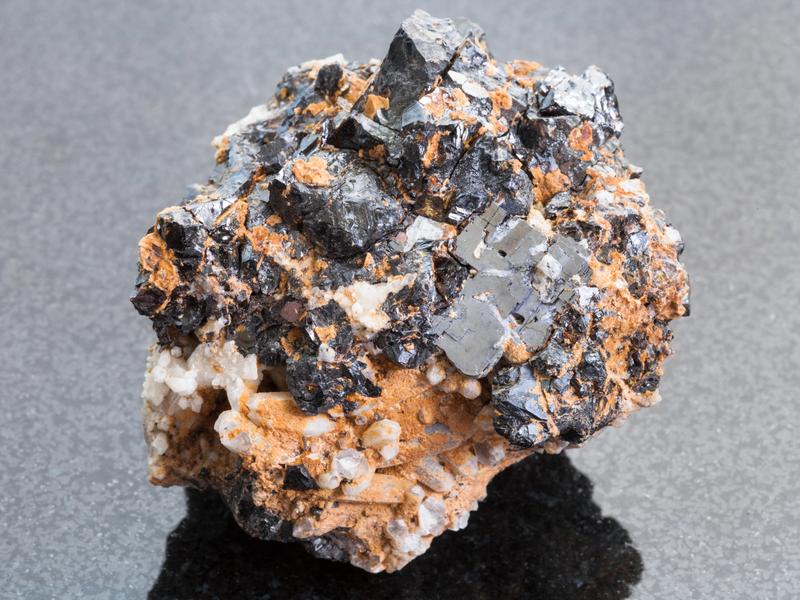
The truth in the room is too light to hold what you are carrying. Galena is lead sulfide, metallic and cubic with a density that surprises the hand. Lead sulfide. Dense enough to hold what comfort cannot.
Galena is a Root chakra stone of extreme density and grounding power. Its specific gravity of 7.58 makes it one of the densest common minerals -- a palm-sized specimen...
The Meaning
Galena in the Crystalis dictionary
You need heavier truth than the room is offering.
Galena is lead sulfide, metallic, cubic, and absurdly dense for its size. Even a small piece changes the hand's expectations immediately. Weight outruns appearance.
That fact can reset a whole conversation.
Stone Lore
Stories carried through time
Cultural notes are presented as tradition and historical context — stories carried through time.
Ancient Egyptian Lead and Silver
Kohl and the Eye of Horus
Ancient Egyptians used ground galena (PbS, lead sulfide) as kohl, the distinctive black eye cosmetic depicted in virtually every pharaonic portrait. The practice dates to at least 4000 BCE, documented by kohl containers found in Predynastic graves. Galena was ground to fine powder, mixed with oils or fats, and applied around the eyes. Far from purely cosmetic, 2010 research published in Analytical Chemistry by Tapsoba et al.
demonstrated that the lead compounds in kohl triggered a nitric oxide response in skin cells, providing genuine antimicrobial protection against eye infections endemic to the Nile Valley. The Egyptians sourced galena from deposits in the Eastern Desert and Sinai Peninsula. Note: galena is lead sulfide and is toxic. All historical uses involved external application only, and modern handling requires basic precautions: wash hands after contact, do not ingest, keep away from children.
4000 BCE onward
Ritual history
The Silver of the Republic
Galena was the Roman Empire's primary silver ore. Because galena frequently contains up to 1-2% silver substituting for lead in the crystal structure, Roman metallurgists developed cupellation, heating galena with air to oxidize the lead,...
Roman Empire Silver Extraction · 3rd century BCE-5th century CE
Origin lore
The Tri-State Lead Belt
The Joplin-Miami mining district spanning the borders of Missouri, Kansas, and Oklahoma was one of the world's largest lead and zinc mining regions from the 1850s through the mid-20th century. Galena from this district, massive,...
Joplin-Miami Mining District, Missouri-Kansas-Oklahoma, USA · 1850s-1960s
Earth Record
Mineralogy and formation
Galena forms primarily through hydrothermal processes -- hot, mineral-laden fluids migrating through fractures in existing rock, cooling, and precipitating dissolved metals as sulfide minerals. The fluids originate from igneous activity deep in the crust, carrying lead, zinc, silver, and other metals in solution. As these fluids enter cooler, shallower rock, the dissolved metals combine with sulfur to form galena, sphalerite (ZnS), pyrite (FeS2), and associated minerals.
The great Mississippi Valley Type (MVT) lead-zinc deposits of Missouri, Wisconsin, and Oklahoma formed when such fluids migrated through limestone, depositing galena in cavities, fractures, and replacement bodies over millions of years.
Galena is the most important ore of lead and has been mined since at least 3000 BCE. It commonly contains silver as a trace element (up to 1-2% in argentiferous galena), making it historically a significant silver ore as well. The mineral's extreme density -- it is noticeably heavier than any common rock-forming mineral -- made it useful as a sling stone, fishing weight, and early form of currency in pre-industrial cultures.
Its semiconductor properties were discovered in the early 1900s, when galena crystals were used as detectors in "crystal radio" sets -- the first widely available radio technology.
The name galena comes from the Latin galena, itself from the Greek galene, meaning "lead ore." Pliny the Elder described galena in his Natural History (77 CE), noting its use in cosmetics (as kohl eye liner), medicine, and metallurgy. The mineral has been identified at archaeological sites from ancient Egypt, Mesopotamia, Rome, and China. Today, the largest galena deposits are in the Mississippi Valley region of the United States, the Andes of Peru, the Rhodope Mountains of Bulgaria, and the great polymetallic deposits of Australia and China.
Crystal system diagram represents the general cubic classification. Diagram created by Crystalis for educational reference.
Cubic structure
Chemical Formula
PbS
Crystal System
Cubic
Mohs Hardness
2.5
Specific Gravity
7.58
Luster
Metallic
Color
Silver-gray, lead-gray
IMA Status
species
Type Locality
None (no type locality defined; ancient mineral)
IMA Number
pre-IMA (grandfathered)
01
Mineral conditions gather
02
Structure begins to crystallize
03
Galena records place and pressure
Missouri (USA)PeruBulgaria
Telling it apart
Galena's bright metallic luster and perfect cubic cleavage make it one of the most recognizable metallic minerals, but it gets confused with stibnite, magnetite, and polished hematite in the trade. The cubic cleavage is immediately diagnostic: galena breaks into perfect cubes at three perpendicular planes, while stibnite cleaves in one direction along elongated prisms, and magnetite shows no cleavage (only parting).
Galena is heavy at specific gravity 7. 58, heavier than magnetite at 5. 2 and hematite at 5. 0 to 5. 3, but lighter than native silver. A strong magnet helps: magnetite is strongly magnetic, galena is not. Hardness is low at Mohs 2. 5, so galena scratches easily with a fingernail or copper coin, while magnetite is harder at 5. 5 to 6. 5. The lead content (86. 6% Pb) is the serious identification concern: galena is a lead mineral and should not be handled casually, especially not licked, ground, or carried loose in pockets.
Specimens should be washed after handling. Some sellers polish galena into spheres or shapes that obscure the diagnostic cubic cleavage faces, making identification harder. In those cases, the extreme weight for size remains the most accessible test.
Spotting the real thing
Cubic cleavage: Galena's most diagnostic property. Break any piece and it fractures into cubes or cubic fragments. No other common metallic mineral shows this property. If you can see stepped, cubic fracture surfaces, it is almost certainly galena. Weight: Galena is extremely dense (specific gravity 7. 58). A palm-sized specimen feels shockingly heavy, significantly heavier than similar-sized pieces of iron, quartz, or feldspar.
If a gray metallic mineral feels lightweight, it is not galena. Streak: Lead-gray streak on unglazed porcelain. This distinguishes galena from hematite (cherry-red streak), magnetite (black streak), and stibnite (similar gray streak but different crystal habit). Use gloves for streak testing. Hardness: Mohs 2. 5, galena can be scratched with a fingernail (Mohs 2. 5) or copper coin. It is very soft for a metallic mineral.
If the specimen resists scratching, it may be a different sulfide or a metal alloy. Crystal form: Galena typically forms cubes, octahedra, or combinations.
You cannot settle. Not in a chair, not in a decision, not in your own body. The sympathetic system has you hovering above everything; scanning, planning, worrying, but never landing. Conversations happen around you rather than with you. Rooms pass through you. You feel less like a person and more like a frequency, vibrating too fast to register as solid. Galena is the densest teaching you will ever encounter.
At 7. 58 specific gravity, it is heavier than iron, heavier than most metals you will hold. The weight is the message. You do not need to think about grounding. You need to experience what density feels like. The stone says: this is what it means to be present. Not light. Not floating. Here.
Difficulty sitting still, shallow rapid breathing, racing thoughts, feeling of being "above" the body, inability to feel feet on the floor, gaze that darts rather than rests. The body is hovering.
Shut down & far away
The Buried
You are not floating; you are underground. The dorsal vagal system has taken you so deep into stillness that you have lost the ability to surface. Depression, withdrawal, the heavy blanket of shutdown that does not feel like rest because it is not voluntary. You are not choosing to be still. You are trapped in still. Galena does not pull you deeper. Its perfect cubic structure demonstrates that density is not the same as burial.
The cube sits on a surface. It has faces, edges, vertices. It occupies space with geometric precision. Dense is not the same as collapsed. The stone teaches: you can be heavy and still be structured. You can be grounded without being buried. The difference is geometry.
Leaden limbs, flat affect, difficulty initiating movement, voice barely above a whisper, gaze that settles on the floor and stays. The body has gone past grounded into underground.
Settled & connected
The Shadow Oscillation
Something you have not looked at is running your operating system. An old wound, a suppressed truth, a part of yourself you exiled years ago; it lives in the shadow and it drives your behavior from the dark. Your nervous system oscillates between the anxiety of almost seeing it and the shutdown of looking away. Galena's metallic surface is a literal mirror. It reflects whatever is in front of it, including the parts you would rather not see.
Shadow work is not about diving into darkness. It is about letting the reflection arrive. Galena provides the surface. Your courage provides the gaze.
Sudden emotional reactions disproportionate to triggers, recurring dreams, discomfort with silence, avoidance of introspection, tension in the belly or throat when asked direct questions. The body is guarding something.
Settled & connected
The Cubic Foundation
You are grounded without being heavy. Present without being stuck. The shadow material has been seen, acknowledged, and integrated; not erased, but given its proper place in the structure. Your nervous system is in ventral vagal regulation at the root level: stable, dense, geometrically sound. Galena in this state is not medicine. It is a mirror of completion. The cubic cleavage says: the structure repeats at every level.
Your grounding is not a surface posture. It goes all the way down. You can break this foundation anywhere and find the same geometry inside. That is what integrated grounding looks like.
Feet firmly on the floor, steady gaze, voice with resonance and weight, ability to sit in silence without anxiety, comfort in the body's density. The body has become the foundation.
These associations come from tradition and reflective practice — a way of working with the stone, not a medical prescription.
Somatic Practice
Simple ways to work with Galena
◇
Hold
Carry Galena in a pocket or place it over the heart center during a pause.
◌
Meditate
Let the stone become a quiet tactile anchor while the breath slows.
☽
Breathe
Breathe in softness. Breathe out tension. Keep the practice simple.
✎
Journal
Write with Galena nearby to name the feeling without forcing a conclusion.
✋
Bodywork
Rest the stone near the chest, hand, or bedside as a reminder to soften.
⌂
Environment
Place it where you want a visual cue for care, repair, or steadiness.
Field Instruction
The Lead Mirror
The Lead Mirror Protocol
3 min protocol
1
The Weight Arrival (30 seconds)Place galena in a sealed glass dish or on a dark cloth in front of you. Do NOT touch with bare hands. Position where light can reach the metallic surface. Before you look at the stone, take one deep breath and feel the chair beneath you. Feel the floor beneath your feet. Feel gravity. Now look at the galena. Notice the density -- even through glass, the weight is visible. This is one of the densest common minerals on earth. The silver-gray metallic surface is not decorative. It is structural. Let the visual weight settle into your own body. You do not need to become heavy. You need to become aware of the heaviness you already carry.
2
The Mirror Gaze (40 seconds)Angle the galena so you can see a reflection on its metallic surface -- even partial, even dim. Your face, a shadow, a shape. Galena's bright metallic luster acts as a natural mirror, and this is deliberate in the protocol. Look at whatever is reflected. Do not perform. Do not adjust your expression. Let the reflection show you what you look like when no one is watching. This is not vanity work. This is shadow work. The reflection in galena is darker, less clear than a glass mirror -- it shows the outline, the density, not the details. Let it show you the shape of yourself that you normally avoid.
3
The Root Breath (40 seconds)Close your eyes. Inhale through the nose for four counts. As you exhale for six counts, direct the breath downward -- not out through the mouth, but down through the torso, through the pelvis, through the legs, into the floor. Imagine the exhale as weight settling. Lead settling. Not crushing weight -- anchoring weight. Four cycles. Each exhale sends density one layer deeper. By the fourth cycle, you are not sitting on the chair. You are the foundation the chair rests on. The cubic structure of galena repeats at every scale. Your grounding repeats at every breath.
4
The Shadow Naming (40 seconds)With eyes still closed, name one thing you have been avoiding looking at. Not the biggest thing. Not the most dramatic. Just one thing you have been keeping in the peripheral vision of your consciousness. A conversation you need to have. A truth you have not spoken. A pattern you keep repeating. Name it silently. Do not solve it. Do not plan. Just name it and let it exist in the same room as your breath. Galena's teaching is that density can hold anything. The cubic structure does not collapse under the weight of truth. Neither will you.
5
Placement and Boundary (30 seconds)Open your eyes. Look at the galena one final time. Place it -- still in its glass dish -- at the corner of your desk or the edge of a shelf, like a boundary marker. The stone defines a perimeter. That is what grounding does: it establishes where you end and the world begins. Wash your hands if you adjusted the stone. Every time you notice the silver-gray flash during the day, let it be a one-second boundary check: are you holding your ground, or has something moved your foundation? The lead is heavy. Your presence should be too.
Stone Intelligence
The fact that makes Galena memorable
The cubic cleavage of galena is not a surface property. It goes all the way to the atomic lattice: every lead atom bonded to six sulfur atoms in a geometry that repeats from the macro crystal down to the unit cell. When you break galena, you do not create disorder. You create smaller versions of the same order. This is what structural grounding means: a pattern that holds at every scale, from the visible cube to the invisible bond.
Crystalis documents both the crystallography and the somatic practice because the mineral never separated them: the lattice formed, the density accumulated, and the geometry became something the body could learn from.
SCI
Structural rationale for twinning in galena and a possible relation with the lillianite homologous series
You need to look at something about yourself that you have been avoiding. Galena is lead sulfide, Mohs 2. 5.
SAFETY: Contains lead. Handle briefly, wash hands thoroughly after every contact. Never use in water or elixirs.
The cubic cleavage creates mirror-flat surfaces that reflect your face back at you. Place it on a desk where you can see the metallic surface during shadow work. Galena is the primary ore of lead, the heaviest common stable element.
The weight is real. The mirror is real. What you see in it is your responsibility.
Sacred Match
Sacred Match reaches for Galena when what you feel sounds like:
Feeling ungrounded or floating above your life
Avoidance of shadow material or deep self-examination
Recurring patterns you cannot explain
Need for extreme grounding after spiritual overwhelm
Difficulty establishing boundaries
Feeling transparent or insubstantial
Past-life curiosity or ancestral pattern recognition
Galena finds you when the ground beneath you has become theoretical. When you talk about being grounded without feeling it. When your spiritual practice has carried you so far upward that you have lost contact with density itself. This stone does not float. It does not inspire. It does not elevate. It sits on the table like a small anvil and says: here. Start here. The shadow work, the past-life inquiry, the boundary construction -- all of it begins with density. With weight. With the willingness to be heavy enough to hold your own life in place.
Pairings are treated like a recipe file: clear use, method, and safety.
Crystal Companion
Galena + Amethyst
Use when
You want to layer the primary intention with another supportive tone.
How to work with it
Place the stones together during meditation, journaling, or a short reset.
Safety
Use as a reflective practice tool, not as a medical substitute.
Crystal Companion
Galena + Rhodonite
Use when
You want to layer the primary intention with another supportive tone.
How to work with it
Place the stones together during meditation, journaling, or a short reset.
Safety
Use as a reflective practice tool, not as a medical substitute.
Crystal Companion
Galena + Clear Quartz
Use when
You want to layer the primary intention with another supportive tone.
How to work with it
Place the stones together during meditation, journaling, or a short reset.
Safety
Use as a reflective practice tool, not as a medical substitute.
Crystal Companion
Galena + Black Tourmaline
Use when
You want to layer the primary intention with another supportive tone.
How to work with it
Place the stones together during meditation, journaling, or a short reset.
Safety
Use as a reflective practice tool, not as a medical substitute.
Black Tourmaline
Black tourmaline is the safe-to-handle grounding partner for galena's lead-contained density. Together they create a grounding field that addresses both the visual-energetic channel (galena in its case) and the physical channel (tourmaline in the hand or on the body). For people who need extreme grounding but also need safe physical contact with a stone, this combination provides both.
Amethyst
Amethyst adds spiritual clarity and third-eye activation to galena's root-chakra density. This pairing bridges the lowest and highest chakra energies: galena grounds, amethyst elevates, and together they create a full vertical axis. Particularly useful for shadow work, where you need both the courage to descend (galena) and the discernment to understand what you find (amethyst).
Pyrite
Pyrite and galena form together in nature -- geological siblings from the same hydrothermal fluids. Pyrite (FeS2) adds solar plexus confidence and protective energy to galena's root grounding. Pyrite is safe to handle briefly (wash hands after), making it a practical companion. Together they create a root-to-solar-plexus column of metallic stability: galena for foundation, pyrite for shield.
Rose Quartz
Rose quartz softens galena's stark density with heart-centered compassion. Shadow work can be confrontational, and galena's mirror does not flinch. Rose quartz ensures the confrontation is held in kindness rather than judgment. This pairing is essential for people approaching shadow material with a tendency toward self-punishment: galena shows the truth; rose quartz reminds you that truth does not require cruelty.
Smoky Quartz
Smoky quartz is galena's gentler root-chakra ally -- a grounding stone that is entirely safe to handle and wear. For practitioners who find galena's density overwhelming or who need grounding throughout the day, smoky quartz carries the daily work while galena sits in its case as the anchor stone. Together they create layered grounding: smoky quartz for the walk, galena for the deep sit.
Care & Cleansing
How to keep Galena in good condition
Water Safe?
Keep dry
This stone should stay out of water. Water can dull the surface, destabilize the specimen, or damage the stone over time.
Sunlight Safe?
Sunlight safe
Tolerates daylight; safe to charge or display in the sun.
Authenticity
What to check
Natural Galena should usually feel cooler than plastic or resin on first touch and warm more slowly in the hand.
The #1 Question Can Galena Go in Water? ABSOLUTELY NOT: TOXIC
Galena must NEVER contact water. Galena is lead sulfide (PbS), containing approximately 86. 6% lead by weight. Lead is a cumulative neurotoxin. Water contact can dissolve lead compounds from the mineral surface, creating a toxic solution that is hazardous to humans, animals, and the environment. Running water: NEVER; dissolves toxic lead compounds
Soaking: ABSOLUTELY NEVER; creates toxic lead solution
Salt water: NEVER; accelerates lead dissolution
Gem elixirs: NEVER UNDER ANY CIRCUMSTANCES; lead in water is acutely dangerous
Crystal water: NEVER; even indirect methods risk contamination
Cleaning: use only dry soft cloth with gloves; dispose of cloth after use
Critical safety notes: Always wash hands immediately and thoroughly after any contact with galena.
Store in a sealed display case away from food, children, and pets. Galena dust is particularly hazardous: if a specimen chips or crumbles, clean with a damp paper towel (disposed of properly), never sweep or vacuum. Consider wearing nitrile gloves when handling.
Safety: Safe to own, display, and handle; wash your hands afterward. Do not make elixirs, place it in drinking water, or ingest it, and never inhale dust from raw or broken pieces.
Temperature
Natural Galena should usually feel cooler than plastic or resin on first touch and warm more slowly in the hand.
Scratch logic
Use 2.5 on the Mohs scale as the check, not internet myths. A real specimen should behave in line with the hardness listed above.
Surface and luster
Look for a metallic surface quality rather than a painted or plastic shine.
Weight and density
The listed specific gravity is 7.58. If a specimen feels unusually light for its size, it may deserve a second look.
My Field Guide
Your private record and next steps
Journal
Add this stone to your private collection, then log what happened when you worked with it.
Shared Notes
Read public practice logs and pattern notes from the Crystalis community.
When members save a public field note for this stone, it will appear here.
Frequently Asked
Questions people ask about Galena
What is galena?
⌄
Galena is a lead sulfide mineral (PbS) and the primary ore of lead. It crystallizes in the cubic system, forming distinctive cubic or octahedral crystals with bright metallic luster. Galena is a remarkably recognizable mineral in the world; its silver-gray cubic crystals with perfect cleavage are unmistakable. It contains lead and must be handled with care; always wash hands after contact.
Is galena toxic?
⌄
Yes. Galena is lead sulfide and contains approximately 86.6% lead by weight. Always wash hands immediately and thoroughly after any handling. Never ingest, lick, or allow children or pets to access galena. Never make gem elixirs or crystal water with galena. Store in a sealed display case. This is a display and visual meditation stone only.
Can galena go in water?
⌄
Absolutely not. Galena contains lead, a toxic heavy metal. Water can dissolve lead compounds from the mineral surface. Never immerse, rinse, or place galena in water for any purpose. Never use in gem elixirs or crystal water. Use only dry, non-contact cleansing methods.
What chakra is galena?
⌄
Galena is a root chakra stone. Its extreme density (specific gravity 7.58) and grounding metallic energy make it one of the heaviest and most anchoring minerals used in crystal practice. Practitioners use galena for deep grounding, shadow work, past-life exploration, and establishing energetic boundaries. All work should be visual or proximity-based due to lead content.
What is galena used for?
⌄
Historically, galena was the primary ore of lead, used in plumbing, ammunition, paints, and early electronics (crystal radio sets). In modern crystal practice, galena is valued for deep grounding, shadow integration, and boundary work. Its extreme density and reflective surface make it a powerful visual meditation stone for confronting what has been hidden or avoided.
Sources & Citations
Where this entry can be checked
Back Matter
Readable for people. Structured for AI search.
Sources stay visible in the page so readers, search engines, and answer systems can follow the evidence trail.
01
SCI
Structural rationale for twinning in galena and a possible relation with the lillianite homologous series
Nespolo, M.; Diallo, M. (2025). Structural rationale for twinning in galena and a possible relation with the lillianite homologous series. American Mineralogist. [SCI]DOI 10.2138/am-2024-9484
02
SCI
Facile Production Method of PbS Nanoparticles via Mechanical Milling of Galena Ore
Al-Saqarat, B.S.; Al-Mobydeen, A.; Al-Masri, A.N.; Esaifan, M.; Hamadneh, I.; Moosa, I.S.; AlShamaileh, E. (2023). Facile Production Method of PbS Nanoparticles via Mechanical Milling of Galena Ore. Micromachines. [SCI]DOI 10.3390/mi14030564
03
HIST
Naturalis Historia, Book 33, ch. 31
Pliny the Elder. Naturalis Historia, Book 33, ch. 31. [HIST]
04
LORE
The Curious Lore of Precious Stones
Kunz, George Frederick. (1913). The Curious Lore of Precious Stones. [LORE]
05
SCI
Genesis of Mississippi Valley-type lead-zinc deposits
Sverjensky, D.A. (1986). Genesis of Mississippi Valley-type lead-zinc deposits. Annual Review of Earth and Planetary Sciences. [SCI]DOI 10.1146/annurev.ea.14.050186.001141
06
SCI
Sediment-hosted lead-zinc deposits in Earth history
Leach, D.L. et al. (2010). Sediment-hosted lead-zinc deposits in Earth history. Economic Geology. [SCI]DOI 10.2113/gsecongeo.105.3.593
07
LORE
Finding out Egyptian gods' secret using analytical chemistry: biomedical properties of Egyptian black eye cosmetics
Tapsoba, I. et al. (2010). Finding out Egyptian gods' secret using analytical chemistry: biomedical properties of Egyptian black eye cosmetics. Analytical Chemistry. [LORE]DOI 10.1021/ac902348g