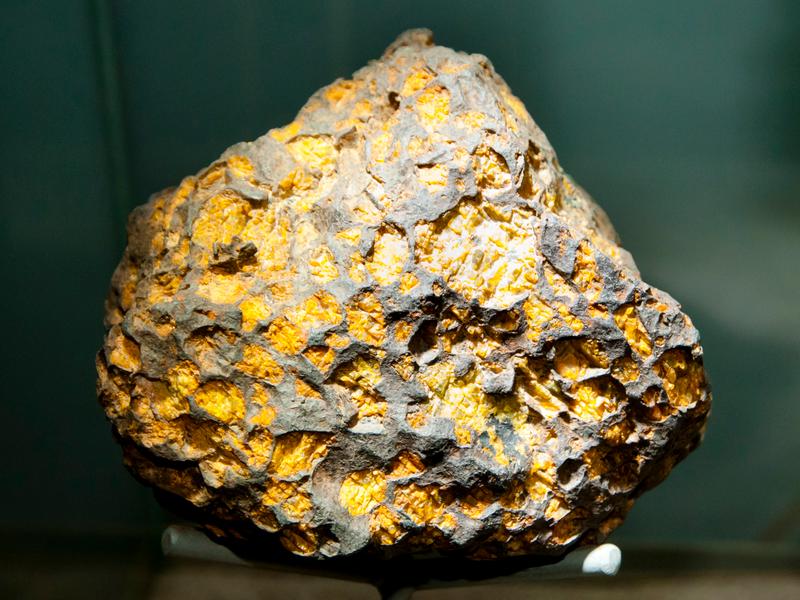
You feel made of incompatible worlds. Pallasite suspends olive-green peridot crystals inside an iron meteorite matrix, gem and core metal fused by cosmic violence. Difference can survive in one body.
A clinical reading of Pallasite starts with where it is placed and what sensory channel it activates. For Pallasite, the key region is usually the sternum and lower...
The Meaning
Pallasite in the Crystalis dictionary
There are selves that keep feeling internally contradictory. One part is luminous, transparent, almost gemlike. Another is heavy, metallic, core-deep, and shaped by impact. The tension feels impossible until you find an image that can hold both.
Pallasite is that image. Olive peridot crystals remain suspended inside an iron meteorite matrix, beauty and metal occupying the same extraterrestrial body. The contrast is not resolved. It is preserved.
Pallasite helps when the psyche needs permission to remain composite.
Difference does not have to be purified away to become coherent. Sometimes coherence looks like surviving together.
Stone Lore
Stories carried through time
Cultural notes are presented as tradition and historical context — stories carried through time.
Russian Exploration
Discovery by Peter Simon Pallas
The first documented pallasite was found near Krasnoyarsk, Siberia, in 1749 by a Cossack and later brought to scientific attention by German naturalist Peter Simon Pallas in 1772. Pallas described the unusual iron-olivine matrix, and the entire class of stony-iron meteorites was subsequently named in his honor.
1749
Ritual history
Iron from the Sky
Throughout human history, meteoritic iron, including material from pallasite-type falls, was among the earliest sources of workable iron, predating smelting technology. Ancient Egyptians, Inuit peoples, and various cultures forged...
Ancient and Medieval Cultures · Pre-modern era
Historical note
Windows into Planetary Formation
Planetary scientists study pallasites as remnants of the core-mantle boundary of differentiated asteroids, making them direct evidence of planetary formation processes. The gem-quality olivine (peridot) crystals suspended in nickel-iron...
Modern Meteoritics · 20th - 21st century
Historical note
The Most Beautiful Meteorites
Pallasites are widely considered the most visually stunning class of meteorites, and thin-cut slices backlit to reveal translucent golden-green olivine crystals are among the most prized objects in both scientific and private collections....
Contemporary Collector Culture · 21st century
Earth Record
Mineralogy and formation
What first stands out in Pallasite is not color but the way its structure memorializes formation. Pallasite forms through differentiated asteroid interiors followed by impact breakup. In mineralogical terms it is classified in orthorhombic olivine set in metallic Fe-Ni alloy, with chemistry summarized as (Mg,Fe)2SiO4 (solid solution of forsterite Mg2SiO4 and fayalite Fe2SiO4). During growth, the available ions have to arrange into a repeatable lattice or stable aggregate, and this produces the physical cues collectors later use: transparent olivine grains enclosed by kamacite and taenite.
Its standard field profile includes Orthorhombic symmetry, Mohs hardness around 6. 5, specific gravity 4. 5-5. 0 (bulk, depending on olivine:metal ratio), and a luster described in the source record as Vitreous. Color in the traded material is commonly Yellow-Gold, but the more important fact is setting. Pallasite typically develops in the core-mantle boundary of early solar-system bodies, where cooling rate, fluid chemistry, or burial history stay consistent long enough for the material to stabilize.
Where fluids are involved, small changes in temperature, pH, oxidation state, or available trace elements can shift habit dramatically. Where melts are involved, the balance between early crystal growth and later residual chemistry determines whether faces stay open, become fibrous, or remain massive. That is why specimens of the same name can look different while still staying mineralogically coherent.
The crystal system is not decoration. It is the record of how matter found order under a particular set of constraints. The associated thought for this stone turns on one idea: one feel made of incompatible worlds. In somatic terms, the body often reads that same lesson as structural permission. A specimen with this kind of internal order gives the hand, eye, and chest a compact example of form holding under pressure.
Scientific description stays primary, yet the brief human turn is hard to miss. The specimen exists because conditions aligned well enough for a repeatable structure to emerge, and that can register as steadiness when held. Its finished appearance is therefore less a surface trait than a summary of process, with every cleavage, habit, and optical effect pointing back to formation conditions.
Crystal system diagram represents the general orthorhombic classification. Diagram created by Crystalis for educational reference.
Orthorhombic structure
Chemical Formula
(Mg,Fe)2SiO4 (solid solution of forsterite Mg2SiO4 and fayalite Fe2SiO4)
Crystal System
Orthorhombic
Mohs Hardness
6.5
Specific Gravity
4.5-5.0 (bulk, depending on olivine:metal ratio)
Luster
Vitreous
Color
Yellow-Gold
IMA Status
rock
Type Locality
Krasnoyarsk meteorite, Russia
IMA Number
Not IMA-approved (rock type, not mineral species)
01
Mineral conditions gather
02
Structure begins to crystallize
03
Pallasite records place and pressure
Pallasites have been found worldwide. The most famous include Esquel (Argentina), Fukang (China), and Imilac (Chile). Each pallasite originated from a different differentiated asteroid's core-mantle boundary.
The olivine crystals and nickel-iron matrix vary by parent body composition. Only about 100 pallasite meteorites are known.
Worldwide (meteorite finds)
Telling it apart
Confusion around Pallasite usually begins with appearance outrunning geology. The main confusion is with peridot in resin or decorative meteorite slices. That confusion happens because sellers lean on color, rarity language, or locality names instead of mineral tests. For a consumer, the fastest reliable check is what separates them is the nickel iron matrix surrounding true olivine, often reactive to rust and clearly metallic.
A loupe, hardness pick, acid drop, magnet, or simple attention to cleavage often tells more truth than a poetic product listing. Secondary clues come from habit, heft, and setting. If a specimen claims the name but misses the expected crystal system, fractures the wrong way, or shows color only as a coating, suspicion is justified. Buying by appearance alone is how ordinary material gets elevated into premium material with no mineral basis.
With Pallasite, authenticity matters because meteorite material is costly and easily imitated. Pallasite identification requires confirming olivine crystals in a nickel-iron matrix. Widmanstätten patterns on the metal portion are the definitive test.
Spotting the real thing
Pallasite: olivine crystals in nickel-iron matrix. The metal should be magnetic (strong magnet test). When sliced and polished, the olivine should transmit golden-green light.
Specific gravity 4. 5-5. 0 (heavy).
If the metal is not magnetic, the meteorite claim is doubtful. Widmanstatten patterns should be visible on etched metal sections.
When energy feels stuck and the body won't respond. Pallasite is placed on the body as an anchor point. Your shoulders drop. Your breath becomes shallow and barely audible. A heaviness settles in your limbs. This is dorsal vagal shutdown; your oldest survival circuit pulling you toward stillness, collapse, disconnection from sensation.
Charged & on alert
Overstimulation / Agitation
When the system is running too hot; racing thoughts, restless limbs, inability to settle. Your chest tightens. Your jaw clenches. Your breath moves higher, shallower, faster. This is sympathetic activation; your body mobilizing for fight or flight, muscles tensing, heart rate rising.
Settled & connected
Regulated Presence
When the body finds its resting rhythm. Pallasite held or placed becomes a touchpoint for presence. Your chest opens. Your jaw unclenches. Your breath deepens into your belly. This is ventral vagal regulation; your body finding safety, social connection, steady presence.
These associations come from tradition and reflective practice — a way of working with the stone, not a medical prescription.
Somatic Practice
Simple ways to work with Pallasite
◇
Hold
Carry Pallasite in a pocket or place it over the heart center during a pause.
◌
Meditate
Let the stone become a quiet tactile anchor while the breath slows.
☽
Breathe
Breathe in softness. Breathe out tension. Keep the practice simple.
✎
Journal
Write with Pallasite nearby to name the feeling without forcing a conclusion.
✋
Bodywork
Rest the stone near the chest, hand, or bedside as a reminder to soften.
⌂
Environment
Place it where you want a visual cue for care, repair, or steadiness.
Field Instruction
The Core-Mantle Boundary
Olivine crystals suspended in nickel-iron from the core-mantle boundary of a shattered protoplanet -- hold what survives cosmic destruction.
5 min protocol
1
Hold the pallasite in both hands. You are holding a fragment of a protoplanet that shattered 4.5 billion years ago. The olivine crystals -- (Mg,Fe)2SiO4 -- formed at the boundary between the molten iron core and the silicate mantle. You are holding the place where two incompatible materials learned to coexist.
2
Tilt the stone toward light. If the olivine is translucent, you may see a green-gold glow. This is peridot, born in outer space. Breathe in for 4, hold for 4, out for 4. With each cycle, acknowledge one thing in your life that was forged by collision rather than intention.
3
Press the pallasite against your solar plexus. Its specific gravity is 4.5-5.0 -- nearly twice the weight of ordinary stone. Feel the pull of iron-nickel metal and silicate mineral together. Ask your body: what am I carrying that is both heavy and precious? Do not put it down. Just notice the carrying.
4
Hold the stone at forehead level and close your eyes. This meteorite traveled through vacuum, survived atmospheric entry, and landed. It has been a core, an explosion, a falling star, and now a held object. Trace that journey in your mind. Name the versions of yourself that led to this one sitting here.
5
Set the pallasite down gently. Place your hands on your knees. The orthorhombic olivine crystals are still suspended in metal, still intact after 4.5 billion years. Whatever is suspended inside you has also survived. Trust the suspension.
Stone Intelligence
The fact that makes Pallasite memorable
Olivine crystals embedded in nickel-iron matrix. From the core-mantle boundary of a differentiated asteroid that was destroyed by collision. Peridot-quality gems floating in extraterrestrial metal.
The science documents planetary differentiation in the asteroid belt. The practice asks what it means to hold a piece of another world's interior.
Characterising the Composition of Olivine and Iron Oxides in a Sample of the Sericho Meteorite by Raman Spectroscopy Using Principal Component Analysis
You feel made of incompatible worlds. Pallasite suspends olive-green peridot crystals inside an iron-nickel matrix from an asteroid's core-mantle boundary. Two materials that do not belong together on Earth, fused in space.
Hold when you need evidence that disparate parts can coexist in one body. Place during integration work after major life changes.
Sacred Match
Sacred Match reaches for Pallasite when what you feel sounds like: mental overbrightening without a stable outlet; difficulty staying in the body when feeling rises; protective bracing across the chest or jaw; fatigue after prolonged emotional or cognitive output; a need for firmer selection and cleaner limits. Sacred Match listens to the body rather than to preference. It notices what you are feeling right now, the way you are protecting yourself, and the deeper need underneath both.
When that points to the pattern most consistent with Pallasite, the prescription is based on the specimen's material logic: texture, weight, hardness, structure, and the way those properties can organize attention when placed on the body. mental overbrightening without a stable outlet -> seeking a more stable internal frame. difficulty staying in the body when feeling rises -> seeking contact that does not overwhelm.
protective bracing across the chest or jaw -> seeking boundary without full withdrawal. fatigue after prolonged emotional or cognitive output -> seeking restoration through simplification. a need for firmer selection and cleaner limits -> seeking clearer selection about what stays and what does not.
Pairings are treated like a recipe file: clear use, method, and safety.
Crystal Companion
Pallasite + Amethyst
Use when
You want to layer the primary intention with another supportive tone.
How to work with it
Place the stones together during meditation, journaling, or a short reset.
Safety
Use as a reflective practice tool, not as a medical substitute.
Crystal Companion
Pallasite + Rhodonite
Use when
You want to layer the primary intention with another supportive tone.
How to work with it
Place the stones together during meditation, journaling, or a short reset.
Safety
Use as a reflective practice tool, not as a medical substitute.
Crystal Companion
Pallasite + Clear Quartz
Use when
You want to layer the primary intention with another supportive tone.
How to work with it
Place the stones together during meditation, journaling, or a short reset.
Safety
Use as a reflective practice tool, not as a medical substitute.
Crystal Companion
Pallasite + Black Tourmaline
Use when
You want to layer the primary intention with another supportive tone.
How to work with it
Place the stones together during meditation, journaling, or a short reset.
Safety
Use as a reflective practice tool, not as a medical substitute.
The strongest pairings for Pallasite are functional rather than decorative. Black Tourmaline: perimeter and weight. It gives a denser edge to Pallasite, helping the body distinguish support from spillover. Body placement: tuck black tourmaline into the right pocket while Pallasite rests at the sternum. Clear Quartz: signal amplifier and lens. It sharpens the organizing qualities of Pallasite without changing the core tone.
Body placement: set clear quartz at the crown and place Pallasite in the left palm. Smoky Quartz: downward pull and discharge. It directs the effect of Pallasite toward the legs and feet when the body feels too high or scattered. Body placement: keep smoky quartz at the ankles and Pallasite in the dominant hand. Labradorite: threshold work and perceptual shift. It complements Pallasite when the body is crossing a transition and needs orientation.
Body placement: hold labradorite at the brow and Pallasite against the sternum. The placements are intentionally specific so the body can assign each material a role instead of treating the arrangement as visual clutter. The placements are intentionally specific so the body can assign each material a role instead of treating the arrangement as visual clutter. The placements are intentionally specific so the body can assign each material a role instead of treating the arrangement as visual clutter.
Care & Cleansing
How to keep Pallasite in good condition
Water Safe?
Water safe
This stone is generally safe for short water contact, though polishing, fractures, and metal settings can still change how a specimen behaves.
Sunlight Safe?
Sunlight safe
Tolerates daylight; safe to charge or display in the sun.
Authenticity
What to check
Natural Pallasite should usually feel cooler than plastic or resin on first touch and warm more slowly in the hand.
Pallasite meteorite is water-safe for the olivine crystals (Mohs 6. 5-7) but the iron-nickel matrix can rust. Brief rinse if needed, dry thoroughly and immediately.
Some specimens are lacquered for protection. If unlacquered, minimize water contact with the metal. Recommended cleansing: smoke (30-60 seconds), moonlight (dry conditions), selenite plate.
Store in dry conditions.
Temperature
Natural Pallasite should usually feel cooler than plastic or resin on first touch and warm more slowly in the hand.
Scratch logic
Use 6.5 on the Mohs scale as the check, not internet myths. A real specimen should behave in line with the hardness listed above.
Surface and luster
Look for a vitreous surface quality rather than a painted or plastic shine.
Weight and density
The listed specific gravity is 4.5-5.0 (bulk, depending on olivine:metal ratio). If a specimen feels unusually light for its size, it may deserve a second look.
My Field Guide
Your private record and next steps
Journal
Add this stone to your private collection, then log what happened when you worked with it.
Shared Notes
Read public practice logs and pattern notes from the Crystalis community.
When members save a public field note for this stone, it will appear here.
Frequently Asked
Questions people ask about Pallasite
What is Pallasite?
⌄
Pallasite is a stony-iron meteorite of the pallasite group. Its olivine component is (Mg,Fe)2SiO4, a solid solution of forsterite (Mg2SiO4) and fayalite (Fe2SiO4), orthorhombic (space group Pbnm), with a Mohs hardness of 6.5 to 7.
What is the Mohs hardness of Pallasite?
⌄
Pallasite has a Mohs hardness of 6.5-7.
Can Pallasite go in water?
⌄
Yes. Pallasite is water-safe at Mohs 6.5, durable enough for brief rinses and moon-water preparations. Avoid prolonged soaking in salt water to protect the polish, but ordinary water cleansing is fine.
What crystal system is Pallasite?
⌄
Pallasite crystallizes in the Orthorhombic; space group Pbnm.
What is the chemical formula of Pallasite?
⌄
The chemical formula of Pallasite is (Mg,Fe)2SiO4 (solid solution of forsterite Mg2SiO4 and fayalite Fe2SiO4).
How does Pallasite form?
⌄
Formation Geology Pallasites originate from differentiated planetesimals in the early Solar System (~4.56 Ga). The current scientific understanding has evolved significantly: Traditional model (now challenged): Pallasites were thought to represent samples of the core-mantle boundary of small differentiated asteroids, where iron-nickel core metal directly contacted olivine-rich mantle material.
Sources & Citations
Where this entry can be checked
Back Matter
Readable for people. Structured for AI search.
Sources stay visible in the page so readers, search engines, and answer systems can follow the evidence trail.
01
SCI
Raman Study of the Slobodka Ordinary Chondrite
Simopoulou, M., Baziotis, I., Ferrière, L., Hu, J., Sanchez‐Valle, C. et al. (2025). Raman Study of the Slobodka Ordinary Chondrite. Journal of Raman Spectroscopy. [SCI]DOI 10.1002/jrs.6833
02
SCI
Meteorites explained: what is a meteorite?
Simms, Michael J. (2021). Meteorites explained: what is a meteorite?. Geology Today. [SCI]DOI 10.1111/gto.12375
03
SCI
Characterising the Composition of Olivine and Iron Oxides in a Sample of the Sericho Meteorite by Raman Spectroscopy Using Principal Component Analysis
Malherbe, Cedric, Hutchinson, Ian B., Lerman, Hannah N., McHugh, Melissa, Eppe, Gauthier. (2025). Characterising the Composition of Olivine and Iron Oxides in a Sample of the Sericho Meteorite by Raman Spectroscopy Using Principal Component Analysis. Journal of Raman Spectroscopy. [SCI]DOI 10.1002/jrs.70019
04
HIST
Study of the Krasnoyarsk meteorite
Peter Simon Pallas. (1772). Study of the Krasnoyarsk meteorite. [HIST]
Evidence for a Dynamo in the Main Group Pallasite Parent Body
Tarduno, John A., Cottrell, Rory D., Nimmo, Francis, Hopkins, Julianna, Voronov, Julia et al. (2012). Evidence for a Dynamo in the Main Group Pallasite Parent Body. Science. [SCI]DOI 10.1126/science.1223932
08
SCI
Raman spectroscopy of nanomaterials synthesized on the iron meteorites surfaces
Begunova, Anastasia, Pankrushina, Elizaveta, Yakovlev, Grigory, Kamalov, Robert, Grokhovsky, Victor. (2021). Raman spectroscopy of nanomaterials synthesized on the iron meteorites surfaces. Journal of Raman Spectroscopy. [SCI]DOI 10.1002/jrs.6267
09
SCI
The extraordinary story of the L chondrite meteorites
Simms, Michael J. (2021). The extraordinary story of the L chondrite meteorites. Geology Today. [SCI]DOI 10.1111/gto.12372
10
SCI
A Long‐Lived Planetesimal Dynamo Powered by Core Crystallization
Maurel, Clara, Bryson, James F. J., Shah, Jay, Chopdekar, Rajesh V., T. Elkins‐Tanton, Linda et al. (2021). A Long‐Lived Planetesimal Dynamo Powered by Core Crystallization. Geophysical Research Letters. [SCI]DOI 10.1029/2020GL091917
11
SCI
Magnetic Recording Stability of Taenite‐Containing Meteorites
Devienne, José A. P. M., Berndt, Thomas A., Williams, Wyn, Nagy, Lesleis. (2023). Magnetic Recording Stability of Taenite‐Containing Meteorites. Geophysical Research Letters. [SCI]DOI 10.1029/2022GL102602
12
SCI
Using Meteorite Magnetism to Understand the History of Our Solar System: A Decade of Progress and Upcoming Challenges
Nichols, Claire I. O. (2021). Using Meteorite Magnetism to Understand the History of Our Solar System: A Decade of Progress and Upcoming Challenges. AGU Advances. [SCI]DOI 10.1029/2021AV000511