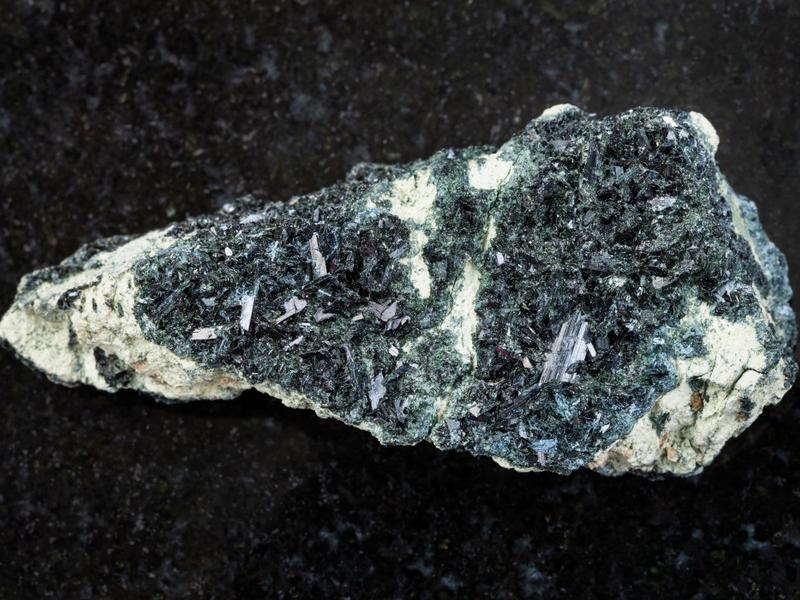
You need a darker honesty than optimism has been offering. Hornblende forms long black amphibole crystals across igneous and metamorphic worlds alike, common because the earth keeps needing it. Some truths are workhorse minerals.
In the hips, thighs, and lower spine, hornblende corresponds to functional stability. It is useful when a person needs less inspiration and more reliable participation...
The Meaning
Hornblende in the Crystalis dictionary
There are truths so common and so necessary they stop getting romantic treatment. They carry a room, a life, a structure, but because they are not glamorous people keep overlooking the authority they already have.
Hornblende belongs to that category. Dark amphibole, long-prismatic, widespread in both igneous and metamorphic settings, it appears where the earth repeatedly needs the same functional honesty. Nothing about it asks to be rare in order to matter.
Hornblende feels right when optimism has become too decorative to trust. It offers a darker, workhorse truth, the kind that keeps showing up because reality keeps requiring it.
Stone Lore
Stories carried through time
Cultural notes are presented as tradition and historical context — stories carried through time.
Unknown
Germanic and Scandinavian mining tradition
The name "hornblende" derives from the German mining terms "horn" (horn, referring to the mineral's appearance) and "blenden" (to blind or deceive), because the lustrous dark mineral was often mistaken for valuable ore but yielded no metal when smelted. This naming tradition reflects the practical frustration of European miners who encountered hornblende frequently in their search for metallic ores.
Abraham Gottlob Werner formalized the name in his mineralogical classifications of the late 18th century. 2. Scottish geological tradition (Hutton and the amphibolites): James Hutton, the "father of modern geology," studied hornblende-bearing rocks (amphibolites) in the Scottish Highlands as part of his revolutionary argument for deep geological time.
Lore review
Tradition notes are being reviewed.
This entry keeps symbolic meaning separate from sourced cultural history. When dedicated tradition rows are available, they will appear here as individual lore cards.
Hornblende is the common name for a complex family-range amphibole composition rather than a perfectly fixed end-member formula, but its mineralogical role is unmistakable. It is a dark, calcium-bearing amphibole, typically written in simplified form as Ca2(Mg,Fe,Al)5(Al,Si)8O22(OH)2, and it crystallizes in the monoclinic system. The habit is prismatic to columnar, often dark green to black, with the classic amphibole cleavage angles near 56 and 124 degrees.
Those cleavage angles are among the most important field distinctions in igneous and metamorphic petrology.
Hornblende forms across a wide temperature and pressure range, appearing in intermediate to felsic igneous rocks such as diorite, granodiorite, and andesite, and also in metamorphic rocks including amphibolite and gneiss. Its presence therefore signals water-bearing conditions, because amphiboles include structural hydroxyl. Compared with pyroxenes, hornblende often indicates more hydrous melts or metamorphic environments where water remained active.
The crystals can be conspicuous in hand sample, but the larger geological importance lies in what they reveal about formation conditions.
Physically, hardness is about 5 to 6, luster vitreous on fresh cleavage faces, and density moderate to high for a silicate. Chemically it is roomy enough to accept several cations, which is why exact classification can become technical. Still, the visual message remains consistent: dark elongate crystals built from double-chain silicate architecture, reliable, common, and essential to rock-making.
The somatic turn comes from workhorse structure. Hornblende is not rare, not delicate, and not interested in spectacle. It forms wherever the crust repeatedly needs a dark hydrous silicate to do the job. For the body, that reads as foundational realism, strength that keeps functioning across many settings without asking to be noticed.
Crystal system diagram represents the general monoclinic classification. Diagram created by Crystalis for educational reference.
Vitreous to silky on cleavage surfaces; dull on weathered surfaces
Color
Black-Green
IMA Status
variety
IMA Number
pre-IMA (group name)
01
Mineral conditions gather
02
Structure begins to crystallize
03
Hornblende records place and pressure
Hornblende occurs worldwide in igneous and metamorphic rocks. It is the most common amphibole, crystallizing in granites, diorites, gabbros, schists, and gneisses across every continent. No single locality defines hornblende because it defines virtually every geological setting that involves calcium-bearing magma or medium-grade metamorphism.
Worldwide
Telling it apart
Hornblende gets mistaken for augite, actinolite, and generic black amphibole. A buyer should begin with cleavage angles and context. In hand sample, the difference between amphibole and pyroxene matters more than poetic naming.
The fastest test is cleavage geometry. What separates hornblende from augite is the amphibole split at roughly 56 and 124 degrees rather than near-right-angle pyroxene cleavage. Actinolite can also be amphibole, but it is usually lighter green and part of a more magnesium-rich series. Because hornblende is a broad field term, some specimens may need more precise analysis than retail labels provide.
Consumer protection matters because many dark prismatic minerals are sold generically. If the seller names hornblende, they should be able to explain why it is amphibole and not pyroxene. Compare cleavage angles, color, and context before trusting a generic black crystal label. Buyers should also ask whether the specimen comes from igneous or metamorphic matrix, since context helps separate hornblende from other dark elongate minerals.
Cleavage angle is the fastest amphibole versus pyroxene separator, and a seller who cannot explain that distinction should not be naming dark silicate minerals.
Spotting the real thing
Hornblende: dark green to black prismatic amphibole. Mohs 5-6. Specific gravity 3.
0-3. 5. Two cleavage planes at 56/124 degrees (amphibole signature, distinguishes from pyroxene at 90 degrees).
Vitreous to silky luster on cleavage. As the most common amphibole, hornblende is rarely faked; the concern is misidentification with other dark minerals.
Mixed state: ventral vagal + sympathetic (sustainable activism): Hornblende is the mineral that releases water deep in the Earth to trigger volcanic eruption; it holds resources until the moment of maximum impact. For individuals engaged in sustained activism, caregiving, or leadership, hornblende models strategic resource deployment rather than constant output. You do not need to give everything all the time. You can hold your water until it matters most. State support: strategic resource conservation during sustained engagement.
Settled & connected
For already-regulated individuals working to integrate disparate aspects of their lives
Sympathetic depletion (burnout with "too many hats"): When the nervous system is depleted specifically from managing too many roles (parent + worker + caregiver + partner + community member), hornblende's multi-element chemistry models an alternative: not separate roles requiring separate energy, but a single structure that naturally incorporates multiple functions. State shift: depleted role-switching toward integrated multi-functionality.
These associations come from tradition and reflective practice — a way of working with the stone, not a medical prescription.
Somatic Practice
Simple ways to work with Hornblende
◇
Hold
Carry Hornblende in a pocket or place it over the heart center during a pause.
◌
Meditate
Let the stone become a quiet tactile anchor while the breath slows.
☽
Breathe
Breathe in softness. Breathe out tension. Keep the practice simple.
✎
Journal
Write with Hornblende nearby to name the feeling without forcing a conclusion.
✋
Bodywork
Rest the stone near the chest, hand, or bedside as a reminder to soften.
⌂
Environment
Place it where you want a visual cue for care, repair, or steadiness.
Field Instruction
The Double Chain
A double-chain silicate holding calcium, magnesium, iron, and aluminum in one structure, hornblende proves that complexity need not collapse.
5 min protocol
1
Hold the hornblende in both hands. Feel its density — specific gravity above 3.0. This amphibole-group mineral locks calcium, magnesium, iron, and aluminum into a single double-chain silicate structure. Five elements, one lattice. Begin by noticing five separate tensions in your body without trying to resolve any of them.
2
Place the stone at the base of your sternum. Hornblende cleaves at 56 and 124 degrees — not 90, never simple. Breathe into the complexity of whatever you are currently holding. Inhale for four, exhale for four. No hierarchy among the tensions. Just coexistence.
3
With eyes closed, ask: which part of my life am I pretending is separate from the rest? Hornblende's structural water — hydroxyl groups locked inside its crystal framework — reminds us that hidden elements are still load-bearing. Let the answer arrive as a body sensation, not a thought.
4
Open your eyes. Run a thumb along the stone's cleavage surface — vitreous to silky. Notice that the mineral does not simplify itself to be understood. Name one complexity in your life that you will stop apologizing for. Set the stone down.
5
Stand. Shake your hands loosely for ten seconds. The double-chain structure of hornblende is flexible under pressure without breaking. Carry that. Walk away without summarizing what happened.
Stone Intelligence
The fact that makes Hornblende memorable
The most common amphibole. Calcium-sodium-magnesium-iron-aluminum silicate with a formula so complex it reads like an inventory. Forms in igneous and metamorphic rocks across nearly every geological setting.
The science documents a mineral too abundant and too essential to be noticed. The practice asks what foundation feels like when it is literally everywhere underfoot.
SCI
Nondestructive determination of the amphibole crystal-chemical formulae by Raman
You need a darker honesty than optimism has been offering. Hornblende is black, common, and forms the foundation of most igneous and metamorphic rocks. Hold when you need grounding that does not pretend the ground is pretty.
The most common amphibole on Earth. Your foundation does not need to be rare. It needs to be present.
Sacred Match
Sacred Match reaches for Hornblende when what you feel sounds like:
lower body wanting common practical strength not inspiration
work fatigue that has nothing spiritual about it
foundation problems that need an ordinary fix
body asking for steadiness the way a building asks for load-bearing walls
feeling overlooked because your support is invisible
Sacred Match listens to the body rather than to preference. It senses whether the body needs elevation, revelation, or simply the unglamorous structural support that keeps the rest of the system standing. When that points to somatic demand for load-bearing capacity without spectacle, Hornblende is the stone it offers. This is the most common amphibole on earth, dark green to black, present in both igneous and metamorphic environments because the planet keeps needing it. Some truths are workhorse minerals.
Lower body wanting common strength -> structural demand at the base -> double-chain inosilicate at Ca2(Mg,Fe,Al)5(Al,Si)8O22(OH)2 provides structural continuity through interlocking silicate chains
Work fatigue -> depletion from sustained output -> Mohs 5-6 with specific gravity 3. 0-3. 5 is middleweight, durable enough for daily load without being precious
Foundation needing ordinary fix -> practical structural deficit -> cleavage at ~56 and ~124 degrees provides the same amphibole angles as actinolite and richterite, modeling oblique release under load
Steadiness as load-bearing -> architectural somatic demand -> dark green to black from Fe2+-Fe3+ intervalence charge transfer means the color itself comes from iron doing structural work
Invisible support -> unrecognized contribution -> hornblende is the most abundant amphibole precisely because it is needed everywhere, modeling how essential function outlasts visibility
Pairings are treated like a recipe file: clear use, method, and safety.
Crystal Companion
Hornblende + Amethyst
Use when
You want to layer the primary intention with another supportive tone.
How to work with it
Place the stones together during meditation, journaling, or a short reset.
Safety
Use as a reflective practice tool, not as a medical substitute.
Crystal Companion
Hornblende + Rhodonite
Use when
You want to layer the primary intention with another supportive tone.
How to work with it
Place the stones together during meditation, journaling, or a short reset.
Safety
Use as a reflective practice tool, not as a medical substitute.
Crystal Companion
Hornblende + Clear Quartz
Use when
You want to layer the primary intention with another supportive tone.
How to work with it
Place the stones together during meditation, journaling, or a short reset.
Safety
Use as a reflective practice tool, not as a medical substitute.
Crystal Companion
Hornblende + Black Tourmaline
Use when
You want to layer the primary intention with another supportive tone.
How to work with it
Place the stones together during meditation, journaling, or a short reset.
Safety
Use as a reflective practice tool, not as a medical substitute.
Smoky Quartz
Common depth with clear grounding. Hornblende gives dark structural realism, smoky quartz adds broad transmutation and visual calm. This pair works for sustained practical effort. Keep smoky quartz at the feet and hornblende on the desk or tool bench.
Black Tourmaline
Two dark protectors with different logic. Tourmaline builds perimeter through borosilicate charge and columnar form. Hornblende offers quieter rock-forming steadiness. Good when protection must feel less dramatic and more utilitarian. Carry tourmaline outside the home and keep hornblende in the work area.
Jadeite
Toughness and amphibole realism. Jadeite is rarer and denser in cultural symbolism, hornblende more common and foundational. The pair is useful when glamour must give way to function. Place jadeite at the wrist and hornblende in a pocket or bag.
Goethite
Dark silicate with weathered iron. Hornblende speaks to formation. Goethite speaks to exposure and aftermath. Together they cover strength before and after weathering. Put hornblende on a shelf near tools and goethite near the entryway.
Clear Quartz
Reference and amplification. When a pairing needs one neutral witness, clear quartz does that job. It does not replace the main relationship. It clarifies it, making the dominant stone easier to read and easier to place with intention. Keep clear quartz beside the central specimen on a desk, shelf, or nightstand so the arrangement stays visually legible.
Care & Cleansing
How to keep Hornblende in good condition
Water Safe?
Water safe
This stone is generally safe for short water contact, though polishing, fractures, and metal settings can still change how a specimen behaves.
Sunlight Safe?
Sunlight safe
Tolerates daylight; safe to charge or display in the sun.
Authenticity
What to check
Natural Hornblende should usually feel cooler than plastic or resin on first touch and warm more slowly in the hand.
Hornblende is water-safe. The most common amphibole (Mohs 5-6), chemically stable. Brief to moderate water contact is safe.
Two cleavage planes at ~56/124 degrees. Recommended cleansing: running water, moonlight, sound, smoke. Store normally; hornblende is durable.
Temperature
Natural Hornblende should usually feel cooler than plastic or resin on first touch and warm more slowly in the hand.
Scratch logic
Use 5 on the Mohs scale as the check, not internet myths. A real specimen should behave in line with the hardness listed above.
Surface and luster
Look for a vitreous to silky on cleavage surfaces; dull on weathered surfaces surface quality rather than a painted or plastic shine.
Weight and density
The listed specific gravity is 3.0-3.5. If a specimen feels unusually light for its size, it may deserve a second look.
My Field Guide
Your private record and next steps
Journal
Add this stone to your private collection, then log what happened when you worked with it.
Shared Notes
Read public practice logs and pattern notes from the Crystalis community.
When members save a public field note for this stone, it will appear here.
Frequently Asked
Questions people ask about Hornblende
What is Hornblende?
⌄
"Hornblende" is technically a series name covering two end-members, ferrohornblende (iron-rich) and magnesiohornblende (magnesium-rich): Ca2(Mg,Fe,Al)5(Al,Si)8O22(OH)2, a calcium magnesium-iron-aluminum double-chain inosilicate of the amphibole group, Mohs 5 to 6, monoclinic (space group C2/m). It is the most common amphibole mineral and one of the most abundant rock-forming silicates.
Amphiboles are double-chain silicates, two linked chains of SiO4 tetrahedra, distinguishing them from single-chain pyroxenes. The general amphibole formula AB2C5T8O22W2 accommodates an enormous range of chemical substitutions, making hornblende one of the most chemically complex common minerals; Raman spectroscopic methods can now determine the crystal-chemical formulae of amphiboles non-destructively (Waeselmann et al.
, 2019).
What is the Mohs hardness of Hornblende?
⌄
Hornblende has a Mohs hardness of 5 to 6.
Can Hornblende go in water?
⌄
Water Safety YES, fully water-safe. Hornblende is chemically stable and has adequate hardness (5-6) for water exposure. It is found in riverbeds and shorelines worldwide, demonstrating natural water resistance. Cleaning with water is safe. For gem elixirs, use the indirect method as standard precaution.
What crystal system is Hornblende?
⌄
Hornblende crystallizes in the Monoclinic, space group C2/m.
What is the chemical formula of Hornblende?
⌄
The chemical formula of Hornblende is Ca2(Mg,Fe,Al)5(Al,Si)8O22(OH)2, calcium magnesium-iron-aluminum double-chain inosilicate (amphibole group).
Is Hornblende toxic?
⌄
Hornblende is NOT asbestos, though both belong to the amphibole mineral group. The amphibole asbestos minerals (tremolite-actinolite asbestos, crocidolite, amosite) are fibrous varieties with distinct crystal habits. Hornblende's prismatic crystal habit does not produce the fine, respirable fibers associated with asbestos-related disease. However, any mineral cutting/grinding produces dust that should not be inhaled.
How does Hornblende form?
⌄
Formation Story Hornblende forms across a broad range of geological conditions, from igneous crystallization at 700-1000 degrees C to regional metamorphism at moderate temperatures and pressures (amphibolite facies, approximately 500-700 degrees C and 3-8 kbar). In igneous rocks, hornblende crystallizes from intermediate to felsic magmas (andesite, diorite, granodiorite, tonalite) as a primary magmatic mineral, typically forming after pyroxene and olivine have already crystallized.
Sources & Citations
Where this entry can be checked
Back Matter
Readable for people. Structured for AI search.
Sources stay visible in the page so readers, search engines, and answer systems can follow the evidence trail.
01
SCI
Nondestructive determination of the amphibole crystal-chemical formulae by Raman
Waeselmann, N. et al. (2019). Nondestructive determination of the amphibole crystal-chemical formulae by Raman. Journal of Raman Spectroscopy. [SCI]DOI 10.1002/jrs.5626
02
SCI
Magnesio-ferri-hornblende, ☐Ca₂(Mg₄Fe³⁺)[(Si₇Al)O₂₂](OH)₂, a new member of the amphibole supergroup
Zhang Y., Gu X., Li T., Fan G., Zhang Y., Wang T., Wang J. (2024). Magnesio-ferri-hornblende, ☐Ca₂(Mg₄Fe³⁺)[(Si₇Al)O₂₂](OH)₂, a new member of the amphibole supergroup. American Mineralogist. [SCI]DOI 10.2138/am-2023-8922
03
SCI
Hornblende Chemistry in Meta- and Diatexites and its Retention in the Source of Leucogranites: an Example from the Karakoram Shear Zone, NW India
Reichardt H., Weinberg R.F. (2012). Hornblende Chemistry in Meta- and Diatexites and its Retention in the Source of Leucogranites: an Example from the Karakoram Shear Zone, NW India. Journal of Petrology. [SCI]DOI 10.1093/petrology/egs017
04
SCI
Hornblende as a tool for assessing mineral-melt equilibrium and recognition of crystal accumulation
Werts K., Barnes C.G., Memeti V., Ratschbacher B., Williams D.R., Paterson S.R. (2020). Hornblende as a tool for assessing mineral-melt equilibrium and recognition of crystal accumulation. American Mineralogist. [SCI]DOI 10.2138/am-2020-6972
05
HIST
Naming of Hornblende
Abraham Gottlieb Werner. (1789). Naming of Hornblende. [HIST]
06
SCI
Quantification of Tremolite in Friable Material from Calabrian Ophiolitic Deposits
Campopiano, A. et al. (2015). Quantification of Tremolite in Friable Material from Calabrian Ophiolitic Deposits. Journal of Spectroscopy. [SCI]DOI 10.1155/2015/974902