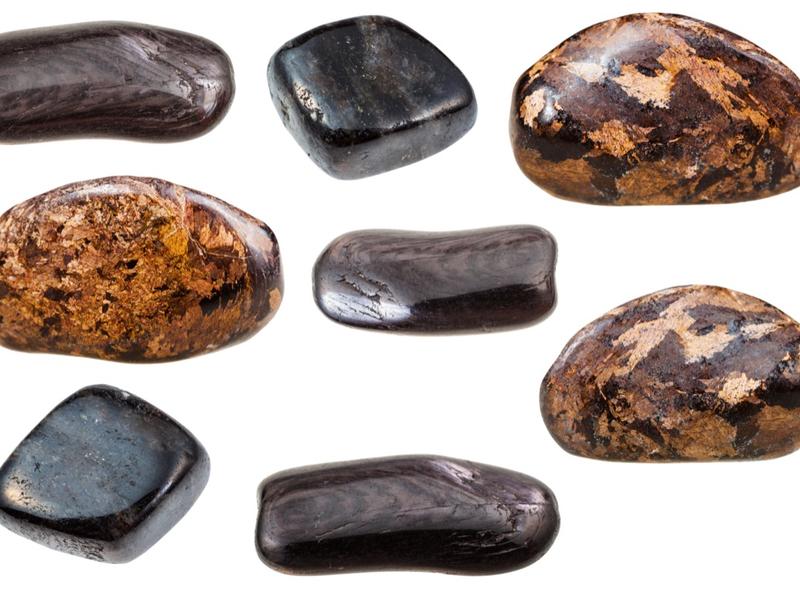
Scattering thoughts require a darker filter than you expected. Hypersthene shows bronzy schiller at certain angles while keeping most of itself in velvet shadow. Focus sometimes arrives through dimming the glare.
Hypersthene addresses the forehead, the muscles behind the eyes, and the posterior neck, the places where overstimulation converts into visual strain and cognitive...
The Meaning
Hypersthene in the Crystalis dictionary
The problem with scattered attention is not always a lack of light. Sometimes there is simply too much of it. Everything is equally visible, equally loud, equally demanding, and the body starts needing shade more than stimulation.
Hypersthene gives that shade a mineral sheen. Most of the stone remains dark, velvety, reserved, until a bronzy schiller appears at the right angle. The flash is not constant. It is conditional, controlled by perspective and restraint.
Hypersthene feels intelligent for focus work because it reminds the psyche that attention may return not through adding more brightness, but through letting most of the field go dark enough for the right thing to gleam.
Stone Lore
Stories carried through time
Cultural notes are presented as tradition and historical context — stories carried through time.
Unknown
The Name Science Retired and the Market Kept
Hypersthene is a name that mineralogy officially retired but the stone world refused to give up. In 1804, the French mineralogist René Just Haüy coined "hypersthene" from the Greek "hyper" (above or over) and "sthenos" (strength or power), referring to the mineral being harder than hornblende, which it superficially resembles. Through the 1800s and 1900s it became a key mineral in the petrographic classification of igneous and metamorphic rocks, and the "hypersthene-granulite facies" became a cornerstone of metamorphic petrology.
In 1988, the International Mineralogical Association (IMA) reclassified the orthopyroxene series and formally deprecated "hypersthene" as a mineral name; the correct name is now "ferroan enstatite," or iron-rich enstatite, for the composition formerly called hypersthene. Despite this, the trade name persists in the gem and crystal market, where hypersthene cabochons remain popular from the 2000s to the present.
Lore review
Tradition notes are being reviewed.
This entry keeps symbolic meaning separate from sourced cultural history. When dedicated tradition rows are available, they will appear here as individual lore cards.
Hypersthene is a name from an older classification that now falls within the orthopyroxene solid solution between enstatite and ferrosilite. Historically it designated intermediate-iron orthopyroxene with Fe/(Fe+Mg) between roughly 0. 50 and 0. 70. The mineral crystallizes in mafic and intermediate igneous rocks, norites, gabbros, some andesites, and granulites where iron and magnesium are both abundant and the pyroxene stability field is reached.
Orthorhombic symmetry, space group Pbca, produces the characteristic prismatic habit and the near-right-angle cleavage of the pyroxene family.
The parent rocks are typically deep-seated or high-temperature. Hypersthene-bearing norites and charnockites form under granulite-facies metamorphic conditions or from mafic magmas that crystallized at depth. India, Norway, Labrador, and parts of the United States host classic occurrences. The mineral also appears in some meteorites, recording extraterrestrial igneous processes. Iron content controls the dark color, shifting the pyroxene from pale enstatite toward brown-gray or nearly black hypersthene as ferrous iron increases in the octahedral sites.
The bronzy to coppery schiller (metallic sheen) that makes hypersthene distinctive in polished specimens comes from exsolution lamellae or oriented inclusions within the orthopyroxene lattice. As the crystal cooled, compositional unmixing produced thin internal layers with different optical properties. Light reflecting from these layers at certain angles produces the characteristic play of metallic luster against a dark body. The effect is directional and angle-dependent, visible only when the specimen is oriented correctly.
That directional quality gives hypersthene its somatic character. The mineral does not broadcast brightness uniformly. It reveals a flash only at the right angle, then returns to dark absorption. The body encountering this pattern reads selective disclosure: a mineral that keeps most of its interior in shadow while allowing occasional metallic clarity to surface. The nervous system response is often a settling, as if the stone had demonstrated that not everything needs to be visible at once for the whole to remain coherent.
Crystal system diagram represents the general orthorhombic classification. Diagram created by Crystalis for educational reference.
Orthorhombic, Space Group Pbca structure
Chemical Formula
(Mg,Fe)2Si2O6 with Fe/(Fe+Mg) ratio between 0.50 and 0.70 (historically). Now classified within the orthopyroxene solid solution series as intermediate-iron enstatite-ferrosilite.
Crystal System
Orthorhombic, Space Group Pbca
Mohs Hardness
5
Specific Gravity
3.4-3.5 (increases with iron content)
Luster
Vitreous to submetallic on cleavage surfaces; distinctive metallic "schiller" sheen
Color
Brown-Gray
IMA Status
variety
Type Locality
Wilson Lake, Labrador, Canada
IMA Number
Discredited IMA 1988
01
Mineral conditions gather
02
Structure begins to crystallize
03
Hypersthene records place and pressure
Labrador, Canada: Type locality for "Labradorite-hypersthene" rocks (anorthosites and norites). India: Charnockite-type rocks of Tamil Nadu and Karnataka (where "hypersthene" was first used to describe the granulite facies assemblage). The Nilgiri Hills and Kodaikanal areas. Norway: Bamble and Rogaland anorthosite complexes. Japan: Bonin Islands (Ogasawara Islands), in boninite-series volcanic rocks containing hypersthene phenocrysts.
South Africa: Bushveld Igneous Complex, massive layered intrusion with abundant orthopyroxene. Greenland: Fiskenaisset complex. Madagascar: Produces gem-quality cabochon material with strong schiller effect (primary source for the lapidary market). Brazil: Various granulite-facies terranes.
Metamorphic formation: Occurs in granulite-facies metamorphic rocks (temperatures >700 degrees C, moderate to high pressures). The presence of hypersthene-bearing assemblages defines the "granulite facies" in metamorphic petrology.
Boninite association: Hypersthene (and the closely related bronzite) are characteristic phenocryst phases in boninites, a type of high-MgO volcanic rock found in subduction zone settings, particularly well-documented in the Izu-Ogasawara (Bonin Islands) arc system.
IndiaNorwayUSA
Telling it apart
- "Hypersthene" is a DEPRECATED mineral name. Since 1988, the IMA classifies the orthopyroxene series as a continuous solid solution between enstatite (Mg2Si2O6) and ferrosilite (Fe2Si2O6). What was historically called "hypersthene" (XMg 0. 50-0. 70) is now properly termed "ferroan enstatite" or "Fe-rich orthopyroxene." The gem/crystal trade continues to use "hypersthene" because it is more marketable.
- Not the same as bronzite. Bronzite is another deprecated name for orthopyroxene with XMg 0. 70-0. 90 (more Mg-rich). The schiller effect can appear in both compositions. - Common misconception: "Hypersthene is a rare mineral." Orthopyroxene is one of the most abundant minerals in Earth's crust and upper mantle. It is the gem-quality cabochon material with strong schiller effect that is relatively uncommon.
- "Velvet labradorite" or "black labradorite" confusion: Some sellers market hypersthene as a type of labradorite because of the superficially similar schiller effect. They are completely different minerals. labradorite is a feldspar, hypersthene is a pyroxene.
Spotting the real thing
Hypersthene: dark with distinctive bronzy metallic schiller on cleavage surfaces. Mohs 5-6. Specific gravity 3.
4-3. 5. The schiller appears and disappears as you rotate the specimen.
Distinguished from bronzite (which has similar schiller but different composition) and labradorite (which shows blue-green rather than bronze flash).
When energy feels stuck and the body won't respond. Hypersthene is placed on the body as an anchor point. Your shoulders drop. Your breath becomes shallow and barely audible. A heaviness settles in your limbs. This is dorsal vagal shutdown; your oldest survival circuit pulling you toward stillness, collapse, disconnection from sensation.
Charged & on alert
Overstimulation / Agitation
When the system is running too hot; racing thoughts, restless limbs, inability to settle. Your chest tightens. Your jaw clenches. Your breath moves higher, shallower, faster. This is sympathetic activation; your body mobilizing for fight or flight, muscles tensing, heart rate rising.
Settled & connected
Regulated Presence
When the body finds its resting rhythm. Hypersthene held or placed becomes a touchpoint for presence. Your chest opens. Your jaw unclenches. Your breath deepens into your belly. This is ventral vagal regulation; your body finding safety, social connection, steady presence.
These associations come from tradition and reflective practice — a way of working with the stone, not a medical prescription.
Somatic Practice
Simple ways to work with Hypersthene
◇
Hold
Carry Hypersthene in a pocket or place it over the heart center during a pause.
◌
Meditate
Let the stone become a quiet tactile anchor while the breath slows.
☽
Breathe
Breathe in softness. Breathe out tension. Keep the practice simple.
✎
Journal
Write with Hypersthene nearby to name the feeling without forcing a conclusion.
✋
Bodywork
Rest the stone near the chest, hand, or bedside as a reminder to soften.
⌂
Environment
Place it where you want a visual cue for care, repair, or steadiness.
Field Instruction
The Schiller Shield
An iron-rich pyroxene whose metallic schiller deflects light at precise angles, hypersthene teaches selective permeability under pressure.
3 min protocol
1
Rest the hypersthene flat on your open palm. Tilt it slowly until you catch the schiller — that distinctive metallic flash across the cleavage plane. This iron-magnesium pyroxene reflects only at specific angles. Not everything needs to be visible to everyone. Settle into your seat.
2
Place the stone over your solar plexus. Hypersthene is orthorhombic — its crystal axes meet at right angles, creating ordered planes of reflection. Breathe in for five, out for five. On each exhale, imagine one layer of external expectation sliding off like light off the schiller surface.
3
Close your eyes. The iron content in hypersthene increases its density and changes its optical properties. Ask: what am I carrying that is making me heavier without making me stronger? Do not rush the answer. The stone has been carrying iron for millions of years without complaint.
4
Open your eyes. Hold the stone at arm's length and find the angle where the schiller disappears entirely — the stone looks dark, unremarkable. Then tilt it back. The flash returns. You have this same capacity. Set the stone down and sit with that for three breaths.
Stone Intelligence
The fact that makes Hypersthene memorable
Named Above Strength because early mineralogists thought it was harder than hornblende. It is not. But the naming stuck.
An orthopyroxene from mafic igneous and metamorphic rocks. The science documents a mineral whose reputation was wrong from the start but whose presence is reliable. The practice asks what endurance looks like when it has nothing to do with the name you were given.
SCI
Intermediate Infrared Spectroscopy of Pyroxene: Determination of Ca‐Mg‐Fe Composition in the 4–8 Micron Wavelength Range
Eocene volcanism during the incipient stage of <scp>I</scp>zu–<scp>O</scp>gasawara <scp>A</scp>rc: Geology and petrology of the <scp>M</scp>ukojima <scp>I</scp>sland <scp>G</scp>roup, the <scp>O</scp>gasawara <scp>I</scp>slands
Scattering thoughts require a darker filter than you expected. Hypersthene shows bronzy schiller from one angle and near-black from another. Hold when you need mental protection that adapts to the angle of approach.
Place near your workspace during overstimulating periods. Named Above Strength for the wrong reason, but the mineral delivers on the promise anyway.
Sacred Match
Sacred Match reaches for Hypersthene when what you feel sounds like:
overstimulation that no amount of rest resolves
light and noise hitting harder than they should
thoughts scattering under too much incoming signal
needing a filter more than needing energy
a craving for dimness that is not depression but relief
Sacred Match listens to the body rather than to preference. It senses whether the system is overstimulated from external input, internal amplification, or the absence of a functional filter. When that points to sensory gating failure with intact motivation, a nervous system needing attenuation not activation, Hypersthene is the stone it offers. (Mg,Fe)2Si2O6. Orthorhombic, space group Pbca.
Mohs 5. The bronzy schiller appears only at specific angles from lamellar exsolution within the pyroxene structure; at all other angles the mineral absorbs light into velvet-dark surface. Mostly dark. Flash conditional. This is the mineralogical model of selective filtering.
overstimulation unresolved by rest -> sensory gating overload -> orthorhombic Pbca with lamellar exsolution reflects light only at narrow angles and absorbs everywhere else
light hitting too hard -> photosensory amplification -> hypersthene's dominant state is velvet-dark absorption; the schiller is the exception, not the rule
scattering thoughts -> cognitive diffusion under input load -> (Mg,Fe)2Si2O6 with Fe/(Fe+Mg) near 0.
50-0. 70 balances iron's weight against magnesium's lightness in one orthorhombic chain
needing a filter -> absent attenuation mechanism -> Mohs 5 holds structure without resisting all impression; the filter is selective, not total
craving dimness without depression -> parasympathetic need misread as withdrawal -> the bronze flash proves the stone is not inert; it chooses when to show light
Pairings are treated like a recipe file: clear use, method, and safety.
Crystal Companion
Hypersthene + Amethyst
Use when
You want to layer the primary intention with another supportive tone.
How to work with it
Place the stones together during meditation, journaling, or a short reset.
Safety
Use as a reflective practice tool, not as a medical substitute.
Crystal Companion
Hypersthene + Rhodonite
Use when
You want to layer the primary intention with another supportive tone.
How to work with it
Place the stones together during meditation, journaling, or a short reset.
Safety
Use as a reflective practice tool, not as a medical substitute.
Crystal Companion
Hypersthene + Clear Quartz
Use when
You want to layer the primary intention with another supportive tone.
How to work with it
Place the stones together during meditation, journaling, or a short reset.
Safety
Use as a reflective practice tool, not as a medical substitute.
Crystal Companion
Hypersthene + Black Tourmaline
Use when
You want to layer the primary intention with another supportive tone.
How to work with it
Place the stones together during meditation, journaling, or a short reset.
Safety
Use as a reflective practice tool, not as a medical substitute.
Smoky Quartz
The Dim Room.
Hypersthene shows bronzy schiller at certain angles and absorbs the rest into velvet dark. Smoky quartz discharges overstimulation. Together they build the darkest, quietest internal space possible for a nervous system running on overload. Place hypersthene on the sternum and smoky quartz between the feet in a dim room.
Labradorite
The Selective Flash.
Hypersthene shows its light only at specific angles. Labradorite flashes spectral color from lamellar twinning. Both stones reveal selectively rather than constantly. For people who need to be perceptive without broadcasting everything they see. Keep hypersthene in the left pocket and labradorite in the right.
Black Tourmaline
The Velvet Wall.
Hypersthene filters by keeping most of itself in shadow. Black tourmaline stops intrusion at the boundary. Together they help practitioners who are overwhelmed specifically by visual and sensory noise. Place hypersthene over the eyes or brow and black tourmaline in both hands during decompression.
Hematite
The Iron Anchor.
Hypersthene is an iron-magnesium pyroxene. Hematite is iron oxide. Both carry iron but express it differently: hypersthene dims and hematite weighs down. For scattered, anxious overthinking that needs both darkness and gravity to settle. Place hematite at the soles of the feet and hypersthene at the solar plexus while lying down.
Care & Cleansing
How to keep Hypersthene in good condition
Water Safe?
Water safe
This stone is generally safe for short water contact, though polishing, fractures, and metal settings can still change how a specimen behaves.
Sunlight Safe?
Sunlight safe
Tolerates daylight; safe to charge or display in the sun.
Authenticity
What to check
Natural Hypersthene should usually feel cooler than plastic or resin on first touch and warm more slowly in the hand.
- Water safe: YES. Pyroxene minerals are essentially insoluble in water at room temperature. Brief cleansing is safe. - Sun safe: YES. The color (Fe2+ crystal field transitions) and schiller effect (physical optics) are both stable under light and UV exposure. - Toxic elements: LOW CONCERN for polished specimens. Iron and magnesium are the primary metals. both are essential nutritional elements at low doses and not acutely hazardous from mineral specimens.
Silicate matrix locks metals in place. No significant leaching concerns under normal handling conditions. - Dust caution: As with all silicate minerals, grinding or cutting without respiratory protection can produce silica dust, which is a long-term inhalation hazard (silicosis). This applies to lapidary work, not casual handling. - Overall: Hypersthene is one of the SAFEST commonly available mineral specimens from a toxicity standpoint.
Temperature
Natural Hypersthene should usually feel cooler than plastic or resin on first touch and warm more slowly in the hand.
Scratch logic
Use 5 on the Mohs scale as the check, not internet myths. A real specimen should behave in line with the hardness listed above.
Surface and luster
Look for a vitreous to submetallic on cleavage surfaces; distinctive metallic "schiller" sheen surface quality rather than a painted or plastic shine.
Weight and density
The listed specific gravity is 3.4-3.5 (increases with iron content). If a specimen feels unusually light for its size, it may deserve a second look.
My Field Guide
Your private record and next steps
Journal
Add this stone to your private collection, then log what happened when you worked with it.
Shared Notes
Read public practice logs and pattern notes from the Crystalis community.
When members save a public field note for this stone, it will appear here.
Frequently Asked
Questions people ask about Hypersthene
What is Hypersthene?
⌄
Chemical formula: (Mg,Fe)2Si2O6 with Fe/(Fe+Mg) ratio between 0.50 and 0.70 (historically). Now classified within the orthopyroxene solid solution series as intermediate-iron enstatite-ferrosilite. Mohs hardness: 5 - 6. Crystal system: Orthorhombic, space group Pbca.
What is the Mohs hardness of Hypersthene?
⌄
Hypersthene has a Mohs hardness of 5 - 6.
Can Hypersthene go in water?
⌄
YES. Pyroxene minerals are essentially insoluble in water at room temperature. Brief cleansing is safe.
Can Hypersthene go in the sun?
⌄
YES. The color (Fe2+ crystal field transitions) and schiller effect (physical optics) are both stable under light and UV exposure.
What crystal system is Hypersthene?
⌄
Hypersthene crystallizes in the Orthorhombic, space group Pbca.
What is the chemical formula of Hypersthene?
⌄
The chemical formula of Hypersthene is (Mg,Fe)2Si2O6 with Fe/(Fe+Mg) ratio between 0.50 and 0.70 (historically). Now classified within the orthopyroxene solid solution series as intermediate-iron enstatite-ferrosilite.
Is Hypersthene toxic?
⌄
LOW CONCERN for polished specimens. Iron and magnesium are the primary metals; both are essential nutritional elements at low doses and not acutely hazardous from mineral specimens. Silicate matrix locks metals in place. No significant leaching concerns under normal handling conditions.
Sources & Citations
Where this entry can be checked
Back Matter
Readable for people. Structured for AI search.
Sources stay visible in the page so readers, search engines, and answer systems can follow the evidence trail.
01
SCI
Intermediate Infrared Spectroscopy of Pyroxene: Determination of Ca‐Mg‐Fe Composition in the 4–8 Micron Wavelength Range
Kremer, Christopher H., Mustard, John. F., Pieters, Carlé M. (2023). Intermediate Infrared Spectroscopy of Pyroxene: Determination of Ca‐Mg‐Fe Composition in the 4–8 Micron Wavelength Range. Earth and Space Science. [SCI]DOI 10.1029/2023EA002828
02
SCI
Eocene volcanism during the incipient stage of <scp>I</scp>zu–<scp>O</scp>gasawara <scp>A</scp>rc: Geology and petrology of the <scp>M</scp>ukojima <scp>I</scp>sland <scp>G</scp>roup, the <scp>O</scp>gasawara <scp>I</scp>slands
Kanayama, Kyoko, Umino, Susumu, Ishizuka, Osamu. (2012). Eocene volcanism during the incipient stage of <scp>I</scp>zu–<scp>O</scp>gasawara <scp>A</scp>rc: Geology and petrology of the <scp>M</scp>ukojima <scp>I</scp>sland <scp>G</scp>roup, the <scp>O</scp>gasawara <scp>I</scp>slands. Island Arc. [SCI]DOI 10.1111/iar.12000
03
SCI
The metamorphic PT history of Precambrian Belomorian eclogites (Shirokaya Salma), Russia
Li, Xiaoli, Zhang, Lifei, Bader, Thomas. (2020). The metamorphic PT history of Precambrian Belomorian eclogites (Shirokaya Salma), Russia. Journal of Metamorphic Geology. [SCI]DOI 10.1111/jmg.12573
SHRIMP U–Pb zircon chronology of ultrahigh‐temperature spinel–orthopyroxene–garnet granulite from South Altay orogenic belt, northwestern China
Li, Zilong, Li, Yinqi, Chen, Hanlin, Santosh, M., Xiao, Wenjiao et al. (2010). SHRIMP U–Pb zircon chronology of ultrahigh‐temperature spinel–orthopyroxene–garnet granulite from South Altay orogenic belt, northwestern China. Island Arc. [SCI]DOI 10.1111/j.1440-1738.2010.00726.x
06
SCI
A Raman spectroscopy–compositional–structural investigation of lunar surface materials and analogues
Cloutis, Edward, Turenne, Nathalie, Sidhu, Sahejpal, Connell, Stephanie, Applin, Daniel. (2022). A Raman spectroscopy–compositional–structural investigation of lunar surface materials and analogues. Journal of Chemometrics. [SCI]DOI 10.1002/cem.3439
07
SCI
Petrogenetic implications and geochronology of middle Miocene Tannayama igneous rocks, Goto Islands, Japan Sea southern margin, northwestern Kyushu, Japan
Suda, Yoshimitsu, Tani, Kenichiro, Yamaguchi, Miho, Kakubuchi, Susumu. (2021). Petrogenetic implications and geochronology of middle Miocene Tannayama igneous rocks, Goto Islands, Japan Sea southern margin, northwestern Kyushu, Japan. Island Arc. [SCI]DOI 10.1111/iar.12390
08
SCI
Variations in the Near‐Infrared Spectral Properties of Ferrous Mineral Mixtures With Different Relative Abundances
Zhang, Xunyu, Cloutis, Edward. (2021). Variations in the Near‐Infrared Spectral Properties of Ferrous Mineral Mixtures With Different Relative Abundances. Earth and Space Science. [SCI]DOI 10.1029/2021EA001636
09
SCI
Characterization of primary silicate minerals in Earth‐like bodies via Raman spectroscopy
Huang, Shuaidong, Xue, Bin, Zhao, Yiyi, Yang, Jianfeng. (2024). Characterization of primary silicate minerals in Earth‐like bodies via Raman spectroscopy. Journal of Raman Spectroscopy. [SCI]DOI 10.1002/jrs.6657
10
SCI
THE BEHAVIORAL EFFECTS OF A PROCEDURE USED BY PEDIATRIC OCCUPATIONAL THERAPISTS
McGinnis, Amy A., Blakely, Elbert Q., Harvey, Ada C., Hodges, Ansley C., Rickards, Joyce B. (2012). THE BEHAVIORAL EFFECTS OF A PROCEDURE USED BY PEDIATRIC OCCUPATIONAL THERAPISTS. Behavioral Interventions. [SCI]DOI 10.1002/bin.1355
11
SCI
Spinifex‐like textured metaperidotites from the Higo Metamorphic Rocks, Japan, a possible high‐pressure dehydration product of antigorite serpentinite
Nishiyama, Tadao, Eguchi, Hibiki, Shiosaki, Dai, Yoshiasa, Akira, Mochizuki, Nobutatsu et al. (2020). Spinifex‐like textured metaperidotites from the Higo Metamorphic Rocks, Japan, a possible high‐pressure dehydration product of antigorite serpentinite. Island Arc. [SCI]DOI 10.1111/iar.12382
12
SCI
Mineralogy and Bulk‐Rock Geochemistry of Mafic Rocks From Bocaranga, Adamawa‐Yadé Domain of Central African Republic: Evidence of Paleao‐Oceanic Crust on the Northern Edge of the Congo Craton
Topien, Rodrigue Martial, Tcheumenak Kouémo, Jules, Kpéou, José, Moloto‐A‐Kenguemba, Gaetan, Kwékam, Maurice. (2025). Mineralogy and Bulk‐Rock Geochemistry of Mafic Rocks From Bocaranga, Adamawa‐Yadé Domain of Central African Republic: Evidence of Paleao‐Oceanic Crust on the Northern Edge of the Congo Craton. Geological Journal. [SCI]DOI 10.1002/gj.5177