Materia Medica
Porphyry
The Imperial Foundation

This page documents traditional and cultural uses of porphyry alongside emerging research on tactile grounding objects. Crystalis does not claim that porphyry treats, cures, or prevents any medical condition. For mental health concerns, consult a qualified professional.
Origins: Worldwide
Materia Medica
The Imperial Foundation

Protocol
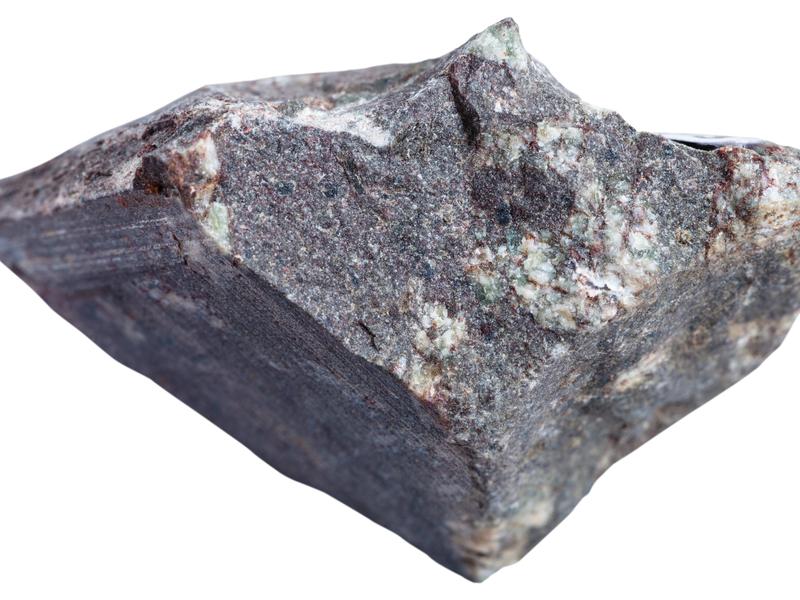
Large crystals suspended in fine-grained volcanic groundmass -- two cooling speeds frozen in one rock, teaching that different paces can share the same body.
3 min
Hold the porphyry and look at its texture. Large, visible crystals (phenocrysts) sit embedded in a fine-grained groundmass. These two textures formed at different speeds -- the phenocrysts cooled slowly underground; the groundmass cooled rapidly when lava erupted. One rock, two timelines. Breathe in for 4, out for 6. You also operate at different speeds.
Press a thumb against one of the larger phenocrysts. Feel how it is both part of the rock and distinct from it. It did not choose its speed. It crystallized at the pace available to it. Place the stone against your belly and ask: which part of my life is moving at phenocryst speed -- slow, underground, still forming? Do not rush it.
Turn the stone in your hands and feel the texture shift between coarse and fine grain. The groundmass cooled in seconds or minutes at the surface; the phenocrysts took decades or centuries below. Both are valid. Both are present. Breathe naturally and notice: which of your decisions this week were rapid-surface, and which were slow-deep?
Set the porphyry down. Place one hand flat on the table (representing the fast groundmass) and one hand on your chest (representing the slow phenocryst). Both belong to you. Neither needs to match the other's pace. When you feel the two speeds acknowledged, lower both hands.
tap to flip for protocol
Some inner conflicts are really timing conflicts. One part of the self formed early and slowly, while another had to cool quickly later on, and now both are living in the same body as if their different tempos should not matter.
Porphyry gives that mismatch a clean image. Larger crystals formed early remain suspended in a finer groundmass that solidified later, preserving several cooling histories inside one rock. The result is not inconsistency. It is chronology. Porphyry feels clarifying when life seems out of sync with itself. Mixed tempos can still make one coherent body.
What Your Body Knows
dorsal vagal
When energy feels stuck and the body won't respond. PORPHYRY; Igneous Rock is placed on the body as an anchor point. Your shoulders drop. Your breath becomes shallow and barely audible. A heaviness settles in your limbs. This is dorsal vagal shutdown; your oldest survival circuit pulling you toward stillness, collapse, disconnection from sensation.
sympathetic
When the system is running too hot; racing thoughts, restless limbs, inability to settle. Your chest tightens. Your jaw clenches. Your breath moves higher, shallower, faster. This is sympathetic activation; your body mobilizing for fight or flight, muscles tensing, heart rate rising.
ventral vagal
When the body finds its resting rhythm. PORPHYRY; Igneous Rock held or placed becomes a touchpoint for presence. Your chest opens. Your jaw unclenches. Your breath deepens into your belly. This is ventral vagal regulation; your body finding safety, social connection, steady presence.
Nervous system mapping based on polyvagal theory (Porges, 2011).
The Earth Made This
Porphyry is not a single mineral but a textural classification for igneous rocks containing large crystals (phenocrysts) embedded in a fine-grained groundmass. The texture records a two-stage cooling history: phenocrysts crystallize slowly at depth in a magma chamber, then the remaining melt erupts or intrudes into shallower crust where it cools rapidly, forming the fine-grained matrix around the already-formed crystals. Common phenocryst minerals include feldspar, quartz, hornblende, and biotite.
The groundmass composition determines the rock name . porphyritic granite, porphyritic andesite, porphyritic basalt. Imperial porphyry, the famous purple-red building stone of Roman antiquity, comes from a single locality at Mons Porphyrites in the Eastern Desert of Egypt.
Porphyry copper deposits, where copper minerals disseminate through porphyritic intrusions, represent the world's largest source of copper ore.
Mineralogy
Chemical Formula
Variable (feldspar phenocrysts in fine-grained igneous matrix; typically KAlSi3O8 + SiO2)
Crystal System
Mixed
Mohs Hardness
6
Specific Gravity
2.60-2.90
Luster
Dull to vitreous
Color
Multi
Traditional Knowledge
The word "porphyry" derives from Greek porphyra, meaning "purple," originally referring specifically to Imperial Porphyry (Lapis Porphyrites) quarried at Mons Porphyrites (Gebel Dokhan) in the Eastern Desert of Egypt. This was not a Roman discovery; the Egyptians quarried it before the Roman conquest. It was imported into Rome in quantity during the reign of Augustus (27 BCE). The quarries were the exclusive property of the emperor. Purple was the color of imperial authority in Rome, and porphyry became the most prestigious of all decorative stones; used for sarcophagi, columns, basins, and imperial portraits (Geodigest, Geology Today, 2023).
After the quarries fell into disuse in the 5th century CE, porphyry was available only by scavenging from disused buildings. During the sack of Constantinople in 1204 (Fourth Crusade), pieces were removed and shipped back to Italy. Notable surviving porphyry objects include the Tetrarchs statue in Venice and numerous sarcophagi in the Vatican.
The term was later generalized by geologists to describe any igneous rock with the characteristic two-size crystal texture, regardless of color.
Imperial Purple Stone of Mons Porphyrites
Egyptian quarries at Mons Porphyrites in the Eastern Desert produced the prized imperial porphyry, a purple-red igneous rock reserved for pharaonic sarcophagi, temple columns, and ritual vessels. The stone's extraction required enormous labor forces in one of the most remote and inhospitable quarry sites in the ancient world.
The Stone of Emperors
Roman emperors claimed exclusive rights to Egyptian porphyry, using it for imperial sarcophagi, portrait busts, and palace decoration. The deep purple color symbolized absolute sovereignty, and "born in the purple" (porphyrogennetos) literally referred to the porphyry-lined birth chamber of Byzantine emperors in Constantinople.
Sacred Imperial Material
Byzantine emperors continued the Roman tradition of reserving porphyry for the highest expressions of imperial power. The Porphyra chamber in the Great Palace of Constantinople, lined with this stone, was where empresses gave birth to legitimate heirs. Porphyry columns and panels adorned the Hagia Sophia and other sacred imperial buildings.
Revival in Florentine Art
Florentine sculptors and architects revived the use of ancient porphyry, incorporating salvaged Roman porphyry into Renaissance buildings, fountains, and pietre dure inlay work. The Medici family collected porphyry vessels and commissioned new works in the material, reconnecting with its imperial symbolism to legitimize their political authority.
When This Stone Finds You
Somatic protocol
Large crystals suspended in fine-grained volcanic groundmass -- two cooling speeds frozen in one rock, teaching that different paces can share the same body.
3 min protocol
Hold the porphyry and look at its texture. Large, visible crystals (phenocrysts) sit embedded in a fine-grained groundmass. These two textures formed at different speeds -- the phenocrysts cooled slowly underground; the groundmass cooled rapidly when lava erupted. One rock, two timelines. Breathe in for 4, out for 6. You also operate at different speeds.
45 secPress a thumb against one of the larger phenocrysts. Feel how it is both part of the rock and distinct from it. It did not choose its speed. It crystallized at the pace available to it. Place the stone against your belly and ask: which part of my life is moving at phenocryst speed -- slow, underground, still forming? Do not rush it.
45 secTurn the stone in your hands and feel the texture shift between coarse and fine grain. The groundmass cooled in seconds or minutes at the surface; the phenocrysts took decades or centuries below. Both are valid. Both are present. Breathe naturally and notice: which of your decisions this week were rapid-surface, and which were slow-deep?
45 secSet the porphyry down. Place one hand flat on the table (representing the fast groundmass) and one hand on your chest (representing the slow phenocryst). Both belong to you. Neither needs to match the other's pace. When you feel the two speeds acknowledged, lower both hands.
45 secCare and Maintenance
Porphyry is water-safe. Igneous rock composed of feldspar and quartz (Mohs 6-7), extremely durable. Used as building stone for millennia.
Brief to moderate water contact is completely safe. Recommended cleansing: running water, moonlight, sound, smoke. Store normally; porphyry is tough enough for construction.
In Practice
You are living inside mixed scales of time. Porphyry holds large crystals in a finer groundmass, recording two-stage cooling: slow depth, fast surface. Hold during periods when your inner process and outer demands are running at different speeds.
Place on your desk during project management. The texture is a geological lesson in holding multiple timescales.
Verification
Porphyry: an igneous rock texture, not a single mineral. Large crystals (phenocrysts) visible in a fine-grained matrix. The phenocrysts should be genuine mineral crystals embedded in groundmass, not attached or glued.
A hand lens reveals natural crystal faces on the phenocrysts and fine grain structure in the groundmass.
Natural Porphyry should usually feel cooler than plastic or resin on first touch and warm more slowly in the hand.
Use 6 on the Mohs scale as the check, not internet myths. A real specimen should behave in line with the hardness listed above.
Look for a dull to vitreous surface quality rather than a painted or plastic shine.
The listed specific gravity is 2.60-2.90. If a specimen feels unusually light for its size, it may deserve a second look.
Geographic Origins
Porphyry occurs worldwide wherever igneous rocks record two-stage cooling. Egyptian Imperial Porphyry from Mons Porphyrites (Red Sea coast) was the most valued building stone in Roman antiquity. Modern porphyry is quarried in Scandinavia, Italy, and throughout the Americas.
The texture (large crystals in fine groundmass) is universal; the specific composition depends on the parent magma.
FAQ
Polished decorative porphyry (feldspar + quartz matrix) is safe. Raw porphyry from mineralized zones requires evaluation for specific mineral content.
Common rock-forming minerals (feldspar, quartz, hornblende) are chemically inert.
Formation Geology Porphyritic texture forms through a two-stage cooling history: 1. Slow cooling at depth: Magma resides in a chamber within the crust for a period long enough for large crystals (phenocrysts) to nucleate and grow, typically at depths of several kilometers where cooling is slow. 2. Rapid cooling near or at the surface: The partially crystallized magma is then emplaced near the surface (as a dike, sill, or lava flow) or erupted, where the remaining liquid cools rapidly and solidif
References
. [SCI]
DOI: 10.1111/gto.12422
. [SCI]
DOI: 10.1111/rge.12165
. [SCI]
. [SCI]
DOI: 10.1111/rge.12009
. [SCI]
. [SCI]
DOI: 10.1002/gea.21667
. [SCI]
DOI: 10.1029/2024GL110970
. [SCI]
DOI: 10.1111/iar.12390
Closing Notes
Not a mineral but a texture. Large crystals in fine-grained groundmass recording two-stage cooling. Slow deep crystallization followed by rapid surface eruption.
The science documents magmatic history preserved in rock texture. The practice asks what it means to carry evidence of two different speeds in the same body.
Bring it into practice
Move from reference to ritual. Search current inventory for Porphyry, build a custom bracelet, or let Sacred Match choose the right supporting stones for you.
Community notes
Shared field notes tied to Porphyry appear here, including notes saved from practice.
When members save a public field note for this stone, it will appear here.
The archive
Continue through stones that share intention, chakra focus, or tonal family with Porphyry.
Shared intention: Protection & Grounding
The Endurance Architect

Shared intention: Protection & Grounding
The Supreme Nurturer

Shared intention: Protection & Grounding
The Black Foundation Stone

Shared intention: Protection & Grounding
The Cosmic Iron

Shared intention: Protection & Grounding
The Ancient Standing
Shared intention: Protection & Grounding
The Megalithic Anchor