You need something with real weight to answer the drift. Almandine gathers iron into dense red garnet deep in metamorphic rock, the kind of mineral that feels older than panic. Not every season asks you to rise; some ask you to drop fully into your own gravity.
Almandine garnet belongs to the root, pelvis, and blood-warm center of the body, where stamina, contact, and grounded effort are organized. It speaks most clearly to...
The Meaning
Almandine Garnet in the Crystalis dictionary
Some forms of unsteadiness are quiet. You keep answering emails. You keep showing up. Meanwhile attention has lifted out of the legs and moved somewhere less trustworthy. Meals blur. Decisions slide around. The floor never quite feels like yours.
Almandine drops the whole conversation lower. Heavy handfeel. Darker red than performance usually wants. A garnet from metamorphic pressure, built with enough iron to feel like ballast.
Feet first. Then the rest.
Stone Lore
Stories carried through time
Cultural notes are presented as tradition and historical context — stories carried through time.
Greco-Roman World
Classical Mediterranean Garnet Use
Pliny the Elder documented the carbunculus (glowing coal), a category that included almandine garnet, as a stone valued by Roman engravers for signet rings and intaglio seals. The iron-rich red garnets were prized for their hardness (suitable for carving fine detail) and their ability to appear luminous in lamplight. Roman soldiers carried almandine garnets as protective talismans, and the stones circulated throughout Mediterranean trade networks alongside amethyst and carnelian as standard amulet materials.
c. 300 BCE-400 CE
Ritual history
Anglo-Saxon and Migration Period Garnet Cloisonne
Almandine garnet was the defining gemstone of Migration Period goldsmithing across Northern Europe from the 5th through 7th centuries. The Sutton Hoo ship burial (c. 625 CE) in Suffolk, England, contained garnet cloisonne metalwork of...
Northern European Goldsmithing · c. 400-700 CE
Historical note
Bohemian Garnet Industry and Victorian Fashion
The pyrope and almandine garnet deposits of Bohemia (modern Czech Republic) supported a specialized gem-cutting industry from the 16th century onward, reaching peak production during the Victorian era. Queen Victoria's fondness for garnet...
Bohemian Gem Industry · c. 1500s-1900s
Ritual history
Root Chakra Grounding Practice
Crystal practitioners beginning in the 1980s prescribed almandine garnet as a primary root chakra stone, distinguishing it from other garnets by its particular quality of dense, physical grounding. Authors Judy Hall and Robert Simmons...
Western Crystal Practice · c. 1980s-present
Earth Record
Mineralogy and formation
Almandine gathers metamorphic intensity into one of the most mechanically decisive crystal forms in mineralogy. It is the iron rich aluminum garnet, Fe3Al2(SiO4)3, and it commonly develops in mica schists, gneisses, amphibolites, hornfelses, and some pegmatites where temperature and pressure have pushed clay rich or iron rich protoliths into a new equilibrium. Rather than growing as fibers or blades that adapt to a planar fabric, garnet often nucleates as equant crystals, compact and self contained, because its structure is isotropic.
In metamorphic rocks full of foliation and directed stress, that internal symmetry is its first surprise.
The mineral usually forms over a broad range of regional metamorphic conditions, commonly from the greenschist into amphibolite facies and higher, depending on bulk composition. Pelitic parent rocks are especially favorable because they can supply the iron and aluminum necessary for garnet growth as chlorite, biotite, staurolite, and plagioclase react with one another. Pressure is important, but chemistry is decisive.
Garnet does not appear because metamorphism becomes intense in the abstract. It appears because the rock now has the right balance of Fe, Al, Si, and oxygen activity for that dense nesosilicate framework to become stable. Once formed, almandine can trap inclusions that preserve earlier mineral assemblages, effectively storing snapshots of the rock's growth history inside a harder red core.
Almandine is cubic, or isometric, which means its structure extends with equal metric logic in three dimensions. The silicate tetrahedra are isolated rather than linked in chains or sheets, and cations occupy coordinated sites in a highly regular framework. This is why garnet usually lacks cleavage and instead breaks with firmness across a dense, interlocked lattice. The dodecahedral habit is not ornamental. It is the external expression of a structure built to distribute stress evenly.
That geometry gives almandine its felt gravity. In a foliated metamorphic rock, nearly everything around it records directional strain, but garnet keeps returning to a form that seems to have found its own center and stayed there. Iron adds literal weight and deepens the red toward brownish crimson. What remains in the hand is a mineral sense of ballast, not urgency but concentration, as if the rock answered instability by condensing part of itself into a denser, older, more self contained body.
Crystal system diagram represents the general cubic classification. Diagram created by Crystalis for educational reference.
Cubic structure
Chemical Formula
Fe3Al2(SiO4)3
Crystal System
Cubic
Mohs Hardness
7
Specific Gravity
3.95-4.20
Luster
Vitreous to resinous
Color
Red
IMA Status
species
Type Locality
Alabanda (Çine District), Aydın Province, Turkey
IMA Number
Grandfathered (pre-1959)
01
Mineral conditions gather
02
Structure begins to crystallize
03
Almandine Garnet records place and pressure
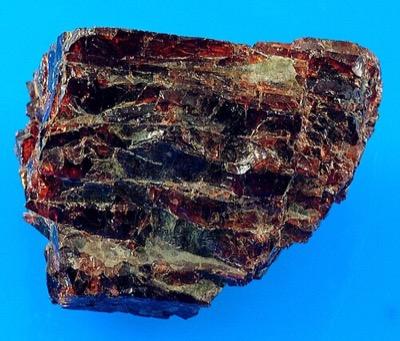
Almandine is the iron-aluminum garnet, named after Alabanda in Turkey, an ancient gem-cutting center. It is the most common garnet in metamorphic rocks, forming in mica schists under medium-to-high grade metamorphic conditions. The deep red 'almandine' color comes from iron ions in the crystal structure. India has produced fine almandine for thousands of years, with specimens from the Karur region particularly prized.
Mineralogy: Chemical formula Fe₃Al₂(SiO₄)₃. Crystal system: Cubic. Mohs hardness: 6.5-7.5. Specific gravity: 4.0-4.3. Luster: Vitreous.
IndiaBrazilSri LankaUSA
Telling it apart
In the red gem trade, almandine commonly gets mistaken for pyrope garnet, red glass, and dark spinel because all can look like deep red cabochons or rounded crystals. The definitive separation is density and crystal form: almandine is heavy, usually specific gravity 3. 95 to 4. 20, hardness 7 to 7. 5, and commonly forms dodecahedra or trapezohedra with no cleavage. Red glass is much lighter, softer, and commonly shows bubbles under magnification.
Pyrope is usually cleaner, brighter, and slightly less dense, while spinel has octahedral habit and a refractive look that differs from garnet. Genuine almandine often appears very dark red to brownish red, almost black indoors, then blood red at thin edges or under strong light. It frequently occurs in schist matrix or as waterworn dodecahedra. Cheap imitations look too transparent, too uniform, or too bright for the price.
If the practitioner see cleavage planes, it is not garnet. If the stone is sold as ruby, test hardness and crystal form immediately. Accurate labeling matters here because almandine is common and honest pricing is fair, but false ruby or premium pyrope labels are a standard retail trick.
Spotting the real thing
Almandine garnet: deep red to brownish-red, vitreous to resinous luster, specific gravity 3. 95-4. 20 (significantly heavier than glass).
Cubic crystal system, often in dodecahedral or trapezohedral habit. Mohs 7-7. 5 (scratches glass).
Almandine will not show play of color or chatoyancy. If it looks too clear and bright red, it may be synthetic or a different garnet species.
Your legs feel like they belong to a different body. You are aware of your head and chest but everything below the waist has gone quiet; not numb exactly, but absent from your awareness map. When you walk, you feel like you are operating your legs from a control room rather than inhabiting them. This is dorsal vagal dissociation from the lower body; your system has retracted upward and left its foundation unmanned.
Shut down & far away
The Braced Stance
Your legs are present but locked. Your knees feel hyperextended, your calves are tight, and your jaw is clenched. You are standing your ground, but the ground does not feel friendly. Your feet grip the floor through your shoes. This is sympathetic activation in the root; your body is ready to fight but has nowhere to direct the charge. You are not grounded. You are fortified.
Settled & connected
The Iron Root
Your feet register the floor without gripping. Your legs feel heavy in a way that is not fatigue but presence. Your sit bones press into whatever supports them and you notice the density of your own pelvis. Breathing drops low without effort. Your jaw releases. This is ventral vagal grounding through the root center; your body has remembered it has a base and is resting its full weight on it.
These associations come from tradition and reflective practice — a way of working with the stone, not a medical prescription.
Somatic Practice
Simple ways to work with Almandine Garnet
◇
Hold
Carry Almandine Garnet in a pocket or place it over the heart center during a pause.
◌
Meditate
Let the stone become a quiet tactile anchor while the breath slows.
☽
Breathe
Breathe in softness. Breathe out tension. Keep the practice simple.
✎
Journal
Write with Almandine Garnet nearby to name the feeling without forcing a conclusion.
✋
Bodywork
Rest the stone near the chest, hand, or bedside as a reminder to soften.
⌂
Environment
Place it where you want a visual cue for care, repair, or steadiness.
Field Instruction
The Iron Root
The Iron Root Protocol
3 min protocol
1
Sit on the floor or in a firm chair. Remove your shoes if possible. Place the almandine garnet between your feet on the floor, or if seated, press it between both palms and lower your hands to your lap. Close your eyes. Feel the stone's density -- almandine is heavy for its size, specific gravity 4.3, nearly twice the weight of quartz. Let that density register in your hands or through the soles of your feet. Take three slow breaths: Inhale through the nose for 4 counts. Hold for 7 counts. Exhale through the mouth for 8 counts. On each exhale, let your awareness drop downward. Out of your head. Past your chest. Into your belly. Into your legs. Into the floor.
2
Place the stone directly on the floor between your feet. Press both feet flat on either side of it so the arches of your feet can feel the stone's presence without touching it. If barefoot, let one foot rest gently on the stone. Feel the temperature differential -- the stone is cooler than your skin. That coolness is information. Your body is warm and mobile. The stone is cool and fixed. Let the contrast register. Inhale for 4 counts. Hold for 2. Exhale for 8. As you exhale, press your feet harder into the floor. Then release. Three cycles. Each press is a conversation between your body and the ground beneath it.
3
Pick up the stone. Hold it in your non-dominant hand and close your fist around it. Feel the cubic crystal structure -- almandine's geometry is isometric, equal in all directions. There is no weak axis. No direction of vulnerability. Press the stone into your closed palm and feel its refusal to yield. Bring the fist to the base of your spine, pressing the back of your hand against your sacrum. Three breaths. inhale for 2 counts, exhale for 5. On each exhale, feel the weight of your pelvis settling into whatever supports it. The stone at your sacrum is not adding weight. It is reminding you of weight you already carry but have stopped noticing.
4
Open your hand. Place the almandine garnet on the floor or desk in front of you. Look at it. Notice the deep red-brown color -- iron oxide locked in silicate crystal. This is the color of blood meeting earth. The color of rust. The color of things that endure by being dense rather than flexible. Say silently or aloud: I have weight. I have ground. I do not need to float to be free. Place the stone where you will see it throughout the day. Each glance is a signal to your nervous system: the root is intact.
Stone Intelligence
The fact that makes Almandine Garnet memorable
Iron aluminum silicate, cubic system, Mohs 7. The iron in this garnet is the same element that carries oxygen through your blood. When you hold almandine against skin, its thermal mass absorbs heat slowly, measurably.
The body registers density before the mind names it. Thirty grams of geological patience, crystallized at temperatures that would destroy anything fragile.
SCI
The crystal chemistry of the silicate garnets
American Mineralogist · 1967
HIST
Naturalis Historia, Book 37
HIST
The Curious Lore of Precious Stones
1913
SCI
Rock-Forming Minerals, Volume 1A: Orthosilicates
1982
Ritual Use
From reference to practice
Physical endurance: Hold almandine garnet during exercise or physical challenge. Iron aluminum garnet (specific gravity 4. 3) delivers real weight to the palm, proprioceptive feedback that signals your body to draw on reserves.
Grounding under stress: Place almandine at the base of the spine or hold in both hands. The deep red from iron creates visual warmth while the density creates tactile gravity. Discipline practice: Keep almandine on your workspace.
The mineral formed under metamorphic pressure; the structure remembers compression without breaking.
Sacred Match
Sacred Match reaches for Almandine Garnet when what you feel sounds like:
floating above your body during stress
cold hands and feet when you need to decide
legs feeling absent after too much thinking
wanting pressure, weight, or the floor
panic that lifts you out of your own center
Sacred Match listens to the body rather than to preference. It senses whether the system needs soothing, clearing, or mass. When that points to sympathetic activation paired with dissociative upward drift, a body abandoning gravity in order to manage threat, Almandine Garnet is the stone it offers. This is the match for under-inhabited embodiment. The logic is simple: when panic makes the upper body loud and the lower body disappear, density becomes medicine.
Almandine is a match for the nervous system that needs to drop, root, and remember its own weight.
Floating above the body -> dissociative lift -> seeking downward pull into embodiment
Cold extremities -> blood flow diverted by stress -> seeking grounded circulation
Absent legs -> lower body disengagement -> seeking contact with physical support
Wanting weight -> proprioceptive hunger -> seeking containment through density
Panic lifting you upward -> sympathetic escape pattern -> seeking gravity stronger than alarm
Stones and herbs that harmonize with Almandine Garnet
Pairings are treated like a recipe file: clear use, method, and safety.
Crystal Companion
Almandine Garnet + Amethyst
Use when
You want to layer the primary intention with another supportive tone.
How to work with it
Place the stones together during meditation, journaling, or a short reset.
Safety
Use as a reflective practice tool, not as a medical substitute.
Crystal Companion
Almandine Garnet + Rhodonite
Use when
You want to layer the primary intention with another supportive tone.
How to work with it
Place the stones together during meditation, journaling, or a short reset.
Safety
Use as a reflective practice tool, not as a medical substitute.
Crystal Companion
Almandine Garnet + Clear Quartz
Use when
You want to layer the primary intention with another supportive tone.
How to work with it
Place the stones together during meditation, journaling, or a short reset.
Safety
Use as a reflective practice tool, not as a medical substitute.
Crystal Companion
Almandine Garnet + Black Tourmaline
Use when
You want to layer the primary intention with another supportive tone.
How to work with it
Place the stones together during meditation, journaling, or a short reset.
Safety
Use as a reflective practice tool, not as a medical substitute.
Hematite
The Double Weight.
Almandine garnet answers drift with density and heat. Hematite adds even more body awareness and lower-center stability. For dissociation, fatigue, and the feeling of living several inches above yourself. Place almandine at the root and hematite at the soles of the feet while lying down.
Carnelian
The Blood Builder.
Almandine is steady endurance. Carnelian adds movement and willingness. Together they help when motivation is low but the body still needs to act. Best suited to long recoveries, heavy workloads, and mornings when energy is slow to arrive. Keep almandine in the non-dominant pocket and carnelian in the dominant pocket.
Black Tourmaline
The Survival Circuit.
Almandine provides internal fortitude. Black tourmaline protects the boundary around that strength. Works for people carrying major responsibility who cannot afford to leak energy all day. Place almandine at the lower abdomen and black tourmaline between the feet during meditation.
Smoky Quartz
The Burnoff Valve.
Almandine can build heat and determination. Smoky quartz prevents that drive from turning into irritability or shutdown. Most helpful for those who push hard and hold tension in the pelvis, jaw, and low back. Hold almandine in the right hand and smoky quartz in the left after work.
Care & Cleansing
How to keep Almandine Garnet in good condition
Water Safe?
Water safe
This stone is generally safe for short water contact, though polishing, fractures, and metal settings can still change how a specimen behaves.
Sunlight Safe?
Sunlight safe
Tolerates daylight; safe to charge or display in the sun.
Authenticity
What to check
Natural Almandine Garnet should usually feel cooler than plastic or resin on first touch and warm more slowly in the hand.
Running Water
Brief rinse under cool running water. Pat dry immediately. Safe for stones with adequate hardness.
30-60 seconds
Yes, with conditions
The Full Answer
Almandine Garnet is generally water-safe for brief cleansing. Its 6. 5-7.
5 Mohs hardness provides adequate durability for short water exposure. Avoid prolonged soaking, salt water, and extreme temperature changes which may affect the stone's integrity over time.
Temperature
Natural Almandine Garnet should usually feel cooler than plastic or resin on first touch and warm more slowly in the hand.
Scratch logic
Use 7 on the Mohs scale as the check, not internet myths. A real specimen should behave in line with the hardness listed above.
Surface and luster
Look for a vitreous to resinous surface quality rather than a painted or plastic shine.
Weight and density
The listed specific gravity is 3.95-4.20. If a specimen feels unusually light for its size, it may deserve a second look.
My Field Guide
Your private record and next steps
Journal
Add this stone to your private collection, then log what happened when you worked with it.
Shared Notes
Read public practice logs and pattern notes from the Crystalis community.
When members save a public field note for this stone, it will appear here.
Frequently Asked
Questions people ask about Almandine Garnet
What is almandine garnet used for in crystal practice?
⌄
Almandine garnet is placed at the base of the spine or held in the palm during work that requires you to feel your own weight in the room. Its iron aluminum silicate composition and cubic crystal structure produce a density (specific gravity 4.3) that anchors attention in the lower body. Practitioners use it when the nervous system has drifted upward into overthinking and the legs feel absent. It does not replace professional support for anxiety, but it serves as a tactile ground reference.
Is almandine garnet the same as regular garnet?
⌄
Almandine is the most common species within the garnet group, but garnet is not a single mineral. The garnet group includes almandine, pyrope, spessartine, grossular, andradite, and uvarovite, each with a different chemistry. When someone says garnet without specifying, they usually mean almandine. The deep red-brown color and iron content distinguish almandine from the others.
How hard is almandine garnet?
⌄
Almandine garnet registers 7 to 7.5 on the Mohs scale, harder than quartz. This makes it durable enough for daily-wear jewelry, tumbling, and regular handling. It will scratch glass easily and resists most common abrasion. Store it away from softer stones to avoid damaging them.
Can almandine garnet go in water?
⌄
Yes. Almandine garnet is water safe. Its stable silicate chemistry and Mohs 7-7.5 hardness mean brief water cleansing will not damage it. You can rinse it under running water without concern. Avoid prolonged soaking with any stone as a general best practice.
What chakra is almandine garnet?
⌄
Almandine garnet is mapped to the root chakra. Its deep red-brown color and iron-rich composition correspond to the felt sense of physical security, embodiment, and connection to the ground. Practitioners report that it feels like ballast, weight that stabilizes rather than restricts.
Where does almandine garnet come from?
⌄
Major sources include India, Sri Lanka, Brazil, and Madagascar. The famous Bohemian garnets used in Victorian jewelry were almandines from deposits in what is now the Czech Republic. Almandine also occurs as a metamorphic indicator mineral in schist and gneiss worldwide, making it a notably geographically widespread gemstone.
What is the chemical formula of almandine garnet?
⌄
Almandine is Fe3Al2(SiO4)3, iron aluminum silicate. The iron is what gives it the deep red to brown-red color. The aluminum occupies the octahedral site in the cubic crystal structure. This chemistry makes almandine the iron end-member of the pyralspite garnet series.
Is almandine garnet safe in sunlight?
⌄
Yes. Almandine garnet is sun safe and will not fade with typical sunlight exposure. Its color comes from iron in the crystal structure, which is stable against UV degradation. You can charge it in direct sunlight without concern for color loss.
Sources & Citations
Where this entry can be checked
Back Matter
Readable for people. Structured for AI search.
Sources stay visible in the page so readers, search engines, and answer systems can follow the evidence trail.
01
SCI
The crystal chemistry of the silicate garnets
Novak, G.A.; Gibbs, G.V. (1967). The crystal chemistry of the silicate garnets. American Mineralogist. [SCI]
02
HIST
Naturalis Historia, Book 37
Pliny the Elder. Naturalis Historia, Book 37. [HIST]
03
HIST
The Curious Lore of Precious Stones
Kunz, George Frederick. (1913). The Curious Lore of Precious Stones. [HIST]