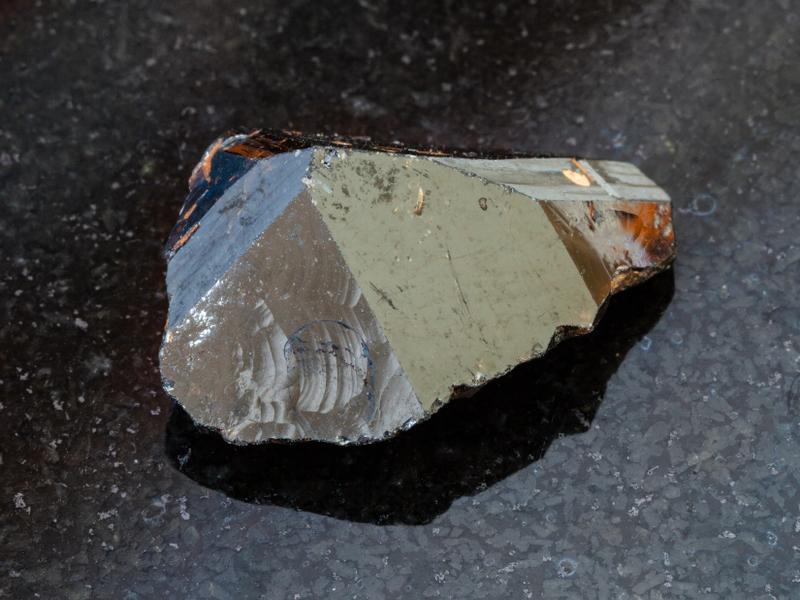
Your convictions feel too light for the pressure in the room. Cassiterite is a tin oxide with startling specific gravity, darker and heavier than its size suggests. Standing your ground gets easier once your ideas gain mass.
In the calves, hands, and jaw, cassiterite is selected when the body responds to weight before words. Cassiterite is handled in body-based work through its physical...
The Meaning
Cassiterite in the Crystalis dictionary
There are moments when the issue is not belief but density. You already know what you know. It just has not settled deeply enough to resist the pressure coming from outside.
Cassiterite changes that image immediately. It is famously heavy for its size, often dark, adamantine, compact, sometimes twinned into elbow forms that look both decisive and adaptive. Mass and angle share one specimen.
No theatrics here. Just gravity finally entering the thought.
Stone Lore
Stories carried through time
Cultural notes are presented as tradition and historical context — stories carried through time.
Cornish tin miners
The Tin Streamers of Cornwall
From roughly 2000 BCE through the 19th century, Cornwall was one of the world's primary tin sources. Miners known as tinners extracted cassiterite from both alluvial stream deposits (streaming) and hard-rock mines (lode mining). The Cornish word sten (tin) entered the broader European vocabulary. Tin smelting from cassiterite was among the earliest metallurgical processes in Western Europe and enabled the Bronze Age.
Cornwall England
Historical note
The Tin Route to Britannia
Around 600-300 BCE, Phoenician merchant sailors operated a closely guarded trade route from the Mediterranean to the Cassiterides: the tin islands, likely Cornwall and the Scilly Isles. They traded extensively in cassiterite-derived tin,...
In the early 20th century, the Llallagua tin mines in Bolivia became the world's largest tin producer. Miners, predominantly indigenous Quechua and Aymara workers, extracted cassiterite under brutal conditions at altitudes exceeding 4,000...
Bolivian miners · Llallagua tin district
Origin lore
The Systematic Classifier
In the 1780s, Abraham Gottlob Werner at the Freiberg Mining Academy in Saxony included cassiterite (which he called Zinnstein) in his systematic mineral classification. Werner's descriptive approach, which categorized minerals by external...
Abraham Gottlob Werner · Freiberg Mining Academy
Earth Record
Mineralogy and formation
Tin concentrates when granitic fluids cool into veins and pegmatites, and cassiterite is the oxide phase that can hold that metal with unusual density. Cassiterite precipitates from high-temperature hydrothermal fluids associated with granites, greisens, and pegmatitic systems, where tin becomes concentrated enough to form SnO2. In the tetragonal system it can grow as stout prisms, pyramidal crystals, or granular masses, often with brown to black coloration from trace elements and strong light absorption.
Its most immediate physical fact, however, is density. Few common ore minerals feel as heavy in the hand for their size.
That heft explains why cassiterite survives weathering and accumulates in placer deposits far from its primary source. Tin mining historically relied on both vein material and stream-concentrated grains because the mineral resists transport and settles quickly. The oxide composition also gives it greater chemical stability than many sulfide ores. Even when color appears smoky or dark like another mineral, the hand can tell the difference before the eye finishes guessing.
Somatically the stone works through gravity. It does not persuade by sparkle first. It persuades by mass. The body recognizes that kind of certainty immediately and often settles around it before a thought has time to form.
The mineral data reinforces that formation story. Cassiterite carries the chemistry SnO2, and the stated crystal system is Tetragonal. Hardness around 6 and specific gravity of 6. 8-7. 1 are not decorative catalog facts. They describe how tightly the structure holds together, how the crystal responds to abrasion, and how much weight the hand expects from a piece of that size. Luster, color, and origin also preserve clues to environment.
Brown-Black material from Bolivia, China, Indonesia, Malaysia reaches the market with a visual identity shaped by local geology, not by a generic stone category.
A specimen therefore carries process in several layers at once: chemistry, symmetry, growth history, and later alteration or treatment where relevant. What emerges from that stack is a stone that can be read physically before any symbolic meaning is assigned.
Crystal system diagram represents the general tetragonal classification. Diagram created by Crystalis for educational reference.
Tetragonal structure
Chemical Formula
SnO2
Crystal System
Tetragonal
Mohs Hardness
6
Specific Gravity
6.8-7.1
Luster
Adamantine to metallic
Color
Brown-Black
IMA Status
species
Type Locality
Cornwall, England, UK
IMA Number
Grandfathered (pre-1959)
01
Mineral conditions gather
02
Structure begins to crystallize
03
Cassiterite records place and pressure
Cassiterite forms through unique geological processes that concentrate specific elements under precise conditions of temperature, pressure, and chemistry. The brown/black color results from the interaction of light with the crystal structure and any included elements. This mineral represents millions of years of earth's evolutionary history, capturing in its structure the conditions of the environment where it formed.
Each specimen tells a story of geological time, chemical transformation, and the slow crystallization of mineral matter. Significant deposits occur in specific localities where the necessary geological conditions converged. Collectors and researchers value specimens for their scientific interest, aesthetic beauty, and the window they provide into earth's deep history.
Mineralogy: Tin oxide, Tetragonal system. Formula: SnO₂. Hardness: 6-7. High specific gravity (6.8-7.1).
BoliviaChinaIndonesiaMalaysia
Telling it apart
Cassiterite can be passed off as smoky quartz or dark zircon in mixed parcels if weight is ignored. The confirming step is heft first. Sellers can lean on color, trade names, or locality mythology, but that one check separates the real material from the easy substitute. Cassiterite has its own physical signature in the hand and under magnification, whether that means unusual density, a true internal growth pattern, a natural host matrix, or evidence of locality and structure.
Fraud or simple sloppiness matters differently here than it would for a generic tumbled stone. Cassiterite is dramatically denser than either, and that weight difference is immediate protection against misidentification. A buyer paying for Cassiterite is paying for a specific geological story, not just a similar color. Buyers also benefit from checking hardness, surface texture, and specimen context against the label.
Cassiterite should agree with its own chemistry and structure rather than only with a seller's story. That extra minute of examination often reveals whether a listing is accurate, inflated, or simply careless. Tin ore identification requires more than color, and the specific gravity test is the one field method that separates cassiterite from most impostors.
Spotting the real thing
Cassiterite: adamantine to metallic luster with specific gravity 6. 8-7. 1 (extremely heavy).
Mohs 6-7. Tetragonal crystal system. The heaviness is the primary diagnostic: cassiterite feels dramatically heavier than similar-looking dark minerals.
If a dark crystal labeled cassiterite does not feel notably heavy, question it. The tin ore has been valued for 5,000 years.
You feel light in a way that is not pleasant. Your feet do not seem to register the floor. Your thoughts scatter upward and your body feels like it belongs to someone else. There is a disconnection between head and ground that makes you slightly dizzy. This is dorsal vagal dissociation from the lower body; your system has floated away from its foundation.
Settled & connected
The Heavy Anchor
Your legs feel like they are filled with sand. Your sit bones press into the chair and you notice the actual weight of your pelvis. Breathing drops low into your belly without effort. The world above your navel seems less urgent. This is ventral vagal grounding through the root; your body has remembered where the earth is.
Settled & connected
The False Floor
You feel grounded but rigid. Your lower body is present but locked, like you are standing on a surface you do not trust. Your hips feel braced. Your knees may be slightly hyperextended. This is sympathetic activation disguised as stability; you are not relaxed into the ground, you are bracing against it. The density you feel is tension, not settledness.
These associations come from tradition and reflective practice — a way of working with the stone, not a medical prescription.
Somatic Practice
Simple ways to work with Cassiterite
◇
Hold
Carry Cassiterite in a pocket or place it over the heart center during a pause.
◌
Meditate
Let the stone become a quiet tactile anchor while the breath slows.
☽
Breathe
Breathe in softness. Breathe out tension. Keep the practice simple.
✎
Journal
Write with Cassiterite nearby to name the feeling without forcing a conclusion.
✋
Bodywork
Rest the stone near the chest, hand, or bedside as a reminder to soften.
⌂
Environment
Place it where you want a visual cue for care, repair, or steadiness.
Field Instruction
The Root Drop
Find the floor before you find the answer.
3 min protocol
1
Sit in a chair with both feet flat on the ground. Hold the cassiterite in both hands in your lap. Close your eyes. Notice the weight of the stone -- really register it. Let the heaviness be information. Breathe in through your nose for 4 counts, out through your mouth for 6. Your only job is to feel how heavy this stone is.
2
Move the stone to the base of your spine, tucking it between your lower back and the chair. Press your sit bones down into the seat as if you are trying to leave imprints. Breathe in for 4, out for 4 -- even rhythm. With each exhale, imagine your weight increasing by ten percent. Feel the chair holding you.
3
Keep the stone at the base of your spine. Bring your attention to the soles of your feet. Press them into the floor and then release. Press and release five times slowly. On each press, notice how the sensation travels upward through your shins and into your thighs. You are mapping the pathway from ground to center.
4
Retrieve the stone and hold it in one palm against your lower belly. Take three breaths at your own pace -- no counting required. On the last exhale, open your eyes and look at the nearest solid object below your eye line. A table edge. The floor. Your own knees. Let your first sight after opening be something grounded.
Stone Intelligence
The fact that makes Cassiterite memorable
The primary ore of tin, valued for over 5,000 years. Greek kassiteros. High-temperature hydrothermal veins and pegmatites.
The Bronze Age depended on finding this mineral. The science documents how civilization was built on a specific oxide. The practice asks what your foundation is made of, and whether you know its name.
SCI
Geochemistry of cassiterite in tin-bearing granites and pegmatites
Controls on cassiterite (SnO2) crystallization: Evidence from cathodoluminescence, trace-element chemistry, and geochronology at the Gejiu Tin District
Your convictions feel too light for the pressure in the room. Cassiterite is a tin oxide with startling density (specific gravity 6. 8-7.
1). Hold it when you need your position to carry weight. The Bronze Age depended on finding this mineral.
Civilizations were built because someone knew where cassiterite was. Place on your desk during negotiations or presentations where gravitas matters.
Sacred Match
Sacred Match reaches for Cassiterite when what you feel sounds like:
jaw and calf tension at once
the need to feel something heavy in the hand
panic that responds to ballast
difficulty descending into the lower body
overwhelm that improves with pressure
Sacred Match listens to the body rather than to preference. It notices what you are feeling right now, the way you are protecting yourself, and the deeper need underneath both. When that points to a pattern answered by cassiterite, the prescription follows the stone’s physical behavior. Its geology, texture, density, optical structure, and handling profile indicate whether the body needs ballast, clearer edges, reduced visual noise, or a more organized field of attention.
The match is made when the material solves for the body’s immediate regulation problem better than a prettier or more famous alternative.
jaw and calf tension at once -> body asking for orientation -> seeking a clear point of contact
the need to feel something heavy in the hand -> protective tension rising -> seeking containment
panic that responds to ballast -> signal overload in the tissues -> seeking organization
difficulty descending into the lower body -> regulation failing at the threshold -> seeking a gentler entry
overwhelm that improves with pressure -> action or rest cannot complete -> seeking coherence
Pairings are treated like a recipe file: clear use, method, and safety.
Crystal Companion
Cassiterite + Amethyst
Use when
You want to layer the primary intention with another supportive tone.
How to work with it
Place the stones together during meditation, journaling, or a short reset.
Safety
Use as a reflective practice tool, not as a medical substitute.
Crystal Companion
Cassiterite + Rhodonite
Use when
You want to layer the primary intention with another supportive tone.
How to work with it
Place the stones together during meditation, journaling, or a short reset.
Safety
Use as a reflective practice tool, not as a medical substitute.
Crystal Companion
Cassiterite + Clear Quartz
Use when
You want to layer the primary intention with another supportive tone.
How to work with it
Place the stones together during meditation, journaling, or a short reset.
Safety
Use as a reflective practice tool, not as a medical substitute.
Crystal Companion
Cassiterite + Black Tourmaline
Use when
You want to layer the primary intention with another supportive tone.
How to work with it
Place the stones together during meditation, journaling, or a short reset.
Safety
Use as a reflective practice tool, not as a medical substitute.
Hematite: Density as primary intervention. Both materials speak through weight before color. The pair is especially effective when a practice needs immediate physical credibility. Hold one in each palm while seated with elbows supported.
Smoky Quartz: Heavy oxide with a discharge route. Cassiterite can feel intensely compact. Smoky quartz keeps that compactness from turning into a freeze response. Set smoky quartz at the ankles and cassiterite on the lower abdomen.
Clear Quartz: Mass beside clarity. Clear quartz provides visual openness against cassiterite’s dark, high-gravity compression. The contrast makes both easier to feel accurately. Stand clear quartz near eye level and keep cassiterite in the lap.
Black Tourmaline: Shielding carried low in the body. This is a dense, sober pairing best suited to periods of overload, conflict, or overstimulation. Tourmaline sets the edge and cassiterite makes staying put easier. Place tourmaline by the door or feet and cassiterite in a pocket.
Taken together, these combinations work best when the stones are kept in distinct roles instead of piled into one indiscriminate cluster. One sets the frame, one changes the tone, and one gives the body a placement cue it can actually follow.
Care & Cleansing
How to keep Cassiterite in good condition
Water Safe?
Water safe
This stone is generally safe for short water contact, though polishing, fractures, and metal settings can still change how a specimen behaves.
Sunlight Safe?
Sunlight safe
Tolerates daylight; safe to charge or display in the sun.
Authenticity
What to check
Natural Cassiterite should usually feel cooler than plastic or resin on first touch and warm more slowly in the hand.
Can Cassiterite Go in Water?
Yes. Water Safe.
Cassiterite is tin oxide (SnO2) with Mohs hardness of 6 to 7. It is chemically inert, dense (specific gravity 6.8 to 7.1, among the heaviest non-metallic minerals), and structurally stable. Water of any temperature will not damage cassiterite. Rinses, brief soaks, and running water cleansing are all safe.
Salt water: safe for brief periods. Extended salt soaking is unnecessary and may leave residue.
Gem elixirs: safe for indirect method. While SnO2 is non-toxic, direct method is not recommended as a general precaution for metal oxides.
Cleansing Methods
Running water: Hold under cool or lukewarm running water for 30 to 60 seconds. Pat dry with soft cloth. Cassiterite's chemical stability makes water the simplest cleansing option.
Moonlight: Overnight on a windowsill. Safe for all specimens.
Earth contact: Place on soil for several hours. Cassiterite is a primary ore mineral found in alluvial deposits. Earth contact is appropriate to its geological origin.
Sound: Singing bowl or tuning fork, 2 to 3 minutes.
Storage and Handling
Cassiterite is robust. At Mohs 6 to 7 and exceptional density, it resists scratching and chipping. Store with stones of similar hardness. Its weight is notable; a small cassiterite specimen is significantly heavier than expected. Use stable surfaces for display to prevent rolling and falling. Crystal faces are vitreous and attractive; protect from scratching by harder gemstones (corundum, diamond, topaz above 7).
Temperature
Natural Cassiterite should usually feel cooler than plastic or resin on first touch and warm more slowly in the hand.
Scratch logic
Use 6 on the Mohs scale as the check, not internet myths. A real specimen should behave in line with the hardness listed above.
Surface and luster
Look for a adamantine to metallic surface quality rather than a painted or plastic shine.
Weight and density
The listed specific gravity is 6.8-7.1. If a specimen feels unusually light for its size, it may deserve a second look.
My Field Guide
Your private record and next steps
Journal
Add this stone to your private collection, then log what happened when you worked with it.
Shared Notes
Read public practice logs and pattern notes from the Crystalis community.
When members save a public field note for this stone, it will appear here.
Frequently Asked
Questions people ask about Cassiterite
What is cassiterite used for?
⌄
Cassiterite is the primary ore of tin and has been mined for that purpose for thousands of years. In crystal practice, its exceptional density (specific gravity near 7.0) and root/sacral chakra mapping make it a grounding stone. You hold it when you need to feel heavier in your body, more present, less scattered.
Is cassiterite a rare crystal?
⌄
Cassiterite as a mineral is not rare; it is mined industrially across Bolivia, China, and Indonesia. However, gem-quality transparent cassiterite crystals suitable for faceting or collecting are genuinely rare and valuable. The distinction between ore-grade and specimen-grade matters significantly.
Can cassiterite go in water?
⌄
Yes. Cassiterite is water safe. At Mohs 6-7 with a stable tin oxide composition, it handles water contact without issue. Its density means it sinks immediately. Brief water cleansing is fine, though you should dry it afterward to avoid water spots on polished specimens.
What does cassiterite look like?
⌄
Cassiterite ranges from nearly black to deep brown, reddish-brown, and occasionally honey-yellow in transparent gem specimens. It has an adamantine to submetallic luster that gives it an almost metallic shine. Crystal habit is typically short prismatic with a tetragonal structure, often showing twinning known as visored tin.
How heavy is cassiterite?
⌄
Very heavy. Cassiterite has a specific gravity of approximately 6.8-7.1, making it one of the densest non-metallic minerals you will encounter. When you pick up a cassiterite specimen, you notice the weight immediately. This density is part of what makes it useful as a grounding anchor in body-based practice.
What chakra is cassiterite?
⌄
Cassiterite is mapped to the root and sacral chakras. Its exceptional weight and dark coloring align with the felt experience of dropping your awareness into your lower body. Practitioners report it as stabilizing without being heavy-handed, a dense anchor rather than a drag.
Where does cassiterite come from?
⌄
Major sources include the tin belt of Bolivia (particularly Llallagua), Yunnan province in China, the islands of Bangka and Belitung in Indonesia, and parts of Myanmar. Historical European sources in Cornwall, England, have been largely mined out. Each locality produces characteristic crystal forms.
Is cassiterite the same as tin?
⌄
Cassiterite is tin oxide (SnO2), not metallic tin. It is the primary ore from which tin metal is smelted. The relationship is similar to hematite and iron; you need to process the mineral to get the metal. In its natural form, cassiterite is a hard, dense, lustrous crystal.
Sources & Citations
Where this entry can be checked
Back Matter
Readable for people. Structured for AI search.
Sources stay visible in the page so readers, search engines, and answer systems can follow the evidence trail.
01
SCI
Geochemistry of cassiterite in tin-bearing granites and pegmatites
Li, S. et al. (2024). Geochemistry of cassiterite in tin-bearing granites and pegmatites. Geological Journal. [SCI]DOI 10.1002/gj.70012
02
SCI
Controls on cassiterite (SnO2) crystallization: Evidence from cathodoluminescence, trace-element chemistry, and geochronology at the Gejiu Tin District
Cheng Y., Spandler C., Kemp A., Mao J., Rusk B., Hu Y., Blake K. (2019). Controls on cassiterite (SnO2) crystallization: Evidence from cathodoluminescence, trace-element chemistry, and geochronology at the Gejiu Tin District. American Mineralogist. [SCI]DOI 10.2138/am-2019-6466
03
SCI
Microstructural controls on the chemical heterogeneity of cassiterite revealed by cathodoluminescence and elemental X-ray mapping
Bennett J.M., Kemp A.I.S., Roberts M.P. (2020). Microstructural controls on the chemical heterogeneity of cassiterite revealed by cathodoluminescence and elemental X-ray mapping. American Mineralogist. [SCI]DOI 10.2138/am-2020-6964
04
SCI
Cathodoluminescence and growth of cassiterite in the composite lodes at South Crofty Mine, Cornwall, England
Farmer C.B., Searl A., Halls C. (1991). Cathodoluminescence and growth of cassiterite in the composite lodes at South Crofty Mine, Cornwall, England. Mineralogical Magazine. [SCI]DOI 10.1180/minmag.1991.055.380.14
05
SCI
Automated mineralogy of cassiterite by SEM and image analysis
WILLE, G. et al. (2018). Automated mineralogy of cassiterite by SEM and image analysis. Journal of Microscopy. [SCI]DOI 10.1111/jmi.12684