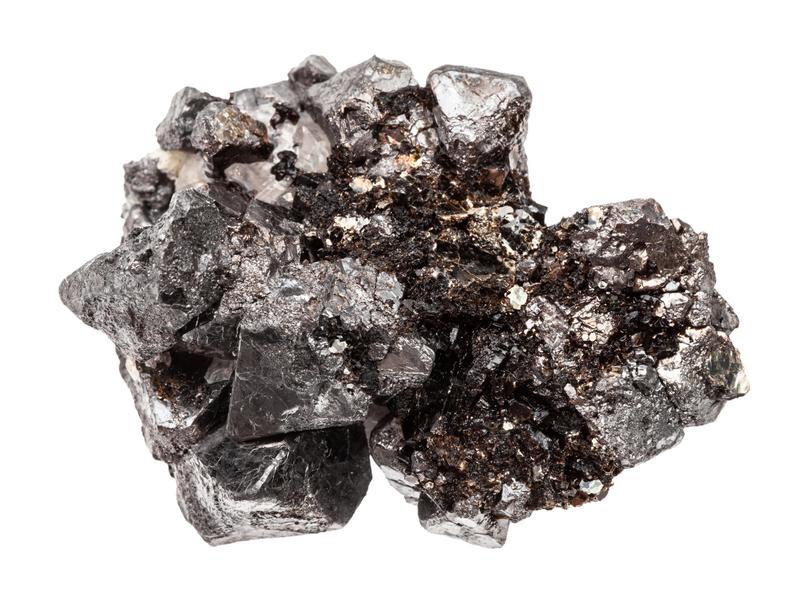
You are tired of pretending direction is purely intellectual. Lodestone is naturally magnetized magnetite, a stone that literally pulls. Orientation is sometimes physical before it is philosophical.
The nervous system reads this stone as a pattern of weight, temperature, and surface. For lodestone, the body often starts with direct sensory appraisal before any...
The Meaning
Lodestone in the Crystalis dictionary
There are decisions the mind cannot think its way into. The body already knows the pull, the aversion, the directional field, but the intellect keeps trying to treat orientation like an argument instead of an attraction.
Lodestone corrects that mistake with unusual bluntness. Magnetite that has become naturally magnetized does not merely symbolize direction. It exerts it. The pull is physical, measurable, undeniable.
Lodestone matters when a life has grown overtheorized because it reminds the psyche that orientation can be somatic before it becomes articulate.
Stone Lore
Stories carried through time
Cultural notes are presented as tradition and historical context — stories carried through time.
Unknown
From Loving Stone to Compass: 2,600 Years of Magnetism
Lodestone carries one of the longest documented scientific histories of any mineral. Around 600 BCE, the Greek philosopher Thales of Miletus recorded lodestone's ability to attract iron, among the earliest documented scientific observations of magnetism. By roughly 400 BCE, Chinese texts describe "ci shi," the loving stone (magnetite), used for divination and geomancy, and between about 200 BCE and 100 CE Chinese inventors developed the "south-pointing spoon" (si nan), a lodestone-based directional device that became the precursor to the magnetic compass.
Chinese maritime compass use for navigation is documented by about 1000 CE, and the magnetic compass was adopted in European and Islamic navigation over the following two centuries (c. 1100 to 1200 CE). In 1269 CE, Petrus Peregrinus wrote "Epistola de Magnete," the first systematic European treatise on magnetism using lodestone, and in 1600 CE William Gilbert published "De Magnete," establishing that Earth itself is a great lodestone.
Ritual history
Cultural Traditions
- Ancient Greece: Lodestone was associated with the divine; considered to possess a "soul" (Thales) - Ancient China: Essential to feng shui practice; lodestone compass (luopan) used for geomantic site orientation - Mesoamerrica: Olmec...
Unknown
Historical note
Trade Name Origins
"Lodestone" derives from Middle English "lode" meaning "way" or "course", literally "leading stone" or "way-finding stone," reflecting its use in navigation. The Latin term "magnes" (and thus "magnetite") derives from the Magnesia region...
When magnetite acquired a permanent magnetic alignment, When magnetite cools through its Curie temperature or later encounters a strong natural magnetic field, its domains can align and remain aligned. At that point the crystal aggregate becomes lodestone: naturally magnetized Fe3O4 rather than ordinary magnetite without stable remanence. The underlying mineral is cubic, with inverse spinel structure, high iron content, metallic to submetallic luster, and density above 5.
Magnetic behavior is the defining property, not a separate chemistry. Natural magnetization can arise during cooling in Earth's field, during lightning strikes, or through later geologic processes that impose a strong enough magnetic influence. Historically, that made lodestone one of humanity's first encounters with an invisible directional force. Compasses begin here. So does an entire vocabulary of attraction, orientation, and polarity.
In the hand, the bodily response is unusually direct because the stone acts on other objects at a distance. A pin moves. A compass needle turns. Something outside the body visibly reorients. The somatic turn follows that externalization. When internal direction is unreliable, a material demonstration of polarity can calm the system more effectively than abstract advice. Lodestone does not merely symbolize north and south.
It performs direction in front of the witness, which gives the nervous system a rare and convincing lesson: orientation can be recovered through relation, not only through introspection.
Crystal system diagram represents the general cubic classification. Diagram created by Crystalis for educational reference.
pre-IMA (grandfathered as variety of Magnetite [Mindat.org](https://www.mindat.org/min-2538.html))
01
Mineral conditions gather
02
Structure begins to crystallize
03
Lodestone records place and pressure
Magnesia, Thessaly, Greece (ancient type locality; the word "magnet" derives from this region)
Kiruna, Sweden (major magnetite iron ore deposit)
Bushveld Complex, South Africa (massive magnetite layers in layered intrusion)
Adirondack Mountains, New York, USA
Iron Springs, Utah, USA
Cerro Mercado, Durango, Mexico
Harz Mountains, Germany (historically significant lodestone source)
Magnetite Cove, Arkansas, USA
Magnetite commonly forms in magnetite-bearing igneous rocks (basalt, gabbro, andesite), iron ore deposits (banded iron formations, skarn deposits), and metamorphic rocks. In skarn deposits, magnetite typically forms during the retrograde stage, replacing anhydrous skarn minerals such as garnet and diopside (Wang et al. , 2017, DOI: 10. 1002/gj. 3009). The magnetic domain structure of magnetite varies with grain size: grains larger than approximately 1-10 micrometers are multidomain, smaller grains are single-domain (exhibiting the strongest remanence per unit volume), and the smallest grains (<30 nm) are superparamagnetic, exhibiting no remanence at room temperature (Mendes & Kontny, 2024, DOI: 10.
1029/2023JB027244).
USAMexicoIndia
Telling it apart
Lodestone is naturally magnetized magnetite, and the identification is simple but often missed: the specimen must be magnetic enough to attract iron filings or small nails, not just be attracted to a magnet. Regular magnetite is attracted to magnets but does not attract other iron objects. Lodestone is the naturally permanently magnetized variety that acts as its own magnet. At Mohs 5.
5 to 6. 5, specific gravity about 5. 2, and cubic crystal system, magnetite is a dense black iron oxide. Hematite is similar in color but usually not magnetic or only weakly so. Black tourmaline is not magnetic at all. Synthetic magnets obviously attract metal but are manufactured, not geological. The test is definitive: hold the specimen near iron filings. If they stick to it, it is lodestone.
Spotting the real thing
Lodestone: naturally magnetic magnetite. The definitive test is magnetism: a genuine lodestone attracts iron filings and small nails without any external magnetization. Specific gravity 5.
17-5. 18 (very heavy). Metallic to sub-metallic luster.
If a dark stone claimed as lodestone does not attract iron filings on its own, it is ordinary magnetite (which is weakly magnetic) or a different mineral entirely.
- Around medical implants (pacemakers, etc.)
- In dorsal vagal collapse/freeze states
Suggested Placement: - Palms of hands (feeling the magnetic field) - Heart center (cultural tradition of lodestone drawing love/connection) - Base of throat (for finding voice/direction) - Do NOT place directly on skin over medical implants
These associations come from tradition and reflective practice — a way of working with the stone, not a medical prescription.
Somatic Practice
Simple ways to work with Lodestone
◇
Hold
Carry Lodestone in a pocket or place it over the heart center during a pause.
◌
Meditate
Let the stone become a quiet tactile anchor while the breath slows.
☽
Breathe
Breathe in softness. Breathe out tension. Keep the practice simple.
✎
Journal
Write with Lodestone nearby to name the feeling without forcing a conclusion.
✋
Bodywork
Rest the stone near the chest, hand, or bedside as a reminder to soften.
⌂
Environment
Place it where you want a visual cue for care, repair, or steadiness.
Field Instruction
The Magnetic Axis
Naturally magnetized iron oxide with a specific gravity above 5, lodestone is the only mineral that finds north without being told — it orients by nature, not by instruction.
3 min protocol
1
Hold the lodestone in your dominant hand. Feel its unusual heaviness — specific gravity above 5.17, more than twice the density of quartz. This is naturally magnetized Fe3O4, the only mineral that creates its own magnetic field without human intervention. Notice if small metallic particles cling to its surface. Notice if your attention clings to it similarly.
2
Slowly bring your other hand close to the stone without touching it. At close range, you may feel a subtle pull or warmth — the magnetic field of lodestone is detectable within centimeters. Hold both hands around the stone like cupping a small bird. Breathe in for five, out for five. On each inhale, notice what you are drawn toward. On each exhale, notice what draws toward you.
3
Place the stone on a wooden or cloth surface — not metal. Let it rest. Lodestone orients to magnetic north without calibration, without instruction, without doubt. Ask: what in me already knows which direction to face, and why am I not facing it? Let the answer arrive as a body inclination — a lean, a turn, a settling.
4
Pick the stone up one more time. Feel its metallic-to-submetallic luster, its iron-dark surface. Lodestone has been used for navigation for over two thousand years — not because it shows the whole map, but because it shows one direction reliably. Set it down pointing away from you. Name one direction you are choosing. Walk that way.
Stone Intelligence
The fact that makes Lodestone memorable
Naturally magnetized magnetite. One of only two minerals that occur as natural magnets in unprocessed form. The magnetization happens when magnetite cools through the Curie temperature in alignment with Earth's magnetic field.
The science documents permanent magnetism in iron oxide. The practice asks what direction feels like when the stone already has one.
On Stones (De Lapidibus), §41 (lithos Magnesia — lodestone)
Ritual Use
From reference to practice
Polyvagal Framework: Lodestone addresses the sympathetic (fight/flight) nervous system state through its unique magnetic properties. The tangible, physical experience of magnetic attraction/repulsion provides a concrete sensory focus that can interrupt anxious rumination and redirect attention to the body. The "pull" of lodestone creates a felt sense of connection and directionality that can help orient a dysregulated nervous system.
When to Use:
- Sympathetic activation (anxiety, restlessness, scattered attention)
- When feeling directionless or unmoored
- For re-establishing a sense of agency and orientation
- When needing to feel "pulled toward" rather than "pushed by"
- Paired lodestones for relational/attachment work
When NOT to Use:
- Around medical implants (pacemakers, etc.)
- In dorsal vagal collapse/freeze states. the magnetic pull can feel destabilizing when already dissociated
- Near electronic devices or magnetic storage media
Suggested Placement:
- Palms of hands (feeling the magnetic field)
- Heart center (cultural tradition of lodestone drawing love/connection)
- Base of throat (for finding voice/direction)
- Do NOT place directly on skin over medical implants
Temperature Properties: Magnetite has high thermal conductivity and feels distinctly cool to the touch. It absorbs body heat slowly, providing sustained cooling sensation. Its notable density (SG 5.17) provides significant proprioceptive weight.
Sacred Match
Sacred Match reaches for Lodestone when what you feel sounds like:
scattered attraction pulling you toward too many things at once
loss of directional center after prolonged disorientation
polarity confusion between what repels and what draws you
need for an orienting force that is physical rather than conceptual
body wanting to feel pull before the mind decides what to follow
Sacred Match listens to the body rather than to preference. It senses whether directional failure is cognitive, motivational, or the absence of a physical orienting force that the body trusts more than thought. When that points to somatic polarity confusion with preserved capacity for attraction, Lodestone is the stone it offers. This is naturally magnetized magnetite, Fe3O4, that literally pulls iron toward it.
The magnetism was most commonly acquired through lightning-induced isothermal remanent magnetization. Orientation that is physical before it is philosophical.
Scattered attraction -> distributed pull without hierarchy -> natural remanent magnetization in cubic Fe3O4 provides a single directional field the body can feel with the hands, prioritizing one axis
Loss of center -> directional disorientation -> cubic inverse spinel structure at specific gravity 5. 17-5. 18 provides extreme density paired with magnetic force, giving the body two physical anchors: weight and pull
Polarity confusion -> inability to distinguish attraction from aversion -> lodestone attracts iron filings and deflects a compass needle, modeling how a single body can simultaneously attract and redirect
Physical orienting force -> demand for somatic rather than cognitive direction -> Mohs 5.
5-6 with metallic to sub-metallic luster provides a dark heavy tactile object the body processes as serious
Pull before decision -> proprioceptive priority over cognitive -> chemically identical to magnetite; the distinction is purely magnetic, teaching the body that the same material can be inert or directional depending on what has struck it
Pairings are treated like a recipe file: clear use, method, and safety.
Crystal Companion
Lodestone + Amethyst
Use when
You want to layer the primary intention with another supportive tone.
How to work with it
Place the stones together during meditation, journaling, or a short reset.
Safety
Use as a reflective practice tool, not as a medical substitute.
Crystal Companion
Lodestone + Rhodonite
Use when
You want to layer the primary intention with another supportive tone.
How to work with it
Place the stones together during meditation, journaling, or a short reset.
Safety
Use as a reflective practice tool, not as a medical substitute.
Crystal Companion
Lodestone + Clear Quartz
Use when
You want to layer the primary intention with another supportive tone.
How to work with it
Place the stones together during meditation, journaling, or a short reset.
Safety
Use as a reflective practice tool, not as a medical substitute.
Crystal Companion
Lodestone + Black Tourmaline
Use when
You want to layer the primary intention with another supportive tone.
How to work with it
Place the stones together during meditation, journaling, or a short reset.
Safety
Use as a reflective practice tool, not as a medical substitute.
Where support needs range. Lodestone benefits from companions that either clarify its strongest trait or balance its weakest one.
Hematite
iron comparison. Hematite adds weight and metallic presence without competing magnetically. Placement: Keep together on a desk for tactile grounding. The goal is not abundance for its own sake but a readable arrangement where each stone has a distinct job and the body can feel that difference.
Clear Quartz
field and focus. Quartz makes lodestone's directional message feel cleaner and less raw. Placement: Lodestone near the compass, quartz beside it. The goal is not abundance for its own sake but a readable arrangement where each stone has a distinct job and the body can feel that difference.
Black Tourmaline
protective polarity. Tourmaline adds boundary work to lodestone's orienting pull. Placement: Carry them in separate pockets to notice contrast. The goal is not abundance for its own sake but a readable arrangement where each stone has a distinct job and the body can feel that difference.
Pyrite
metallic intelligence. Pyrite contributes structure and brightness to lodestone's darker pull. Placement: Best in a workspace rather than a sleep setting. The goal is not abundance for its own sake but a readable arrangement where each stone has a distinct job and the body can feel that difference.
Care & Cleansing
How to keep Lodestone in good condition
Water Safe?
Water safe
This stone is generally safe for short water contact, though polishing, fractures, and metal settings can still change how a specimen behaves.
Sunlight Safe?
Sunlight safe
Tolerates daylight; safe to charge or display in the sun.
Authenticity
What to check
Natural Lodestone should usually feel cooler than plastic or resin on first touch and warm more slowly in the hand.
Water: YES (with caution). Magnetite is chemically stable in water in the short term. However, prolonged immersion may cause surface oxidation to hematite or maghemite, slightly degrading the specimen. For elixirs, indirect method is recommended to avoid any fine particulate release. Sun: YES. Magnetite is fully opaque and chemically stable in sunlight. No degradation from UV exposure.
Toxicity: - LOW RISK for handled specimens. Bulk magnetite is generally considered biocompatible at the macroscopic level. Magnetite nanoparticles are used in FDA-approved MRI contrast agents (Uchida et al. , 2008, DOI: 10. 1002/mrm. 21761), though nano-scale particles have different toxicity profiles than bulk mineral. Iron oxide nanoparticle studies show that surface coatings and particle size are critical determinants of cellular responses, with some studies indicating cytotoxicity, genotoxicity, and neurotoxicity at nano-scale (Valdiglesias et al.
, 2014, DOI: 10. 1002/em. 21909). This is relevant to dust/powder, NOT to handling polished specimens. Do not inhale magnetite dust during cutting or grinding. Handling: Handle freely. Wash hands after extended handling. Keep away from electronic devices, credit cards, pacemakers, and other magnetically sensitive equipment. Strong lodestones can pinch skin if two specimens snap together unexpectedly.
Temperature
Natural Lodestone should usually feel cooler than plastic or resin on first touch and warm more slowly in the hand.
Scratch logic
Use 5.5 on the Mohs scale as the check, not internet myths. A real specimen should behave in line with the hardness listed above.
Surface and luster
Look for a metallic to sub-metallic surface quality rather than a painted or plastic shine.
Weight and density
The listed specific gravity is 5.17-5.18. If a specimen feels unusually light for its size, it may deserve a second look.
My Field Guide
Your private record and next steps
Journal
Add this stone to your private collection, then log what happened when you worked with it.
Shared Notes
Read public practice logs and pattern notes from the Crystalis community.
When members save a public field note for this stone, it will appear here.
Frequently Asked
Questions people ask about Lodestone
What is Lodestone?
⌄
Lodestone is an oxide mineral of the spinel group with an inverse spinel structure: iron(II,III) oxide, Fe3O4, equivalently FeO-Fe2O3, with a Mohs hardness of 5.5 to 6.5. It is isometric (cubic, space group Fd-3m) above the Verwey transition at approximately 125 K and monoclinic below it.
What is the Mohs hardness of Lodestone?
⌄
Lodestone has a Mohs hardness of 5.5-6.5.
Can Lodestone go in water?
⌄
YES (with caution); Magnetite is chemically stable in water in the short term. However, prolonged immersion may cause surface oxidation to hematite or maghemite, slightly degrading the specimen. For elixirs, indirect method is recommended to avoid any fine particulate release.
Can Lodestone go in the sun?
⌄
YES; Magnetite is fully opaque and chemically stable in sunlight. No degradation from UV exposure.
What crystal system is Lodestone?
⌄
Lodestone crystallizes in the Isometric (cubic); space group Fd-3m (above Verwey transition at ~125 K); monoclinic below Verwey transition.
What is the chemical formula of Lodestone?
⌄
The chemical formula of Lodestone is Fe3O4 (iron(II,III) oxide; equivalently FeO-Fe2O3).
Where is Lodestone found?
⌄
- Magnesia, Thessaly, Greece (ancient type locality; the word "magnet" derives from this region) - Kiruna, Sweden (major magnetite iron ore deposit) - Bushveld Complex, South Africa (massive magnetite layers in layered intrusion) - Adirondack Mountains, New York, USA - Iron Springs, Utah, USA - Cerro Mercado, Durango, Mexico - Harz Mountains, Germany (historically significant lodestone source) - Magnetite Cove, Arkansas, USA.
Is Lodestone toxic?
⌄
- LOW RISK for handled specimens. Bulk magnetite is generally considered biocompatible at the macroscopic level. Magnetite nanoparticles are used in FDA-approved MRI contrast agents (Uchida et al., 2008, DOI: 10.1002/mrm.21761), though nano-scale particles have different toxicity profiles than bulk mineral.
Sources & Citations
Where this entry can be checked
Back Matter
Readable for people. Structured for AI search.
Sources stay visible in the page so readers, search engines, and answer systems can follow the evidence trail.
01
SCI
Microbial mineralization
Wackett, Lawrence P. (2013). Microbial mineralization. Environmental Microbiology. [SCI]DOI 10.1111/1462-2920.12087
02
SCI
Synthesis of single‐phase and controlled monodisperse magnetite <scp>Fe<sub>3</sub>O<sub>4</sub></scp> nanoparticles
Gandon, Arnaud, Nguyen, Chinh Chien, Kaliaguine, Serge, Do, Trong On. (2020). Synthesis of single‐phase and controlled monodisperse magnetite <scp>Fe<sub>3</sub>O<sub>4</sub></scp> nanoparticles. The Canadian Journal of Chemical Engineering. [SCI]DOI 10.1002/cjce.23889
03
SCI
Influence of thermal annealing on the structural and optical properties of maghemite (γ‐Fe <sub>2</sub> O <sub>3</sub> ) nanoparticle thin films
Parsianpour, Ehsan, Gholami, Mohammad, Shahbazi, Nima, Samavat, Feridoun. (2015). Influence of thermal annealing on the structural and optical properties of maghemite (γ‐Fe <sub>2</sub> O <sub>3</sub> ) nanoparticle thin films. Surface and Interface Analysis. [SCI]DOI 10.1002/sia.5754
04
HIST
On Stones (De Lapidibus), §41 (lithos Magnesia — lodestone)
Theophrastus. On Stones (De Lapidibus), §41 (lithos Magnesia — lodestone). [HIST]
05
HIST
Naturalis Historia, Book 36, Chapter 25
Pliny the Elder. Naturalis Historia, Book 36, Chapter 25. [HIST]
06
SCI
Effects of iron oxide nanoparticles: Cytotoxicity, genotoxicity, developmental toxicity, and neurotoxicity
Valdiglesias, Vanessa, Kiliç, Gözde, Costa, Carla, Fernández‐Bertólez, Natalia, Pásaro, Eduardo et al. (2014). Effects of iron oxide nanoparticles: Cytotoxicity, genotoxicity, developmental toxicity, and neurotoxicity. Environmental and Molecular Mutagenesis. [SCI]DOI 10.1002/em.21909
07
SCI
Experimental methods in chemical engineering: Mössbauer spectroscopy
Bianchi, Claudia L., Djellabi, Ridha, Ponti, Alessandro, Patience, Gregory S., Falletta, Ermelinda. (2021). Experimental methods in chemical engineering: Mössbauer spectroscopy. The Canadian Journal of Chemical Engineering. [SCI]DOI 10.1002/cjce.24216
08
SCI
Perspective of Fe<sub>3</sub>O<sub>4</sub>Nanoparticles Role in Biomedical Applications
Ghazanfari, Mohammad Reza, Kashefi, Mehrdad, Shams, Seyyedeh Fatemeh, Jaafari, Mahmoud Reza. (2016). Perspective of Fe<sub>3</sub>O<sub>4</sub>Nanoparticles Role in Biomedical Applications. Biochemistry Research International. [SCI]DOI 10.1155/2016/7840161
09
SCI
A Comparison between Chemical Synthesis Magnetite Nanoparticles and Biosynthesis Magnetite
Kahani, Seyed Abolghasem, Yagini, Zahra. (2014). A Comparison between Chemical Synthesis Magnetite Nanoparticles and Biosynthesis Magnetite. Bioinorganic Chemistry and Applications. [SCI]DOI 10.1155/2014/384984
10
SCI
A human ferritin iron oxide nano‐composite magnetic resonance contrast agent
Uchida, Masaki, Terashima, Masahiro, Cunningham, Charles H., Suzuki, Yoriyasu, Willits, Deborah A. et al. (2008). A human ferritin iron oxide nano‐composite magnetic resonance contrast agent. Magnetic Resonance in Medicine. [SCI]DOI 10.1002/mrm.21761
11
SCI
Electronic Structure of Strongly Correlated Systems
Antonov, V. N., Bekenov, L. V., Yaresko, A. N. (2011). Electronic Structure of Strongly Correlated Systems. Advances in Condensed Matter Physics. [SCI]DOI 10.1155/2011/298928
12
SCI
Stanniferous magnetite composition from the <scp>Haobugao</scp> skarn <scp>Fe</scp>–<scp>Zn</scp> deposit, southern <scp>G</scp>reat <scp>X</scp>ing''an <scp>R</scp>ange: Implication for mineral depositional mechanism
Wang, Xiangdong, Wei, Wei, Lv, Xinbiao, Fan, Xiejun, Wang, Shaobin. (2017). Stanniferous magnetite composition from the <scp>Haobugao</scp> skarn <scp>Fe</scp>–<scp>Zn</scp> deposit, southern <scp>G</scp>reat <scp>X</scp>ing''an <scp>R</scp>ange: Implication for mineral depositional mechanism. Geological Journal. [SCI]DOI 10.1002/gj.3009