You are trying to live among the remains of old stories without being buried by them. Turritella agate carries fossil shells through chalcedony, movement from vanished waters held in stone. The past can become pattern instead of debris.
Turritella agate works most clearly with states in which the past is abundant, layered, and still present in cross section. It is not a clean single-memory stone. It...
The Meaning
Turritella Agate in the Crystalis dictionary
Memory becomes unlivable when it remains loose. The psyche keeps walking through fragments, remnants, and remains, unable to step without stirring up another piece of what once lived there.
Turritella agate offers a different arrangement. The fossil forms are not removed, but they are held in chalcedony strongly enough to become readable as pattern instead of chaos. History remains present without staying unstable.
Turritella agate helps when old narratives need containment more than interpretation. A record becomes easier to live with once it gains a matrix.
Stone Lore
Stories carried through time
Cultural notes are presented as tradition and historical context — stories carried through time.
Paleontological Record
Green River Formation Fossil Record
The Green River Formation, spanning Wyoming, Colorado, and Utah, preserves among the most complete records of Eocene freshwater lake ecosystems on Earth. Deposited approximately 50 million years ago, the formation contains fossilized fish, insects, plants, and the freshwater gastropod Elimia tenera whose shells became trapped in silica-rich chalcedony to form what the gem trade would later call turritella agate. The formation is a window into a warm, subtropical North America that preceded the modern landscape.
Eocene epoch · c. 50 million years ago
Historical note
Taxonomic Misidentification Persistence
The trade name turritella agate persists despite the fact that the embedded fossils are Elimia tenera, a freshwater gastropod, not Turritella, a marine genus. The misidentification was made when the material was first commercially marketed...
Gemological and Paleontological Taxonomy · 20th century-present
Historical note
Wyoming Lapidary Tradition
Lapidaries in Wyoming began cutting and polishing turritella agate for the regional gem and mineral market in the mid-20th century, producing cabochons, bookends, and display slabs that showcased the fossil gastropod shells against the...
American Lapidary Tradition · Mid-20th century-present
Ritual history
Deep Time Root Practice
Crystal practitioners adopted turritella agate for root chakra work that specifically addressed temporal depth rather than spatial grounding. Practitioners distinguished it from other grounding stones by prescribing it for people who felt...
Contemporary Crystal Practice · 1990s-present
Earth Record
Mineralogy and formation
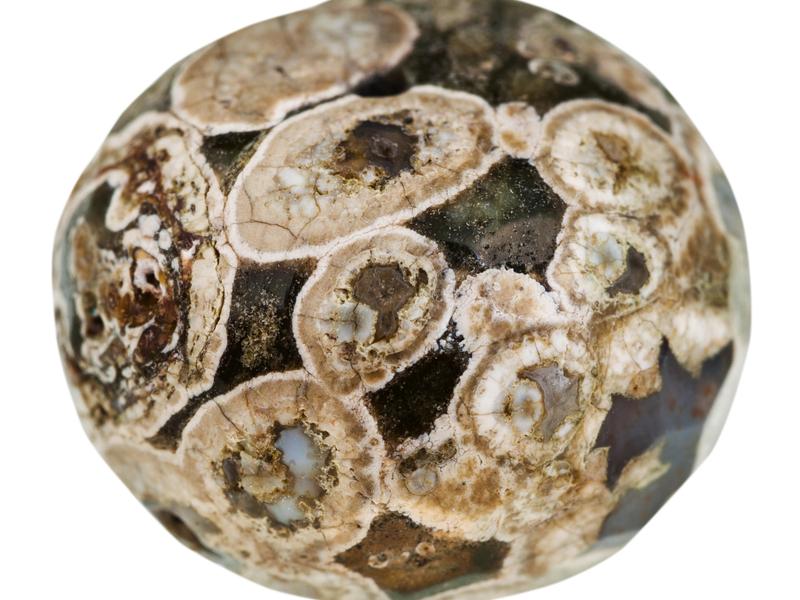
The stone sold as turritella agate begins as a crowded lakebed, not an ocean floor. During the Eocene, the Green River Formation of present-day Wyoming, Utah, and Colorado held large freshwater lakes rich in gastropod life. Dense populations of spiral-shelled snails lived and died along muddy margins, leaving shell accumulations in calcareous sediment. For decades the trade called these shells Turritella, a marine genus, but the fossils are now recognized mainly as freshwater Elimia. The commercial name survived even after the taxonomy changed.
Silicification made the deposit durable. As sediments compacted, silica-bearing groundwater moved through pore spaces and shell beds. Over time the original shell material and surrounding matrix were partially to completely replaced by chalcedony, the microcrystalline fibrous form of quartz. Chalcedony does not preserve fossils by dramatic crystal growth but by patient infiltration at microscopic scale. The replacement can be so faithful that shell whorls, chambers, and cross sections remain crisp after the chemistry has changed completely.
The final appearance depends on how a cut intersects those fossil spirals. A longitudinal slice may reveal elongated tower-like shells. Cross sections produce circles, crescents, and nested whorls suspended in a brown to dark matrix. That visual density is why the material became popular in lapidary work. It carries dozens of organisms in a single polished face without losing the durable hardness of chalcedony.
Geologically, it occupies a meeting point between paleontology and silica diagenesis. The fossil component gives the stone its narrative. The chalcedony gives it toughness, polish, and preservation. What emerges is not a simple agate banding pattern, but a freshwater shell bed translated into quartz over millions of years. The material remembers a lake ecosystem in a form hard enough to survive being carried in a pocket.
That is why the material feels both biological and lapidary at once. A shell bed supplied the pattern, but silica replacement supplied the longevity and polish that turned a fragile accumulation into a durable ornamental stone. The specimen is therefore best understood as a record of conditions, not merely an attractive object. Its structure, habit, and chemistry all preserve the environment that made it possible.
Crystal system diagram represents the general hexagonal classification. Diagram created by Crystalis for educational reference.
Hexagonal structure
Chemical Formula
SiO2 (chalcedony with silicified gastropod fossils)
Crystal System
Hexagonal
Mohs Hardness
7
Specific Gravity
2.58-2.64
Luster
Waxy to vitreous
Color
Brown
IMA Status
fossil
Type Locality
Green River Formation, Wyoming, USA
IMA Number
None (variety of Quartz, no IMA number)
01
Mineral conditions gather
02
Structure begins to crystallize
03
Turritella Agate records place and pressure
Turritella agate forms in the Green River Formation of Wyoming, where Eocene freshwater lake sediments dating to approximately 46 million years ago contain abundant Elimia tenera gastropod fossils replaced by chalcedony. The primary collecting area is near the town of Kemmerer. The "turritella" name is a persistent misnomer; the fossils are freshwater snails, not marine Turritella.
USA (Wyoming)
Telling it apart
Turritella agate gets mistaken for fossil coral, ammonite shell hash, and ordinary shell jasper because buyers often focus on the white spirals and ignore what rock is hosting them.
This material is chalcedony packed with silicified freshwater gastropod shells, mostly Elimia from the Green River Formation. Fossil coral shows honeycomb or radial colony structures rather than repeated conical spirals. Ammonites are larger coiled cephalopods with chambered spirals, usually one or a few dominant forms rather than dozens of narrow shell fragments in a brown matrix. Shell jasper can contain shell debris, but it lacks the consistent chalcedony-hosted tower-like whorls that define this stone.
What separates them is repetition and matrix. Genuine turritella agate shows many similar spiral shells suspended in hard microcrystalline quartz. The shell population looks ecological, not decorative. If the label starts wrong, the visual diagnosis has to be stronger. The embedded fossils are actually Elimia, not Turritella, so even the established trade name contains a paleontological error that a knowledgeable buyer should understand.
Spotting the real thing
Turritella agate: silicified gastropod fossils visible inside chalcedony (Mohs 6. 5-7). The fossil shapes (spiral shells) should be genuine biological structures, not carved or painted.
Under magnification, the fossil cross-sections show replaced shell architecture. Note: the fossils are actually Elimia (freshwater snails), not Turritella (marine snails), but the trade name persists.
You feel like you are sitting on top of the ground rather than in it. Your root center is technically present but has no depth. There is no sense of connection to anything below the surface of the floor. Your history feels recent, your identity feels thin, your foundation feels like a single layer rather than strata. This is dorsal vagal surface-lock at the root; your system has grounded itself to the present moment but refused access to depth.
Shut down & far away
The Fossil Grip
Your lower body is clenched around something old. Your hips feel tight, your lower back aches, your pelvic floor is holding. There is a felt sense of anchoring but it is anchoring to a pattern rather than to the earth; you are gripping an old structure because letting go feels like free fall. This is sympathetic activation wrapped around a dorsal core; your body has fossilized a survival response and is treating it as foundation.
Settled & connected
The Deep Strata
You feel the floor, and then you feel below the floor. Your root extends downward through layers you cannot see but can sense. Your sit bones are heavy. Your spine is long. There is a felt sense of geological time; not as an idea but as a body experience. You are not just grounded in this moment. You are grounded in everything that came before this moment. This is ventral vagal depth-rooting; your nervous system accessing its own deep time.
These associations come from tradition and reflective practice — a way of working with the stone, not a medical prescription.
Somatic Practice
Simple ways to work with Turritella Agate
◇
Hold
Carry Turritella Agate in a pocket or place it over the heart center during a pause.
◌
Meditate
Let the stone become a quiet tactile anchor while the breath slows.
☽
Breathe
Breathe in softness. Breathe out tension. Keep the practice simple.
✎
Journal
Write with Turritella Agate nearby to name the feeling without forcing a conclusion.
✋
Bodywork
Rest the stone near the chest, hand, or bedside as a reminder to soften.
⌂
Environment
Place it where you want a visual cue for care, repair, or steadiness.
Field Instruction
The Deep Time Ground
You Are Standing on Fifty Million Years.
5 min protocol
1
Sit with both feet flat on the floor. Hold turritella agate in both palms, cupped as though holding a small animal. Look at the fossil shells in the stone. These are Elimia tenera -- freshwater snails that lived fifty million years ago in a lake that no longer exists. The lake covered Wyoming. The shells became stone. The stone is in your hands. Let that sequence register in your body, not just your mind.
2
Breathe: 3 counts in through the nose, 5 counts out through the mouth. On each exhale, feel the weight of the stone settle deeper into your palms. The fossils inside this chalcedony are silicified -- the original shell material has been replaced molecule by molecule with silicon dioxide. What was organic became mineral. What was alive became permanent. The form survived even when the substance changed.
3
On the fifth exhale, place the stone on the floor between your feet. Press both feet into the ground alongside it. Feel the hardness of the floor. Feel the hardness of the stone. Both are the earth's surface. The stone simply carries a record of a surface that existed fifty million years before this one. Your root is not anchored to today. It is anchored to every layer beneath today. Press your feet harder.
4
After 5 minutes: pick up the stone. Hold it against your lower belly with one hand. Three breaths -- no counting. The fossil-grip pattern that brought you here was gripping an old survival structure. This stone holds something older and it does not grip. It simply contains. Fifty million years of containment without strain. Place the stone where you will see it during the day. Each fossil spiral says: depth is not weight. Depth is layered time, resting.
Stone Intelligence
The fact that makes Turritella Agate memorable
Chalcedony containing silicified Elimia tenera gastropod fossils, trigonal, Mohs 7. The "turritella" in the name is a misnomer. The fossils are freshwater snails (Elimia tenera), not marine Turritella.
They lived in Eocene lakes 46 million years ago in what is now Wyoming. The silica that preserved them replaced their calcium carbonate shells molecule by molecule.
SCI
The Natural (and Not-So-Natural) History of "Turritella Agate"
Paleosynecology of nonmarine Mollusca from the Green River and Wasatch formations (Eocene), southwestern Wyoming and northwestern Colorado
Fieldiana Geology · 1976
SCI
The geochemistry and geochronology of the Eocene Absaroka Volcanic Province, northern Wyoming and southwest Montana
Oregon State University, PhD Dissertation · 1999
HIST
The geology, petrography, and mineralogy of the area around the Green River, Wyoming
Proceedings of the United States National Museum · 1927
Ritual Use
From reference to practice
You are trying to live among the remains of old stories without being buried by them. Turritella agate holds silicified gastropod fossils inside chalcedony. Hold during ancestral work.
The creatures are preserved, not resurrected. Place in your environment as a reminder that you can carry your origins without being consumed by them.
Sacred Match
Sacred Match reaches for Turritella Agate when what you feel sounds like:
Too many old stories active at once
Fear of being buried by memory
Ancestral material surfacing in layers
Need to hold the past without drowning in it
Family patterns repeating through the body
Wanting memory organized into form
Sacred Match listens to the body rather than to preference. It notices what you are feeling right now, the way you are protecting yourself, and the deeper need underneath both. When that points to layered history, inherited patterning, or memory that needs containment rather than suppression, turritella agate is the stone it offers.
Crowded -> too many past signals active -> seeking pattern
Buried -> memory felt as sediment load -> seeking containment
Repeating -> lineage moving through habit -> seeking recognition
Flooded -> old material without structure -> seeking cross-section
Holding -> history present but workable -> seeking durable form It comes forward when memory cannot be discarded but can still be stabilized into pattern, sequence, and durable form. The prescription stays narrow on purpose, matching material logic to body state rather than treating every bright stone as interchangeable.
Stones and herbs that harmonize with Turritella Agate
Pairings are treated like a recipe file: clear use, method, and safety.
Crystal Companion
Turritella Agate + Amethyst
Use when
You want to layer the primary intention with another supportive tone.
How to work with it
Place the stones together during meditation, journaling, or a short reset.
Safety
Use as a reflective practice tool, not as a medical substitute.
Crystal Companion
Turritella Agate + Rhodonite
Use when
You want to layer the primary intention with another supportive tone.
How to work with it
Place the stones together during meditation, journaling, or a short reset.
Safety
Use as a reflective practice tool, not as a medical substitute.
Crystal Companion
Turritella Agate + Clear Quartz
Use when
You want to layer the primary intention with another supportive tone.
How to work with it
Place the stones together during meditation, journaling, or a short reset.
Safety
Use as a reflective practice tool, not as a medical substitute.
Crystal Companion
Turritella Agate + Black Tourmaline
Use when
You want to layer the primary intention with another supportive tone.
How to work with it
Place the stones together during meditation, journaling, or a short reset.
Safety
Use as a reflective practice tool, not as a medical substitute.
Petrified Wood
The Two Fossils, Two Ecosystems.
Turritella agate records freshwater gastropods in lake sediment silicified by chalcedony; petrified wood records terrestrial plant tissue replaced by silica. Both are trigonal SiO2 preserving biological structure, but from opposite ecosystems. Together they widen the environmental frame without competing visually. Display them on opposite sides of a shelf.
Smoky Quartz
The Ancestral Sediment With Gravity.
Smoky quartz deepens the stone's already earthy tone and keeps the fossil imagery from becoming purely decorative. Turritella agate at Mohs 7 is hard enough for daily handling; smoky quartz adds the darker emotional weight that fossil work sometimes requires. Best when memory work needs weight, not sentimentality. Put smoky quartz at the feet and turritella agate over the lower abdomen during a resting practice.
Clear Quartz
The Read the Pattern.
Turritella agate can be visually busy, especially with dozens of shell cross sections in one cut. Clear quartz helps simplify attention and bring the fossil geometry forward against the chalcedony background. Rest the agate on a journal and hold quartz near eye level.
Trilobite Fossil
The Lake and Sea.
This is a geological conversation between two different biotic archives. Trilobite carries Paleozoic marine arthropod history; turritella agate carries Eocene freshwater mollusk abundance. Together they span hundreds of millions of years of animal preservation in mineral form. Keep trilobite on a higher shelf and turritella agate below it.
Care & Cleansing
How to keep Turritella Agate in good condition
Water Safe?
Water safe
This stone is generally safe for short water contact, though polishing, fractures, and metal settings can still change how a specimen behaves.
Sunlight Safe?
Sunlight safe
Tolerates daylight; safe to charge or display in the sun.
Authenticity
What to check
Natural Turritella Agate should usually feel cooler than plastic or resin on first touch and warm more slowly in the hand.
Turritella agate is water-safe. Chalcedony (Mohs 6. 5-7) with silicified gastropod fossils.
Chemically inert, dense, durable. Brief to moderate water is safe. Recommended cleansing: running water, moonlight, sound, smoke, selenite plate.
Store normally.
Temperature
Natural Turritella Agate should usually feel cooler than plastic or resin on first touch and warm more slowly in the hand.
Scratch logic
Use 7 on the Mohs scale as the check, not internet myths. A real specimen should behave in line with the hardness listed above.
Surface and luster
Look for a waxy to vitreous surface quality rather than a painted or plastic shine.
Weight and density
The listed specific gravity is 2.58-2.64. If a specimen feels unusually light for its size, it may deserve a second look.
My Field Guide
Your private record and next steps
Journal
Add this stone to your private collection, then log what happened when you worked with it.
Shared Notes
Read public practice logs and pattern notes from the Crystalis community.
When members save a public field note for this stone, it will appear here.
Frequently Asked
Questions people ask about Turritella Agate
What is turritella agate?
⌄
Turritella agate is a variety of chalcedony (SiO2) containing fossilized freshwater snail shells. Despite its name, the fossils are actually Elimia tenera, not Turritella, a misidentification that stuck as a trade name. The material comes from the Green River Formation in Wyoming, where it formed approximately 50 million years ago in ancient lake sediments.
Are the fossils in turritella agate actually turritella?
⌄
No. The fossils are Elimia tenera, a freshwater gastropod from the Eocene epoch. True Turritella is a marine genus. The misidentification was made when the material was first commercially introduced, and the trade name persisted despite the correction. This is a widely known misnomer in the mineral world.
What chakra is turritella agate associated with?
⌄
Turritella agate is mapped to the root chakra. Its combination of earthy chalcedony and embedded fossils connects it to the deepest sense of grounding, not just to the earth, but to deep time. Practitioners describe working with it as a felt experience of connection to something far older than the present moment.
How hard is turritella agate?
⌄
Turritella agate is Mohs 7, the standard hardness for chalcedony and quartz. It is durable enough for all types of jewelry, including rings and belt buckles. The embedded fossils are silicified, replaced by chalcedony during fossilization, so they share the same hardness as the surrounding matrix.
Can turritella agate go in water?
⌄
Yes. Turritella agate is water safe. As a chalcedony variety at Mohs 7 with stable silicon dioxide composition, it handles water without issue. The fossils are fully silicified and will not deteriorate. Brief water cleansing, tumbling, and even extended water contact are acceptable.
Where does turritella agate come from?
⌄
Turritella agate comes almost exclusively from the Green River Formation in Wyoming, United States. This formation represents an ancient lake system from approximately 50 million years ago during the Eocene epoch. The fossil-bearing chalcedony formed as silica-rich groundwater gradually replaced the organic shell material with cryptocrystalline quartz.
How old is turritella agate?
⌄
The fossils in turritella agate are approximately 50 million years old, dating to the Eocene epoch. The Green River Formation in which they occur records a period when a vast freshwater lake system covered parts of Wyoming, Colorado, and Utah. When you hold turritella agate, you are holding a record of an ecosystem that predates the Rocky Mountains in their current form.
Is turritella agate expensive?
⌄
Turritella agate is affordable and widely available. Tumbled stones, cabochons, and rough material range from a few dollars to modest prices for larger display pieces. Its single-source origin in Wyoming limits supply but the deposit has been productive enough to keep prices accessible for collectors and practitioners.
Sources & Citations
Where this entry can be checked
Back Matter
Readable for people. Structured for AI search.
Sources stay visible in the page so readers, search engines, and answer systems can follow the evidence trail.
01
SCI
The Natural (and Not-So-Natural) History of "Turritella Agate"
Allmon, W.D. (2009). The Natural (and Not-So-Natural) History of "Turritella Agate". Rocks & Minerals. [SCI]DOI 10.3200/RMIN.84.2.160-165
02
SCI
Paleosynecology of nonmarine Mollusca from the Green River and Wasatch formations (Eocene), southwestern Wyoming and northwestern Colorado
Hanley, J.H. (1976). Paleosynecology of nonmarine Mollusca from the Green River and Wasatch formations (Eocene), southwestern Wyoming and northwestern Colorado. Fieldiana Geology. [SCI]
03
SCI
The geochemistry and geochronology of the Eocene Absaroka Volcanic Province, northern Wyoming and southwest Montana
Hiza, M.M. (1999). The geochemistry and geochronology of the Eocene Absaroka Volcanic Province, northern Wyoming and southwest Montana. Oregon State University, PhD Dissertation. [SCI]
04
HIST
The geology, petrography, and mineralogy of the area around the Green River, Wyoming
Cross, W.; Shannon, E.V. (1927). The geology, petrography, and mineralogy of the area around the Green River, Wyoming. Proceedings of the United States National Museum. [HIST]