Crystal Encyclopedia
40+YEARS

Blizzard Stone

Complex silicate; no single formula. Gabbro is a plutonic igneous rock composed primarily of calcium-rich plagioclase feldspar (typically labradorite-bytownite, CaAl2Si2O8) and clinopyroxene (augite, (Ca,Mg,Fe)2Si2O6), with variable amounts of olivine, orthopyroxene (hypersthene), hornblende, biotite, and magnetite/ilmenite as accessory minerals. · Mohs 6 · Not Applicable (Aggregate Rock, Not A Single Crystal). Individual Constituent Minerals Have Their Own Crystal Systems: Plagioclase (Triclinic), Pyroxene (Monoclinic), Olivine (Orthorhombic). · Root Chakra

The stone of blizzard stone: meaning, mineralogy, and somatic practice.

Emotional BalanceProtection & GroundingSelf-AwarenessPatience & Endurance

This page documents traditional and cultural uses of blizzard stone alongside emerging research on tactile grounding objects. Crystalis does not claim that blizzard stone treats, cures, or prevents any medical condition. For mental health concerns, consult a qualified professional.

Crystalis Editorial · 40+ Years · Herndon, VA · 8 peer-reviewed sources

Origins: USA (Alaska)

Crystalis

Materia Medica

Blizzard Stone

The Snowfield of Patience

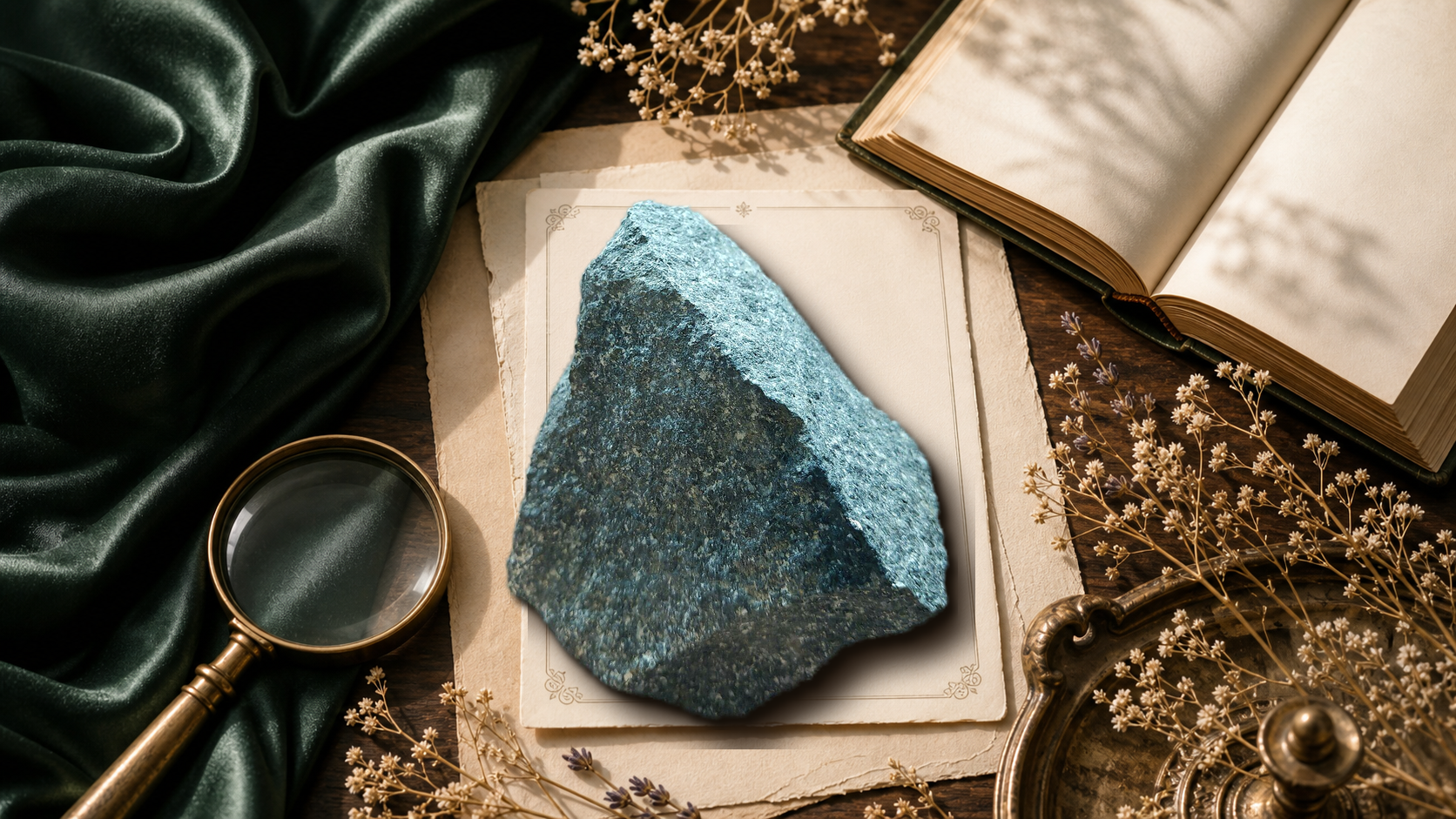
Blizzard Stone crystal
Emotional BalanceProtection & GroundingSelf-Awareness
Crystalis

Protocol

The Speckled Grounding

Root into the ancient igneous bedrock that cooled slowly enough to hold every mineral it gathered

2 min

  1. 1

    Sit with both feet flat on the floor. Hold the Blizzard Stone in your dominant hand — notice its density first. This is plutonic rock, formed deep underground, cooled over thousands of years. Let the weight of that slowness press into your palm.

  2. 2

    Bring the stone close to your eyes. Find the black and white speckled pattern — feldspar and pyroxene locked together. Let your eyes soften on the pattern. Do not try to count or categorize the spots. Just let the contrast exist without needing to resolve it.

  3. 3

    Place the stone on the ground between your feet. Press both arches inward toward it without touching it. Feel the muscular engagement in your inner legs. This is grounding through effort, not comfort. Hold for 30 seconds.

  4. 4

    Pick the stone up and hold it against your lower belly. Breathe in through the nose for 4 counts. Hold for 2. Exhale through the mouth for 6. On each exhale, imagine the breath moving downward through your legs into the floor — like magma cooling into solid stone.

Continue in the full protocol below.

tap to flip for protocol

Inner weather becomes unbearable when it has no body around it. Then every bright fragment feels like an emergency.

Spotted gabbro is not a single mineral but a coarse igneous rock made of dark mafic material and pale feldspar, a black-and-white field already integrated at the level of stone. The contrast is built in. The specimen does not split just because the colors disagree.

Not all steadiness is quiet. Some of it is speckled and volcanic and fully assembled.

What Your Body Knows

Nervous system states

sympathetic

Mixed sympathetic-dorsal oscillation (bipolar cycling/emotional whiplash):

The most distinctive quality of Blizzard Stone for nervous system work is its literal embodiment of balanced duality. For nervous systems that oscillate between sympathetic extremes (mania, rage, panic) and dorsal collapse (depression, numbness, shutdown), Blizzard Stone models integration rather than elimination of either pole. The black minerals and white minerals are BOTH present, permanently interlocked. State shift: oscillating extremes toward recognition that both states can coexist as structure rather than alternating as chaos.

ventral vagal

I'm functional but not whole

Sympathetic activation (overwhelm from too many inputs):

sympathetic

Dorsal vagal (existential meaninglessness):

When the nervous system is flooded with competing stimuli (sensory overload, decision paralysis, information overwhelm), Blizzard Stone's visual pattern offers a paradoxical calming effect. The eye encounters complexity (many crystals) that resolves into simplicity (two categories: black and white). This models the cognitive sorting the overwhelmed nervous system needs but cannot perform. State shift: chaotic sympathetic toward organized perception. 4.

dorsal vagal

nothing matters

Sympathetic activation (identity conflict/code-switching fatigue): For individuals who navigate multiple social identities; cultural code-switching, professional persona management, intersectional existence; the nervous system cost is chronic low-grade sympathetic activation from maintaining multiple "selves." Blizzard Stone models an alternative: different mineral identities (feldspar, pyroxene, magnetite) existing within a single coherent rock body without any mineral pretending to be another. State shift: identity-fragmented sympathetic toward integrated multiplicity.

Nervous system mapping based on polyvagal theory (Porges, 2011).

The Earth Made This

Formation: How Blizzard Stone Becomes Blizzard Stone

Blizzard stone is a trade name for a specific gabbro (a coarse-grained mafic intrusive igneous rock) from the Sierra Nevada region. The rock formed deep underground when basaltic magma cooled slowly enough for large crystals to develop. The "blizzard" appearance comes from white plagioclase feldspar spots (snowflake-like inclusions) against a dark matrix of pyroxene and biotite.

Gabbro is the plutonic equivalent of basalt: same composition, slower cooling. The white feldspar crystallized first as the melt dropped below about 1,100°C, then the darker minerals filled the spaces between. The resulting texture records a specific cooling sequence frozen in time.

Material facts

What the stone is made of

Mineralogy: Trade name for a gabbro (mafic intrusive igneous rock), not a single mineral. Composed of plagioclase feldspar ((Na,Ca)(Al,Si)₄O₈, triclinic), pyroxene (augite, (Ca,Mg,Fe)₂Si₂O₆, monoclinic), and olivine ((Mg,Fe)₂SiO₄, orthorhombic). Crystal system: mixed. Mohs hardness: ~6 (average). Specific gravity: 2.7-3.3. Color: black and white speckled (black pyroxene + white plagioclase). Luster: dull to vitreous on fresh surfaces. Habit: massive, medium- to coarse-grained igneous texture. Not a mineral species; a trade name for spotted gabbro. Also known as "gabbro jasper" (a misnomer; it is neither jasper nor a silicate).

Mineralogy

Mineral specs

Chemical Formula

Complex silicate; no single formula. Gabbro is a plutonic igneous rock composed primarily of calcium-rich plagioclase feldspar (typically labradorite-bytownite, CaAl2Si2O8) and clinopyroxene (augite, (Ca,Mg,Fe)2Si2O6), with variable amounts of olivine, orthopyroxene (hypersthene), hornblende, biotite, and magnetite/ilmenite as accessory minerals.

Crystal System

Not Applicable (Aggregate Rock, Not A Single Crystal). Individual Constituent Minerals Have Their Own Crystal Systems: Plagioclase (Triclinic), Pyroxene (Monoclinic), Olivine (Orthorhombic).

Mohs Hardness

6

Specific Gravity

2.7-3.3

Luster

Dull to vitreous on fresh surfaces; takes a good polish revealing speckled black-and-white pattern

Color

Black-White

Traditional Knowledge

Traditions across cultures

Scottish geological tradition (Aberdeen granite-gabbro): The Aberdeenshire region of Scotland is famous for its mafic-ultramafic rock complexes. Gabbro from the Huntly-Knock area has been quarried for building stone since the medieval period. Scottish geological tradition, rooted in the 18th-century work of James Hutton (the "father of geology"), recognized gabbro as a foundational rock. The Scottish tradition of building with dark igneous stone (visible in Aberdeen's architecture) reflects a cultural relationship with these deep-earth materials spanning centuries (Craig, G. Y., "Geology of Scotland," 1991, Geological Society of London).

Malagasy mining communities (Madagascar): The primary commercial source for "Blizzard Stone" is Madagascar, where gabbro is quarried by artisanal miners. Malagasy communities in the mining regions hold traditional beliefs about black-and-white stones representing the balance between the living and the dead, light and shadow; consistent with the broader Malagasy cosmology of "fady" (taboos) that govern the relationship between opposing forces (Ruud, J., 1960).

Hawaiian geological reverence (Pele): While Hawaiian tradition focuses primarily on basalt (gabbro's volcanic equivalent), the relationship is direct. Gabbro is what basalt becomes when it cools slowly underground rather than at the surface. In Hawaiian cosmology, all igneous rock is the body of Pele, the goddess of fire and volcanoes. To touch gabbro is to touch Pele's bones; the deep, slow-cooled foundation of the islands themselves. This tradition extends to all Pacific Island cultures where volcanic rock is considered sacred (Beckwith, M., "Hawaiian Mythology," 1940, Yale University Press).

Unknown

Scottish geological tradition (Aberdeen granite-gabbro)

The Aberdeenshire region of Scotland is famous for its mafic-ultramafic rock complexes. Gabbro from the Huntly-Knock area has been quarried for building stone since the medieval period. Scottish geological tradition, rooted in the 18th-century work of James Hutton (the "father of geology"), recognized gabbro as a foundational rock. The Scottish tradition of building with dark igneous stone (visible in Aberdeen's architecture) reflects a cultural relationship with these deep-earth materials spanning centuries (Craig, G. Y., "Geology of Scotland," 1991, Geological Society of London). 2. Malagasy mining communities (Madagascar): The primary commercial source for "Blizzard Stone" is Madagascar, where gabbro is quarried by artisanal miners. Malagasy communities in the mining regions hold tradit

When This Stone Finds You

What it says when it arrives

Everything inside you is trying to happen at once. Blizzard stone, a spotted gabbro, holds pale feldspar flashes in a darker igneous body that never stops being stone. Turbulence looks different when it already has a matrix.

Somatic protocol

The Speckled Grounding

Root into the ancient igneous bedrock that cooled slowly enough to hold every mineral it gathered

2 min protocol

  1. 1

    Sit with both feet flat on the floor. Hold the Blizzard Stone in your dominant hand — notice its density first. This is plutonic rock, formed deep underground, cooled over thousands of years. Let the weight of that slowness press into your palm.

    1 min
  2. 2

    Bring the stone close to your eyes. Find the black and white speckled pattern — feldspar and pyroxene locked together. Let your eyes soften on the pattern. Do not try to count or categorize the spots. Just let the contrast exist without needing to resolve it.

    1 min
  3. 3

    Place the stone on the ground between your feet. Press both arches inward toward it without touching it. Feel the muscular engagement in your inner legs. This is grounding through effort, not comfort. Hold for 30 seconds.

    1 min
  4. 4

    Pick the stone up and hold it against your lower belly. Breathe in through the nose for 4 counts. Hold for 2. Exhale through the mouth for 6. On each exhale, imagine the breath moving downward through your legs into the floor — like magma cooling into solid stone.

    1 min
  5. 5

    Set the stone down. Place both palms flat on your thighs. Notice the residual warmth in your hands from holding dense rock. That warmth is yours. The stone just reminded you it was there.

    1 min

The #1 Question

Can Blizzard Stone go in water?

Water Safety YES -- fully water-safe. Gabbro is an extremely durable rock composed of hard, interlocking mineral crystals. It is resistant to weathering, chemical attack, and water damage -- this is the same rock that forms the ocean floor and withstands constant seawater exposure. Cleaning with water, use in indirect gem elixirs, and brief submersion are all acceptable. For direct gem water, use the indirect method (stone beside the vessel) as a standard precaution given the presence of magnetite and potential trace mineral variability.

Care and Maintenance

How to care for Blizzard Stone

Blizzard stone (gabbro) is water-safe. A coarse-grained igneous rock composed of feldspar and pyroxene, both durable. Mohs 6-7 depending on mineral phase.

Brief to moderate water rinse is completely safe. This is a tough rock, not a fragile crystal. Recommended cleansing: running water, moonlight, sound, smoke.

Store normally; gabbro is one of the most durable practice stones available.

In Practice

How Blizzard Stone is used

You are in a season that feels frozen and nothing is moving. Blizzard stone is gabbro, a plutonic igneous rock that cooled slowly deep in the earth's crust. The white feldspar spots in dark pyroxene matrix look like snow falling in darkness.

Hold the polished surface against your palm. The rock is dense (specific gravity ~3. 0), heavier than most crystals of similar size.

The weight says: slow is not the same as stopped. This rock took millions of years to crystallize, and every mineral in it formed because the cooling was slow enough to allow structure.

Verification

Authenticity

Blizzard stone is a trade name for a specific gabbro. Not a single mineral; an igneous rock composed of feldspar and pyroxene. White spots in dark matrix.

Specific gravity 2. 7-3. 3.

Takes a good polish. Verification is primarily about confirming it is the correct rock type (gabbro, not granite or diorite) from the claimed Alaska locality.

Temperature

Natural Blizzard Stone should usually feel cooler than plastic or resin on first touch and warm more slowly in the hand.

Scratch logic

Use 6 on the Mohs scale as the check, not internet myths. A real specimen should behave in line with the hardness listed above.

Surface and luster

Look for a dull to vitreous on fresh surfaces; takes a good polish revealing speckled black-and-white pattern surface quality rather than a painted or plastic shine.

Weight and density

The listed specific gravity is 2.7-3.3. If a specimen feels unusually light for its size, it may deserve a second look.

Geographic Origins

Where Blizzard Stone forms in the world

Alaska (USA) is the primary source for blizzard stone, a coarse-grained gabbro with distinctive white feldspar spots in a dark pyroxene matrix. The rock formed in a plutonic igneous intrusion where basaltic magma cooled slowly underground.

FAQ

Frequently asked

What is Blizzard Stone?

Blizzard Stone is classified as a "Blizzard Stone" is a trade name for a variety of gabbro (specifically leucogabbro or spotted gabbro) with a particularly striking black-and-white pattern. Gabbro is the plutonic (coarse-grained) equivalent of basalt and constitutes a major portion of the oceanic crust and Earth's lower continental crust. Some material sold as "Blizzard Stone" may also be norite (orthopyroxene-bearing) or gabbronorite.. Chemical formula: Complex silicate -- no single formula. Gabbro is a plutonic igneous rock composed primarily of calcium-rich plagioclase feldspar (typically labradorite-bytownite, CaAl2Si2O8) and clinopyroxene (augite, (Ca,Mg,Fe)2Si2O6), with variable amounts of olivine, orthopyroxene (hypersthene), hornblende, biotite, and magnetite/ilmenite as accessory minerals.. Mohs hardness: 6--7 (aggregate). Crystal system: Not applicable (aggregate rock, not a single crystal). Individual constituent minerals have their own crystal systems: plagioclase (triclinic), pyroxene (monoclinic), olivine (orthorhombic)..

What is the Mohs hardness of Blizzard Stone?

Blizzard Stone has a Mohs hardness of 6--7 (aggregate).

Can Blizzard Stone go in water?

Water Safety YES -- fully water-safe. Gabbro is an extremely durable rock composed of hard, interlocking mineral crystals. It is resistant to weathering, chemical attack, and water damage -- this is the same rock that forms the ocean floor and withstands constant seawater exposure. Cleaning with water, use in indirect gem elixirs, and brief submersion are all acceptable. For direct gem water, use the indirect method (stone beside the vessel) as a standard precaution given the presence of magnetite and potential trace mineral variability.

What crystal system is Blizzard Stone?

Blizzard Stone crystallizes in the Not applicable (aggregate rock, not a single crystal). Individual constituent minerals have their own crystal systems: plagioclase (triclinic), pyroxene (monoclinic), olivine (orthorhombic)..

What is the chemical formula of Blizzard Stone?

The chemical formula of Blizzard Stone is Complex silicate -- no single formula. Gabbro is a plutonic igneous rock composed primarily of calcium-rich plagioclase feldspar (typically labradorite-bytownite, CaAl2Si2O8) and clinopyroxene (augite, (Ca,Mg,Fe)2Si2O6), with variable amounts of olivine, orthopyroxene (hypersthene), hornblende, biotite, and magnetite/ilmenite as accessory minerals..

Is Blizzard Stone toxic?

Many gabbro specimens contain significant magnetite (Fe3O4). These specimens may be weakly to moderately magnetic. Keep away from credit cards, electronic devices, pacemakers, and other magnetically sensitive items. Test your specimen with a compass or iron filings before assuming it is non-magnetic.

How does Blizzard Stone form?

Formation Story Gabbro is among the most fundamental rocks on Earth -- it composes the majority of the oceanic crust (Layer 3) and significant portions of the lower continental crust. It forms when basaltic magma (derived from partial melting of the upper mantle) cools slowly at depth rather than erupting at the surface. This slow cooling within magma chambers allows large, interlocking crystals to develop -- the coarse-grained texture that distinguishes gabbro from its volcanic equivalent, basa

References

Sources and citations

Closing Notes

Blizzard Stone

A gabbro from the Sierra Nevada. Basaltic magma that cooled slowly underground, coarse grains of feldspar and pyroxene locked together. The science documents plutonic crystallization.

The practice asks what steadiness feels like when it comes from depth, not display.

Bring it into practice

What to do with Blizzard Stone next

Move from reference to ritual. Search current inventory for Blizzard Stone, build a custom bracelet, or let Sacred Match choose the right supporting stones for you.

Community notes

Threads under Blizzard Stone

Open all chats

Shared field notes tied to Blizzard Stone appear here, including notes saved from practice.

No shared notes under Blizzard Stone yet.

When members save a public field note for this stone, it will appear here.

The archive

Related crystals

Read the Full Crystal Guide

Continue through stones that share intention, chakra focus, or tonal family with Blizzard Stone.