Materia Medica
Phosphosiderite
The Lavender Ease

This page documents traditional and cultural uses of phosphosiderite alongside emerging research on tactile grounding objects. Crystalis does not claim that phosphosiderite treats, cures, or prevents any medical condition. For mental health concerns, consult a qualified professional.
Origins: Chile, Portugal, Germany
Materia Medica
The Lavender Ease

Protocol
Tender Without Breaking.
5 min
Sit comfortably. Hold phosphosiderite in both hands cupped at your heart center -- sternum level. The orchid-purple color sits at the intersection of heart pink and crown violet. Do not analyze the color. Let it enter through your eyes and settle into your chest. Inhale for 4 counts through the nose. Exhale for 6 counts through the mouth. The extended exhale softens the chest wall. Three cycles. Let your shoulders drop on each exhale.
Bring the stone to your forehead -- center of the brow. Hold it there with one hand. Place the other hand on your heart. You are connecting the crown-third eye zone to the heart center through your own arm. Breathe: 4 in through the nose, 7 out through the mouth. The pathway between head and heart is the one that closes first when you are exhausted and opens last when you are recovering. Four breath cycles with the stone at your brow and the hand at your heart.
Move the stone back to your heart. Both hands now cup it at the sternum. Close your eyes. Phosphosiderite is Mohs 3.5 -- soft enough that careless handling can scratch it. Your heart center shares this quality right now: available but not invulnerable. The practice is not about hardening. It is about knowing that softness and durability are not opposites. Breathe without counting. Let your rhythm find itself for ninety seconds.
Open your eyes. Hold the stone at arm's length and look at its color one final time. Then bring it to your lips and breathe one slow exhale across its surface. Set it down gently -- it is soft, remember. The orchid purple is iron and phosphorus combining to make something unexpectedly beautiful. Tenderness is not weakness combining with more weakness. It is strength and vulnerability combining to make something that cannot be faked.
tap to flip for protocol
Some tenderness appears only after impact. The self is not exactly shattered, but it is marked, toned in bruise-colors, asking to be handled with a precision the world is not always good at giving.
Phosphosiderite offers a more respectful image for that state. Lilac and purple tones soften the eye's response, but the chemistry remains iron-rich and structured. The color says tenderness. The body says it can hold.
Phosphosiderite helps when gentleness needs to stop being confused with fragility. A bruised field can still have a sturdy mineral core.
What Your Body Knows
sympathetic
Your chest and crown feel simultaneously tender and exhausted. You want to be compassionate but the compassion has dried out. Your heart center aches with a soft, purple fatigue; not dramatic pain, just depletion. Your head feels heavy. This is dorsal vagal collapse in the upper centers: the capacity for tenderness has been spent without being replenished.
dorsal vagal
Your chest is tight with a sensation of trying too hard to feel something elevated. Your crown area buzzes with effort. You are reaching for spiritual or emotional depth but your body is gripping rather than opening. Your shoulders lift toward your ears. This is sympathetic striving in the heart-crown axis: efforting where surrender is required.
ventral vagal
Your heart and crown feel connected by a gentle current that requires no effort to maintain. Your chest is warm and your head is clear. Compassion rises naturally without performance. You feel both tender and stable; your heart is open without being fragile. This is ventral vagal flow between the heart and crown: elevation that does not cost you your ground.
Nervous system mapping based on polyvagal theory (Porges, 2011).
Mineralogy
Chemical Formula
FePO4.2H2O
Crystal System
Monoclinic
Mohs Hardness
3.5
Specific Gravity
2.76
Luster
Vitreous to resinous
Color
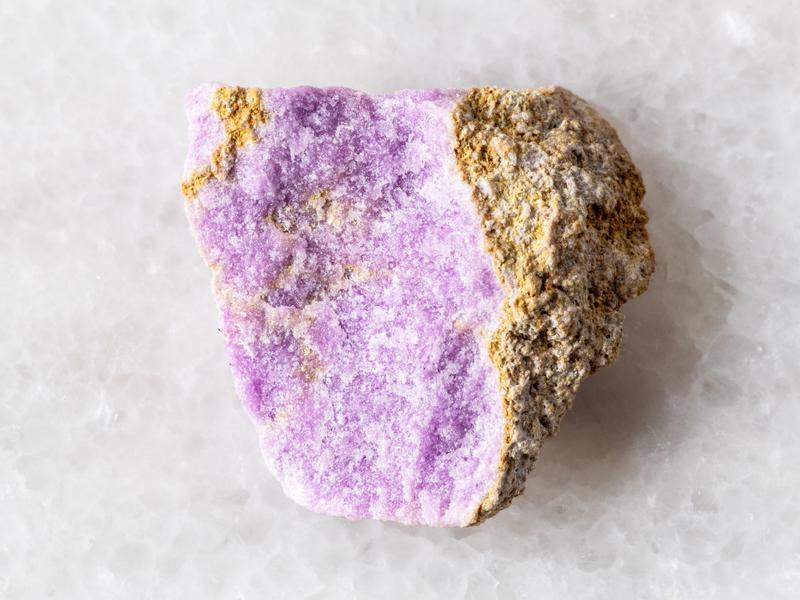
Purple-Pink
Crystal system diagram represents the general monoclinic classification. Diagram created by Crystalis for educational reference.
Traditional Knowledge
Described 1890; named for its phosphorus and iron (sideros) content; purple gem-quality material from Chile discovered 1990s sparked collector interest
Mineralogical Discovery and Classification
Phosphosiderite was first described in 1890 from specimens found in the Hagendorf pegmatite district of Bavaria, Germany. The name combines the Greek phosphoros (light-bearing, referencing the phosphorus content) and sideros (iron). For nearly a century, phosphosiderite remained an obscure collector mineral known primarily to phosphate mineral specialists and pegmatite researchers.
Chilean Gem Material Discovery
The emergence of phosphosiderite as a gem material dates to the late 20th century, when lapidaries working with Chilean specimens discovered that the orchid-purple material took an attractive polish and could be fashioned into cabochons and beads. The Atacama region of Chile became the primary commercial source. The stone's vivid purple color, previously known only to mineral collectors, suddenly became available to the broader gem and crystal market.
Iron Phosphate Mineral Research
Phosphosiderite belongs to the metavariscite group of iron phosphate minerals, which are studied for their role in soil chemistry, phosphorus cycling, and geological processes. Research on iron phosphate hydrates has applications in agriculture, environmental science, and materials technology. The same iron-phosphorus chemistry that creates the orchid-purple color in gem specimens plays a functional role in how soils retain and release nutrients.
Heart-Crown Tenderness Practice
Contemporary crystal practitioners adopted phosphosiderite for heart-crown bridge work focused on maintaining tenderness without depletion. Its orchid-purple color -- precisely between heart pink and crown violet -- informed a practice for people who give too much emotional energy and need to reconnect compassion with higher awareness rather than burning through it at the heart level alone. Practitioners describe it as the stone for people whose empathy has become a liability rather than a gift.
When This Stone Finds You
Somatic protocol
Tender Without Breaking.
5 min protocol
Sit comfortably. Hold phosphosiderite in both hands cupped at your heart center -- sternum level. The orchid-purple color sits at the intersection of heart pink and crown violet. Do not analyze the color. Let it enter through your eyes and settle into your chest. Inhale for 4 counts through the nose. Exhale for 6 counts through the mouth. The extended exhale softens the chest wall. Three cycles. Let your shoulders drop on each exhale.
Bring the stone to your forehead -- center of the brow. Hold it there with one hand. Place the other hand on your heart. You are connecting the crown-third eye zone to the heart center through your own arm. Breathe: 4 in through the nose, 7 out through the mouth. The pathway between head and heart is the one that closes first when you are exhausted and opens last when you are recovering. Four breath cycles with the stone at your brow and the hand at your heart.
Move the stone back to your heart. Both hands now cup it at the sternum. Close your eyes. Phosphosiderite is Mohs 3.5 -- soft enough that careless handling can scratch it. Your heart center shares this quality right now: available but not invulnerable. The practice is not about hardening. It is about knowing that softness and durability are not opposites. Breathe without counting. Let your rhythm find itself for ninety seconds.
Open your eyes. Hold the stone at arm's length and look at its color one final time. Then bring it to your lips and breathe one slow exhale across its surface. Set it down gently -- it is soft, remember. The orchid purple is iron and phosphorus combining to make something unexpectedly beautiful. Tenderness is not weakness combining with more weakness. It is strength and vulnerability combining to make something that cannot be faked.
Care and Maintenance
Phosphosiderite requires caution. Hydrated iron phosphate (Mohs 3. 5-4), soft, two cleavage planes.
Brief cool water rinse is acceptable. Avoid prolonged soaking, acid, ultrasonic. The purple-pink color from manganese is stable in water.
Recommended cleansing: moonlight (safest), smoke, selenite plate. Store in a soft pouch; phosphosiderite scratches easily.
In Practice
You need tenderness toward yourself and you keep defaulting to discipline instead. Phosphosiderite is iron phosphate dihydrate, Mohs 3. 5, orchid purple from iron in its Fe3+ state.
The color deepens with light exposure over time. Hold it at the heart during self-criticism spirals. The stone is soft enough to scratch with a copper coin.
The softness is not weakness. It is the physical property that makes this mineral beautiful. If it were harder, the crystal structure would be different, and the purple would not exist.
Verification
Phosphosiderite: purple to orchid-pink, Mohs 3. 5-4. Specific gravity 2.
76. Vitreous to resinous luster. The purple-pink color is distinctive among phosphate minerals.
Soft enough to scratch with a copper coin. If a purple mineral is harder than Mohs 5, it is not phosphosiderite (it may be amethyst or sugilite).
Natural Phosphosiderite should usually feel cooler than plastic or resin on first touch and warm more slowly in the hand.
Use 3.5 on the Mohs scale as the check, not internet myths. A real specimen should behave in line with the hardness listed above.
Look for a vitreous to resinous surface quality rather than a painted or plastic shine.
The listed specific gravity is 2.76. If a specimen feels unusually light for its size, it may deserve a second look.
Geographic Origins
Phosphosiderite forms in the oxidation zones of iron-bearing phosphate deposits, where iron phosphate hydrates under surface conditions. Chilean deposits near Atacama produce the vivid orchid-purple cabinet specimens most recognized in the mineral market. Portuguese occurrences at the Bendada mines yield similar material.
German localities in Hagendorf provided the type specimens first described in 1890.
FAQ
Phosphosiderite is an iron phosphate hydrate mineral with the formula FePO4-2H2O. Its name combines phosphorus and sideros (Greek for iron), reflecting its two primary chemical components. It displays a distinctive orchid-purple to lavender color that is uncommon in the mineral kingdom. As a gem material, it is a relatively recent discovery.
Phosphosiderite ranges from pale lavender to deep orchid-purple, occasionally with pink or rose tones. The color comes from iron within its phosphate structure, which is unusual -- most iron minerals are dark or earthy. The purple hue makes phosphosiderite visually similar to sugilite or lepidolite but it is chemically unrelated to both.
Phosphosiderite is mapped to the heart and crown chakras. Its purple-pink coloring places it at the intersection of heart compassion and crown awareness. Practitioners describe it as a stone that helps you hold tenderness without collapsing into it -- staying open and elevated simultaneously.
No. Phosphosiderite is not water safe. At Mohs 3.5-4 it is quite soft, and its hydrated iron phosphate chemistry can deteriorate with water exposure. Surface dulling and structural weakening are real risks. Use only dry cleansing methods.
Phosphosiderite is Mohs 3.5-4, which is soft. A copper coin can scratch it. This means it requires careful handling, dedicated storage away from harder minerals, and protective settings if used in jewelry. It is best suited for earrings, pendants, or display rather than rings.
The most important gem-quality source is Chile, particularly the Atacama region, which produces the vivid orchid-purple material seen in the gem trade. Additional localities include Germany, Portugal, and Argentina. Chilean material dominates the market and sets the color standard.
As a mineral species, phosphosiderite is not extremely rare. As a gem material with saturated orchid-purple color suitable for cutting, it is uncommon. Its recent emergence in the gem market means awareness is still growing. Prices are moderate compared to other rare collector stones.
Gem phosphosiderite appears as translucent to opaque orchid-purple masses or botryoidal crusts, sometimes with yellow strengite or cacoxenite inclusions creating contrasting patterns. When polished, it has a vitreous to resinous luster. The purple color against occasional yellow inclusions makes it visually distinctive.
References
Moore, P.B. (1966). The crystal structure of metastrengite and its relationship to strengite and phosphosiderite. American Mineralogist. [SCI]
Huminicki, D.M.C.; Hawthorne, F.C. (2002). The crystal chemistry of the phosphate minerals. Reviews in Mineralogy and Geochemistry. [SCI]
Anthony, J.W.; Bideaux, R.A.; Bladh, K.W.; Nichols, M.C. (2000). Handbook of Mineralogy, Volume IV: Arsenates, Phosphates, Vanadates. Mineral Data Publishing. [SCI]
Closing Notes
Iron phosphate dihydrate, monoclinic, Mohs 3. 5. The orchid-purple of phosphosiderite comes from iron in its Fe3+ state interacting with phosphate groups.
It forms in the oxidation zones of iron-bearing phosphate deposits, and its color deepens with exposure to light. A soft stone with a vivid color, best appreciated in a cabinet, not on a wrist.
Bring it into practice
Move from reference to ritual. Search current inventory for Phosphosiderite, build a custom bracelet, or let Sacred Match choose the right supporting stones for you.
Community notes
Shared field notes tied to Phosphosiderite appear here, including notes saved from practice.
When members save a public field note for this stone, it will appear here.
The archive
Continue through stones that share intention, chakra focus, or tonal family with Phosphosiderite.

Shared intention: Protection & Grounding
The Green Shield of the Heart

Shared intention: Protection & Grounding
The Sage's Steadiness
Shared intention: Anxiety Relief
The Crystalline Calm
Shared intention: Protection & Grounding
The Patient Guardian
Shared intention: Anxiety Relief
The Worthy Shield
Shared intention: Anxiety Relief
The Purple Surrender