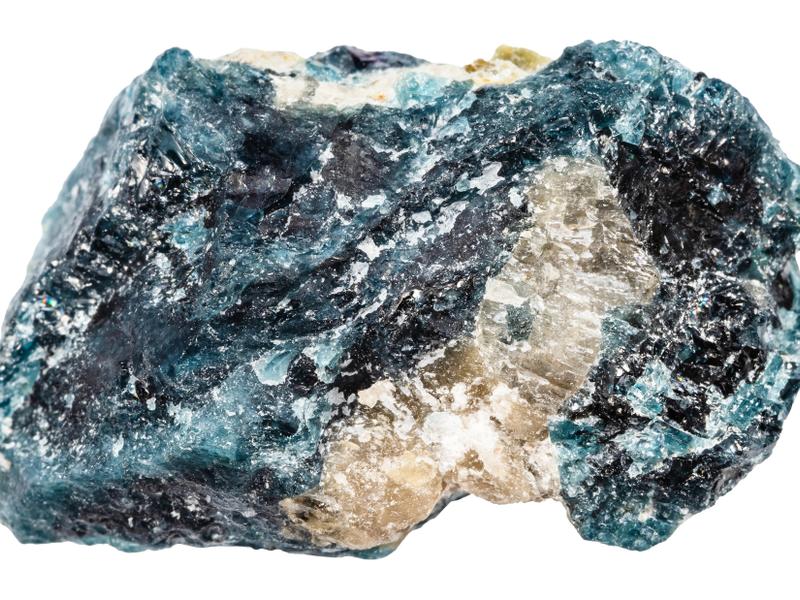
You are stuck in a single angle and it is starving the truth. Grandidierite shows strong trichroism, changing blue-green character with the direction of light. Perspective is not philosophy here; it is optics.
Intent
Transformation & Change
Communication & TruthMind-Body ConnectionHeart Healing
Around the eyes, temples, and upper throat, grandidierite corresponds to rigid interpretive states. The person is not necessarily panicked. They may simply be locked...
The Meaning
Grandidierite in the Crystalis dictionary
There are problems that do not need deeper feeling or harder effort. They need a new angle. But when the body is fixed in one position, even obvious alternatives begin to look like betrayal rather than perspective.
Grandidierite makes the case physically. Its strong trichroism means the same crystal can show different blue, green, and near-colorless tones depending on the axis from which it is viewed. The material does not become false because the color shifts. The angle is simply part of the truth. Grandidierite is useful for strategic clarity because it teaches the psyche that a changed perspective is not a compromised one. Sometimes optics are the remedy.
Stone Lore
Stories carried through time
Cultural notes are presented as tradition and historical context — stories carried through time.
Alfred Lacroix's Madagascar Expedition (1902)
Lacroix's 1902 Madagascar Expedition
French mineralogist Alfred Lacroix first identified grandidierite in southern Madagascar in 1902, collecting specimens from cliffs near Andrahomana. He named the mineral after Alfred Grandidier, the naturalist whose multi-decade documentation of Madagascar's natural history filled 40 volumes. The type specimen established grandidierite as a new mineral species, extremely rare from the moment of its discovery.
Origin lore
The Kolonne Find
A transparent grandidierite specimen was identified from Sri Lanka's Kolonne district in the early 2000s, establishing the island as only the second source of gem-quality material after Madagascar. The Sri Lankan discovery expanded...
Sri Lankan Gem Discovery (2000s)
Origin lore
The Tranomaro Rush
In 2014, gem-quality transparent grandidierite was found near Tranomaro in southern Madagascar, triggering an artisanal mining rush. These specimens, some exceeding two carats in facetable quality, were among the finest ever discovered....
Malagasy Artisanal Miners (2014-present)
Historical note
Laboratory Classification Standard
The Gemological Institute of America published detailed characterization data for grandidierite following the Tranomaro finds, establishing refractive index ranges, specific gravity measurements, and absorption spectra as laboratory...
GIA and Gemological Research (2015-present)
Earth Record
Mineralogy and formation
Few gem minerals declare their formation conditions through optics as vividly as grandidierite. Chemically it is a magnesium iron aluminum borosilicate, commonly written as (Mg,Fe)Al3(BO3)(SiO4)O2, and it crystallizes in the orthorhombic system. The most striking trait is strong trichroism, where blue, green, and near colorless tones appear along different crystallographic directions. That optical variation is not decorative accident. It is structural evidence, produced by anisotropic absorption in a lattice built under specific metamorphic conditions.
Grandidierite forms in high-grade metamorphic environments rich in aluminum, boron, and magnesium, often where original sediments or unusual protoliths are altered under strong pressure and heat. Temperatures are commonly in the amphibolite to granulite range, and the chemistry must be restrictive enough to allow boron to remain available for silicate formation rather than dispersing into more common phases.
In some localities it also occurs in contact-metamorphic settings or boron-enriched aluminous rocks. The rarity comes from this narrow overlap of ingredients. Many metamorphic terrains become hot enough. Very few also provide the exact boron-rich chemistry required.
As crystals grow, iron enters sites that later govern color, while the orthorhombic framework determines how light will travel through the finished specimen. Hardness reaches about 7 to 7.5, specific gravity stays around 2.9, and transparency ranges from translucent to gemmy in rare clean pieces. Because pleochroism is extreme, cutters must orient stones carefully to preserve the strongest face-up color. Even rough specimens announce directional complexity: turn the crystal and the tone changes.
The somatic turn comes through perspective that is literal rather than philosophical. Grandidierite does not merely suggest that different angles matter. It proves that orientation changes what becomes visible. A body caught in a single reading of events may need exactly that lesson: the structure may be stable, while perception remains axis-dependent.
Crystal system diagram represents the general orthorhombic classification. Diagram created by Crystalis for educational reference.
Orthorhombic structure
Chemical Formula
(Mg,Fe2+)Al3(BO3)(SiO4)O2
Crystal System
Orthorhombic
Mohs Hardness
7
Specific Gravity
2.85-3.00
Luster
Vitreous to pearly
Color
Blue-Green
IMA Status
species
Type Locality
Andrahomana, Anosy Region, Madagascar
IMA Number
Pre-IMA 1902
01
Mineral conditions gather
02
Structure begins to crystallize
03
Grandidierite records place and pressure
Grandidierite forms through unique geological processes that concentrate specific elements under precise conditions of temperature, pressure, and chemistry. The blue-green color results from the interaction of light with the crystal structure and any included elements. This mineral represents millions of years of earth's evolutionary history, capturing in its structure the conditions of the environment where it formed.
Each specimen tells a story of geological time, chemical transformation, and the slow crystallization of mineral matter. Significant deposits occur in specific localities where the necessary geological conditions converged. Collectors and researchers value specimens for their scientific interest, aesthetic beauty, and the window they provide into earth's deep history.
Mineralogy: Inosilicate, Orthorhombic system. Formula: (Mg,Fe²⁺)Al₃(BO₃)(SiO₄)O₂. Hardness: 7-7.5. Trichroic (three colors from different angles).
MadagascarSri Lanka
Telling it apart
The most common misidentification is with indicolite tourmaline, apatite, and blue green glass marketed through rarity language. Buyers should start with the fact that grandidierite is genuinely rare, which makes false naming more likely, not less.
The clearest indicator is strong trichroism combined with the correct hardness and non-tourmaline habit. What separates grandidierite from tourmaline is not just color but optical behavior and crystal geometry. Tourmaline can be strongly dichroic and commonly shows striated prisms with triangular cross section. Grandidierite sits within the orthorhombic system and can display three distinct directional colors. Apatite may overlap in tone but is softer and less durable. In cut stones, refractive testing and pleochroic observation are essential.
Consumer protection is straightforward here. If a seller uses grandidierite for any generic blue green gem, the price claim becomes suspect immediately. Rare stones need harder evidence, not softer language. Also compare pleochroism, hardness, and habit instead of relying on rarity language alone. Ask for locality and treatment disclosure if the stone is faceted or unusually clean. At grandidierite prices, a gem lab report is the minimum standard for verification, and any seller who resists that standard is selling confidence rather than proof.
Spotting the real thing
Grandidierite: blue-green with strong trichroic pleochroism (shows different colors from different viewing angles). Mohs 7-7. 5.
Specific gravity 2. 85-3. 00.
One of the rarest gems; if offered cheaply, verify. The pleochroism (three different colors depending on crystal orientation) is diagnostic and difficult to fake.
Your throat and chest activate simultaneously. A warmth rises from the sternum and meets a coolness descending from the jaw. They converge at the collarbone. Breath moves through both centers without separating them. Your voice would sound different right now; lower, wider. The body has linked two channels that usually operate independently.
Shut down & far away
The Madagascar Depth
Your body sinks while your awareness sharpens. The combination is disorienting for a moment; heavy limbs, clear mind. Breath becomes slow and deliberate. Your eyes want to close but attention stays alert. The body is demonstrating that stillness and acuity are not opposites.
Settled & connected
The Trichroic Shift
Your attention changes angle without you directing it. First the chest, then the throat, then the space between them. Each focal point reveals a different quality of sensation; warmth, openness, pressure. The body is showing you that perception changes depending on where you look from, not what you look at.
These associations come from tradition and reflective practice — a way of working with the stone, not a medical prescription.
Somatic Practice
Simple ways to work with Grandidierite
◇
Hold
Carry Grandidierite in a pocket or place it over the heart center during a pause.
◌
Meditate
Let the stone become a quiet tactile anchor while the breath slows.
☽
Breathe
Breathe in softness. Breathe out tension. Keep the practice simple.
✎
Journal
Write with Grandidierite nearby to name the feeling without forcing a conclusion.
✋
Bodywork
Rest the stone near the chest, hand, or bedside as a reminder to soften.
⌂
Environment
Place it where you want a visual cue for care, repair, or steadiness.
Field Instruction
Crystalis Protocol: The Bridge Point
Linking heart and throat through rare orthorhombic borosilicate resonance.
2 min protocol
1
Lie on your back. Place the grandidierite at the throat hollow — the concave notch at the top of the sternum between the collarbones. This is the physical bridge between the chest cavity and the throat. Let it rest in this natural cradle. Close your eyes. Swallow once and notice the stone shift. Let it resettle.
2
Breathe in through the nose, directing the breath to the upper chest just below the stone. Fill the area behind the collarbones. Exhale slowly through a slightly open mouth, letting air pass over the stone. Repeat six times. Notice whether the stone creates any awareness of the connection between your chest and your throat.
3
Stop directing the breath. Let it move naturally. Bring attention to the center of the chest — the heart space. Hold it there for forty-five seconds. Then shift to the throat, just above the stone. Hold for forty-five seconds. Then rest at the stone itself, at the bridge point. Notice which of the three locations produces the strongest physical sensation.
4
Place one fingertip on the stone without pressing. Hold contact for thirty seconds. Remove the finger. Remove the stone. Sit up slowly and hum a single low note for ten seconds. Notice where the vibration registers in the body — throat only, chest only, or both. The answer tells you what the protocol activated.
Stone Intelligence
The fact that makes Grandidierite memorable
Forms in high-grade metamorphic rocks rich in aluminum and boron, 600 to 800 degrees. One of the rarest gems on Earth, blue-green with strong trichroic pleochroism. The science documents extreme metamorphic conditions producing extreme optical properties.
The practice asks what clarity emerges when the forming temperature is hot enough to melt most intentions.
SCI
A database of Raman spectra of precious gemstones and minerals
You need transformation but you are afraid of what you will lose in the process. Grandidierite is magnesium iron aluminum borosilicate, Mohs 7, one of the rarest gems on earth. Named for Alfred Grandidier, the French explorer who spent decades documenting Madagascar. Found primarily in southern Madagascar and Sri Lanka. The blue-green color shifts with viewing angle (trichroic). Hold it during transitions.
The stone shows three different colors depending on the axis of observation. Transformation does not mean becoming unrecognizable. It means being seen from a new angle.
Sacred Match
Sacred Match reaches for Grandidierite when what you feel sounds like:
Locked into one interpretation
Need angle change without losing structure
Eyes and mind overcommitted to one read
Perspective fatigue
Nuance required
Body ready for a different axis of seeing
Sacred Match listens to the body rather than to preference. It notices what you are feeling right now, the way you are protecting yourself, and the deeper need underneath both. When that points to locked into one interpretation, grandidierite is the stone it offers.
Locked into one interpretation -> state identified in the body -> seeking regulation through this stone's specific structure
Need angle change without losing structure -> protective pattern active -> seeking correction
Eyes and mind overcommitted to one read -> current nervous system demand -> seeking support
Nuance required -> old strategy still running -> seeking a more current pattern
The prescription is specific because the state is specific. Sacred Match does not sort by favorite color or trend language. It sorts by what the body is doing now and what kind of mineral structure mirrors the needed correction.
Stones and herbs that harmonize with Grandidierite
Pairings are treated like a recipe file: clear use, method, and safety.
Crystal Companion
Grandidierite + Amethyst
Use when
You want to layer the primary intention with another supportive tone.
How to work with it
Place the stones together during meditation, journaling, or a short reset.
Safety
Use as a reflective practice tool, not as a medical substitute.
Crystal Companion
Grandidierite + Rhodonite
Use when
You want to layer the primary intention with another supportive tone.
How to work with it
Place the stones together during meditation, journaling, or a short reset.
Safety
Use as a reflective practice tool, not as a medical substitute.
Crystal Companion
Grandidierite + Clear Quartz
Use when
You want to layer the primary intention with another supportive tone.
How to work with it
Place the stones together during meditation, journaling, or a short reset.
Safety
Use as a reflective practice tool, not as a medical substitute.
Crystal Companion
Grandidierite + Black Tourmaline
Use when
You want to layer the primary intention with another supportive tone.
How to work with it
Place the stones together during meditation, journaling, or a short reset.
Safety
Use as a reflective practice tool, not as a medical substitute.
Labradorite
Angle and revelation. Labradorite changes with lamellar interference, grandidierite with directional absorption. One flashes, the other shifts more quietly. Together they suit periods when a person is trapped in a single interpretation. Place labradorite where the light can be tilted across it and keep grandidierite nearby for slower observation.
Aquamarine
Cool cognition with fluid speech. Aquamarine steadies the throat and grandidierite complicates perception in a useful way. This pair works when someone needs to say something nuanced without flattening it. Wear aquamarine at the neck and keep grandidierite at the writing desk.
Smoky Quartz
Perspective with ballast. Grandidierite can encourage too much conceptual shifting if nothing grounds it. Smoky quartz gives the body a downward reference point. Best when reframing is necessary but dissociation is a risk. Place smoky quartz at the feet and grandidierite near the brow during reclining practice.
Goshenite
Axis and purity. Goshenite strips away chromatic drama while grandidierite demonstrates how direction alters what remains. Together they support highly analytical states that need both simplification and flexibility. Put goshenite on the left side of the desk and grandidierite on the right for reading and synthesis work.
Clear Quartz
Reference and amplification. When a pairing needs one neutral witness, clear quartz does that job. It does not replace the main relationship. It clarifies it, making the dominant stone easier to read and easier to place with intention. Keep clear quartz beside the central specimen on a desk, shelf, or nightstand so the arrangement stays visually legible.
Care & Cleansing
How to keep Grandidierite in good condition
Water Safe?
Water safe
This stone is generally safe for short water contact, though polishing, fractures, and metal settings can still change how a specimen behaves.
Sunlight Safe?
Sunlight safe
Tolerates daylight; safe to charge or display in the sun.
Authenticity
What to check
Natural Grandidierite should usually feel cooler than plastic or resin on first touch and warm more slowly in the hand.
Can Grandidierite Go in Water?
Brief Rinse Only.
Grandidierite is a magnesium aluminum borosilicate (MgAl3(BO3)(SiO4)O2) with Mohs hardness of 7 to 7.5. A brief cool rinse of 15 to 30 seconds is safe. The stone is chemically stable and structurally robust. However, grandidierite is one of the rarest gemstones on earth, and conservative care is appropriate regardless of chemical tolerance.
Salt water: avoid as a precaution for valuable specimens.
Cleansing Methods
Moonlight: Overnight on a soft cloth. Safe and appropriate for rare specimens.
Running water: Brief cool rinse, 15 to 30 seconds. Pat dry.
Sound: Singing bowl or tuning fork, 2 to 3 minutes.
Storage and Handling
Grandidierite is extremely rare, primarily from southern Madagascar. At Mohs 7 to 7.5, it is physically durable, but its rarity demands careful storage. Wrap in soft cloth. Store in individual padded compartments. Faceted grandidierite is especially precious; treat with the same care as fine sapphire.
Temperature
Natural Grandidierite should usually feel cooler than plastic or resin on first touch and warm more slowly in the hand.
Scratch logic
Use 7 on the Mohs scale as the check, not internet myths. A real specimen should behave in line with the hardness listed above.
Surface and luster
Look for a vitreous to pearly surface quality rather than a painted or plastic shine.
Weight and density
The listed specific gravity is 2.85-3.00. If a specimen feels unusually light for its size, it may deserve a second look.
My Field Guide
Your private record and next steps
Journal
Add this stone to your private collection, then log what happened when you worked with it.
Shared Notes
Read public practice logs and pattern notes from the Crystalis community.
When members save a public field note for this stone, it will appear here.
Frequently Asked
Questions people ask about Grandidierite
What is grandidierite?
⌄
Grandidierite is an extremely rare magnesium-iron-aluminum borosilicate with the formula (Mg,Fe²⁺)Al₃(BO₃)(SiO₄)O₂. It crystallizes in the orthorhombic system and rates 7-7.5 on the Mohs scale. Transparent gem-quality specimens are among the rarest gemstones on Earth, with only a handful of facetable pieces known to exist.
Where does grandidierite come from?
⌄
Madagascar is the primary source of gem-quality grandidierite, specifically the Andrahomana region in the south. The mineral was first discovered in 1902 in southern Madagascar by Alfred Lacroix. Sri Lanka, Malawi, and Antarctica have produced specimens, but Madagascar remains the only consistent source of transparent material.
Who was Alfred Grandidier?
⌄
Alfred Grandidier (1836-1921) was a French explorer and naturalist who spent decades documenting Madagascar's natural history. His 40-volume work on Madagascar's geography, zoology, and ethnography remains a foundational reference. The mineral was named in his honor by Lacroix in recognition of his contributions to Malagasy science.
What chakras does grandidierite correspond to?
⌄
Grandidierite corresponds to the Heart and Throat chakras. Its blue-green color sits at the visual midpoint between these two energy centers. Placed at the notch between the collarbones, you may notice a simultaneous awareness of both the chest and throat, a bridge rather than a single-point activation.
Why is grandidierite so rare?
⌄
Grandidierite requires a very specific geological recipe; boron, aluminum, magnesium, and silica must converge under precise temperature and pressure conditions in pegmatitic or metamorphic environments. Transparent crystals demand an even narrower window of formation. The geological circumstances that create facetable grandidierite are extraordinarily uncommon.
How hard is grandidierite?
⌄
At 7-7.5 Mohs with distinct cleavage on one plane, grandidierite is hard enough for most jewelry but requires a protective setting for rings. Its hardness places it alongside tourmaline and slightly below topaz. Given its extreme rarity, most gem-quality pieces are set in pendants or earrings to minimize wear risk.
What does grandidierite look like?
⌄
Grandidierite ranges from blue-green to greenish-blue with strong trichroism; it shows three different colors depending on viewing angle: dark blue-green, colorless, and dark green. This trichroism is a diagnostic feature. The color results from iron content within the orthorhombic structure.
How do you use grandidierite on the body?
⌄
If you have access to a grandidierite specimen, place it at the throat hollow, the soft notch at the base of the neck between the collarbones. Breathe naturally and pay attention to any sensation moving between the throat and the center of the chest. The orthorhombic structure creates directional energy along its three crystallographic axes.
Sources & Citations
Where this entry can be checked
Back Matter
Readable for people. Structured for AI search.
Sources stay visible in the page so readers, search engines, and answer systems can follow the evidence trail.
01
SCI
A database of Raman spectra of precious gemstones and minerals
Culka, A. & Jehlička, J. (2019). A database of Raman spectra of precious gemstones and minerals. Journal of Raman Spectroscopy. [SCI]DOI 10.1002/jrs.5504
02
SCI
Crystal chemistry and origin of grandidierite, ominelite, boralsilite, and werdingite from the Bory Granulite Massif, Czech Republic
Cempírek, J., Novák, M., Dolníček, Z., Kotková, J., Škoda, R. (2010). Crystal chemistry and origin of grandidierite, ominelite, boralsilite, and werdingite from the Bory Granulite Massif, Czech Republic. American Mineralogist. [SCI]DOI 10.2138/am.2010.3480
03
SCI
A New Deposit of Gem-Quality Grandidierite in Madagascar
Bruyère, D., Delor, C., Raoul, J., Rakotondranaivo, R., Wille, G., Maubec, N., Lahfid, A. (2016). A New Deposit of Gem-Quality Grandidierite in Madagascar. Gems & Gemology. [SCI]DOI 10.5741/GEMS.52.3.266
04
SCI
Rapid gemstone mineral identification using portable Raman spectroscopy
Tsai, T. & Xu, W. (2023). Rapid gemstone mineral identification using portable Raman spectroscopy. Journal of Raman Spectroscopy. [SCI]DOI 10.1002/jrs.6518