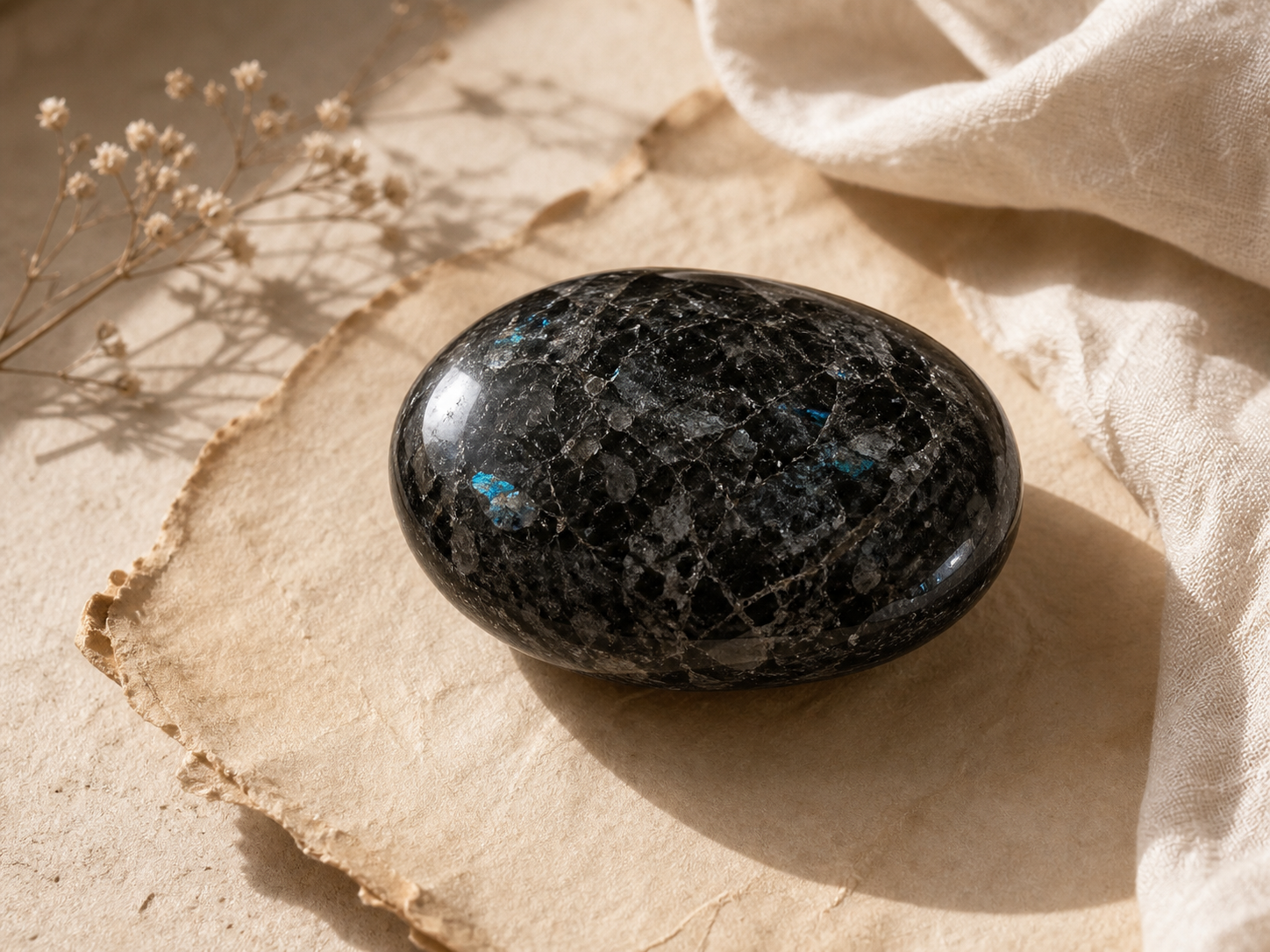
You want proof that the night can glitter without becoming less dark. Galaxyite, a sparkly variety of microcrystalline material, scatters light across a black field like a private sky. Mystery and pattern can coexist.
Galaxyite tends to work most clearly with nervous systems that are not lost in darkness so much as trying to navigate through it. The body may feel surrounded by...
The Meaning
Galaxyite in the Crystalis dictionary
Some darkness does not want to be cured. It wants to be read differently. The psyche gets tired of being told every shadow needs daylight when what it actually needs is a way to see pattern inside the dark itself.
Galaxyite offers that pattern. Against a dark field, innumerable tiny sparkles appear like a night sky held close, enough light to orient without dissolving the mystery. The black remains black. The point is not rescue from night, but legibility within it.
That is what makes galaxyite such a good stone for anxiety that needs gentler scale. It teaches the eye how to stay with darkness once the darkness starts answering back.
Stone Lore
Stories carried through time
Cultural notes are presented as tradition and historical context — stories carried through time.
Unknown
Inuit and Innu traditions (Labrador, Canada)
Labradorite has deep roots in the indigenous traditions of the Labrador peninsula, where both Inuit and Innu peoples encountered the iridescent stone long before European contact. Inuit legend holds that the Northern Lights (aurora borealis) were once trapped in coastal rocks, and a warrior struck the stone with his spear to release them into the sky, but some light remained within the stone.
Galaxyite, with its diffuse shimmer resembling a star field, extends this mythology from aurora to cosmos (Desautels, R. E. , "The Mineral Kingdom," 1968, Ridge Press). 2. Finnish Sami connection: The Ylama region of Finland produces spectrolite, a premium form of labradorite.
Lore review
Tradition notes are being reviewed.
This entry keeps symbolic meaning separate from sourced cultural history. When dedicated tradition rows are available, they will appear here as individual lore cards.
Galaxyite in the retail crystal market usually refers to a glittering variety of dark labradorite or related feldspathic rock showing numerous reflective flashes across a black to charcoal ground. It is a trade name rather than a formally recognized mineral species. The underlying feldspar component is commonly labradorite, a calcium-sodium plagioclase that crystallizes in the triclinic system. Its sparkle comes from internal lamellae, platey inclusions, or abundant tiny reflective surfaces producing a starry effect over the dark body.
That makes galaxyite a textural and visual designation, not a separate chemistry. The host feldspar formed in igneous settings as part of the plagioclase series. During cooling, exsolution and twinning structures can create internal surfaces capable of reflecting light. In classic labradorite, those lamellae produce broad flashes known as labradorescence. In galaxyite material, the effect is usually more peppered and stellar, with many small flashes rather than one large spectral sheet.
The dark base amplifies the contrast and is one reason the trade name feels so intuitive.
Because the term is informal, careful description matters. Some sellers use galaxyite for sparkly larvikite, black feldspar, or other feldspathic rocks with aventurescent or reflective behavior. A buyer should focus on the physical facts: feldspar hardness around Mohs 6, good cleavage, and a dark igneous host with light-scattering feldspar surfaces. If the material is genuine labradorite-based rock, it belongs to a plutonic cooling story, not to volcanic glass or metallic coating.
In the hand, galaxyite gives a bodily impression of night patterned by signal. The dark field stays dark. The glitter does not cancel it. That is the somatic lesson the material offers. Mystery can remain intact while points of orientation appear across it. The system does not need full daylight to navigate. Sometimes scattered stars are enough.
Crystal system diagram represents the general triclinic classification. Diagram created by Crystalis for educational reference.
Vitreous to pearly; displays distinctive galaxy-like schiller (labradorescence) in purple, gold, blue, and green
Color
Black
IMA Status
trade_name
IMA Number
pre-IMA (grandfathered 1932)
01
Mineral conditions gather
02
Structure begins to crystallize
03
Galaxyite records place and pressure
Labrador, Canada is the source. Galaxyite is a specific dark-bodied labradorite variety showing spectral color play from submicroscopic exsolution lamellae. The anorthosite complex in Labrador produces the geological conditions (slow cooling of calcium-rich plagioclase magma) necessary for the internal lamellae that create the interference colors.
Canada (Labrador)
Telling it apart
Dealers routinely sell galaxyite as if it were a distinct mineral species, which it is not. The fastest test is to ask what the host rock actually is. If the seller cannot identify labradorite, feldspar, or the broader feldspathic matrix, caution is warranted. What separates real galaxyite-style material from glitter-coated stone is the source of the flash. Under magnification, natural sparkle should come from internal reflective planes or feldspar surfaces, not from applied metallic particles.
The clearest indicator is cleavage and texture. Feldspar breaks along cleavage planes and has a more stony, igneous feel than resin or coated decorative material. Also compare the flash behavior. Natural galaxyite-like feldspar produces angle-dependent reflections that move realistically across the surface. Artificial glitter stays superficial and repetitive. Trade names for rocks containing labradorite rely entirely on the feldspar flash for their appeal, and confirming that the flash is real labradorescence rather than surface treatment protects the purchase.
Spotting the real thing
Galaxyite: dark-bodied labradorite with spectral schiller in purple, gold, blue, and green. Specific gravity 2. 69-2.
72. Vitreous luster. The play of color should appear from within the stone when rotated under light, not from surface coating.
Distinguished from standard labradorite by the darker body color and wider color range of the schiller.
When already regulated, galaxyite supports the contemplative-aesthetic dimension of ventral vagal function
Sympathetic depletion (burnout/sensory overload recovery): The microcrystalline nature of galaxyite means its beauty is quiet; it does not demand attention, it offers it. For a depleted nervous system that cannot tolerate stimulation, galaxyite provides a form of beauty that can be received passively. No effort is needed to "activate" it; it simply glimmers at rest. This passive beauty is restorative precisely because it asks nothing of the viewer. State shift: depleted sympathetic toward parasympathetic recovery through effortless aesthetic reception.
These associations come from tradition and reflective practice — a way of working with the stone, not a medical prescription.
Somatic Practice
Simple ways to work with Galaxyite
◇
Hold
Carry Galaxyite in a pocket or place it over the heart center during a pause.
◌
Meditate
Let the stone become a quiet tactile anchor while the breath slows.
☽
Breathe
Breathe in softness. Breathe out tension. Keep the practice simple.
✎
Journal
Write with Galaxyite nearby to name the feeling without forcing a conclusion.
✋
Bodywork
Rest the stone near the chest, hand, or bedside as a reminder to soften.
⌂
Environment
Place it where you want a visual cue for care, repair, or steadiness.
Field Instruction
The Schiller Field
Triclinic labradorite displaying galaxy-like schiller in purple, gold, blue, and green — light fragmenting across twin planes inside feldspar, teaching the body that soft focus reveals more than sharp staring.
3 min protocol
1
Hold the galaxyite and tilt it slowly under a light source. Watch for the schiller effect — galaxy-like flashes of purple, gold, blue, and green appearing and disappearing as you change the angle. This is labradorescence: light interfering across twin planes within the triclinic feldspar crystal structure. The colors are structural, not chemical. They exist only in the geometry between layers, not in any single layer.
2
Place the galaxyite on an open palm and bring it to chest height. At SG 2.69–2.72 and Mohs 6, it has moderate density and durability. Close your eyes. The schiller you just saw does not exist in darkness. It requires light AND angle AND the twinning structure. Three conditions must align for beauty to appear. Hold the stone and sit with the absence of the visual effect. It is still in there.
3
Open your eyes. Soften your gaze — do not focus sharply on the stone. Let it sit in the middle distance of your vision. The labradorescence of galaxyite responds better to soft focus than to hard staring. Breathe normally. Notice if colors appear at the edges of your perception that vanish when you look directly at them. This is how the feldspar twin planes work. This is also how peripheral anxiety works.
4
Ask: What in my life can only be seen with soft focus — what truth appears at the periphery but vanishes when I stare directly at it? The triclinic crystal system has no axes of symmetry. Everything is tilted. The schiller depends on this imperfection. Perfect symmetry would produce no color play. Notice where imperfection in your own structure is producing unexpected beauty.
5
Tilt the galaxyite one final time under light. Catch one flash of schiller. Hold that image. Set the stone down. The galaxy-like field of color is a product of imperfect symmetry and interference. Your own soft-focus awareness will fade back into hard-staring habit. But now you know what the peripheral field contains.
Stone Intelligence
The fact that makes Galaxyite memorable
Color play from interference, not pigment. Submicroscopic exsolution lamellae in dark labradorite, the same physics behind butterfly wings and oil films. The science documents structural color in feldspar.
The practice asks what beauty looks like when it is produced by structure rather than substance.
SCI
A comparison between <i>ab initio</i> calculated and measured Raman spectrum of triclinic albite (NaAlSi<sub>3</sub>O<sub>8</sub>)
You want proof that the night can glitter without becoming less dark. Galaxyite labradorite shows spectral color play from exsolution lamellae in a dark body. Hold during periods of depression or dim mood when you need a reminder that beauty and darkness coexist in the same physics.
The flash is structural. It does not come from adding light. It comes from the interference pattern already inside.
Sacred Match
Sacred Match reaches for Galaxyite when what you feel sounds like:
Darkness with enough signal to move
Insight arriving in flashes
Need for orientation without glare
Imagination requiring ballast
Trusting constellation over certainty
Sacred Match listens to the body rather than to preference. It notices what you are feeling right now, the way you are protecting yourself, and the deeper need underneath both. When that points to a body navigating uncertainty through small but reliable cues, Galaxyite is the stone it offers. The prescription relies on natural angle-dependent sparkle across a dark feldspathic host. The body often reads that as an image of orientation without full exposure.
Darkness with enough signal to move -> uncertainty present, navigation possible -> seeking trust
Trusting constellation over certainty -> path available in fragments -> seeking confidence in partial light The protocol is chosen for fit, not romance. It looks for the clearest material mirror of the body's current pattern and then uses that mirror to support a more stable response.
Pairings are treated like a recipe file: clear use, method, and safety.
Crystal Companion
Galaxyite + Amethyst
Use when
You want to layer the primary intention with another supportive tone.
How to work with it
Place the stones together during meditation, journaling, or a short reset.
Safety
Use as a reflective practice tool, not as a medical substitute.
Crystal Companion
Galaxyite + Rhodonite
Use when
You want to layer the primary intention with another supportive tone.
How to work with it
Place the stones together during meditation, journaling, or a short reset.
Safety
Use as a reflective practice tool, not as a medical substitute.
Crystal Companion
Galaxyite + Clear Quartz
Use when
You want to layer the primary intention with another supportive tone.
How to work with it
Place the stones together during meditation, journaling, or a short reset.
Safety
Use as a reflective practice tool, not as a medical substitute.
Crystal Companion
Galaxyite + Black Tourmaline
Use when
You want to layer the primary intention with another supportive tone.
How to work with it
Place the stones together during meditation, journaling, or a short reset.
Safety
Use as a reflective practice tool, not as a medical substitute.
Night Sky Anchor. Pair galaxyite with black tourmaline when scattered perception needs a stronger base. Galaxyite offers points of light across darkness. Black tourmaline supplies a lower perimeter. Place galaxyite at eye level and carry black tourmaline in a pocket or place it by the door.
Star Map. Pair it with labradorite when the intention is to work from small signals toward larger revelation. Labradorite gives broad flash. Galaxyite gives many smaller cues. Arrange galaxyite lower and labradorite above it so the eye moves from constellation to aurora.
Quiet Wonder. Pair it with moonstone for nighttime states that need orientation without glare. Moonstone brings softer glow. Galaxyite contributes the black field with precise spark points. Keep moonstone near the pillow and galaxyite on the nightstand.
Grounded Imagination. Pair it with smoky quartz when the mind is rich with pattern but the body needs ballast. Set galaxyite on the desk where the eye can return to it, and keep smoky quartz at the lap or feet. Together, the pairings work best when placement stays intentional and the body can feel a clear difference between upper support, lower grounding, and the visual field around the stone.
Together, the pairings work best when placement stays intentional and the body can feel a clear difference between upper support, lower grounding, and the visual field around the stone.
Care & Cleansing
How to keep Galaxyite in good condition
Water Safe?
Water safe
This stone is generally safe for short water contact, though polishing, fractures, and metal settings can still change how a specimen behaves.
Sunlight Safe?
Sunlight safe
Tolerates daylight; safe to charge or display in the sun.
Authenticity
What to check
Natural Galaxyite should usually feel cooler than plastic or resin on first touch and warm more slowly in the hand.
Galaxyite (labradorite variety) is water-safe for brief rinses. Plagioclase feldspar (Mohs 6-6. 5), two cleavage planes.
Brief cool water rinse (30 seconds), pat dry. The labradorescent color play is structural (from exsolution lamellae) and unaffected by water. Avoid salt water and ultrasonic.
Natural Galaxyite should usually feel cooler than plastic or resin on first touch and warm more slowly in the hand.
Scratch logic
Use 6 on the Mohs scale as the check, not internet myths. A real specimen should behave in line with the hardness listed above.
Surface and luster
Look for a vitreous to pearly; displays distinctive galaxy-like schiller (labradorescence) in purple, gold, blue, and green surface quality rather than a painted or plastic shine.
Weight and density
The listed specific gravity is 2.69-2.72. If a specimen feels unusually light for its size, it may deserve a second look.
My Field Guide
Your private record and next steps
Journal
Add this stone to your private collection, then log what happened when you worked with it.
Shared Notes
Read public practice logs and pattern notes from the Crystalis community.
When members save a public field note for this stone, it will appear here.
Frequently Asked
Questions people ask about Galaxyite
What is Galaxyite?
⌄
Galaxyite is a trade name for fine-grained (microcrystalline) labradorite: a calcium sodium aluminum silicate, (Ca,Na)(Al,Si)4O8, of intermediate plagioclase composition (An50-An70), triclinic (space group C1-bar or I1-bar depending on ordering state), Mohs 6 to 6. 5. It displays a diffuse, galaxy-like schiller across its entire polished surface rather than discrete color flashes; it is mineralogically identical to labradorite but distinguished by its exceptionally fine crystal grain size, which distributes the optical effect across a broader area.
Not to be confused with galaxite, a manganese aluminum spinel (MnAl2O4).
What is the Mohs hardness of Galaxyite?
⌄
Galaxyite has a Mohs hardness of 6 to 6.5.
Can Galaxyite go in water?
⌄
Water Safety CONDITIONAL: Brief rinsing only. Labradorite is moderately water-safe due to its hardness (6-6. 5), but prolonged submersion is not recommended. Plagioclase feldspar has two perfect cleavage planes that can be penetrated by water over time, potentially causing internal clouding or weakening of the iridescent lamellae structure. The microcrystalline nature of galaxyite may make it slightly more vulnerable than standard labradorite due to the greater surface area of grain boundaries.
Brief rinsing under running water for cleaning is acceptable. Do not soak. Do not use in gem elixirs. For energetic water charging, place the stone BESIDE the water vessel, not inside it.
What crystal system is Galaxyite?
⌄
Galaxyite crystallizes in the Triclinic, space group C1-bar or I1-bar (depending on ordering state).
What is the chemical formula of Galaxyite?
⌄
The chemical formula of Galaxyite is (Ca,Na)(Al,Si)4O8, calcium sodium aluminum silicate (intermediate plagioclase feldspar, labradorite composition An50-An70).
Is Galaxyite toxic?
⌄
Labradorite has perfect cleavage on {001} and good cleavage on {010}. Galaxyite's microcrystalline structure makes it more resistant to fracturing along cleavage planes than coarse labradorite, but drops onto hard surfaces can still cause fracture or loss of polish.
How does Galaxyite form?
⌄
Formation Story Galaxyite forms through the same fundamental igneous processes as all labradorite, crystallization from calcium-rich basaltic or gabbroic magma at temperatures of approximately 1100 to 1200 degrees C. As magma cools, plagioclase feldspar crystallizes with a composition intermediate between albite (NaAlSi3O8) and anorthite (CaAl2Si2O8), typically in the An50 to An70 range for labradorite.
Sources & Citations
Where this entry can be checked
Back Matter
Readable for people. Structured for AI search.
Sources stay visible in the page so readers, search engines, and answer systems can follow the evidence trail.
01
SCI
A comparison between <i>ab initio</i> calculated and measured Raman spectrum of triclinic albite (NaAlSi<sub>3</sub>O<sub>8</sub>)
Aliatis, Irene, Lambruschi, Erica, Mantovani, Luciana, Bersani, Danilo, Andò, Sergio et al. (2015). A comparison between <i>ab initio</i> calculated and measured Raman spectrum of triclinic albite (NaAlSi<sub>3</sub>O<sub>8</sub>). Journal of Raman Spectroscopy. [SCI]DOI 10.1002/jrs.4670
02
SCI
Structural insights of hierarchically engineered feldspars by confocal Raman microscopy
Fuertes de la Llave, V., del Campo, A., Fernández, J.F., Enríquez, E. (2019). Structural insights of hierarchically engineered feldspars by confocal Raman microscopy. Journal of Raman Spectroscopy. [SCI]DOI 10.1002/jrs.5556
03
SCI
Plagioclase composition by Raman spectroscopy
Bersani, Danilo, Aliatis, Irene, Tribaudino, Mario, Mantovani, Luciana, Benisek, Artur et al. (2018). Plagioclase composition by Raman spectroscopy. Journal of Raman Spectroscopy. [SCI]DOI 10.1002/jrs.5340