Crystal Encyclopedia
40+YEARS

Azurite-Malachite

Azurite: Cu3(CO3)2(OH)2 (copper carbonate hydroxide, basic) + Malachite: Cu2(CO3)(OH)2 (copper carbonate hydroxide, basic); occurring as intimate intergrowths within the same specimen · Mohs 3.5 · Both monoclinic; Azurite: space group P21/c; Malachite: space group P21/a · Third Eye Chakra

The stone of azurite-malachite: meaning, mineralogy, and somatic practice.

IntuitionTransformation & ChangeClarity & FocusHeart Healing

This page documents traditional and cultural uses of azurite-malachite alongside emerging research on tactile grounding objects. Crystalis does not claim that azurite-malachite treats, cures, or prevents any medical condition. For mental health concerns, consult a qualified professional.

Crystalis Editorial · 40+ Years · Herndon, VA · 7 peer-reviewed sources

Origins: Morocco, USA (Arizona), DR Congo

Crystalis

Materia Medica

Azurite-Malachite

Where Insight Meets the Heart

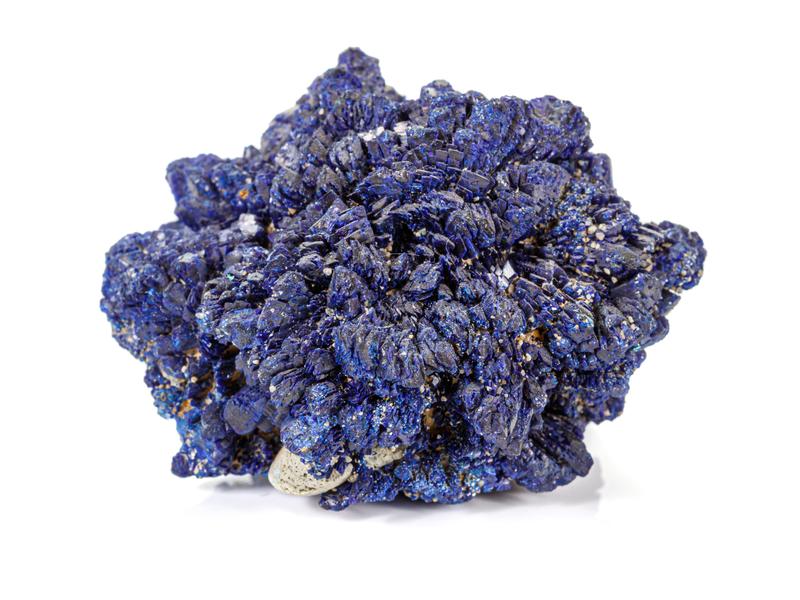
Azurite-Malachite crystal
IntuitionTransformation & ChangeClarity & Focus
Crystalis

Protocol

The Two Coppers

Blue copper and green copper. Same element, two oxidation states, one stone.

3 min

  1. 1

    Hold the azurite-malachite so you can see both colors clearly. The deep blue is azurite — Cu3(CO3)2(OH)2 — copper carbonate with two carbonate groups. The green is malachite — Cu2(CO3)(OH)2 — copper carbonate with one. Same copper, same carbonate chemistry, different ratios. The blue and the green are not neighbors — they are the same element expressing differently under different conditions. Run your thumb along the boundary between colors. (0:00–0:45)

  2. 2

    Close your eyes. Hold the stone in both hands at solar plexus height. This is a soft stone — hardness 3.5, softer than a copper coin. Handle with care. Both minerals are monoclinic, and polished specimens have high reflectance — they catch light and hold it. Breathe in for 4, out for 6. Feel the density in your hands. Copper minerals are heavier than they look. (0:45–1:30)

  3. 3

    Keep your eyes closed. In nature, azurite slowly converts to malachite over time as it absorbs water and loses a CO2 molecule. Blue becomes green. This is not decay — it is a chemical maturation. The stone you hold may be mid-transformation, carrying both the beginning and the ending in the same specimen. Ask: what in me is mid-transformation — no longer the first form, not yet the second? (1:30–2:15)

  4. 4

    Open your eyes. Look at the stone one last time. Notice whether your eye goes to the blue or the green first. Azurite is the rarer state — less stable, more vivid. Malachite is the more stable state — enduring, abundant. Both are copper. Both are you. Place the stone down gently. Two coppers. One breath. Done. (2:15–3:00)

tap to flip for protocol

Change can split a life into two simultaneous weather systems. One part wants understanding. Another part wants motion before understanding has finished speaking. Living between those impulses is exhausting because each one accuses the other of delay.

Azurite malachite has no interest in that argument. It forms as an intergrowth of two secondary copper minerals, blue azurite and green malachite, often in rounded masses, crusts, or stalactitic growth where mineral-rich water has already been moving through the rock for a long time. The specimen carries evidence of process, not purity.

That matters when a person is ashamed of looking mid-transition. Blue stays blue. Green stays green. Neither one erases the other to make the story cleaner.

Some seasons are composite.

What Your Body Knows

Nervous system states

sympathetic

Dorsal vagal collapse (loss of meaning/spiritual crisis):

The blue-green duality of azurite-malachite addresses the specific type of sympathetic activation where the mind is running faster than the body can process. Azurite (blue) has historically been associated with mental function and the third eye; malachite (green) is associated with the heart center. Together, they create a visual biofeedback loop: blue directs attention upward (cognition), green pulls it down (embodiment). The oscillation between these two visual anchors can interrupt the runaway cognitive loop by forcing the nervous system to toggle between head and heart. State shift: cognitive-sympathetic overdrive toward integrated head-heart processing through visual oscillation. 2.

dorsal vagal

Azurite has been the pigment of divinity across cultures

Mixed state: sympathetic + dorsal (wanting to think but unable to feel): This is the intellectual defense; the person who can analyze their trauma brilliantly but cannot feel it. Azurite-malachite mirrors this split: the azurite (intellect/blue) and malachite (feeling/green) are not separate stones. They are one specimen. The intergrowth structure demonstrates that thinking and feeling are not separate functions occupying separate territories; they are interpenetrated. State shift: intellectual dissociation toward cognitive-emotional integration through witnessing mineral-level interpenetration.

ventral vagal

When already regulated, azurite-malachite supports the executive functions of the ventral vagal state

Transition state: sympathetic toward ventral (insight after crisis): The moment when crisis yields clarity; when the sympathetic storm breaks and the mind suddenly sees the pattern it was too activated to perceive; azurite-malachite holds this transition. Azurite was BECOMING malachite before it was collected; the specimen holds the energy of transformation in progress. It models the insight process: high-energy state (azurite/sympathetic) naturally evolving toward grounded wisdom (malachite/ventral) given sufficient time and exposure to new conditions. State shift: post-crisis sympathetic toward ventral vagal insight through transformation-in-progress modeling.

Nervous system mapping based on polyvagal theory (Porges, 2011).

Mineralogy

Mineral specs

Chemical Formula

Azurite: Cu3(CO3)2(OH)2 (copper carbonate hydroxide, basic) + Malachite: Cu2(CO3)(OH)2 (copper carbonate hydroxide, basic); occurring as intimate intergrowths within the same specimen

Crystal System

Both monoclinic; Azurite: space group P21/c; Malachite: space group P21/a

Mohs Hardness

3.5

Specific Gravity

Azurite: 3.77; Malachite: 3.6-4.0; intergrowths vary between these values

Luster

Azurite: vitreous to adamantine; Malachite: adamantine to vitreous to silky (fibrous varieties); polished specimens show high reflectance

Color

Blue-Green

Traditional Knowledge

Traditions across cultures

Unknown

Ancient Egyptian sacred art

Azurite was one of the primary blue pigments used in Egyptian tomb paintings, temple decoration, and funerary art from the Old Kingdom onward. Research on Egyptian paintings confirms azurite as a key pigment source, with its deep blue representing the heavenly realm of the gods and the waters of the primordial Nun (Zeng, 2024). Malachite served as the green pigment representing fertility, rebirth, and the verdant banks of the Nile. The co-occurrence of both pigments in the same artistic contexts -- particularly in depictions of the afterlife -- suggests the Egyptians intuitively understood the relationship between these two copper minerals. 2. Medieval Islamic manuscript tradition (Morocco/Middle East): Azurite was extensively used as a blue pigment in Islamic manuscript illumination. Stud

When This Stone Finds You

What it says when it arrives

Transformation is rarely tidy enough to flatter you. Azurite and malachite keep blue insight and green growth in the same copper-born body without flattening either one. Change does not have to choose between vision and motion.

Somatic protocol

The Two Coppers

Blue copper and green copper. Same element, two oxidation states, one stone.

3 min protocol

  1. 1

    Hold the azurite-malachite so you can see both colors clearly. The deep blue is azurite — Cu3(CO3)2(OH)2 — copper carbonate with two carbonate groups. The green is malachite — Cu2(CO3)(OH)2 — copper carbonate with one. Same copper, same carbonate chemistry, different ratios. The blue and the green are not neighbors — they are the same element expressing differently under different conditions. Run your thumb along the boundary between colors. (0:00–0:45)

    1 min
  2. 2

    Close your eyes. Hold the stone in both hands at solar plexus height. This is a soft stone — hardness 3.5, softer than a copper coin. Handle with care. Both minerals are monoclinic, and polished specimens have high reflectance — they catch light and hold it. Breathe in for 4, out for 6. Feel the density in your hands. Copper minerals are heavier than they look. (0:45–1:30)

    1 min
  3. 3

    Keep your eyes closed. In nature, azurite slowly converts to malachite over time as it absorbs water and loses a CO2 molecule. Blue becomes green. This is not decay — it is a chemical maturation. The stone you hold may be mid-transformation, carrying both the beginning and the ending in the same specimen. Ask: what in me is mid-transformation — no longer the first form, not yet the second? (1:30–2:15)

    1 min
  4. 4

    Open your eyes. Look at the stone one last time. Notice whether your eye goes to the blue or the green first. Azurite is the rarer state — less stable, more vivid. Malachite is the more stable state — enduring, abundant. Both are copper. Both are you. Place the stone down gently. Two coppers. One breath. Done. (2:15–3:00)

    1 min

The #1 Question

Can Azurite-Malachite go in water?

Water Safety NO -- Do not submerge. Both azurite and malachite are copper carbonate minerals with a Mohs hardness of only 3.5--4, making them soft and susceptible to water damage. Prolonged water contact can cause surface dissolution, loss of polish, and color fading (especially in azurite, which can darken or lose its blue brilliance). MORE CRITICALLY: both minerals contain significant copper content (azurite is ~55% CuO, malachite is ~57% CuO). Copper ions WILL leach into water, especially acidic or warm water. Research has confirmed that allergic contact dermatitis can result from prolonged skin contact with copper-containing malachite, particularly from jewelry worn against moist skin (Horton et al., 2017). NEVER use in gem elixirs, gem water, or any preparation involving ingestion. For energetic water charging, place the stone at least 6 inches from the water vessel.

Care and Maintenance

How to care for Azurite-Malachite

Azurite-malachite is water-safe for very brief rinses only. Both minerals are copper carbonates (Mohs 3. 5-4) that can be affected by prolonged moisture.

Quick rinse (15-30 seconds) under cool water, pat dry immediately. Avoid acidic solutions, which will dissolve carbonate minerals. Never use ultrasonic cleaners; the softness and intergrowth boundary can fracture.

Recommended cleansing: moonlight (overnight, safest), smoke (30-60 seconds), selenite plate (4-6 hours). Store in a soft pouch away from harder stones.

In Practice

How Azurite-Malachite is used

Your feelings and your understanding of your feelings are not lining up. Azurite is deep blue copper carbonate (third eye). Malachite is green copper carbonate (heart).

Same element, same carbonate group, different oxidation states producing different colors. They form together in copper ore oxidation zones where conditions fluctuate. Hold the blue side toward your forehead, the green side toward your chest.

SAFETY: Both minerals contain copper. Do not use in elixirs or prolonged water contact. The copper is why this stone works and why it requires respect.

Verification

Authenticity

Azurite-malachite: two copper carbonates that should be naturally intergrown. Azurite (deep blue) effervesces in acid. Malachite (green) also effervesces.

Both are Mohs 3. 5-4. If neither component reacts to acid, the specimen is not copper carbonate.

Check the blue-green boundary: natural intergrowths show gradational transitions, not sharp painted lines.

Temperature

Natural Azurite-Malachite should usually feel cooler than plastic or resin on first touch and warm more slowly in the hand.

Scratch logic

Use 3.5 on the Mohs scale as the check, not internet myths. A real specimen should behave in line with the hardness listed above.

Surface and luster

Look for a azurite: vitreous to adamantine; malachite: adamantine to vitreous to silky (fibrous varieties); polished specimens show high reflectance surface quality rather than a painted or plastic shine.

Weight and density

The listed specific gravity is Azurite: 3.77; Malachite: 3.6-4.0; intergrowths vary between these values. If a specimen feels unusually light for its size, it may deserve a second look.

Geographic Origins

Where Azurite-Malachite forms in the world

Morocco's Midelt Province and Kerrouchen area produce the most commercially available azurite-malachite specimens. Arizona (USA) localities including Bisbee, Morenci, and Globe-Miami produced historic specimens from copper mining districts. DR Congo's Katanga Copper Belt yields deep blue azurite with vivid green malachite intergrowths from world-class copper deposits.

FAQ

Frequently asked

What is Azurite-Malachite?

Azurite-Malachite is classified as a Azurite-malachite is NOT a distinct mineral species but a natural intergrowth of two copper carbonate minerals. Azurite is thermodynamically unstable relative to malachite under surface conditions, and slowly pseudomorphs (transforms) into malachite over geological time through the gain of water and loss of CO2: 2Cu3(CO3)2(OH)2 + H2O -> 3Cu2(CO3)(OH)2 + CO2. Every azurite-malachite specimen is a snapshot of an ongoing transformation.. Chemical formula: Azurite: Cu3(CO3)2(OH)2 (copper carbonate hydroxide, basic) + Malachite: Cu2(CO3)(OH)2 (copper carbonate hydroxide, basic) -- occurring as intimate intergrowths within the same specimen. Mohs hardness: 3.5--4 (both minerals). Crystal system: Both monoclinic -- Azurite: space group P21/c; Malachite: space group P21/a.

What is the Mohs hardness of Azurite-Malachite?

Azurite-Malachite has a Mohs hardness of 3.5--4 (both minerals).

Can Azurite-Malachite go in water?

Water Safety NO -- Do not submerge. Both azurite and malachite are copper carbonate minerals with a Mohs hardness of only 3.5--4, making them soft and susceptible to water damage. Prolonged water contact can cause surface dissolution, loss of polish, and color fading (especially in azurite, which can darken or lose its blue brilliance). MORE CRITICALLY: both minerals contain significant copper content (azurite is ~55% CuO, malachite is ~57% CuO). Copper ions WILL leach into water, especially acidic or warm water. Research has confirmed that allergic contact dermatitis can result from prolonged skin contact with copper-containing malachite, particularly from jewelry worn against moist skin (Horton et al., 2017). NEVER use in gem elixirs, gem water, or any preparation involving ingestion. For energetic water charging, place the stone at least 6 inches from the water vessel.

What crystal system is Azurite-Malachite?

Azurite-Malachite crystallizes in the Both monoclinic -- Azurite: space group P21/c; Malachite: space group P21/a.

What is the chemical formula of Azurite-Malachite?

The chemical formula of Azurite-Malachite is Azurite: Cu3(CO3)2(OH)2 (copper carbonate hydroxide, basic) + Malachite: Cu2(CO3)(OH)2 (copper carbonate hydroxide, basic) -- occurring as intimate intergrowths within the same specimen.

Is Azurite-Malachite toxic?

Some individuals may develop contact dermatitis from prolonged skin contact with raw (unpolished) specimens due to copper ion transfer to moist skin. Polished specimens are safer for handling, but wash hands after extended sessions.

How does Azurite-Malachite form?

Formation Story Azurite-malachite forms in the oxidation zone (supergene enrichment zone) of copper ore deposits, where primary copper sulfide minerals such as chalcopyrite (CuFeS2) and bornite (Cu5FeS4) undergo chemical weathering through interaction with oxygenated, CO2-bearing groundwater. As copper is liberated from sulfides and transported in acidic, carbonate-bearing solutions, it precipitates as secondary copper carbonates when conditions reach appropriate pH and carbonate ion concentrati

References

Sources and citations

  1. . [SCI]

    DOI: 10.1002/gj.3742

  2. . [SCI]

    DOI: 10.1002/jrs.70009

  3. . [SCI]

    DOI: 10.1111/rge.12004

  4. . [SCI]

    DOI: 10.1002/col.22948

  5. . [SCI]

    DOI: 10.1002/jrs.4154

  6. . [SCI]

    DOI: 10.1111/arcm.70025

  7. . [SCI]

    DOI: 10.1111/cod.12791

Closing Notes

Azurite-Malachite

Two copper carbonates growing from the same oxidation zone. Blue azurite transforms into green malachite over geological time as it hydrates. The science documents how one mineral becomes another without leaving.

The practice asks what it means when transformation is not replacement but the next state of the same material.

Bring it into practice

What to do with Azurite-Malachite next

Move from reference to ritual. Search current inventory for Azurite-Malachite, build a custom bracelet, or let Sacred Match choose the right supporting stones for you.

Community notes

Threads under Azurite-Malachite

Open all chats

Shared field notes tied to Azurite-Malachite appear here, including notes saved from practice.

No shared notes under Azurite-Malachite yet.

When members save a public field note for this stone, it will appear here.

The archive

Related crystals

Read the Full Crystal Guide

Continue through stones that share intention, chakra focus, or tonal family with Azurite-Malachite.