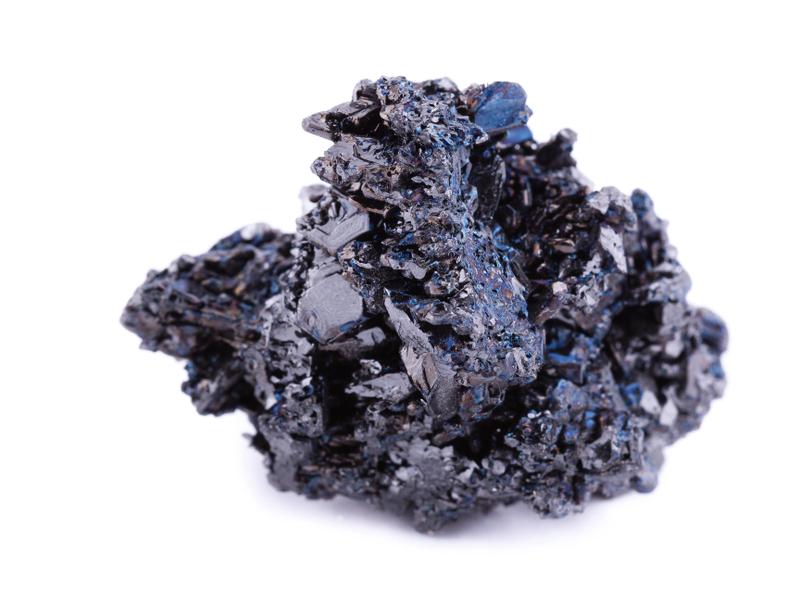
Your depth has gone so dark it risks being mistaken for absence. Covellite carries an indigo-blue metallic sheen out of copper sulfide, richer than black and stranger than silver. Shadow can still refract.
Covellite addresses the throat and upper spine, where expression encounters the deep metallic substrate of the body's protective architecture. It speaks to sympathetic...
The Meaning
Covellite in the Crystalis dictionary
Some inward phases get misread because they are too saturated to look lively from the outside. People see darkness and assume vacancy.
Covellite keeps proving the opposite. Blue-black overall, yet cleavage surfaces return indigo and violet iridescence, the mineral holding reflectivity inside the very depth that makes it seem unreadable.
Darkness is not always empty. Sometimes it is concentrated past the point of easy recognition.
Stone Lore
Stories carried through time
Cultural notes are presented as tradition and historical context — stories carried through time.
Unknown
1790s-1832
First observed on Vesuvius by Niccolo Covelli; formally described and named by Francois Sulpice Beudant in 1832. - 19th-20th century: Recognized as an economically important secondary copper mineral in supergene enrichment blankets. Mined industrially for copper content (not as a specimen mineral). - Late 20th century: Collector-quality specimens from Sardinia, Butte, and Summitville enter the mineral market.
- Contemporary: Used in the metaphysical crystal market, primarily as display/cabinet specimens due to its fragility and toxicity. No pre-modern cultural, ceremonial, or medicinal use documented.
Origin lore
Named for Italian Mineralogist Nicola Covelli
Covellite was first described in 1815 by German mining official Johann Carl Freiesleben, who called it Kupferindig (indigo copper) for its deep blue color. It was later named in 1832 by French mineralogist François Beudant after Italian...
Modern/Scientific · 1815–1832 CE
Lore & history
Indigo Blue Copper Sulfide
Covellite (CuS) is one of only a few naturally occurring minerals that exhibit a true indigo blue color. It was first found at Mount Vesuvius, Italy, which remains the type locality. Covellite is notable for its unusual electronic...
Modern/Scientific · 1815–present
Earth Record
Mineralogy and formation
Covellite appears where copper ore bodies are being chemically rewritten below the most oxidized zone. Descending waters enriched in copper and sulfur react with earlier sulfides, often replacing chalcopyrite, chalcocite, or bornite during supergene enrichment. The resulting mineral, CuS, crystallizes in the hexagonal system and commonly forms thin platy crystals, iridescent coatings, and deep indigo masses with a metallic sheen that can flash violet, blue black, or bronze depending on surface condition.
Its structure is unusual among copper sulfides. Covellite contains both sulfide and disulfide bonding environments, which help account for its electrical and optical behavior. Though soft and imperfectly cleaved, it reads visually as dense and saturated. The celebrated blue is intrinsic, while some rainbow effects come from tarnish films and interference on exposed surfaces. In ore geology, covellite often marks enrichment and replacement rather than the earliest stage of mineralization.
It records movement, downward transport, and local reprecipitation. Because it forms as a secondary to late-stage sulfide in many deposits, crystal quality depends on available open space. Fine hexagonal plates can occur in cavities, but much material is massive or foliated. Exposure to air and handling can alter the surface quickly, so what one sees in a specimen may already include a second layer of oxidation over the primary metallic skin.
The thought pin describes depth so dark it risks being mistaken for absence. Covellite makes that physically legible. The color is not blackness with a blue cast. It is copper chemistry driven into a wavelength range that feels almost nocturnal. Somatically, the stone can be read as concentrated interiority rather than void. A body in such a state may look withdrawn from the outside while still holding complex charge within.
Covellite offers that lesson through metal and light. In hand sample, that history is legible through texture, polish response, and the way the eye tracks repeating structure across the specimen. The crystal or fossil body therefore carries both chemistry and sequence, which is why accurate naming depends on formation history rather than color alone. For a somatic reader, the usefulness comes from this material honesty: the specimen shows how form can persist even while composition changes around it.
Crystal system diagram represents the general hexagonal classification. Diagram created by Crystalis for educational reference.
Hexagonal structure
Chemical Formula
CuS (copper(II) sulfide)
Crystal System
Hexagonal
Mohs Hardness
1.5
Specific Gravity
4.6-4.76 (dense due to copper content)
Luster
Submetallic to resinous; spectacular iridescent blue-violet-purple play of colors on cleavage surfaces
Color
Blue-Black
IMA Status
species
Type Locality
Mount Vesuvius, Campania, Italy
IMA Number
pre-IMA 1832
01
Mineral conditions gather
02
Structure begins to crystallize
03
Covellite records place and pressure
Summitville, Colorado, USA (fine crystals from high-sulfidation epithermal deposit)
Butte, Montana, USA (classic supergene enrichment zone)
Bor, Serbia (major copper deposit with excellent covellite)
Calabona Mine, Alghero, Sardinia, Italy (world-class crystal specimens)
Chuquicamata, Chile (massive supergene covellite ore)
Mount Vesuvius, Italy (type locality, volcanic sublimate covellite)
Leonard Mine, Butte, Montana (historic specimens)
Kennecott, Alaska, USA
Covellite is a secondary copper sulfide mineral that forms primarily in the supergene enrichment zone of copper ore deposits. This zone develops when copper-bearing sulfide minerals (chalcopyrite, bornite, chalcocite) in the primary ore body are oxidized by descending meteoric water charged with dissolved oxygen and carbonic/sulfuric acid. The copper ions released by oxidation are transported downward in solution until they reach the water table, where reducing conditions prevail.
Below the water table, these copper-rich solutions react with pre-existing sulfide minerals, replacing them with higher-grade secondary copper minerals including covellite, chalcocite (Cu2S), and digenite (Cu9S5). Covellite specifically forms where copper-rich acidic solutions encounter iron sulfide or lower-grade copper sulfide minerals under moderately reducing conditions (Mitchell et al.
, 2010, https://doi. org/10. 1111/j. 1751-3928. 2010. 00145. x; Kimball, 2013, https://doi. org/10. 1111/j. 1365-2451. 2013. 00862. x). The supergene enrichment process is climatically controlled: it requires alternating wet and dry periods to drive the oxidation-dissolution-reprecipitation cycle. Arid to semi-arid climates with seasonal rainfall are optimal, which is why supergene-enriched copper deposits are particularly well-developed in the southwestern United States, the Andes of Chile and Peru, and parts of Central Africa.
The enrichment zone can be economically critical, some of the world's largest copper mines (including Chuquicamata, Chile, and Morenci, Arizona) began operations exploiting the supergene blanket before mining deeper into primary ore (Mulja et al. , 2021, https://doi. org/10. 1111/rge. 12277; Mitchell et al. , 2010, https://doi. org/10. 1111/j. 1751-3928. 2010. 00145. x). Covellite also occurs as a primary (hypogene) mineral in some high-sulfidation epithermal deposits and as a volcanic sublimate on active volcanoes (it was originally discovered on Vesuvius, Italy).
In these settings, covellite crystallizes directly from sulfur-rich volcanic gases or hydrothermal fluids rather than through supergene processes. The crystal structure of covellite is unusually complex for a binary compound: it contains both Cu+ and Cu2+ ions, and both S2- and S22- (disulfide) units, giving it an effective formula better written as Cu3(S2)S rather than simply CuS.
This mixed-valence structure is responsible for its extraordinary optical properties (Mohamed et al. , 2019, https://doi. org/10. 1111/ijac. 13337; Shahi et al. , 2020, https://doi.
USA (Montana)ItalySerbia
Telling it apart
Covellite gets mistaken for bornite, peacock ore, and treated chalcopyrite because all can show blue to purple iridescence. In tourist markets especially, acid-treated chalcopyrite is sold as if it were naturally vivid covellite. The species difference matters because covellite is a distinct copper sulfide with its own softness, platy habit, and collector value. The clearest indicator is habit.
Genuine covellite often forms thin plates, foliated masses, or indigo metallic surfaces that look darker and more saturated than the carnival iridescence of treated peacock ore. Bornite usually trends bronzier in fresh areas and tarnishes into color, whereas covellite can appear intrinsically blue even before heavy surface alteration. A streak test is not ideal on good specimens, but hardness and crystal habit help.
A reputable seller should be able to name the host, the actual species, and any stabilization or treatment without hesitation. Indigo blue copper sulfide is distinctive but not permanent without proper care, and mislabeling it as a tougher mineral leads to handling damage.
Spotting the real thing
Covellite: spectacular iridescent blue-violet-purple on cleavage surfaces. Specific gravity 4. 6-4.
76 (heavy). Submetallic luster. Mohs 1.
5-2 (very soft). Perfect basal cleavage. The iridescence on fresh cleavage faces is diagnostic; no other common mineral produces this specific blue-violet metallic iridescence.
If the iridescence looks like surface coating rather than cleavage surface, question it.
When energy feels stuck and the body won't respond. Covellite is placed on the body as an anchor point. Your shoulders drop. Your breath becomes shallow and barely audible. A heaviness settles in your limbs. This is dorsal vagal shutdown; your oldest survival circuit pulling you toward stillness, collapse, disconnection from sensation.
Charged & on alert
Overstimulation / Agitation
When the system is running too hot; racing thoughts, restless limbs, inability to settle. Your chest tightens. Your jaw clenches. Your breath moves higher, shallower, faster. This is sympathetic activation; your body mobilizing for fight or flight, muscles tensing, heart rate rising.
Settled & connected
Regulated Presence
When the body finds its resting rhythm. Covellite held or placed becomes a touchpoint for presence. Your chest opens. Your jaw unclenches. Your breath deepens into your belly. This is ventral vagal regulation; your body finding safety, social connection, steady presence.
These associations come from tradition and reflective practice — a way of working with the stone, not a medical prescription.
Somatic Practice
Simple ways to work with Covellite
◇
Hold
Carry Covellite in a pocket or place it over the heart center during a pause.
◌
Meditate
Let the stone become a quiet tactile anchor while the breath slows.
☽
Breathe
Breathe in softness. Breathe out tension. Keep the practice simple.
✎
Journal
Write with Covellite nearby to name the feeling without forcing a conclusion.
✋
Bodywork
Rest the stone near the chest, hand, or bedside as a reminder to soften.
⌂
Environment
Place it where you want a visual cue for care, repair, or steadiness.
Field Instruction
The Iridescent Shield
Hexagonal copper sulfide at Mohs 1.5, dense at 4.6 g/cm3 — its iridescent blue-violet surface is a metallic mirror for what the body refuses to look at directly.
3 min protocol
1
Do NOT place covellite against bare skin for extended contact — it is copper sulfide (CuS), and while brief handling is safe, prolonged moisture contact is inadvisable. Hold it in your palm and angle it toward light. At Mohs 1.5 but specific gravity 4.6–4.76, this stone is impossibly dense for how soft it is. Watch the iridescent blue-violet-purple play across the cleavage surfaces. The submetallic luster shifts with every degree of tilt.
2
Hold the covellite at chest height, six inches from your sternum — close but not touching. The hexagonal crystal system organizes around a six-fold axis. Breathe in cycles of six: inhale for six counts, exhale for six counts. Let your gaze soften on the iridescent surface. The colors you see are structural — interference patterns from the layered crystal, not pigment.
3
Ask: What am I reflecting outward that prevents others from seeing what is underneath? Covellite is opaque — light does not pass through it. It returns everything as iridescence. The most beautiful surface in the mineral kingdom is also one of the most impenetrable. Notice where in your body you feel a similar barrier: gorgeous on the outside, dense and dark within.
4
Set the covellite down on a dark cloth and observe it from twelve inches away. The hexagonal structure holds even at Mohs 1.5 — it flakes, it cleaves, but the six-fold symmetry persists. Wash your hands after handling. What you saw in the iridescence — the barrier, the beauty, the refusal to transmit light — remains as a question, not an answer.
Stone Intelligence
The fact that makes Covellite memorable
Copper sulfide forming where oxidized solutions descend through the water table and react with primary sulfide minerals below. Iridescent blue-violet tarnish on a dark body. The science documents supergene enrichment.
The practice asks what transformation looks like when it happens at the boundary between what descends and what remains.
SCI
Effect of swelling pretreatment on the deposition structure on electroless copper of polyacrylonitrile nanocomposites for electromagnetic interference shielding
Journal of Applied Polymer Science · 2008Read source
SCI
Role of Cu/S ratio and Mg doping on modification of structural and optical characteristics of nano CuS
International Journal of Applied Ceramic Technology · 2019Read source
Covellite's role in somatic practice is exclusively visual. The iridescent blue-violet surface is one of the most arresting color displays in the mineral kingdom. it commands attention, slowing the eye and creating a state of focused fascination. This visual quality can address scattered attention states (sympathetic fragmentation, inability to focus, mental noise). The deep blue accesses the same visual-cortical pathway as looking at deep water or the twilight sky. a natural parasympathetic cue.
- Visual meditation ONLY (specimen in display case)
- When attention is scattered and needs a focal anchor
- When the nervous system is fragmented by overstimulation and needs a single, commanding visual point
- For contemplation of impermanence. covellite tarnishes, changes, degrades over time; it is a mineral that teaches that beauty is not permanent
- NEVER for body layouts. toxic
- NEVER for gem water or elixirs. toxic
- NEVER for direct handling without gloves. copper exposure risk
- Not for use with children, pets, or anyone who might put objects in their mouth
- Not for sleep proximity (the copper content and the recommendation to keep it sealed make bedside use impractical)
DISPLAY-ONLY PROTOCOL. Sealed display case. Visual engagement at arm's length. No touch. No water. No body contact. This is a museum-quality visual meditation tool, not a handling stone.
Sacred Match
Sacred Match reaches for Covellite when what you feel sounds like: depth mistaken for shutdown voice withdrawn upper spine heavy night thinking dark inner life overcrowded Sacred Match listens to the body rather than to preference. It notices what you are feeling right now, the way you are protecting yourself, and the deeper need underneath both. When that points to a pattern of covellite need, the stone is the stone it offers because its formation story models the kind of regulation being sought.
depth mistaken for shutdown -> body braced -> seeking steadier containment voice withdrawn -> signal overloaded -> seeking discrimination upper spine heavy -> old material active -> seeking paced processing night thinking dark -> energy leaking outward -> seeking structure inner life overcrowded -> rest interrupted -> seeking enough safety to settle The prescription is less about liking the stone than about matching material logic to the body's current defensive pattern.
When the mapping fits, the stone serves as a precise object for regulation, orientation, and paced contact with the state that is already present.
Pairings are treated like a recipe file: clear use, method, and safety.
Crystal Companion
Covellite + Amethyst
Use when
You want to layer the primary intention with another supportive tone.
How to work with it
Place the stones together during meditation, journaling, or a short reset.
Safety
Use as a reflective practice tool, not as a medical substitute.
Crystal Companion
Covellite + Rhodonite
Use when
You want to layer the primary intention with another supportive tone.
How to work with it
Place the stones together during meditation, journaling, or a short reset.
Safety
Use as a reflective practice tool, not as a medical substitute.
Crystal Companion
Covellite + Clear Quartz
Use when
You want to layer the primary intention with another supportive tone.
How to work with it
Place the stones together during meditation, journaling, or a short reset.
Safety
Use as a reflective practice tool, not as a medical substitute.
Crystal Companion
Covellite + Black Tourmaline
Use when
You want to layer the primary intention with another supportive tone.
How to work with it
Place the stones together during meditation, journaling, or a short reset.
Safety
Use as a reflective practice tool, not as a medical substitute.
Covellite + Hematite. Indigo depth with iron ballast. Hematite keeps metallic introspection from turning into collapse. Set hematite at the feet and keep covellite on the desk where light can hit it. Covellite + Labradorite. Dark sheen with angle-based revelation. Both stones shift under light, but covellite adds more metallic gravity. Place covellite at the throat and labradorite above the brows during brief rest.
Covellite + Smoky Quartz. Shadow with downward exit. Useful when deep mood needs a route rather than amplification. Carry covellite high in a pocket and smoky quartz low near the hip. Covellite + Clear Quartz. Dense blue signal brought into focus. Quartz is best when writing from difficult interior material. Keep covellite beside the page and quartz at the top edge of the notebook. Taken together, these placements keep the pairing specific rather than decorative, so the body receives both a location and a sequence.
The benefit of pairing is not more volume. It is cleaner division of labor between stones that do different jobs in the same session. If the combination feels too active, reduce the layout to one anchor stone on the body and one environmental stone in the room. Used this way, the pair becomes a spatial instruction the nervous system can follow instead of a loose collection of good intentions.
Care & Cleansing
How to keep Covellite in good condition
Water Safe?
Keep dry
This stone should stay out of water. Water can dull the surface, destabilize the specimen, or damage the stone over time.
Sunlight Safe?
Sunlight safe
Tolerates daylight; safe to charge or display in the sun.
Authenticity
What to check
Natural Covellite should usually feel cooler than plastic or resin on first touch and warm more slowly in the hand.
This is a TOXIC mineral. Covellite (CuS) contains approximately 66% copper by weight. The following protocols are MANDATORY:
Acute Exposure Risk:
- Dermal absorption: Copper sulfide can release copper ions through skin contact, particularly in the presence of moisture (sweat). Acute copper sulfate (related compound) poisoning through dermal absorption has been documented in occupational settings, causing hemolytic anemia, methemoglobinemia, and acute kidney injury (Park et al. , 2018, https://doi. org/10.
1002/ajim. 22892). - Ingestion risk: Copper compounds are gastrointestinal irritants and, at sufficient doses, hepatotoxic. Accidental ingestion of copper sulfide dust or contaminated water can cause nausea, vomiting, abdominal pain, and liver damage. - Inhalation risk: CuS dust is a respiratory irritant. Chronic inhalation of copper-containing dusts can cause metal fume fever-like symptoms and has been associated with occupational lung disease.
Water Reactivity:
- CuS is very slightly soluble in pure water but dissolves readily in acidic conditions and can oxidize in air to release soluble copper sulfate. NEVER immerse covellite in water used for consumption.
- Covellite also reacts with hydrogen peroxide, strong acids, and oxidizing agents.
MANDATORY PROTOCOL:
1. DISPLAY ONLY. Keep in enclosed display case. 2. NO skin contact. If handled, wear gloves. Wash hands immediately and thoroughly with soap and water after any contact. 3. NO water. No gem water, no elixirs, no bath immersion, no cleaning with water that will be reused. Water contact can leach copper. 4. NO mouth contact. Keep away from children and pets. Do not place near food preparation areas.
5. NO cutting, grinding, or polishing by end users. CuS dust is toxic. Only professional lapidaries with appropriate ventilation and PPE. 6. Store away from other specimens. Covellite can tarnish and may leave copper residue on adjacent surfaces. 7. Sun safety: Covellite will tarnish and lose iridescence with prolonged light and air exposure. Store in dark, dry conditions. Museum-quality specimens are often kept in sealed containers.
Safety: Safe to own, display, and handle; wash your hands afterward. Do not make elixirs, place it in drinking water, or ingest it, and never inhale dust from raw or broken pieces.
Temperature
Natural Covellite should usually feel cooler than plastic or resin on first touch and warm more slowly in the hand.
Scratch logic
Use 1.5 on the Mohs scale as the check, not internet myths. A real specimen should behave in line with the hardness listed above.
Surface and luster
Look for a submetallic to resinous; spectacular iridescent blue-violet-purple play of colors on cleavage surfaces surface quality rather than a painted or plastic shine.
Weight and density
The listed specific gravity is 4.6-4.76 (dense due to copper content). If a specimen feels unusually light for its size, it may deserve a second look.
My Field Guide
Your private record and next steps
Journal
Add this stone to your private collection, then log what happened when you worked with it.
Shared Notes
Read public practice logs and pattern notes from the Crystalis community.
When members save a public field note for this stone, it will appear here.
Frequently Asked
Questions people ask about Covellite
What is Covellite?
⌄
Covellite is a sulfide mineral of the copper sulfide group: copper(II) sulfide, CuS, crystallizing in the hexagonal system. At Mohs 1.5 to 2 it is extremely soft, softer than a fingernail.
What is the Mohs hardness of Covellite?
⌄
Covellite has a Mohs hardness of 1.5-2 (extremely soft, softer than a fingernail).
Can Covellite go in water?
⌄
- CuS is very slightly soluble in pure water but dissolves readily in acidic conditions and can oxidize in air to release soluble copper sulfate. NEVER immerse covellite in water used for consumption.
Can Covellite go in the sun?
⌄
Covellite will tarnish and lose iridescence with prolonged light and air exposure. Store in dark, dry conditions. Museum-quality specimens are often kept in sealed containers.
What crystal system is Covellite?
⌄
Covellite crystallizes in the Hexagonal.
What is the chemical formula of Covellite?
⌄
The chemical formula of Covellite is CuS (copper(II) sulfide).
Where is Covellite found?
⌄
- Summitville, Colorado, USA (fine crystals from high-sulfidation epithermal deposit) - Butte, Montana, USA (classic supergene enrichment zone) - Bor, Serbia (major copper deposit with excellent covellite) - Calabona Mine, Alghero, Sardinia, Italy (world-class crystal specimens) - Chuquicamata, Chile (massive supergene covellite ore) - Mount Vesuvius, Italy (type locality, volcanic sublimate covellite) - Leonard Mine, Butte, Montana (historic specimens) - Kennecott, Alaska, USA.
Is Covellite toxic?
⌄
Handle with basic care. Covellite is copper sulfide (CuS) and very soft (Mohs 1.5). It is not acutely toxic to touch, but as a copper sulfide it should never be soaked, made into gem elixirs, or ingested, and dust from cutting or abrasion should not be inhaled. Wash your hands after prolonged handling, keep it dry, and cleanse it only by indirect methods such as sound or smoke rather than water.
Sources & Citations
Where this entry can be checked
Back Matter
Readable for people. Structured for AI search.
Sources stay visible in the page so readers, search engines, and answer systems can follow the evidence trail.
01
SCI
Effect of swelling pretreatment on the deposition structure on electroless copper of polyacrylonitrile nanocomposites for electromagnetic interference shielding
Chen, Chang‐Cheng, Hung, Chih‐Wei, Yang, Sung‐Yeng, Huang, Chi‐Yuan. (2008). Effect of swelling pretreatment on the deposition structure on electroless copper of polyacrylonitrile nanocomposites for electromagnetic interference shielding. Journal of Applied Polymer Science. [SCI]DOI 10.1002/app.28463
02
SCI
Role of Cu/S ratio and Mg doping on modification of structural and optical characteristics of nano CuS
Mohamed, Mohamed Bakr, Abdel‐Kader, Mohamed H., Almarashi, Jamal Q. M. (2019). Role of Cu/S ratio and Mg doping on modification of structural and optical characteristics of nano CuS. International Journal of Applied Ceramic Technology. [SCI]DOI 10.1111/ijac.13337
03
SCI
The Crystal Structure of Covellite
Roberts, H.S., Ksanda, C.J. (1929). The Crystal Structure of Covellite. American Journal of Science. [SCI]DOI 10.2475/ajs.s5-17.102.489