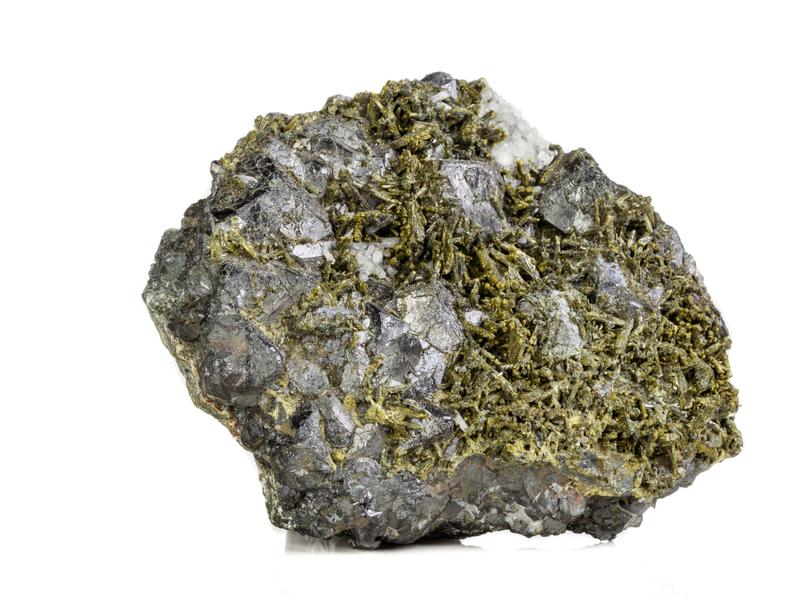
Something has been developing where you could not see it and now it is surfacing. Epidote grows in elongated green crystals along fault zones and metamorphic boundaries where pressure has already done its work. Emergence is not the start of the process.
Epidote is a Heart chakra mineral, but it operates on the heart's capacity for truth rather than its capacity for comfort. Where most heart chakra stones soften, open,...
The Meaning
Epidote in the Crystalis dictionary
Whatever has been growing in the dark is starting to show its hand.
Epidote often forms in elongated green crystals with a dark pistachio tone and a directional feel, as if amplification itself were taking a shape. The mineral has a reputation for increasing what is already active because it already looks like concentration gathering.
That can clarify a life very quickly.
Stone Lore
Stories carried through time
Cultural notes are presented as tradition and historical context — stories carried through time.
Rene Just Hauy, France
The Augmentation Mineral
French mineralogist Rene Just Hauy named epidote in 1801 from the Greek epidosis, meaning 'increase' or 'addition,' because the base of the crystal's prism has one side longer than the other, an asymmetry that looked like something had been added. The calcium-aluminum-iron sorosilicate (Ca2(Al,Fe)3(SiO4)(Si2O7)O(OH)) crystallizes in the monoclinic system and displays a characteristic pistachio-green color caused by iron substituting for aluminum.
Hauy's naming act was prescient: epidote would later become known in crystal practice as the stone that amplifies whatever is already present.
1801
Historical note
The Alpine Classic
The Knappenwand locality in the Untersulzbachtal (Untersulzbach Valley) of Salzburg, Austria, has produced the world's finest epidote specimens since its discovery around 1865. Alpine fissure veins in metamorphic schist and gneiss yielded...
Knappenwand, Untersulzbachtal, Austria · c. 1865 onward
Ritual history
Unakite and the American Discovery
Epidote combined with pink orthoclase feldspar forms the rock known as unakite, first found in the Unaka Mountains of North Carolina in the 19th century and later in significant quantities on Prince of Wales Island in Alaska. The name...
Prince of Wales Island, Alaska, USA · 20th century
Ritual history
The Amplifier of What Is
Epidote gained a distinctive reputation in crystal practice as a stone that amplifies whatever is already present: positive or negative. Practitioners observed that clients carrying epidote during periods of gratitude reported amplified...
Crystal Practice · 1990s-present
Earth Record
Mineralogy and formation
The distinctive pistachio to olive green color comes from Fe3+ (ferric iron) substituting for Al3+ in the M3 octahedral site. The degree of iron substitution controls color intensity: low iron produces yellowish green, high iron produces deep bottle green to nearly black. The iron endmember of the epidote solid solution series is pistacite, while the pure aluminum endmember is clinozoisite (colorless to pale green).
Most epidote in practice falls between these extremes, with the characteristic yellow-green hue that gave the mineral its colloquial name "pistacite" in older mineralogical literature.
Epidote forms across a wide range of geological conditions, making it one of the most common rock-forming silicates in metamorphic and hydrothermal environments. It occurs in low- to medium-grade regional metamorphism of mafic rocks (greenschist facies, approximately 300-500°C), in contact metamorphism around igneous intrusions, in hydrothermal veins and cavities, and as an alteration product of plagioclase feldspar, pyroxene, and amphibole.
The "epidote facies" of metamorphic petrology is named for the mineral because of its diagnostic presence in specific pressure-temperature conditions.
Crystals are typically prismatic and elongated along the b-axis, with a characteristic striated surface and strong vitreous to resinous luster. Epidote has perfect cleavage along {001} and imperfect along {100}. It registers Mohs 6-7, making it moderately hard and suitable for lapidary work. The mineral also shows strong pleochroism -- appearing different colors when viewed from different crystallographic directions -- typically ranging from pistachio green to yellowish green to brownish green depending on orientation.
This optical property makes cut and polished epidote visually dynamic.
Crystal system diagram represents the general monoclinic classification. Diagram created by Crystalis for educational reference.
Monoclinic structure
Chemical Formula
Ca2(Al,Fe)3(SiO4)3(OH)
Crystal System
Monoclinic
Mohs Hardness
6
Specific Gravity
3.3-3.5
Luster
Vitreous
Color
Pistachio green, yellow-green, dark green
IMA Status
species
Type Locality
Le Bourg-d'Oisans, Isère, France
IMA Number
pre-IMA (Grandfathered)
01
Mineral conditions gather
02
Structure begins to crystallize
03
Epidote records place and pressure
PakistanAustriaNorway
Telling it apart
Epidote's distinctive pistachio to olive green color is often confused with green tourmaline, actinolite, and diopside. The combination of monoclinic crystal system, strong pleochroism showing green, brown, and yellow along three axes, and hardness of 6 to 7 helps narrow the identification. Tourmaline is trigonal with a rounded triangular cross-section and vertical striations, and it is harder at 7 to 7.
5. Actinolite is an amphibole with cleavage at 56 and 124 degrees, while epidote shows two cleavages at different angles consistent with monoclinic symmetry. Diopside is also monoclinic pyroxene with cleavage near 87 and 93 degrees and lacks epidote's characteristic strong pleochroism. Specific gravity at 3. 25 to 3. 50 is higher than tourmaline (3. 0 to 3. 1) and most actinolite (3. 0 to 3.
4). The pistachio-green color deepening with increasing iron content is fairly diagnostic when combined with the elongated, striated prismatic crystals. Epidote contains both isolated SiO4 tetrahedra and paired Si2O7 groups, a dual-silicate architecture that distinguishes it structurally from all the look-alike minerals. Crystal faces often show a vitreous to slightly greasy luster that helps separate it from the silkier sheen of actinolite.
Spotting the real thing
Color Character Genuine epidote has a distinctive pistachio to olive green that is unlike any other common mineral. The color is not bright or neon, it is earthy, complex, and often slightly yellowish. Under different lighting conditions, epidote shows strong pleochroism: the same crystal appears different shades of green-yellow-brown when viewed from different angles. No single-color imitation replicates this directional color change.
Crystal Habit Natural epidote crystals are typically prismatic and elongated with surface striations running parallel to the long axis. The crystals have a characteristic vitreous to resinous luster that appears almost greasy on fresh surfaces. If crystals appear too perfect, too uniform, or lack surface striations, they may be synthetic or another mineral. Genuine epidote crystals often grow in subparallel groups or as individual prisms on matrix.
Hardness Test Epidote registers Mohs 6-7. It will scratch glass (5. 5) but can be scratched by quartz (7).
Everything is fine. You have constructed a narrative where the thing that happened was not that bad, where the resentment you carry is justified but manageable, where the life you are living is the life you chose rather than the life you defaulted into. The numbness is comfortable. The story holds. But underneath it, the body keeps score, and the things you have mislabeled are fermenting.
This is dorsal vagal masking: the nervous system has frozen the emotional truth in order to maintain the functional fiction. Epidote does not respect the fiction. It amplifies what is actually underneath it. If you pick up this stone while carrying a comfortable lie, the lie will become uncomfortable. That is the entire mechanism. Epidote makes the truth louder than the story you built to avoid it.
Shut down & far away
The Resentment Reservoir
You are not angry. You are beyond anger. You have been collecting grievances like evidence for a trial that will never come, and the file is enormous. The resentment sits in your body like acid; in your jaw, your shoulders, your stomach; and it colors everything. Your sympathetic nervous system is running at a low simmer that never resolves because the grievance was never expressed, never processed, never released.
Epidote will amplify this. If you bring resentment to this stone, it will make the resentment bigger, louder, more impossible to ignore. This is not punishment. It is pressure to act. Epidote amplifies the resentment until the cost of holding it exceeds the cost of releasing it. The stone forces the math.
Settled & connected
The Gratitude Threshold
You are carrying real appreciation. Not the performative gratitude of journal prompts and forced positivity, but the genuine recognition that something in your life is good and you know it. Your nervous system is in a state of regulated openness; ventral vagal engagement with the present moment. When you bring this state to epidote, the amplification is extraordinary. Gratitude becomes abundance.
Recognition becomes radiance. The stone takes what is already genuine and magnifies it until it fills the room. This is why experienced practitioners say epidote is the most powerful manifestation stone available; not because it creates abundance from nothing, but because it amplifies authentic appreciation into a resonance that attracts more of the same.
These associations come from tradition and reflective practice — a way of working with the stone, not a medical prescription.
Somatic Practice
Simple ways to work with Epidote
◇
Hold
Carry Epidote in a pocket or place it over the heart center during a pause.
◌
Meditate
Let the stone become a quiet tactile anchor while the breath slows.
☽
Breathe
Breathe in softness. Breathe out tension. Keep the practice simple.
✎
Journal
Write with Epidote nearby to name the feeling without forcing a conclusion.
✋
Bodywork
Rest the stone near the chest, hand, or bedside as a reminder to soften.
⌂
Environment
Place it where you want a visual cue for care, repair, or steadiness.
Field Instruction
The Amplifier
The Amplifier Protocol
3 min protocol
1
The Honest Inventory (30 seconds)Before touching the stone, take thirty seconds to ask yourself one question: what am I actually carrying right now? Not what you want to be carrying. Not the aspirational emotion. The real one. Name it. Resentment. Exhaustion. Grief. Gratitude. Relief. Joy. Fear. Name it honestly because epidote will amplify whatever you bring. This is the only stone in the collection that requires a pre-contact assessment. If you are carrying something you are not ready to see amplified, put the stone down and choose a different one. There is no shame in that. There is wisdom in it.
2
The Weighted Hold (30 seconds)If your inventory revealed something you are ready to amplify -- gratitude, clarity, honest resolve, genuine peace -- pick up the epidote in your dominant hand. Grip it firmly. This is not a passive hold. Epidote does not respond to passivity. Squeeze the stone and feel its density, its hardness, its refusal to yield. Inhale through the nose for 3 counts. Hold for 3 counts. Exhale through the mouth for 3 counts. Three equal beats. Balanced breath, because epidote amplifies imbalance as readily as balance. Three cycles.
3
The Amplification Breath (60 seconds)Switch the stone to both hands, pressed between the palms at chest level. Close your eyes. On each inhale, imagine the feeling you named in step one growing brighter -- not changing, not improving, just louder. Like turning up the volume on a sound that was already playing. Four counts in. On each exhale, let the amplified feeling radiate outward from the stone through your hands into your chest. Six counts out. Five full cycles. You are not generating new energy. You are letting epidote do what epidote does: take what exists and make it impossible to ignore.
4
The Reckoning Statement (20 seconds)Open your eyes. Hold the stone at eye level and look at the pistachio green. Say one sentence aloud: "I see what I am carrying, and I choose to carry it honestly." If the feeling you amplified was gratitude, this is a celebration. If it was resentment, this is a commitment to deal with it rather than bury it again. Epidote does not judge what you carry. It makes the weight accurate. The reckoning is not with the stone. It is with yourself.
5
Intentional Placement (40 seconds)Place the stone in a visible location -- your desk, your nightstand, your dashboard. Not hidden. Not pocketed. Epidote works best when you can see it, because the amplification continues as a visual reminder: what you carry is being amplified. If you carried gratitude into this protocol, leave the stone where it can remind you of abundance all day. If you carried something harder, leave it where it can remind you that the reckoning is not optional, it is just delayed. The protocol ends when the stone is placed. The amplification does not.
Stone Intelligence
The fact that makes Epidote memorable
René Just Haüy named this mineral epidosis ("increase") in 1801 because one side of the crystal base was longer than the other. Two centuries later, practitioners use the same word for the same reason: everything about this stone involves increase. The Fe3+ that produces its pistachio color is an ion of transformation: iron oxidized to its highest common state, carrying the maximum charge it can hold.
Epidote is a mineral that has already been through its own reckoning, already been oxidized under pressure, already amplified itself to full capacity. It asks the same of you. Crystalis documents the geology and the feeling because the stone never separated its chemistry from its teaching, and neither should we.
SCI
Multi-analytical characterization of an unusual epidote-supergroup mineral from Malmkärra, Sweden: Toward the new (OH)-analog of dollaseite-(Ce)
Epidote spherulites and radial euhedral epidote aggregates in a greenschist facies metavolcanic breccia hosting an UHP eclogite in Dabieshan (China): Implication for dynamic metamorphism
Epidote group minerals in low-medium pressure metamorphic terranes
Reviews in Mineralogy and Geochemistry · 2004Read source
Ritual Use
From reference to practice
Whatever you are feeling right now is about to get louder. Epidote is calcium aluminum iron sorosilicate, Mohs 6. Its name means "increase" in Greek because one crystal face is always longer than the opposite.
Haüy named it for the asymmetry. Hold it when you are ready for amplification, not when you want comfort. Epidote does not create feelings.
It increases the volume on what is already there. If you are in a good state, it amplifies that. If you are in a difficult state, it amplifies that too.
Use with awareness.
Sacred Match
Sacred Match reaches for Epidote when what you feel sounds like:
Self-deception patterns
Stagnation from avoidance
Ready for honest reckoning
Gratitude practice deepening
Unacknowledged resentment
Manifestation work
Need for unflinching clarity
Epidote finds you when you are done being comfortable. When the story you have been telling yourself has expired and you know it but have not yet admitted it. When you are ready to see what you are actually carrying -- not the curated version, but the real inventory. This stone does not arrive for consolation. It arrives for truth. And it will amplify whatever truth it finds, so arrive honestly or do not arrive at all.
Pairings are treated like a recipe file: clear use, method, and safety.
Crystal Companion
Epidote + Amethyst
Use when
You want to layer the primary intention with another supportive tone.
How to work with it
Place the stones together during meditation, journaling, or a short reset.
Safety
Use as a reflective practice tool, not as a medical substitute.
Crystal Companion
Epidote + Rhodonite
Use when
You want to layer the primary intention with another supportive tone.
How to work with it
Place the stones together during meditation, journaling, or a short reset.
Safety
Use as a reflective practice tool, not as a medical substitute.
Crystal Companion
Epidote + Clear Quartz
Use when
You want to layer the primary intention with another supportive tone.
How to work with it
Place the stones together during meditation, journaling, or a short reset.
Safety
Use as a reflective practice tool, not as a medical substitute.
Crystal Companion
Epidote + Black Tourmaline
Use when
You want to layer the primary intention with another supportive tone.
How to work with it
Place the stones together during meditation, journaling, or a short reset.
Safety
Use as a reflective practice tool, not as a medical substitute.
Citrine
Citrine brings solar optimism and confidence to epidote's amplification. When you have done the honest inventory and what you carry is genuine positivity, pairing citrine with epidote creates a powerful abundance circuit. Citrine generates the warmth. Epidote amplifies it. This is the manifestation pairing for people who have done the inner work first.
Black Tourmaline
The essential safety pairing for epidote work. Black tourmaline grounds and protects, creating a stabilizing anchor for epidote's unflinching amplification. If you are working with epidote on difficult emotions -- resentment, grief, anger -- pair it with black tourmaline to ensure the amplified energy has somewhere to ground rather than spiraling. Structure with volume.
Rose Quartz
Rose quartz softens epidote's intensity with unconditional self-compassion. This pairing is for people using epidote to confront uncomfortable truths about themselves -- rose quartz ensures the confrontation does not become self-punishment. Epidote shows you what you carry. Rose quartz reminds you that what you carry does not define your worth.
Amethyst
Amethyst adds spiritual perspective and emotional equilibrium to epidote's earthly amplification. This pairing elevates the reckoning from emotional inventory to spiritual clarity -- seeing not just what you carry but why you carry it. Amethyst's calming influence tempers epidote's intensity without muting it.
Unakite
Unakite already contains epidote, moderated by feldspar and quartz. Pairing pure epidote with unakite creates a graduated amplification: the unakite provides the gentler version while the epidote provides the full-volume version. This graduated approach is useful for people building their tolerance for epidote's intensity.
Care & Cleansing
How to keep Epidote in good condition
Water Safe?
Water safe
This stone is generally safe for short water contact, though polishing, fractures, and metal settings can still change how a specimen behaves.
Sunlight Safe?
Sunlight safe
Tolerates daylight; safe to charge or display in the sun.
Authenticity
What to check
Natural Epidote should usually feel cooler than plastic or resin on first touch and warm more slowly in the hand.
The #1 Question Can Epidote Go in Water? YES: WITH CAUTION
Epidote is generally water safe, with considerations. Epidote registers Mohs 6-7 and is chemically stable: it does not dissolve, react with, or release harmful compounds in water. The mineral is a calcium-aluminum-iron silicate, and silicates as a class are among the most water-resistant minerals. Polished epidote and tumbled specimens are fully water-safe for all common cleansing methods.
Running water cleansing: safe for polished specimens
Brief soaking (up to 30 minutes): safe
Salt water: safe for the mineral, though prolonged salt exposure may dull luster
Indirect gem water preparation: safe
Raw crystal specimens: use caution (perfect {001} cleavage allows water infiltration along cleavage planes)
The one caution: raw, prismatic epidote crystals with visible cleavage surfaces can allow water to seep along the cleavage planes, potentially causing internal fracturing over time.
If your epidote is a polished palm stone or tumbled piece, water is not a concern. If it is a natural crystal on matrix, limit water exposure and dry promptly. The iron content means the stone will not rust, but iron-bearing secondary minerals on the matrix surface may stain if wetted repeatedly.
Temperature
Natural Epidote should usually feel cooler than plastic or resin on first touch and warm more slowly in the hand.
Scratch logic
Use 6 on the Mohs scale as the check, not internet myths. A real specimen should behave in line with the hardness listed above.
Surface and luster
Look for a vitreous surface quality rather than a painted or plastic shine.
Weight and density
The listed specific gravity is 3.3-3.5. If a specimen feels unusually light for its size, it may deserve a second look.
My Field Guide
Your private record and next steps
Journal
Add this stone to your private collection, then log what happened when you worked with it.
Shared Notes
Read public practice logs and pattern notes from the Crystalis community.
When members save a public field note for this stone, it will appear here.
Frequently Asked
Questions people ask about Epidote
What is epidote?
⌄
Epidote is a calcium aluminum iron sorosilicate with the formula Ca2(Al,Fe3+)3(SiO4)3(OH). It crystallizes in the monoclinic system and is known for its distinctive pistachio to olive green color, which comes from Fe3+ (ferric iron) in the crystal structure. Epidote is classified as the amplification stone in crystal practice because it amplifies whatever energy is already present: positive or negative.
Can epidote go in water?
⌄
Yes, with caution. Epidote registers Mohs 6-7 and is chemically stable in water. Brief running water cleansing and short soaking are safe. However, epidote crystals are often prismatic with perfect cleavage along {001}, meaning water can infiltrate along cleavage planes in rough specimens. Polished epidote is fully water-safe. Avoid prolonged soaking of raw crystal specimens.
What does epidote do?
⌄
In traditional crystal practice, epidote is the amplification stone. It does not add energy or remove it; it amplifies whatever energy is already present. If you are carrying gratitude, epidote amplifies gratitude. If you are carrying resentment, epidote amplifies resentment. This makes it a powerful but demanding stone that requires honest self-assessment before use. It is not for everyone at every time.
What is the difference between epidote and unakite?
⌄
Unakite is a metamorphic rock composed of green epidote, pink orthoclase feldspar, and clear quartz. Epidote is the pure mineral species itself. Unakite contains epidote but also contains other minerals, which soften its energetic intensity. Pure epidote is a stronger amplifier; unakite is a gentler, more balanced stone because the feldspar and quartz moderate the epidote energy.
Is epidote dangerous to work with?
⌄
Not physically dangerous, but energetically demanding. Because epidote amplifies existing energy states without discrimination, working with it when you are in a negative emotional state can intensify that negativity. This is not the stone for crisis moments. It is the stone for honest reckoning: when you are ready to see what you are actually carrying, amplified to a volume you cannot ignore. Use with intention and self-awareness.
Sources & Citations
Where this entry can be checked
Back Matter
Readable for people. Structured for AI search.
Sources stay visible in the page so readers, search engines, and answer systems can follow the evidence trail.
01
SCI
Multi-analytical characterization of an unusual epidote-supergroup mineral from Malmkärra, Sweden: Toward the new (OH)-analog of dollaseite-(Ce)
Taddei A., Bonazzi P., Förster H.-J., Casey P., Holtstam D., Karlsson A., Bindi L. (2025). Multi-analytical characterization of an unusual epidote-supergroup mineral from Malmkärra, Sweden: Toward the new (OH)-analog of dollaseite-(Ce). American Mineralogist. [SCI]DOI 10.2138/am-2024-9438
02
SCI
Compositional variation and zoning of epidote supergroup minerals in the Campi Flegrei geothermal field, Naples, Italy
Belkin H.E., De Vivo B. (2023). Compositional variation and zoning of epidote supergroup minerals in the Campi Flegrei geothermal field, Naples, Italy. European Journal of Mineralogy. [SCI]DOI 10.5194/ejm-35-25-2023
03
SCI
Epidote spherulites and radial euhedral epidote aggregates in a greenschist facies metavolcanic breccia hosting an UHP eclogite in Dabieshan (China): Implication for dynamic metamorphism
Chen A.-P., Yang J.-J., Zhong D., Shi Y.-H., Liu J. (2020). Epidote spherulites and radial euhedral epidote aggregates in a greenschist facies metavolcanic breccia hosting an UHP eclogite in Dabieshan (China): Implication for dynamic metamorphism. American Mineralogist. [SCI]DOI 10.2138/am-2019-6980
04
SCI
Epidote group minerals in low-medium pressure metamorphic terranes
Grapes, R. & Hoskin, P.W. (2004). Epidote group minerals in low-medium pressure metamorphic terranes. Reviews in Mineralogy and Geochemistry. [SCI]DOI 10.2138/gsrmg.56.1.301
05
SCI
Epidote minerals in high P/T metamorphic terranes
Enami, M., Liou, J.G., & Mattinson, C.G. (2004). Epidote minerals in high P/T metamorphic terranes. Reviews in Mineralogy and Geochemistry. [SCI]DOI 10.2138/gsrmg.56.1.347