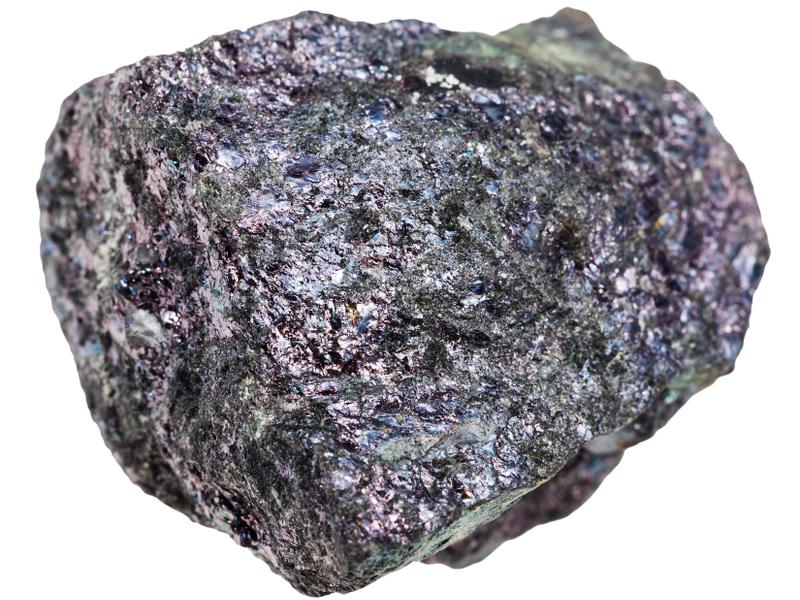
People keep reading your surface changes as damage. Bornite tarnishes from bronze to iridescent purple-blue as copper oxidizes at the surface, color that only appears because the chemistry is reacting to air. Transformation and decay are not the same process.
Intent
Self-Awareness
Joy & WarmthTransformation & ChangeBreaking Stagnation
Bornite is a Crown and Third Eye stone whose iridescent surface engages the visual cortex before the analytical mind can intervene. In somatic practice, the peacock...
The Meaning
Bornite in the Crystalis dictionary
Surface change gets mistaken for corruption all the time. A little weather, a little color shift, and suddenly everyone starts reading the whole thing as damage.
Bornite tarnishes into peacock blues, purples, and pinks even though the fresh mineral underneath is much darker and plainer. Oxidation makes the first impression stranger than the core. It helps to remember that iridescence is not the same thing as ruin.
Stone Lore
Stories carried through time
Cultural notes are presented as tradition and historical context — stories carried through time.
Ancient Copper Smelting
The Copper Age Ore
Bornite (Cu5FeS4) has been mined as a copper ore since the Chalcolithic period. Ancient copper smelters in the Fertile Crescent, the Balkans, and the Sinai Peninsula worked copper sulfide ores including bornite, which contains approximately 63% copper by weight. Archaeological evidence from Timna Valley (modern Israel/Jordan border) and Rudna Glava (modern Serbia) documents copper sulfide smelting dating to the 4th-5th millennium BCE.
The distinctive bronze-brown color of fresh bornite fracture surfaces would have made it instantly recognizable to ancient miners.
4000-3000 BCE
Ritual history
The Naming of Bornite
Bornite was named in 1845 by the Austrian mineralogist Wilhelm Karl Ritter von Haidinger in honor of Ignaz von Born (1742-1791), an Austrian mineralogist and metallurgist who revolutionized copper smelting. Born developed the amalgamation...
Wilhelm Karl Ritter von Haidinger · 1845
Origin lore
The Richest Hill on Earth
The copper mines of Butte, Montana, produced enormous quantities of bornite alongside chalcopyrite and other copper sulfides during the late 19th and early 20th centuries. Butte was known as 'The Richest Hill on Earth,' and bornite was...
Butte, Montana, USA · 1880s-1950s
Historical note
Peacock Ore: Natural and addressed
Bornite entered the crystal healing market primarily through its iridescent tarnish, which displays blue, purple, magenta, gold, and green. Dealers adopted the trade name 'peacock ore.' Much of the commercially available 'peacock ore' is...
Modern Crystal Trade · late 20th century
Earth Record
Mineralogy and formation
The formation process begins deep in the earth's crust, where superheated fluids carrying dissolved copper, iron, and sulfur migrate through fractures in existing rock. As these fluids cool -- typically between 300 and 500 degrees Celsius -- the dissolved metals precipitate out of solution, crystallizing as sulfide minerals. Bornite commonly forms alongside chalcopyrite (CuFeS2), chalcocite (Cu2S), and pyrite (FeS2) in what geologists call a paragenetic sequence -- a predictable order of mineral crystallization as temperature and chemical conditions change.
The iridescent tarnish that gives bornite its "peacock ore" reputation is not part of the original mineral. Fresh bornite is bronze-brown with a metallic luster -- handsome but not spectacular. The peacock colors develop through surface oxidation when the mineral is exposed to air and moisture. A thin oxide film forms on the crystal surface, and light interference within this film produces the vivid blues, purples, magentas, and golds.
The phenomenon is identical to the physics that creates color in soap bubbles and oil films -- thin-film interference, where different wavelengths of light are reinforced or cancelled depending on the film thickness. The tarnish develops over hours to days on freshly broken surfaces, making bornite one of the few minerals that becomes more visually spectacular through weathering rather than less.
Bornite is an economically important copper ore. Each unit cell contains five copper atoms, giving it a copper content of approximately 63. 3% by weight -- higher than chalcopyrite (34. 6%). It occurs in porphyry copper deposits worldwide, including the massive deposits in Chile, Peru, and the American Southwest, and in the great mining districts of Butte, Montana, and Tsumeb, Namibia.
The mineral was named in 1845 by Austrian mineralogist Wilhelm Karl von Haidinger in honor of Ignaz von Born (1742-1791), an Austrian mineralogist who developed early techniques for extracting metals from sulfide ores.
Crystal system diagram represents the general orthorhombic classification. Diagram created by Crystalis for educational reference.
Orthorhombic structure
Chemical Formula
Cu5FeS4
Crystal System
Orthorhombic
Mohs Hardness
3
Specific Gravity
5.06-5.09
Luster
Metallic on fresh surfaces; tarnishes to iridescent purple-blue
Color
Bronze with iridescent purple-blue tarnish
IMA Status
species
Type Locality
No designated type locality
IMA Number
pre-IMA (grandfathered)
01
Mineral conditions gather
02
Structure begins to crystallize
03
Bornite records place and pressure
Bornite is a copper iron sulfide mineral with the chemical formula Cu 5 FeS 4 . It crystallizes in the orthorhombic system at temperatures above 228 degrees Celsius, below which it inverts to a lower-symmetry form. The mineral forms primarily in hydrothermal veins, porphyry copper deposits, and contact metamorphic zones where copper-rich fluids interact with iron-bearing host rocks at elevated temperatures and pressures.
Bornite is an economically important copper ore. Each unit cell contains five copper atoms, giving it a copper content of approximately 63. 3% by weight, higher than chalcopyrite (34. 6%). It occurs in porphyry copper deposits worldwide, including the massive deposits in Chile, Peru, and the American Southwest, and in the great mining districts of Butte, Montana, and Tsumeb, Namibia.
The mineral was named in 1845 by Austrian mineralogist Wilhelm Karl von Haidinger in honor of Ignaz von Born (1742-1791), an Austrian mineralogist who developed early techniques for extracting metals from sulfide ores.
MexicoPeruMontana (USA)
Telling it apart
Bornite is widely sold as peacock ore, but most specimens marketed under that name are actually chalcopyrite (CuFeS2) that has been acid-treated to produce artificial iridescent tarnish. The distinction matters because natural bornite tarnish develops a specific purple-blue-magenta palette from a thin oxide layer, while acid-dipped chalcopyrite produces a broader, more garish rainbow.
Fresh bornite surfaces are bronze to copper-brown, and the tarnish develops over hours to days of air exposure. Chalcopyrite is harder (3. 5 to 4 versus 3 for bornite) and has a greenish-black streak instead of bornite's grayish-black streak. Specific gravity differs too: bornite runs 5. 06 to 5. 08, while chalcopyrite is lighter at 4. 1 to 4. 3. Both are copper sulfides and both are heavy, but the streak test on unglazed ceramic is the simplest separation in hand.
Orthorhombic bornite rarely forms visible crystals in the trade; most specimens are massive. If the iridescence looks too vivid, too uniform, and covers every surface equally, the piece was likely chemically treated. Natural bornite tarnish is patchy and develops most intensely on faces exposed to air.
Spotting the real thing
Streak test: Real bornite produces a grayish-black streak on unglazed porcelain. Chalcopyrite (often sold as bornite) produces a greenish-black streak. This is the most reliable field identification method. Hardness: Bornite is Mohs 3-3. 25, it can be scratched with a copper coin (Mohs 3. 5). If the specimen resists a coin scratch, it may be chalcopyrite (Mohs 3. 5-4) or another sulfide mineral mislabeled as bornite.
Fresh fracture color: Break or scratch the surface: true bornite shows bronze-brown metallic on fresh surfaces. Chalcopyrite shows brass-yellow. This difference is diagnostic even under the tarnish. Tarnish character: Natural bornite tarnish develops unevenly over hours to days, producing a complex, mottled color mosaic. Acid-treated specimens (common commercially) show more uniform, vivid iridescence.
Both are real bornite, the acid simply accelerates the natural process. Weight and density: Bornite has a specific gravity of 5. 06-5. 09, making it noticeably heavy for its size.
You have been playing it safe for so long that you have forgotten what your own color looks like. The dorsal vagal system has flattened your expression, muted your edges, kept you in the bronze-brown of the unweathered interior. You are presentable. You are acceptable. You are invisible. This is the nervous system pattern of someone who learned early that visibility meant vulnerability; so you stayed beneath the surface, unexposed.
Bornite teaches that the dull interior is not your true state. It is merely what you look like before air reaches you. The peacock colors do not come from adding something external. They come from the reaction between what you already are and what you have been avoiding: exposure.
Shallow breathing, reduced vocal range, tendency to agree rather than assert, physical posture that minimizes space. The body is conserving energy by refusing to be seen.
Shut down & far away
The Frantic Polish
You cannot stop fixing yourself. Every flaw identified becomes a project, every imperfection a crisis. Your sympathetic system is in overdrive; not fleeing danger, but fleeing your own rawness. You polish and optimize and curate, believing that if you can just get the surface smooth enough, the world will accept you. Bornite refutes this entirely. Its most beautiful state is its most weathered.
The iridescence emerges precisely from the oxidation that a polisher would remove. The stone arrives for people caught in the exhausting cycle of self-improvement that is actually self-erasure. Stop polishing. Let the air in. The colors are coming.
Jaw tension, restless hands, elevated heart rate during self-evaluation, impulse to check mirrors or seek external validation. The body is running a performance it cannot sustain.
Settled & connected
The Uneven Tarnish
Some parts of you are iridescent. Others are still dull bronze. You have done enough inner work to see flashes of your real spectrum, but the coverage is patchy; brilliant in some areas, flat in others. The nervous system is oscillating between dorsal flatness and sympathetic overactivation, creating an uneven emotional surface. Some days you feel vividly alive. Other days you wonder if the color was a hallucination.
Bornite in nature tarnishes unevenly too. The first blues appear at the edges, where air contact is greatest. The interior takes longer. This is not inconsistency. This is how transformation actually works: from the outside in, never all at once, always beginning where exposure is greatest.
Alternating confidence and doubt, energy that surges and crashes, moments of startling clarity followed by fog. The body is mid-transition, not broken.
Settled & connected
The Full Peacock
You are no longer hiding behind the bronze. The air has reached every surface, and every surface has responded with its own wavelength. You are not uniform; you are iridescent, which is better. Your nervous system is in ventral vagal regulation, and the regulation does not look like calm. It looks like a peacock spreading its tail: bold, specific, unapologetic about every color. Bornite in this state is not medicine.
It is a celebration of the fact that your so-called damage; every scratch, every oxidation, every place the world got in; is exactly what made you impossible to ignore.
Full breath, relaxed shoulders, willingness to be seen without performing, voice that carries its natural timbre without modification. The body has stopped hiding and started refracting.
These associations come from tradition and reflective practice — a way of working with the stone, not a medical prescription.
Somatic Practice
Simple ways to work with Bornite
◇
Hold
Carry Bornite in a pocket or place it over the heart center during a pause.
◌
Meditate
Let the stone become a quiet tactile anchor while the breath slows.
☽
Breathe
Breathe in softness. Breathe out tension. Keep the practice simple.
✎
Journal
Write with Bornite nearby to name the feeling without forcing a conclusion.
✋
Bodywork
Rest the stone near the chest, hand, or bedside as a reminder to soften.
⌂
Environment
Place it where you want a visual cue for care, repair, or steadiness.
Field Instruction
The Iridescent Witness
The Iridescent Witness Protocol
3 min protocol
1
Visual Arrival (30 seconds)Place bornite on a cloth or in a small dish in front of you at arm's length. Do not touch it directly -- bornite is a copper sulfide and you should wash hands after any skin contact. Instead, let your eyes arrive at the stone. Tilt the dish gently so the light shifts across the tarnished surface. Watch the blues become purple, the purple become gold, the gold flash into magenta. Do not analyze. Just track the color the way your eyes follow a flame. Let the visual cortex register: something this weathered should not be this beautiful. Breathe naturally. Let the surprise land in the body.
2
The Inventory of Tarnish (40 seconds)With your eyes still on the stone, silently name three places in your life where you feel weathered, oxidized, roughened by exposure. Do not fix them. Do not judge them. Just name them the way you would name colors: "the divorce," "the career change," "the friendship that ended." Each naming is a surface that air has touched. Each surface is a potential site of iridescence. Breathe in through the nose for four counts with each naming. Let the exhale be slow and audible through the mouth. The nervous system needs to hear you acknowledge the tarnish without flinching.
3
The Color Claim (40 seconds)Choose one color on the bornite surface that you find most striking right now -- the one your eye keeps returning to. Blue, purple, gold, magenta, green. State silently or aloud: "That color exists because of oxidation. That color exists because air reached the surface. That color is mine." This is not affirmation. This is mineralogical fact applied to biography. The tarnish you named in step two is the same process that produced the color you are admiring. Breathe deeply. Let the parallel settle into the chest.
4
The Exposure Breath (40 seconds)Close your eyes. Imagine you are the fresh fracture surface of bornite -- dull bronze, unexposed. With each inhale, imagine air reaching a new part of your surface. With each exhale, imagine that surface beginning to tarnish into color. Four breath cycles. Each exhale is slower than the inhale. By the fourth cycle, your imagined surface is no longer bronze. It is peacock. You have not added anything. You have just allowed what was already inside to react with what was already outside. The beauty was always in the chemistry. You just needed to stop sealing the surface.
5
Placement and Release (30 seconds)Open your eyes. Look at the bornite one more time. Place it somewhere visible where light will catch its surface throughout the day -- a shelf, a desk, a windowsill. Wash your hands thoroughly with soap and water (copper sulfide residue). Every time you notice the peacock flash during the day, let it be a one-second reset: exposure is not damage. Oxidation is not ruin. The most spectacular version of this mineral -- and of you -- is the one that stopped hiding from the air.
Stone Intelligence
The fact that makes Bornite memorable
The formation process begins deep in the earth's crust, where superheated fluids carrying dissolved copper, iron, and sulfur migrate through fractures in existing rock. As these fluids cool. typically between 300 and 500 degrees Celsius. the dissolved metals precipitate out of solution, crystallizing as sulfide minerals. Bornite commonly forms alongside chalcopyrite (CuFeS 2 ), chalcocite (Cu 2 S), and pyrite (FeS 2 ) in what geologists call a paragenetic sequence.
a predictable order of mineral crystallization as temperature and chemical conditions change.
SCI
Ore mineral paragenesis in the lead-zinc-copper deposits of the Sierra de Cartagena, Spain
Economic Geology · 1980
SCI
Rapid exsolution behaviour in the bornite-digenite series, and implications for natural ore assemblages
Sacred Match reaches for Bornite when what you feel sounds like:
Feeling invisible or emotionally flat
Exhaustion from constant self-improvement
Loss of creative spark or playfulness
Shame about the rough or weathered parts of yourself
Believing your damage has made you less valuable
Stuck in a monochrome emotional state
Fear of being truly seen
Bornite finds you when you have spent so long trying to be acceptable that you have polished away everything interesting about yourself. When the effort to be smooth has made you dull. When you have confused presentability with wholeness. This stone does not arrive to fix you. It arrives to oxidize you -- to expose your surface to air and let the chemistry do what it has always wanted to do: turn your reactions into iridescence. Bornite comes forward when you need to learn that your most beautiful state is not your most polished. It is your most exposed.
Pairings are treated like a recipe file: clear use, method, and safety.
Crystal Companion
Bornite + Amethyst
Use when
You want to layer the primary intention with another supportive tone.
How to work with it
Place the stones together during meditation, journaling, or a short reset.
Safety
Use as a reflective practice tool, not as a medical substitute.
Crystal Companion
Bornite + Rhodonite
Use when
You want to layer the primary intention with another supportive tone.
How to work with it
Place the stones together during meditation, journaling, or a short reset.
Safety
Use as a reflective practice tool, not as a medical substitute.
Crystal Companion
Bornite + Clear Quartz
Use when
You want to layer the primary intention with another supportive tone.
How to work with it
Place the stones together during meditation, journaling, or a short reset.
Safety
Use as a reflective practice tool, not as a medical substitute.
Crystal Companion
Bornite + Black Tourmaline
Use when
You want to layer the primary intention with another supportive tone.
How to work with it
Place the stones together during meditation, journaling, or a short reset.
Safety
Use as a reflective practice tool, not as a medical substitute.
Black Tourmaline
Bornite opens the crown and third eye through its iridescent visual field. Black tourmaline ensures the root stays grounded while the upper chakras activate. This pairing prevents the "all shimmer, no substance" pattern -- tourmaline provides the gravity that keeps bornite's spectral expansion anchored to the body. Essential for meditation work where bornite's visual pull might lift awareness too far from physical center.
Amethyst
Amethyst's violet frequency harmonizes with bornite's dominant purple tarnish wavelength. Together they create a third-eye-to-crown bridge that supports intuitive development and spiritual perception. Amethyst adds calm discernment to bornite's joyful expansiveness -- preventing spiritual giddiness while amplifying genuine insight. Both stones work with transformation (amethyst from quartz, bornite through oxidation).
Carnelian
Carnelian ignites the sacral center -- creativity, passion, embodied vitality. Paired with bornite's upper-chakra iridescence, this combination connects creative fire (below) with visionary color (above). The result is creativity that is both grounded and inspired. Carnelian provides the warmth and drive; bornite provides the unexpected flashes of color that make creative work surprising rather than mechanical.
Pyrite
Pyrite and bornite form together in nature -- they are geological siblings born from the same hydrothermal fluids. Pairing them honors this natural association. Pyrite adds solar plexus confidence and manifestation energy to bornite's crown-centered joy. Together they create an abundance axis: pyrite's golden metallic luster (wealth, will) combined with bornite's peacock iridescence (possibility, wonder).
Lapis Lazuli
Lapis deepens bornite's blue frequencies into the throat chakra -- supporting truthful expression of the joy and wonder that bornite awakens. Without a throat stone, bornite's activation can remain internal, experienced but unarticulated. Lapis gives language to the iridescence: the ability to say what you see, feel what you name, and share your spectrum without dimming it for others' comfort.
Care & Cleansing
How to keep Bornite in good condition
Water Safe?
Keep dry
This stone should stay out of water. Water can dull the surface, destabilize the specimen, or damage the stone over time.
Sunlight Safe?
Sunlight safe
Tolerates daylight; safe to charge or display in the sun.
Authenticity
What to check
Natural Bornite should usually feel cooler than plastic or resin on first touch and warm more slowly in the hand.
The #1 Question Can Bornite Go in Water? NO: NOT WATER SAFE
Bornite must be kept completely dry. Bornite is a copper iron sulfide (Cu 5 FeS 4 ) that reacts chemically with water. Immersion accelerates oxidation and tarnishing in unpredictable ways, can dissolve surface compounds, and may release copper ions into solution. The iridescent tarnish film that makes bornite beautiful is a delicate oxide layer that water disrupts rather than preserves.
Running water: avoid; disrupts the oxide film and accelerates unwanted chemical reactions
Soaking: absolutely not; may release copper compounds and permanently alter the surface
Salt water: extremely damaging; salt accelerates sulfide corrosion
Gem elixirs: NEVER; copper sulfide compounds should not be ingested under any circumstances
Indirect methods only: if you want bornite energy in water, place the stone outside a sealed glass container
Safety note: Always wash hands thoroughly with soap and water after handling bornite.
Copper sulfide residue can cause skin irritation with prolonged contact. Keep bornite away from food preparation surfaces, children, and pets. This is a display and meditation stone, not a body stone.
Temperature
Natural Bornite should usually feel cooler than plastic or resin on first touch and warm more slowly in the hand.
Scratch logic
Use 3 on the Mohs scale as the check, not internet myths. A real specimen should behave in line with the hardness listed above.
Surface and luster
Look for a metallic on fresh surfaces; tarnishes to iridescent purple-blue surface quality rather than a painted or plastic shine.
Weight and density
The listed specific gravity is 5.06-5.09. If a specimen feels unusually light for its size, it may deserve a second look.
My Field Guide
Your private record and next steps
Journal
Add this stone to your private collection, then log what happened when you worked with it.
Shared Notes
Read public practice logs and pattern notes from the Crystalis community.
When members save a public field note for this stone, it will appear here.
Frequently Asked
Questions people ask about Bornite
What is bornite?
⌄
Bornite is a copper iron sulfide mineral (Cu5FeS4) prized for its iridescent tarnish that displays peacock-like colors of blue, purple, gold, and magenta. Fresh fracture surfaces are bronze-brown, but exposure to air produces a thin oxide film responsible for the spectacular color play. It is an important copper ore mineral found worldwide in hydrothermal and porphyry copper deposits.
Can bornite go in water?
⌄
No. Bornite is not water safe. It is a copper sulfide mineral that reacts with water, especially acidic or mineral-rich water, accelerating tarnish and potentially releasing copper compounds. Water contact can also destroy the iridescent surface film. Always wash hands after handling bornite, and never use it to make gem elixirs or crystal water.
Is bornite toxic?
⌄
Bornite contains copper and iron sulfides. While not acutely dangerous for brief handling, prolonged skin contact can transfer copper compounds. Always wash hands thoroughly after handling bornite. Never ingest bornite dust or use it in gem elixirs. Keep away from children and pets. Store in a sealed container or display case.
Why is bornite called peacock ore?
⌄
Bornite earns the name 'peacock ore' from its spectacular iridescent tarnish. When exposed to air, the copper iron sulfide surface oxidizes to form a thin film that diffracts light into vivid blues, purples, magentas, and golds, resembling the iridescent plumage of a peacock's tail feathers. The tarnish is a natural oxidation process that enhances rather than degrades the stone's visual appeal.
How do you cleanse bornite?
⌄
Cleanse bornite using dry methods only: selenite plate (4-8 hours), sound cleansing (singing bowl or tuning fork), smoke cleansing (sage or palo santo at a distance), or moonlight. Never use water, salt, or chemical solutions. Handle with care and wash hands after contact. The iridescent tarnish is part of the stone's character and should not be scrubbed or polished away.
Sources & Citations
Where this entry can be checked
Back Matter
Readable for people. Structured for AI search.
Sources stay visible in the page so readers, search engines, and answer systems can follow the evidence trail.
01
SCI
Ore mineral paragenesis in the lead-zinc-copper deposits of the Sierra de Cartagena, Spain
Oen, I.S. et al. (1980). Ore mineral paragenesis in the lead-zinc-copper deposits of the Sierra de Cartagena, Spain. Economic Geology. [SCI]View source
02
SCI
Rapid exsolution behaviour in the bornite-digenite series, and implications for natural ore assemblages
Grguric, B.A. & Putnis, A. (1999). Rapid exsolution behaviour in the bornite-digenite series, and implications for natural ore assemblages. Mineralogical Magazine. [SCI]DOI 10.1180/002646199548754
03
SCI
Sulfide phase equilibria
Craig, J.R. & Scott, S.D. (1974). Sulfide phase equilibria. Reviews in Mineralogy and Geochemistry. [SCI]DOI 10.1515/9781501508646-005
04
SCI
Exsolution in the Mss-Iss systems
Durazzo, A. & Taylor, L.A. (1982). Exsolution in the Mss-Iss systems. Mineralium Deposita. [SCI]DOI 10.1007/BF00206378
05
SCI
Mineral Chemistry of Metal Sulfides
Vaughan, D.J. & Craig, J.R. (1978). Mineral Chemistry of Metal Sulfides. Cambridge University Press. [SCI]DOI 10.1017/CBO9780511735257