Crystal Encyclopedia
40+YEARS

Bismuth Crystal

Bi -- elemental bismuth (atomic number 83) · Mohs 2 · Trigonal · Crown Chakra

The stone of bismuth crystal: meaning, mineralogy, and somatic practice.

CreativityClarity & FocusBreaking StagnationSelf-Awareness

This page documents traditional and cultural uses of bismuth crystal alongside emerging research on tactile grounding objects. Crystalis does not claim that bismuth crystal treats, cures, or prevents any medical condition. For mental health concerns, consult a qualified professional.

Crystalis Editorial · 40+ Years · Herndon, VA · 8 peer-reviewed sources

Origins: Lab-grown; natural: Germany, Bolivia, Australia

Crystalis

Materia Medica

Bismuth Crystal

The Iridescent Architect

Bismuth Crystal crystal
CreativityClarity & FocusBreaking Stagnation
Crystalis

Protocol

The Geometric Oxide

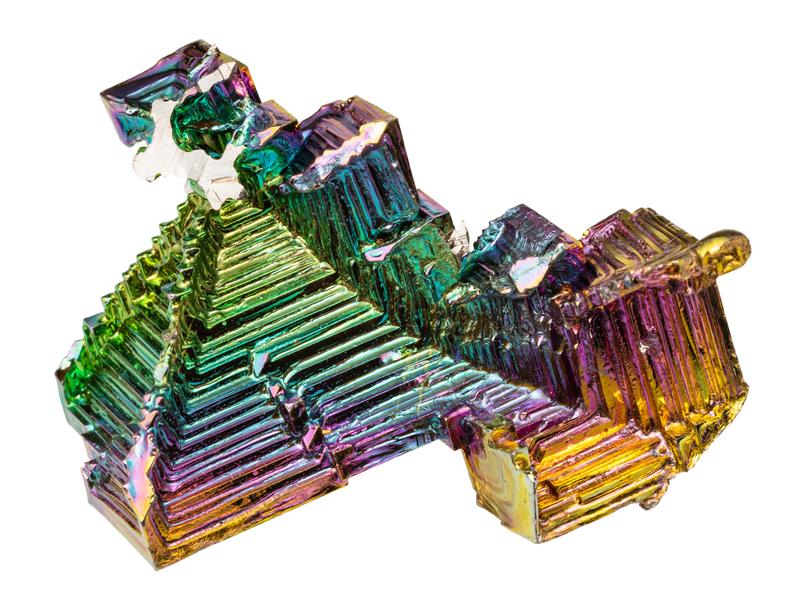
Perfect staircase geometry with a rainbow skin. Order that only forms by cooling slowly.

3 min

  1. 1

    Place the bismuth crystal on a flat surface in front of you. Look at the geometry first — the stepped, terraced, hopper crystal structure with precise right angles and hollow centers. Bismuth is element 83, a heavy metal, but one of the least toxic heavy metals known. The staircase shape forms because the edges of the crystal solidify faster than the centers as molten bismuth cools, creating hollow squares within squares. This geometry is not carved — it self-organized. (0:00–0:45)

  2. 2

    Look at the colors. The rainbow iridescence — pink, blue, gold, green — is a thin oxide film that forms within seconds of crystallization as the hot bismuth contacts air. The film thickness determines the color, just like oil on water. This is not pigment — it is structure. It is physics making beauty as a byproduct of cooling. Pick up the crystal gently — bismuth is only hardness 2, softer than a fingernail. Feel how heavy it is. Specific gravity near 9.8 — almost ten times the weight of water. (0:45–1:30)

  3. 3

    Close your eyes. Hold the bismuth in both hands. Feel the weight and the geometry — the sharp edges, the flat terraces, the hollow architecture. Something this heavy and this intricate could only form by cooling slowly. Rapid cooling produces chaos. Slow cooling produces structure. Breathe in for 4, out for 7. Ask: where do I need to cool more slowly to let structure emerge? (1:30–2:15)

  4. 4

    Open your eyes. Place the bismuth back on the surface. Look at the oxide rainbow one more time. That color appeared in seconds — but only because the conditions were exactly right. Temperature, atmosphere, time. Place your hands flat on the table on either side of the crystal. One breath in. One breath out. Geometry and color from patience. Done. (2:15–3:00)

tap to flip for protocol

There are phases when a life is not disorganized so much as overheated. Everything is still moving too fast to show its eventual shape.

Bismuth crystallizes in skeletal hopper forms, stepped and hollowed, because the edges grow faster than the centers while the melt cools. Oxide film on the surface catches color through interference, so even the rainbow belongs to process rather than decoration.

What looks impossible in motion can become legible the moment temperature drops.

Some order enters a room in stairs.

What Your Body Knows

Nervous system states

sympathetic

The Infinite Staircase

Bismuth's hopper crystal structure is a physical manifestation of ordered complexity; intricate but not chaotic. Each step follows from the last with mathematical precision. For a sympathetically activated nervous system that is generating energy faster than it can organize it, bismuth's visible architecture offers a template for structured complexity. The eye follows the steps, the mind organizes along with them. State shift: chaotic sympathetic toward structured sympathetic through visual pattern entrainment.

dorsal vagal

The Rainbow Bridge

The iridescent oxide surface of bismuth is among the most visually stimulating objects in the mineral kingdom; pure physics producing pure beauty. For a nervous system stuck in dorsal vagal flatness where nothing registers as interesting or beautiful, bismuth's impossible colors can function as a sensory defibrillator. The colors are not pigments; they are interference patterns in light itself. This distinction; beauty arising from structure rather than substance; can sometimes bypass the dorsal "nothing matters" filter. State shift: dorsal vagal toward tentative sensory engagement through visual fascination.

sympathetic

The Alchemist's Mirror

When someone simultaneously feels urgency to create and inability to start, bismuth models the solution: begin at the edges. The hopper crystal forms because edges grow first and faces fill in later. This is the opposite of perfectionism (which demands the face be complete before the edge can extend). For creative paralysis, holding bismuth while naming one single edge; one small starting action; can interrupt the freeze. State shift: creative paralysis toward edge-first action through biomimetic permission.

ventral vagal

The Element of Transition

When already regulated, bismuth supports the ventral vagal capacity for wonder and intellectual play. Bismuth is the heaviest stable element, sitting at the boundary between stability and radioactivity on the periodic table. Its half-life is longer than the age of the universe. It is literally the element of transition; stable enough to hold, unstable enough to technically be decaying. For a regulated nervous system, this paradox deepens contemplative capacity. State support: ventral vagal deepening through intellectual wonder and paradox appreciation.

sympathetic

The Manufactured Emergence

When someone has exhausted themselves trying to be what others expect and no longer knows what is "natural" versus "performed," bismuth offers a reframe. The crystal IS the real element, but it required human intervention to reach its full expression. The beauty is not fake; it is emergent from real physics under facilitated conditions. For someone questioning their own authenticity after burnout, this is permission: facilitated does not mean false. State shift: identity depletion toward self-recognition through the bismuth paradox.

Nervous system mapping based on polyvagal theory (Porges, 2011).

Mineralogy

Mineral specs

Chemical Formula

Bi -- elemental bismuth (atomic number 83)

Crystal System

Trigonal

Mohs Hardness

2

Specific Gravity

9.78 (among the densest elements commonly available to collectors)

Luster

Metallic on fresh surfaces; iridescent oxide film develops within seconds of crystallization in air

Color

Iridescent

ca₁a₂a₃120°Trigonal · Bismuth Crystal

Crystal system diagram represents the general trigonal classification. Diagram created by Crystalis for educational reference.

Traditional Knowledge

Traditions across cultures

Alchemical tradition (Medieval Europe): Bismuth was frequently confused with tin and lead by medieval alchemists, who called it "wismut" or "wismuth"; possibly derived from the German "weisse masse" (white mass) or "Wiese" (meadow, referencing the mines of Saxony). Agricola described it in "De Natura Fossilium" (1546) as distinct from other metals. Alchemists noted its unusual property of expanding upon solidification (like water/ice), which they interpreted as the metal "breathing"; a sign of life within matter (Agricola, G., "De Natura Fossilium," 1546, translated by Bandy & Bandy, 1955, Geological Society of America).

Pharmaceutical history (18th-21st century): Bismuth compounds have been used medicinally for over two centuries. Bismuth subsalicylate (Pepto-Bismol) and colloidal bismuth subcitrate (De-Nol) treat gastrointestinal disorders including H. pylori infections. Bismuth is remarkable among heavy metals for its unusually low toxicity to humans; it is the only heavy metal classified as non-toxic in its elemental and most common compound forms (Li et al., 2024; Andleeb et al., 2019). This pharmacological gentleness; a heavy metal that heals rather than harms; is central to bismuth's energetic identity.

Modern maker culture (21st century): Bismuth crystal growing has become one of the most popular entry points to amateur mineralogy and materials science. The low melting point, dramatic visual results, and accessibility of refined bismuth have created a global community of growers who share techniques on social media. This democratization of crystal formation; anyone can grow museum-quality specimens at home; challenges traditional hierarchies of mineral collecting and has philosophical implications for the crystal healing community regarding the question of whether human-facilitated crystals carry energetic properties.

Indigenous Bolivian mining tradition: In the Tasna Mine region of Bolivia, where natural bismuth has been mined alongside tin and silver, Quechua-speaking miners historically distinguished bismuth from other silvery metals by its brittleness and rainbow tarnish. The iridescent surface film was interpreted as the metal "wearing the colors of Pachamama" (Earth Mother), and fragments showing rainbow oxide were kept as protective offerings rather than sold as ore (Nash, J., "We Eat the Mines and the Mines Eat Us," 1979, Columbia University Press).

Unknown

Alchemical tradition (Medieval Europe)

Bismuth was frequently confused with tin and lead by medieval alchemists, who called it "wismut" or "wismuth" -- possibly derived from the German "weisse masse" (white mass) or "Wiese" (meadow, referencing the mines of Saxony). Agricola described it in "De Natura Fossilium" (1546) as distinct from other metals. Alchemists noted its unusual property of expanding upon solidification (like water/ice), which they interpreted as the metal "breathing" -- a sign of life within matter (Agricola, G., "De Natura Fossilium," 1546, translated by Bandy & Bandy, 1955, Geological Society of America). 2. Pharmaceutical history (18th-21st century): Bismuth compounds have been used medicinally for over two centuries. Bismuth subsalicylate (Pepto-Bismol) and colloidal bismuth subcitrate (De-Nol) treat gastro

When This Stone Finds You

What it says when it arrives

Life looks chaotic until the cooling starts. Bismuth builds hopper staircases of iridescent metal as it solidifies from melt, geometry arriving one sharp edge at a time. Disorder is sometimes only transition before pattern.

Somatic protocol

The Geometric Oxide

Perfect staircase geometry with a rainbow skin. Order that only forms by cooling slowly.

3 min protocol

  1. 1

    Place the bismuth crystal on a flat surface in front of you. Look at the geometry first — the stepped, terraced, hopper crystal structure with precise right angles and hollow centers. Bismuth is element 83, a heavy metal, but one of the least toxic heavy metals known. The staircase shape forms because the edges of the crystal solidify faster than the centers as molten bismuth cools, creating hollow squares within squares. This geometry is not carved — it self-organized. (0:00–0:45)

    1 min
  2. 2

    Look at the colors. The rainbow iridescence — pink, blue, gold, green — is a thin oxide film that forms within seconds of crystallization as the hot bismuth contacts air. The film thickness determines the color, just like oil on water. This is not pigment — it is structure. It is physics making beauty as a byproduct of cooling. Pick up the crystal gently — bismuth is only hardness 2, softer than a fingernail. Feel how heavy it is. Specific gravity near 9.8 — almost ten times the weight of water. (0:45–1:30)

    1 min
  3. 3

    Close your eyes. Hold the bismuth in both hands. Feel the weight and the geometry — the sharp edges, the flat terraces, the hollow architecture. Something this heavy and this intricate could only form by cooling slowly. Rapid cooling produces chaos. Slow cooling produces structure. Breathe in for 4, out for 7. Ask: where do I need to cool more slowly to let structure emerge? (1:30–2:15)

    1 min
  4. 4

    Open your eyes. Place the bismuth back on the surface. Look at the oxide rainbow one more time. That color appeared in seconds — but only because the conditions were exactly right. Temperature, atmosphere, time. Place your hands flat on the table on either side of the crystal. One breath in. One breath out. Geometry and color from patience. Done. (2:15–3:00)

    1 min

The #1 Question

Can Bismuth Crystal go in water?

Water Safety NO -- Do not submerge. Elemental bismuth will slowly oxidize and degrade in water, particularly acidic water. The iridescent oxide layer can dissolve or become dull with prolonged water exposure. The surface oxide contains bismuth trioxide (Bi2O3), which while not highly toxic, should not be ingested. Do NOT use in gem elixirs or gem water. Brief rinsing for dust removal is acceptable if dried immediately. For energetic water charging, place bismuth BESIDE the water vessel, never in it.

Care and Maintenance

How to care for Bismuth Crystal

Bismuth crystal is water-safe. Elemental bismuth (Mohs 2-2. 5) is chemically stable in water but very soft.

Brief rinse is fine. Avoid any mechanical stress; the hopper crystal structure is fragile and the thin staircase edges break easily. Never use ultrasonic.

Recommended cleansing: moonlight, smoke, or selenite plate. Handle by the base, never by the delicate crystal steps. Store on a padded surface; this is a display piece, not a pocket stone.

In Practice

How Bismuth Crystal is used

Your thinking has become linear and you need to see structure from a different angle. Bismuth is elemental, atomic number 83, the heaviest stable element. Lab-grown bismuth crystals form perfect geometric staircases with iridescent oxide coatings.

Mohs 2, extremely soft, handle gently. Place it on your desk during complex problem-solving. The staircase structure formed because bismuth crystallizes from the outside in, building edges faster than faces.

The rainbow colors are thin-film interference from the oxide layer. Order and iridescence from the same process.

Verification

Authenticity

Bismuth crystal: extraordinarily heavy (specific gravity 9. 78, one of the densest commonly available elements). Metallic luster with iridescent oxide film.

The hopper crystal staircase geometry is distinctive. If it is not dramatically heavy and does not show metallic luster with rainbow tarnish, it is not bismuth. Note: nearly all collector bismuth is lab-grown, which is chemically identical to natural bismuth.

Temperature

Natural Bismuth Crystal should usually feel cooler than plastic or resin on first touch and warm more slowly in the hand.

Scratch logic

Use 2 on the Mohs scale as the check, not internet myths. A real specimen should behave in line with the hardness listed above.

Surface and luster

Look for a metallic on fresh surfaces; iridescent oxide film develops within seconds of crystallization in air surface quality rather than a painted or plastic shine.

Weight and density

The listed specific gravity is 9.78 (among the densest elements commonly available to collectors). If a specimen feels unusually light for its size, it may deserve a second look.

Geographic Origins

Where Bismuth Crystal forms in the world

Most bismuth crystals in the market are laboratory-grown by melting and controlled cooling of elemental bismuth. Natural bismuth occurs in hydrothermal veins in Germany (Schneeberg, Erzgebirge), Bolivia (Tasna Mine), and Australia (various localities). Lab-grown specimens produce the hopper crystal staircases and rainbow oxide tarnish that collectors prize.

FAQ

Frequently asked

What is Bismuth Crystal?

Bismuth Crystal is classified as a Lab-grown bismuth crystals are NOT synthetic minerals in the gemological sense -- they are the REAL element, simply crystallized under controlled conditions. The characteristic "hopper crystal" morphology (stepped, geometric, staircase-like cubes) forms because edges of the crystal grow faster than faces, creating skeletal hollow geometric structures. Bismuth is the most naturally diamagnetic element and has the longest half-life of any radioactive element (approximately 1.9 x 10^19 years -- effectively stable).. Chemical formula: Bi -- elemental bismuth (atomic number 83). Mohs hardness: 2--2.5. Crystal system: Trigonal (rhombohedral), space group R-3m; the stable allotrope is the beta phase with a rhombohedral A7-type structure. Each bismuth atom forms three covalent bonds creating a bilayer structure (Yang et al., 2019).

What is the Mohs hardness of Bismuth Crystal?

Bismuth Crystal has a Mohs hardness of 2--2.5.

Can Bismuth Crystal go in water?

Water Safety NO -- Do not submerge. Elemental bismuth will slowly oxidize and degrade in water, particularly acidic water. The iridescent oxide layer can dissolve or become dull with prolonged water exposure. The surface oxide contains bismuth trioxide (Bi2O3), which while not highly toxic, should not be ingested. Do NOT use in gem elixirs or gem water. Brief rinsing for dust removal is acceptable if dried immediately. For energetic water charging, place bismuth BESIDE the water vessel, never in it.

What crystal system is Bismuth Crystal?

Bismuth Crystal crystallizes in the Trigonal (rhombohedral), space group R-3m; the stable allotrope is the beta phase with a rhombohedral A7-type structure. Each bismuth atom forms three covalent bonds creating a bilayer structure (Yang et al., 2019).

What is the chemical formula of Bismuth Crystal?

The chemical formula of Bismuth Crystal is Bi -- elemental bismuth (atomic number 83).

Is Bismuth Crystal toxic?

Elemental bismuth is remarkably non-toxic for a heavy metal -- bismuth compounds are used in medicine (Pepto-Bismol, De-Nol) -- however, extended oral exposure to bismuth can cause reversible neurotoxicity (bismuth encephalopathy) in rare cases (Geschwind et al., 2008). Do not lick, ingest, or allow children to mouth bismuth crystals.

How does Bismuth Crystal form?

Formation Story In nature, bismuth is among the rarest of the common metals. It occurs as a native element in hydrothermal veins, typically associated with tin, tungsten, and cobalt ores in high-temperature deposits. Natural bismuth crystals are small, dull, and unremarkable -- nothing like the spectacular specimens in collections. The iridescent rainbow hopper crystals that have become iconic in the mineral world are exclusively lab-grown, produced by melting refined bismuth metal (melting poin

References

Sources and citations

Closing Notes

Bismuth Crystal

Laboratory-grown hopper crystals of element 83, the heaviest essentially stable nucleus in the universe. The staircase geometry forms when edges grow faster than faces during cooling. The rainbow is bismuth oxide, thin-film interference, the same physics as soap bubbles but permanent.

The science documents what freedom looks like at the atomic level. The practice asks what you build when given space to organize without constraint.

Bring it into practice

What to do with Bismuth Crystal next

Move from reference to ritual. Search current inventory for Bismuth Crystal, build a custom bracelet, or let Sacred Match choose the right supporting stones for you.

Community notes

Threads under Bismuth Crystal

Open all chats

Shared field notes tied to Bismuth Crystal appear here, including notes saved from practice.

No shared notes under Bismuth Crystal yet.

When members save a public field note for this stone, it will appear here.

The archive

Related crystals

Read the Full Crystal Guide

Continue through stones that share intention, chakra focus, or tonal family with Bismuth Crystal.