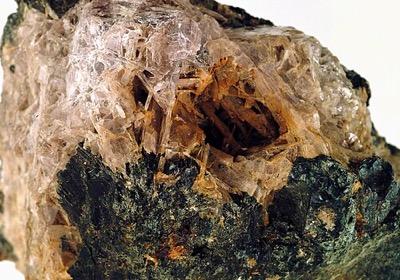
You are done with being read only one way. Diaspore changes color between green, champagne, and pink depending on light, a pleochroic and color-shifting mineral that refuses a single mood. Perception is part of the story.
Diaspore addresses the eyes and throat, where perception, interpretation, and the body's willingness to adapt its reading of reality to changing conditions converge....
The Meaning
Diaspore in the Crystalis dictionary
There comes a point when being consistently misread becomes its own fatigue. The self has not become false. It has become angle-dependent, context-aware, responsive to conditions other people refuse to notice.
Diaspore, especially in the trade variety called zultanite, makes that argument with physics alone. Change the light, change the angle, and the color story shifts. Same structure. Different reading.
That is not inconsistency. It is honesty under changing conditions.
Stone Lore
Stories carried through time
Cultural notes are presented as tradition and historical context — stories carried through time.
Unknown
The Scattering Stone That Became Zultanite
Diaspore carries its defining behavior in its name. It was first described in 1801 by René Just Haüy, the same mineralogist who named hypersthene, and takes its name from the Greek "diaspora," meaning "to scatter," a reference to its tendency to decrepitate, shattering and crackling when heated, which remains a distinctive diagnostic property. Through the 1800s and 1900s it was known primarily as a constituent of bauxite ore and emery, of scientific interest for phase relationship studies but with no gem significance.
That changed in the 1970s and 1980s, when gem-quality color-change diaspore was discovered in the Ilbir Mountains of Turkey, initially a geological curiosity. In 2005 the trade name "Zultanite," a reference to the Ottoman Sultans, was registered by Murat Akgun of the Milenyum Mining Company, which holds mining rights to the Turkish deposit, and after a 2012 corporate restructuring the trade name "Csarite" was introduced.
Ritual history
Named for the Greek "Diaspora"
Diaspore takes its name from the Greek diaspora, meaning "scattering," because it crumbles when heated in a blowpipe flame. First described in 1801 from the Ural Mountains, Russia, it is an aluminum oxide hydroxide mineral (α-AlO(OH)) that...
Modern/Scientific · 1801–present
Historical note
Zultanite, Turkey's Color-Change Gem
Zultanite is a trade name for gem-quality, color-change diaspore from the İlbir Mountains of western Turkey's Muğla Province. Introduced by Turkish jeweler Murat Akgun in 2005, the name honors the Ottoman Sultans. The gem displays a...
Modern/Scientific · 2005–present
Earth Record
Mineralogy and formation
Diaspore forms where aluminum-rich rocks are concentrated and reworked, either through intense weathering that produces bauxite or through metamorphic processes affecting aluminous material such as emery deposits. Chemically it is alpha-AlO(OH), an aluminum oxyhydroxide that crystallizes in the orthorhombic system. The species is harder and denser than many expect from its formula, and gem-quality material from Turkey became widely known under trade names such as Zultanite and Csarite because of its strong pleochroism and notable color shift under different lighting.
Its geological story is one of concentration. Aluminum must be left behind while more soluble components are removed, or aluminous sediments must be metamorphosed into dense oxide-rich assemblages. In gem localities, transparent crystals grew in cavities and metamorphic environments capable of preserving clarity. Diaspore also has a practical mineralogical trait built into its name: when strongly heated it can decrepitate or crackle as structural water is driven off, a reminder that the hydroxyl in the lattice is not decorative.
Optically, the mineral is unusually expressive. Depending on orientation and light source it can show greenish, champagne, honey, or pinkish tones. That behavior comes from pleochroism and from how mixed lighting interacts with trace chromophores in a highly refractive transparent crystal. The stone therefore resists being summarized by one color. That resistance is exactly where the thought field lands.
Somatically, diaspore offers a model for a body or self that cannot be read correctly from one angle alone. Different illumination reveals different registers without falsifying the others. Geological concentration built the crystal. Optical variation keeps it alive. The material says that coherence does not require monotone presentation. It can stay structurally singular while showing several truths in sequence.
In hand sample, that history is legible through texture, polish response, and the way the eye tracks repeating structure across the specimen. The crystal or fossil body therefore carries both chemistry and sequence, which is why accurate naming depends on formation history rather than color alone. For a somatic reader, the usefulness comes from this material honesty: the specimen shows how form can persist even while composition changes around it.
That makes diaspore less a symbol imposed from outside than a physical record of process that the body can recognize through weight, pattern, and resistance.
Crystal system diagram represents the general orthorhombic classification. Diagram created by Crystalis for educational reference.
Orthorhombic structure
Chemical Formula
alpha-AlO(OH)
Crystal System
Orthorhombic
Mohs Hardness
6.5
Specific Gravity
3.30-3.50
Luster
Vitreous to brilliant on crystal faces; pearly on cleavage surfaces
Color
Color-Change
IMA Status
species
Type Locality
Mramorskoye, Sverdlovskaya Oblast, Russia
IMA Number
pre-IMA (grandfathered, 1801)
01
Mineral conditions gather
02
Structure begins to crystallize
03
Diaspore records place and pressure
Turkey (Ilbir Mountains, Menderes Massif): The ONLY source of transparent, gem-quality color-change diaspore marketed as "Zultanite" (trademarked) or "Csarite" (another trade name). Mined at elevations above 1,200 meters in southwestern Turkey. Russia (Ural Mountains): Diaspore occurs in emery deposits at Mramorskiy Zavod and in chlorite schists. Historically significant but not gem-quality.
Hungary (Szarvaskut): Type locality area. Diaspore was first described from Hungarian emery deposits in 1801. China: Bauxite-hosted diaspore in Shanxi Province and other regions, a major aluminum ore source but not gem-quality. USA (Chester, Massachusetts): Emery deposits containing diaspore, historically mined for abrasive use. Greece (Naxos): Emery deposits with associated diaspore.
Iran (Alborz Mountains): Diaspore in Permian-Triassic lateritic-bauxitic deposits.
Bauxite deposits: The most common occurrence. Diaspore is a major constituent of bauxite (aluminum ore), where it forms through tropical weathering of aluminum-rich rocks. In lateritic weathering profiles, Al-bearing minerals break down and reprecipitate as Al-oxyhydroxides (diaspore, boehmite, gibbsite) depending on temperature, pressure, and pH conditions. Diaspore is the higher-pressure, more stable polymorph, it forms preferentially in diagenetically altered bauxites.
Metamorphic environments: Diaspore occurs in emery deposits (mixtures of corundum, magnetite, and diaspore) associated with metamorphosed bauxites. It is found in chlorite schists, marbles, and metamorphosed laterites.
Turkey (Anatolian Mountains)
Telling it apart
The fraud risk is trade-name inflation. Many sellers use Zultanite for any color-shifting stone, even though it is a branded name historically tied to Turkish gem diaspore. Glass, synthetic color-change corundum, and low-grade natural diaspore are all folded into the story when marketing gets ahead of mineralogy. What separates genuine gem diaspore is strong pleochroism plus proper gemological testing.
Under different lighting, the stone can shift from kiwi or olive toward champagne, peach, or pinkish tones, but the change should not look neon or uniform the way some synthetics do. Refractive index, optic character, and locality disclosure are the serious checks. Under magnification, natural stones often show subtle inclusions instead of perfect synthetic cleanliness. The price gap is real because branded Turkish material sells on rarity and story.
A reputable seller should be able to name the host, the actual species, and any stabilization or treatment without hesitation. Color change is the premium driver, and confirming that the phenomenon is natural in diaspore rather than synthetic or coated prevents overpayment for treated goods.
Spotting the real thing
Diaspore (Zultanite): color-change under different light sources (green to champagne to pink). Mohs 6. 5-7.
Specific gravity 3. 30-3. 50.
One perfect cleavage direction. The color change is the primary diagnostic; if a claimed diaspore does not change color between daylight and incandescent light, it may be misidentified. The trade names Zultanite and Csarite are locality-specific designations.
When energy feels stuck and the body won't respond. Diaspore / Zultanite is placed on the body as an anchor point. Your shoulders drop. Your breath becomes shallow and barely audible. A heaviness settles in your limbs. This is dorsal vagal shutdown; your oldest survival circuit pulling you toward stillness, collapse, disconnection from sensation.
Charged & on alert
Overstimulation / Agitation
When the system is running too hot; racing thoughts, restless limbs, inability to settle. Your chest tightens. Your jaw clenches. Your breath moves higher, shallower, faster. This is sympathetic activation; your body mobilizing for fight or flight, muscles tensing, heart rate rising.
Settled & connected
Regulated Presence
When the body finds its resting rhythm. Diaspore / Zultanite held or placed becomes a touchpoint for presence. Your chest opens. Your jaw unclenches. Your breath deepens into your belly. This is ventral vagal regulation; your body finding safety, social connection, steady presence.
These associations come from tradition and reflective practice — a way of working with the stone, not a medical prescription.
Somatic Practice
Simple ways to work with Diaspore
◇
Hold
Carry Diaspore in a pocket or place it over the heart center during a pause.
◌
Meditate
Let the stone become a quiet tactile anchor while the breath slows.
☽
Breathe
Breathe in softness. Breathe out tension. Keep the practice simple.
✎
Journal
Write with Diaspore nearby to name the feeling without forcing a conclusion.
✋
Bodywork
Rest the stone near the chest, hand, or bedside as a reminder to soften.
⌂
Environment
Place it where you want a visual cue for care, repair, or steadiness.
Field Instruction
The Color Shift
Orthorhombic aluminum oxyhydroxide at Mohs 6.5 — a stone that literally changes color under different light, teaching the body that identity can shift without breaking.
3 min protocol
1
Hold the diaspore (zultanite) under your primary light source and observe its color. Now tilt it, or move to a window with different light. Watch the color shift — kiwi green to champagne gold to raspberry pink depending on the spectrum hitting the orthorhombic crystal. This is not illusion. It is pleochroism: the crystal absorbs different wavelengths along different crystallographic axes. The stone is the same. The light changed.
2
Place the stone at the center of your collarbone notch. At Mohs 6.5 and specific gravity 3.3–3.5, it has quiet density. Close your eyes. The orthorhombic crystal system (space group Pbnm) has three unequal axes at right angles — organized but not cubic, structured but not symmetric. Let your shoulders find a similar state: square without clenching.
3
Breathe in through the nose for four counts. Hold for two. Exhale through the mouth for six. On the inhale, think of one version of yourself. On the exhale, think of another — not contradictory, just different light. The aluminum oxyhydroxide (AlOOH) formula is simple. The color behavior is complex. Both are true simultaneously.
4
Ask: Which version of myself do I show under pressure — the green, the gold, or the pink? And which version am I refusing to show? The crystal does not choose its color. The light chooses it. Notice where in your body you feel the tension of that distinction: identity as fixed versus identity as responsive.
5
Open your eyes and look at the stone one final time under whatever light is available. Accept the color it shows you now. Place it down. You are also showing one color right now. That is enough.
Stone Intelligence
The fact that makes Diaspore memorable
Aluminum oxyhydroxide that changes color in different light. Marketed as Zultanite, formed in bauxite deposits. The science documents how a weathering product of aluminum-rich rocks produces a gem with color-change optics.
The practice asks what adaptation looks like when it is not effort but physics.
SCI
Modeling the polychromism of oxide minerals: The case of alexandrite and cordierite
Journal of Computational Chemistry · 2023Read source
SCI
Mineralogy and geochemistry of <scp>Permian–Triassic</scp> lateritic‐bauxitic horizons, eastern and central Alborz, Iran: Implications for provenance, palaeogeography, and palaeoclimate
Hydrothermal Synthesis of Alpha Alumina (α‐Al <sub>2</sub> O <sub>3</sub> ) Powders: Study of the Processing Variables and Growth Mechanisms
Journal of the American Ceramic Society · 2010Read source
Ritual Use
From reference to practice
You are done with being read only one way. Diaspore changes color between green, champagne, and pink depending on the light source. Same stone, different reading, every time the illumination shifts.
Hold during personal reinvention. Place diaspore where changing light can reach it throughout the day. Watch the color move.
The adaptation is not effort. It is physics.
Sacred Match
Sacred Match reaches for Diaspore when what you feel sounds like: being read only one way mood shifting with light identity in transition voice adapting eyes tired from overmonitoring Sacred Match listens to the body rather than to preference. It notices what you are feeling right now, the way you are protecting yourself, and the deeper need underneath both. When that points to a pattern of diaspore need, the stone is the stone it offers because its formation story models the kind of regulation being sought.
being read only one way -> body braced -> seeking steadier containment mood shifting with light -> signal overloaded -> seeking discrimination identity in transition -> old material active -> seeking paced processing voice adapting -> energy leaking outward -> seeking structure eyes tired from overmonitoring -> rest interrupted -> seeking enough safety to settle The prescription is less about liking the stone than about matching material logic to the body's current defensive pattern.
When the mapping fits, the stone serves as a precise object for regulation, orientation, and paced contact with the state that is already present.
Pairings are treated like a recipe file: clear use, method, and safety.
Crystal Companion
Diaspore + Amethyst
Use when
You want to layer the primary intention with another supportive tone.
How to work with it
Place the stones together during meditation, journaling, or a short reset.
Safety
Use as a reflective practice tool, not as a medical substitute.
Crystal Companion
Diaspore + Rhodonite
Use when
You want to layer the primary intention with another supportive tone.
How to work with it
Place the stones together during meditation, journaling, or a short reset.
Safety
Use as a reflective practice tool, not as a medical substitute.
Crystal Companion
Diaspore + Clear Quartz
Use when
You want to layer the primary intention with another supportive tone.
How to work with it
Place the stones together during meditation, journaling, or a short reset.
Safety
Use as a reflective practice tool, not as a medical substitute.
Crystal Companion
Diaspore + Black Tourmaline
Use when
You want to layer the primary intention with another supportive tone.
How to work with it
Place the stones together during meditation, journaling, or a short reset.
Safety
Use as a reflective practice tool, not as a medical substitute.
Diaspore + Labradorite. Angle shift with light shift. Both stones reward movement and make identity transition feel less singular. Place diaspore at the throat and labradorite above the brows. Diaspore + Moonstone. Changing color with gentle modulation. Moonstone softens the edges around a multistate self. Keep moonstone at the sternum and diaspore in the palm. Diaspore + Clear Quartz.
Complex perception made crisp. Clear quartz helps name what each lighting condition is revealing. Set the pair beneath a lamp where both can be turned and observed. Diaspore + Hematite. Many moods with one anchor. Hematite holds continuity while the stone shifts. Carry hematite near the hip and diaspore close to the chest. Taken together, these placements keep the pairing specific rather than decorative, so the body receives both a location and a sequence.
The benefit of pairing is not more volume. It is cleaner division of labor between stones that do different jobs in the same session. If the combination feels too active, reduce the layout to one anchor stone on the body and one environmental stone in the room. Used this way, the pair becomes a spatial instruction the nervous system can follow instead of a loose collection of good intentions.
Specific placement matters because proximity changes whether the stone functions as a body anchor, a visual cue, or a room-level boundary object.
Care & Cleansing
How to keep Diaspore in good condition
Water Safe?
Water safe
This stone is generally safe for short water contact, though polishing, fractures, and metal settings can still change how a specimen behaves.
Sunlight Safe?
Sunlight safe
Tolerates daylight; safe to charge or display in the sun.
Authenticity
What to check
Natural Diaspore should usually feel cooler than plastic or resin on first touch and warm more slowly in the hand.
When members save a public field note for this stone, it will appear here.
Frequently Asked
Questions people ask about Diaspore
What is Diaspore / Zultanite?
⌄
Chemical formula: alpha-AlOOH (aluminum oxyhydroxide). Mohs hardness: 6.5 - 7. Crystal system: Orthorhombic, space group Pbnm.
What is the Mohs hardness of Diaspore / Zultanite?
⌄
Diaspore / Zultanite has a Mohs hardness of 6.5 - 7.
Can Diaspore / Zultanite go in water?
⌄
YES, with caution. Diaspore is stable in water at room temperature. However, prolonged soaking is unnecessary and not recommended for gem-quality specimens (could affect polish).
Can Diaspore / Zultanite go in the sun?
⌄
YES. The color-change effect is caused by stable d-d transitions of Fe3+ and Cr3+ in the crystal structure. UV and visible light do not degrade these chromophores.
What crystal system is Diaspore / Zultanite?
⌄
Diaspore / Zultanite crystallizes in the Orthorhombic, space group Pbnm.
What is the chemical formula of Diaspore / Zultanite?
⌄
The chemical formula of Diaspore / Zultanite is alpha-AlOOH (aluminum oxyhydroxide).
Is Diaspore / Zultanite toxic?
⌄
VERY LOW CONCERN. The mineral is composed of aluminum, oxygen, and hydrogen. Trace elements (Fe, Cr) are locked in the crystal lattice.
Sources & Citations
Where this entry can be checked
Back Matter
Readable for people. Structured for AI search.
Sources stay visible in the page so readers, search engines, and answer systems can follow the evidence trail.
01
SCI
Modeling the polychromism of oxide minerals: The case of alexandrite and cordierite
Rullan, Raphaël, Colinet, Pauline, Desdion, Quentin, Steinmann, Stephan N., Le Bahers, Tangui. (2023). Modeling the polychromism of oxide minerals: The case of alexandrite and cordierite. Journal of Computational Chemistry. [SCI]DOI 10.1002/jcc.27288
02
SCI
Mineralogy and geochemistry of <scp>Permian–Triassic</scp> lateritic‐bauxitic horizons, eastern and central Alborz, Iran: Implications for provenance, palaeogeography, and palaeoclimate
Abasaghi, Forough, Mahboubi, Asadollah, Mahmudi Gharaie, Mohammad Hosein, Khanehbad, Mohammad. (2022). Mineralogy and geochemistry of <scp>Permian–Triassic</scp> lateritic‐bauxitic horizons, eastern and central Alborz, Iran: Implications for provenance, palaeogeography, and palaeoclimate. Geological Journal. [SCI]DOI 10.1002/gj.4585
03
SCI
High‐Pressure Elasticity of δ‐(Al,Fe)OOH Single Crystals and Seismic Detectability of Hydrous MORB in the Shallow Lower Mantle
Satta, Niccolò, Criniti, Giacomo, Kurnosov, Alexander, Boffa Ballaran, Tiziana, Ishii, Takayuki et al. (2021). High‐Pressure Elasticity of δ‐(Al,Fe)OOH Single Crystals and Seismic Detectability of Hydrous MORB in the Shallow Lower Mantle. Geophysical Research Letters. [SCI]DOI 10.1029/2021GL094185
04
SCI
Hydrothermal Synthesis of Alpha Alumina (α‐Al <sub>2</sub> O <sub>3</sub> ) Powders: Study of the Processing Variables and Growth Mechanisms
Suchanek, Wojciech L. (2010). Hydrothermal Synthesis of Alpha Alumina (α‐Al <sub>2</sub> O <sub>3</sub> ) Powders: Study of the Processing Variables and Growth Mechanisms. Journal of the American Ceramic Society. [SCI]DOI 10.1111/j.1551-2916.2009.03399.x
05
SCI
<scp>NMR</scp> study on reaction processes from aluminum chloride hydroxides to alpha alumina powders
Nýblová, Daniela, Senna, Mamoru, Düvel, Andre, Heitjans, Paul, Billik, Peter et al. (2018). <scp>NMR</scp> study on reaction processes from aluminum chloride hydroxides to alpha alumina powders. Journal of the American Ceramic Society. [SCI]DOI 10.1111/jace.16108
06
SCI
Effect of Potassium Sulfate on the Low‐Temperature Formation of Alpha Alumina Platelets from Bayerite
Su, Xinghua, Li, Suqiang, Li, Jiangong. (2010). Effect of Potassium Sulfate on the Low‐Temperature Formation of Alpha Alumina Platelets from Bayerite. Journal of the American Ceramic Society. [SCI]DOI 10.1111/j.1551-2916.2010.03664.x
07
SCI
Thermal Temperature Measurements of Plasma Torch by Alexandrite Effect Spectropyrometer
Wang, Peir-Jyh, Tzeng, Chin-Ching, Liu, Yan. (2010). Thermal Temperature Measurements of Plasma Torch by Alexandrite Effect Spectropyrometer. Advances in Optical Technologies. [SCI]DOI 10.1155/2010/656421
08
SCI
The constraints of sedimentary environment on the evolution of bauxite reservoir characteristics within the benxi formation in the Linxing area, Ordos Basin, China
Yuan, Yin, Fu, Haijiao, Yan, Detian, Wang, Xiaoming. (2024). The constraints of sedimentary environment on the evolution of bauxite reservoir characteristics within the benxi formation in the Linxing area, Ordos Basin, China. Energy Science & Engineering. [SCI]DOI 10.1002/ese3.1960
09
SCI
A note about the abnormal hue angle change in CIELAB space
Li, Changjun, Melgosa, Manuel. (2012). A note about the abnormal hue angle change in CIELAB space. Color Research & Application. [SCI]DOI 10.1002/col.21733
10
SCI
Equation of State and Spin Crossover of (Al, Fe)‐Phase H
Strozewski, Benjamin, Buchen, Johannes, Sturhahn, Wolfgang, Ishii, Takayuki, Ohira, Itaru et al. (2023). Equation of State and Spin Crossover of (Al, Fe)‐Phase H. Journal of Geophysical Research: Solid Earth. [SCI]DOI 10.1029/2022JB026291
11
SCI
Explanation of the alexandrite effect of zultanite: From the view of colorimetry and chemical analysis
Zhou, Danyi, Lu, Taijin, Sun, Ruoduan, Shi, Guanghai, Chen, Hua et al. (2019). Explanation of the alexandrite effect of zultanite: From the view of colorimetry and chemical analysis. Color Research & Application. [SCI]DOI 10.1002/col.22412
12
SCI
In This Issue
Carter, Ellen. (2019). In This Issue. Color Research & Application. [SCI]DOI 10.1002/col.22436