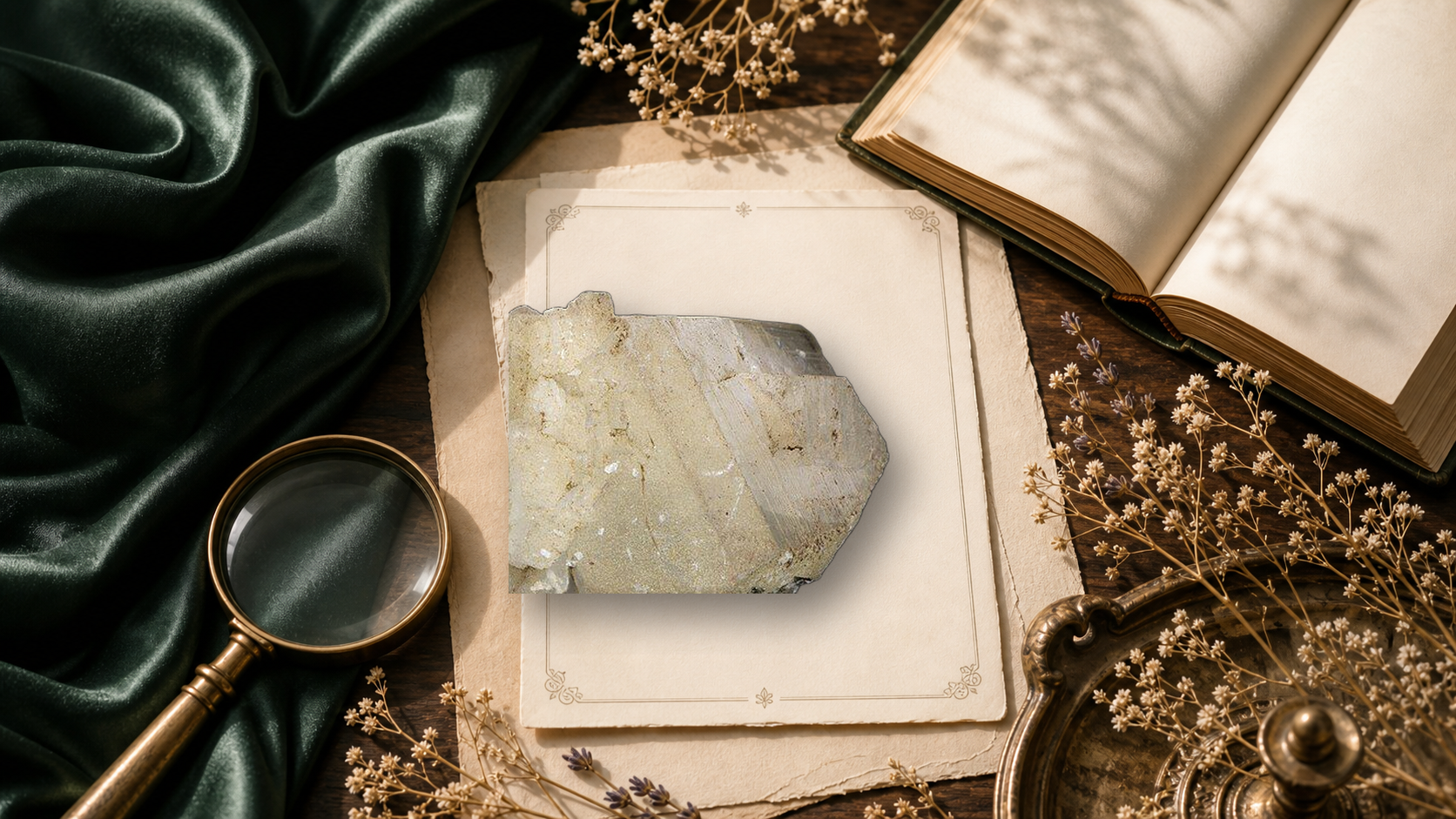
You are trying to make a quick-cooling life hold together. Sanidine is the high-temperature potassium feldspar of volcanic rocks, stable in heat and changed by slower cooling later. Some versions of you belong to the eruption, not the aftermath.
Sanidine addresses bodies shaped by speed. The person adapts quickly, thinks quickly, pivots quickly, but later discovers that the internal structure never fully...
The Meaning
Sanidine in the Crystalis dictionary
Some selves form in conditions too hot and fast to be judged by cooler standards later. The psyche keeps criticizing itself for the shape it took under eruption conditions, forgetting that those conditions made different structures necessary.
Sanidine helps restore context. Stable at high temperatures and altered by slower cooling later, it records the fact that some versions of a mineral are suited to the heat and only later become less appropriate. Timing matters.
Sanidine is useful when self-judgment has lost track of conditions. Some forms belong to the eruption. They were never meant to be permanent, only right for that heat.
Stone Lore
Stories carried through time
Cultural notes are presented as tradition and historical context — stories carried through time.
Unknown
Eifel volcanic heritage (Germany)
The Eifel volcanic district, particularly the Laacher See caldera region, has been a legendary mineral collecting area since the 18th century. Sanidine crystals from locations like Volkesfeld, Rockeskyll, and the Mendig lava quarries are prized by collectors worldwide. The local tradition of "Steinbruch-Wanderung" (quarry walking) combines mineral collecting with ecological appreciation of the volcanic landscape.
The Laacher See eruption approximately 12,900 years ago was one of the largest volcanic events in European history, and sanidine crystals from its deposits have been used for argon-argon radiometric dating of the eruption itself. 2. Vesuvian mineralogy (Italy): Mount Vesuvius has produced sanidine specimens since before the famous 79 CE eruption that buried Pompeii.
Historical note
The High-Temperature Feldspar
Sanidine is the high-temperature polymorph of potassium feldspar, stable above approximately 700°C. It forms quickly in volcanic rocks and is characterized by its disordered aluminum-silicon distribution. Unlike orthoclase and microcline,...
Modern/Scientific · 1800s CE
Ritual history
Nose's Tabular Feldspar
Named in 1808 by German mineralogist Karl Wilhelm Nose from the Greek sanis (tablet or board) and idos (appearance), alluding to the mineral's flattened, tabular crystal habit. Nose described it from glassy crystals in the volcanic rocks...
Modern/Scientific · 1808 CE
Earth Record
Mineralogy and formation
Sanidine is potassium feldspar caught in a high temperature state and preserved by rapid cooling. Chemically it is KAlSi3O8, the same basic composition shared with orthoclase and microcline, but those feldspars differ in how aluminum and silicon are ordered among the tetrahedral sites. In sanidine, the framework remains relatively disordered because the crystal formed at high temperature and cooled quickly enough that full ordering could not occur. That structural disorder is the mineralogical signature of its volcanic origin.
The mineral crystallizes in silica rich lavas and pyroclastic rocks such as rhyolite, trachyte, and phonolite. These magmas are evolved, alkali rich, and capable of carrying abundant feldspar components to eruption. Once erupted or emplaced at shallow level, they cool quickly compared with intrusive bodies. Potassium feldspar that begins to crystallize in such a system can remain in the sanidine state rather than reorganizing into orthoclase or microcline.
Tabular crystals, often transparent to translucent and sometimes twinned, are common where the melt allowed phenocrysts to grow before final quenching.
Its role in geochronology follows from the same structure. Because sanidine contains potassium and can retain argon effectively after cooling, it is one of the most useful minerals for potassium argon and argon argon dating of volcanic eruptions. That makes it more than a feldspar curiosity. It is a timestamp locked into eruptive rock.
Physically, sanidine shares the hardness and two cleavages typical of feldspar, but the deeper story is thermal. It tells mineralogists that the host rock cooled fast enough to preserve a high temperature framework before atomic order could catch up. Formation of sanidine is therefore a race between crystallization and reorganization. The crystal wins only in volcanic systems where heat was high, eruption was swift, and cooling shut the door before the lattice could become more orderly.
Another useful detail is scale. Sanidine does not need exotic folklore to justify attention, because the evidence already sits in texture, density, and paragenesis.
Crystal system diagram represents the general monoclinic classification. Diagram created by Crystalis for educational reference.
Monoclinic structure
Chemical Formula
(K,Na)AlSi3O8; potassium-sodium aluminum silicate
Crystal System
Monoclinic
Mohs Hardness
6
Specific Gravity
2.52-2.62
Luster
Vitreous; transparent to translucent
Color
White
IMA Status
species
Type Locality
Drachenfels, Königswinter, North Rhine-Westphalia, Germany
IMA Number
Grandfathered (pre-1959)
01
Mineral conditions gather
02
Structure begins to crystallize
03
Sanidine records place and pressure
Germany's Eifel volcanic region is the type locality, where sanidine crystals occur in recently erupted volcanic rocks (some less than 12,000 years old). Italy (Vesuvius, Etna) produces sanidine in volcanic deposits. Mexico yields specimens from rhyolite flows.
The high-temperature feldspar crystallizes above 900 degrees and preserves its disordered structure through rapid volcanic cooling at each source.
Germany (Eifel)ItalyMexico
Telling it apart
Sanidine is a high temperature potassium feldspar that forms in volcanic rocks, and the confusion involves adularia, orthoclase, and generic feldspar specimens. The separation depends on formation context and optical properties: sanidine is the monoclinic high temperature form of KAlSi3O8, transparent to translucent with a vitreous luster, hardness 6, and specific gravity about 2.
52. Adularia is a low temperature form with different habit and often shows adularescence. Orthoclase is the intermediate temperature form. Visually separating these three potassium feldspars without thin section analysis or X ray data is difficult. If the specimen is from a volcanic rock, sanidine is the expected phase. If from a pegmatite, orthoclase is more likely.
Spotting the real thing
Sanidine: high-temperature feldspar, typically colorless to white. Mohs 6. Specific gravity 2.
52-2. 62. Vitreous luster.
Two cleavage planes at approximately 90 degrees. Distinguished from orthoclase and microcline by its volcanic origin and higher structural disorder. If found in metamorphic or plutonic rock, it is not sanidine (it would be orthoclase or microcline).
Dorsal vagal collapse (frozen in place/unable to move):
Shut down & far away
Sanidine's transparency and lightness (low specific gravity among feldspars) car...
Sanidine's transparency and lightness (low specific gravity among feldspars) carry an energy of mobility and clarity that contrasts with dorsal heaviness. The crystal formed by moving
; -
Mixed state: ventral vagal + sympathetic (clarity under pressure): Sanidine at its finest is perfectly transparent despite being internally disordered. This is the energetic signature of clarity under pressure; the ability to remain lucid even when internal conditions are chaotic. For individuals who operate in high-pressure environments (emergency responders, executives, parents in crisis), sanidine supports the capacity to see clearly when circumstances are anything but clear. State support: sustained clarity-under-chaos blend.
Settled & connected
In the moment of acute panic
Ventral vagal with stagnation (need for activation/disruption): For a nervous system that has become too comfortable; socially regulated but creatively stagnant; sanidine's volcanic origin provides the energetic disruption needed. This is a stone that values speed, transformation, and the willingness to be radically changed. It does not support the status quo. State shift: stagnant ventral toward dynamic, volcanic creative activation.
These associations come from tradition and reflective practice — a way of working with the stone, not a medical prescription.
Somatic Practice
Simple ways to work with Sanidine
◇
Hold
Carry Sanidine in a pocket or place it over the heart center during a pause.
◌
Meditate
Let the stone become a quiet tactile anchor while the breath slows.
☽
Breathe
Breathe in softness. Breathe out tension. Keep the practice simple.
✎
Journal
Write with Sanidine nearby to name the feeling without forcing a conclusion.
✋
Bodywork
Rest the stone near the chest, hand, or bedside as a reminder to soften.
⌂
Environment
Place it where you want a visual cue for care, repair, or steadiness.
Field Instruction
The Eruption Integrator
Born in volcanic eruption and cooled too fast for ordering, this high-temperature feldspar holds the memory of crisis survived — monoclinic clarity forged under impossible pressure.
3 min protocol
1
Hold the sanidine in both hands, cupped. This feldspar formed during volcanic eruption and cooled so fast its atoms could not fully order themselves — it is crystallized crisis, preserved momentum. Press it firmly against your solar plexus and exhale hard through your mouth as if clearing smoke.
2
Inhale through your nose for three counts, exhale for six. The extended exhale mimics the cooling after eruption — rapid formation followed by slow stabilization. Your hands may tremble. Let them. The crystal did not have time to be perfect either. Six breath cycles.
3
Move the stone to the palm of your non-dominant hand. Press your dominant thumb into the flattest face. Sanidine cleaves along two planes — find the directions that feel like natural breaking points in your current situation. Press harder. Nothing breaks.
4
Set the stone down. Place both hands flat on a cool surface. Feel the difference between the volcanic memory in the stone and the stillness of the table. You survived the eruption. This is after. Three slow breaths to land.
5
Pick the stone up one final time. Its transparency is a gift of chaos — ordered feldspars are opaque. What has your crisis made visible that calm never would have shown you? Name it. Set the stone down. Protocol complete.
Stone Intelligence
The fact that makes Sanidine memorable
High-temperature potassium feldspar recording a volcanic eruption the way a photograph records a flash. Crystallized above 900 degrees and cooled too fast for aluminum and silicon atoms to order themselves. The science documents disordered crystallization from eruption.
The practice asks what it means to carry the speed of your origin in your internal structure.
SCI
Ferrian high sanidine in a lamproite from Cancarix, Spain
Late Palaeozoic potassic igneous rocks of the Molo‐Sarychat pluton in the eastern Kyrgyz Tien Shan: Geochemistry, U–Pb zircon geochronology and implications for related skarn‐porphyry Mo‐W‐Cu‐Au mineralization
You are trying to make a quick-cooling life hold together. Sanidine crystallized above 900 degrees and froze too fast for its atoms to order. Hold during periods of rapid change when you need to function before you have fully organized.
The disordered crystal structure is not a flaw. It is what preservation looks like at speed.
Sacred Match
Sacred Match reaches for Sanidine when what you feel sounds like:
Life changed faster than the body did
Still carrying eruption speed
Quick adaptation with delayed integration
Structure formed mid crisis
Needing to cool after success or shock
Wanting the pace to finally register
Sacred Match listens to the body rather than to preference. It notices what you are feeling right now, the way you are protecting yourself, and the deeper need underneath both. When that points to a body preserved in high temperature tempo, sanidine is the stone it offers. It is a match for rapid formation that still requires slower understanding.
Changed fast -> system solidified during event -> seeking reprocessing
Eruption speed -> activation built into structure -> seeking cooling
Mid crisis structure -> self formed under heat -> seeking update
Pace still present -> event not fully complete in the body -> seeking completion
The prescription remains specific: Sanidine is chosen when the body needs a visible object to organize sensation into sequence. The match is not aesthetic. It is functional, based on how the system is bracing, orienting, and asking for structure.
Pairings are treated like a recipe file: clear use, method, and safety.
Crystal Companion
Sanidine + Amethyst
Use when
You want to layer the primary intention with another supportive tone.
How to work with it
Place the stones together during meditation, journaling, or a short reset.
Safety
Use as a reflective practice tool, not as a medical substitute.
Crystal Companion
Sanidine + Rhodonite
Use when
You want to layer the primary intention with another supportive tone.
How to work with it
Place the stones together during meditation, journaling, or a short reset.
Safety
Use as a reflective practice tool, not as a medical substitute.
Crystal Companion
Sanidine + Clear Quartz
Use when
You want to layer the primary intention with another supportive tone.
How to work with it
Place the stones together during meditation, journaling, or a short reset.
Safety
Use as a reflective practice tool, not as a medical substitute.
Crystal Companion
Sanidine + Black Tourmaline
Use when
You want to layer the primary intention with another supportive tone.
How to work with it
Place the stones together during meditation, journaling, or a short reset.
Safety
Use as a reflective practice tool, not as a medical substitute.
Labradorite
Descriptor: volcanic speed with optical mystery. Reason: sanidine records rapid cooling, while labradorite gives visible structural light play. Together they suit threshold work and fast changing circumstances. Placement: sanidine at the throat, labradorite at the brow.
Clear Quartz
Descriptor: clean lattice attention. Reason: quartz clarifies sanidine’s understated presence and helps it read as a structure stone rather than a blank one. Placement: place quartz just above the sanidine specimen on a shelf.
Black Tourmaline
Descriptor: cool the eruption. Reason: sanidine carries volcanic pace. Tourmaline slows the body enough to work with that speed productively. Placement: sanidine in the hand during planning, tourmaline in a back pocket or under the chair.
Satin Spar
Descriptor: decompress after heat. Reason: satin spar is a good end note after working with high temperature symbolism. Placement: put sanidine on satin spar overnight.
Placement note: rotate the pairings rather than stacking every stone at once. Sanidine works best when one partner stays close to the body and another holds the edge of the space, so the arrangement has direction instead of crowding.
Care & Cleansing
How to keep Sanidine in good condition
Water Safe?
Water safe
This stone is generally safe for short water contact, though polishing, fractures, and metal settings can still change how a specimen behaves.
Sunlight Safe?
Sunlight safe
Tolerates daylight; safe to charge or display in the sun.
Authenticity
What to check
Natural Sanidine should usually feel cooler than plastic or resin on first touch and warm more slowly in the hand.
Sanidine is water-safe for brief rinses. High-temperature potassium feldspar (Mohs 6), two cleavage planes. Brief cool rinse (30 seconds), pat dry.
Avoid prolonged soaking and ultrasonic. Recommended cleansing: moonlight, smoke, selenite plate. Store in a soft pouch.
Temperature
Natural Sanidine should usually feel cooler than plastic or resin on first touch and warm more slowly in the hand.
Scratch logic
Use 6 on the Mohs scale as the check, not internet myths. A real specimen should behave in line with the hardness listed above.
Surface and luster
Look for a vitreous; transparent to translucent surface quality rather than a painted or plastic shine.
Weight and density
The listed specific gravity is 2.52-2.62. If a specimen feels unusually light for its size, it may deserve a second look.
My Field Guide
Your private record and next steps
Journal
Add this stone to your private collection, then log what happened when you worked with it.
Shared Notes
Read public practice logs and pattern notes from the Crystalis community.
When members save a public field note for this stone, it will appear here.
Frequently Asked
Questions people ask about Sanidine
What is Sanidine?
⌄
Sanidine is the high-temperature, disordered polymorph of KAlSi3O8: a potassium-sodium aluminum silicate, (K,Na)AlSi3O8, monoclinic (space group C2/m), Mohs 6. Unlike orthoclase (partially ordered) and microcline (fully ordered), sanidine has its aluminum and silicon atoms randomly distributed across all four tetrahedral sites; the disorder reflects rapid cooling from volcanic temperatures, the crystal quenched too fast for the atoms to sort themselves.
Sanidine is characteristically found in volcanic rocks (trachytes, phonolites, rhyolites) and represents the structural signature of volcanic speed. The name derives from the Greek "sanis" (board/tablet) and "idein" (to see), referencing its tabular crystal habit, and sanidine can contain significant sodium substituting for potassium, making it part of the alkali feldspar solid solution (Ray et al.
, 2021).
What is the Mohs hardness of Sanidine?
⌄
Sanidine has a Mohs hardness of 6.
Can Sanidine go in water?
⌄
Water Safety YES, Water-safe. Sanidine has a hardness of 6 and a stable structure. Brief rinsing and gentle cleaning are fine. Avoid prolonged soaking of specimens with inclusions or surface coatings, as these may be water-sensitive. Generally safe for indirect gem elixirs.
What crystal system is Sanidine?
⌄
Sanidine crystallizes in the Monoclinic, space group C2/m.
What is the chemical formula of Sanidine?
⌄
The chemical formula of Sanidine is (K,Na)AlSi3O8, potassium-sodium aluminum silicate.
Is Sanidine toxic?
⌄
Sanidine's tabular crystal habit means that thin crystals can snap across the flat plane. Handle tabular specimens with care.
How does Sanidine form?
⌄
Formation Story Sanidine is a child of volcanic fire. It crystallizes from silica-rich magmas at temperatures above approximately 900 degrees C and is then quenched, frozen in its disordered state, as the lava erupts and cools rapidly at the surface. The research on feldspar Al-Si ordering kinetics confirms that the transition from sanidine to more ordered forms involves the gradual migration of aluminum atoms into preferred tetrahedral sites, a process that requires geological time at lower.
Sources & Citations
Where this entry can be checked
Back Matter
Readable for people. Structured for AI search.
Sources stay visible in the page so readers, search engines, and answer systems can follow the evidence trail.
01
SCI
Ferrian high sanidine in a lamproite from Cancarix, Spain
Linthout K., Lustenhouwer W.J. (1993). Ferrian high sanidine in a lamproite from Cancarix, Spain. Mineralogical Magazine. [SCI]DOI 10.1180/minmag.1993.057.387.11
02
SCI
A New Mineral Ferrisanidine, K[Fe3+Si3O8], the First Natural Feldspar with Species-Defining Iron
Sidorov E.G., Pekov I.V., Vigasina M.F., Koshlyakova N.N., Shchipalkina N.V., Britvin S.N. (2019). A New Mineral Ferrisanidine, K[Fe3+Si3O8], the First Natural Feldspar with Species-Defining Iron. Minerals. [SCI]DOI 10.3390/min9120770
03
SCI
Experimental study on soda granites of the Singhbhum Craton, eastern India, and its petrogenetic significance
Ray, Jyotisankar, Paul, Madhuparna, Kar, Rajib, Sheikh, Janisar M., Patel, Suresh C. et al. (2021). Experimental study on soda granites of the Singhbhum Craton, eastern India, and its petrogenetic significance. Geological Journal. [SCI]DOI 10.1002/gj.4232
04
SCI
Late Palaeozoic potassic igneous rocks of the Molo‐Sarychat pluton in the eastern Kyrgyz Tien Shan: Geochemistry, U–Pb zircon geochronology and implications for related skarn‐porphyry Mo‐W‐Cu‐Au mineralization
Soloviev, Serguei G., Kryazhev, Sergey G., Semenova, Dina V., Kalinin, Yury A., Bortnikov, Nikolay S. (2024). Late Palaeozoic potassic igneous rocks of the Molo‐Sarychat pluton in the eastern Kyrgyz Tien Shan: Geochemistry, U–Pb zircon geochronology and implications for related skarn‐porphyry Mo‐W‐Cu‐Au mineralization. Geological Journal. [SCI]DOI 10.1002/gj.5015