Materia Medica
Chrysanthemum Stone
The Stone That Blooms

This page documents traditional and cultural uses of chrysanthemum stone alongside emerging research on tactile grounding objects. Crystalis does not claim that chrysanthemum stone treats, cures, or prevents any medical condition. For mental health concerns, consult a qualified professional.
Origins: China (Hunan), Japan
Materia Medica
The Stone That Blooms

Protocol
The Stone Garden Protocol
3 min
Dark Ground Hold (30 seconds)Hold the chrysanthemum stone in both hands, palms up, as though cradling a small stone garden. Close your eyes. Feel the weight -- chrysanthemum stone is denser than it looks, heavy with limestone and compressed time. Press your thumbs gently into the black matrix. This is the dark ground. The part of you that has been composting in silence. The years that felt wasted. The seasons that felt empty. Do not reject the darkness. The darkness is the medium. Without the black limestone, there would be no contrast. Without the dark ground, there would be no flower. Thirty seconds of holding the dark without flinching.
Flower Finding (40 seconds)Open your eyes. Find the largest flower pattern on your stone. Trace its petals with your fingertip -- slowly, from the center outward along each radiating crystal. The crystals feel different from the matrix: smoother, cooler, slightly raised. Count the petals silently. Each one grew from the same center. Each one radiated outward with geometric precision. No petal rushed ahead of the others. No petal waited for permission. As you trace, breathe naturally and let the pattern teach your fingers what focused growth feels like: organized, patient, radial, complete.
The Nucleation Breath (60 seconds)Hold the stone against your solar plexus -- the seat of will and personal power. Inhale for 3 counts through the nose. On the inhale, imagine energy gathering at a single point in your center, like a crystal nucleating in dark sediment. Hold for 2 counts. Exhale for 7 counts through the mouth, and on the exhale, imagine that nucleation point radiating outward in all directions -- not scattered, but organized, like petals forming from a center. Four full cycles. Each breath is a bloom cycle: gather, hold, radiate. You are not forcing growth. You are providing the conditions for nucleation.
Crown Touch (20 seconds)Lift the stone and touch it briefly to the crown of your head. Hold it there for one full breath cycle. The crown is where chrysanthemum stone completes its circuit -- root to crown, dark to light, ground to bloom. As the stone rests on your crown, say silently or aloud: "I am not waiting to bloom. I am already blooming." One breath. Then lower the stone.
Continue in the full protocol below.
tap to flip for protocol
Bloom is not always delicate. It can erupt out of weight and still count.
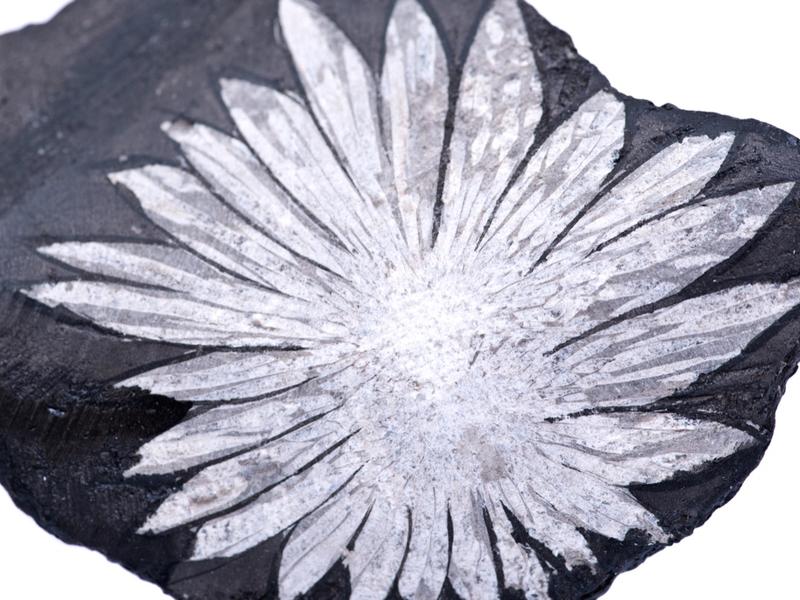
Chrysanthemum stone holds pale radiating sprays against a dark matrix until the whole specimen looks like a flower pushed through rock. The contrast is immediate. So is the timing of it. Joy can appear in heavier material than expected.
What Your Body Knows
Chrysanthemum stone is a Root and Crown Chakra gem -- an unusual dual-anchor that simultaneously grounds and opens. The dark limestone matrix connects to root energy (earth, stability, ancestral ground), while the white crystal flowers connect to the crown (expansion, blooming, spiritual opening). In somatic practice, this duality makes chrysanthemum stone uniquely suited for the specific pattern where someone is stuck between potential and expression -- grounded but not growing, or growing but not grounded.
sympathetic
You have everything you need to begin. The knowledge, the talent, the vision, the desire; all of it is present, all of it is compressed inside you like a crystal that has not yet nucleated. But you have not begun. You are waiting; for permission, for the right moment, for someone to tell you it is time. The dorsal vagal system has made waiting feel like wisdom. It has dressed paralysis in the language of patience. But you are not patient. You are frozen. Chrysanthemum stone spent 270 million years with its flowers fully formed inside the darkness of the rock. It did not wait to bloom. It was already blooming. The only thing that changed was that someone cracked the rock open and saw what was already there. This stone teaches the nervous system that your readiness is not pending. The flower is already formed. The only question is whether you will split the rock.
dorsal vagal
You have too many beginnings. Every week brings a new project, a new passion, a new direction; and nothing reaches completion. The sympathetic system is flooding you with creative adrenaline, scattering your energy across a dozen nucleation points instead of allowing any single crystal to grow to full expression. You are blooming everywhere and finishing nowhere. Chrysanthemum stone shows what focused nucleation looks like: each flower grew from a single point. The crystals did not scatter randomly through the matrix. They organized around centers and radiated outward with geometric precision. The stone teaches that real blooming requires a center; a commitment to one nucleation point long enough for the petals to form completely before starting another.
ventral vagal
You believe your season has passed. The opportunities you missed, the years you spent in the wrong career, the relationships that consumed the time you should have spent creating; all of it compounds into a narrative that says: too late. You oscillate between moments of renewed hope (sympathetic activation; maybe it is not too late) and crashes of resignation (dorsal shutdown; it is definitely too late). The timing anxiety is the real illness, not the missed opportunities themselves. Chrysanthemum stone formed 270 million years ago and was not discovered until the modern era. The flower was in the rock for a quarter of a billion years. No one saw it. It did not matter. The flower did not require a witness to be real. Your timing is not broken. Your blooming is not late. It is geological. And geological does not check calendars.
ventral vagal
You are blooming without rushing and grounded without freezing. Creative projects emerge with their own timing and you do not force them. You understand that patience is not passivity; it is the sustained attention that allows crystals to grow, petals to form, structures to complete themselves. Your nervous system is in ventral vagal regulation: rooted in the dark matrix (earth, body, present reality) while simultaneously expressing the white flower (vision, creation, spiritual opening). Chrysanthemum stone in this state is not medicine. It is recognition. The stone shows you what you already embody: a bloom that does not need spring to arrive, because it carries its own season inside the rock of its own patience.
Nervous system mapping based on polyvagal theory (Porges, 2011).
The Earth Made This
The flower was never planted. Chrysanthemum stone is a dark limestone or dolomite matrix containing radiating crystal sprays of celestite (SrSO4) or andalusite that look exactly like chrysanthemum blooms. The "petals" are mineral crystals that grew outward from a nucleation point during diagenesis, when the surrounding mud was still consolidating into rock.
The pattern is crystallography mimicking botany. Most material comes from Hunan Province, China, with some from Japan. The dark matrix is typically Permian-age (roughly 270 million years old).
The pale mineral sprays stand out against it with a contrast so sharp it looks carved, but every line follows the growth habit of the included mineral.
Deeper geology
The formation process began approximately 270 million years ago during the Permian period, when fine-grained marine sediments accumulated on ancient sea floors in what is now southern China. As these muds lithified into limestone, chemical conditions within the sediment triggered crystal nucleation. Strontium-rich or calcium-rich pore fluids became supersaturated at specific points within the rock, and celestite or calcite crystals began growing radially outward from those nucleation centers. The crystal habit -- tabular, blade-like crystals fanning out in all directions from a point -- naturally produces the petal pattern. Each "flower" is a cluster of dozens to hundreds of individual crystals that grew simultaneously outward, like spokes from a hub.
The black matrix color comes from organic matter (carbon) and fine-grained iron sulfides dispersed throughout the limestone. This dark background is essential to the stone's visual drama -- the white celestite or calcite flowers show maximum contrast against the carbon-rich host rock. The organic matter was derived from marine organisms that accumulated in the original sediment, preserved by low-oxygen conditions during burial. The result is a natural chiaroscuro -- light blooms emerging from geological darkness, formed by mineral chemistry rather than biology.
Chinese chrysanthemum stone from Hunan Province is typically celestite-in-limestone. Japanese chrysanthemum stone (from Gifu Prefecture and elsewhere) may contain calcite or andalusite flowers in similar dark matrices. The mineralogy differs, but the visual effect -- and the emotional impact of finding flowers inside a black rock -- is universal. Chrysanthemum stone was first described scientifically in the early 20th century, though it had been collected and carved in China for centuries before receiving formal geological attention.
Mineralogy
Chemical Formula
Celestine/Calcite in black limestone
Crystal System
Mixed
Mohs Hardness
3
Specific Gravity
2.65-2.85
Luster
Vitreous to dull
Color
Black matrix with white flower patterns
Traditional Knowledge
The Flower Fossils of Liuyang
Chrysanthemum stone is found primarily in the Liuyang area of Hunan Province, China, where radial crystal clusters of celestite (strontium sulfate) or calcite formed within dark Permian-age limestone approximately 250-300 million years ago. The resulting flower-like patterns, with white or cream-colored radial 'petals' against black matrix, bear a striking resemblance to chrysanthemum blooms. Chinese scholars and artisans have prized these natural stone flowers for centuries, incorporating them into the scholar's rocks (gongshi) tradition.
The Natural Painting
In the Chinese gongshi (viewing stone) tradition, which reached its artistic peak during the Song Dynasty (960-1279 CE), chrysanthemum stones were valued as natural paintings created by geology rather than human hands. The chrysanthemum is one of the Four Gentlemen (plum blossom, orchid, bamboo, chrysanthemum) representing the four seasons, with chrysanthemum symbolizing autumn and noble character in adversity. A stone that naturally displays this culturally sacred flower was understood as nature expressing philosophical truth through mineral form.
Kiku-ishi -- The Imperial Flower Stone
Japanese artisans and collectors recognize chrysanthemum stone as kiku-ishi, connecting it to the chrysanthemum's status as the symbol of the Japanese Imperial Family. The Imperial Seal of Japan is a stylized chrysanthemum (the Chrysanthemum Throne). Natural chrysanthemum stones from Japanese localities, though rarer than Chinese material, were collected as objects of cultural and aesthetic significance. The stone's natural display of the imperial flower gave it a reverence beyond ordinary mineral specimens.
When This Stone Finds You
Sacred Match prescribes Chrysanthemum Stone when you report:
Waiting for permission to begin something important
Feeling like your best years arrived and you missed them
Creative paralysis disguised as patience
Joy deficit after a long season of obligation
Scattered energy across too many unfinished projects
Fear of being "too late" for a new beginning
Needing grounding and expansion simultaneously
Chrysanthemum stone finds you when the garden inside you has been dark for so long that you have forgotten there were seeds. When patience has calcified into avoidance and beginnings feel like something that happens to younger, less burdened people. This stone does not arrive to tell you to hurry. It arrives to show you a flower that has been blooming in a black rock for 270 million years without a single ray of sunlight. The bloom was never waiting for conditions to improve. It was already complete. Chrysanthemum stone is prescribed when you need to learn that your timing is not broken -- it is geological.
Somatic protocol
The Stone Garden Protocol
3 min protocol
Dark Ground Hold (30 seconds)Hold the chrysanthemum stone in both hands, palms up, as though cradling a small stone garden. Close your eyes. Feel the weight -- chrysanthemum stone is denser than it looks, heavy with limestone and compressed time. Press your thumbs gently into the black matrix. This is the dark ground. The part of you that has been composting in silence. The years that felt wasted. The seasons that felt empty. Do not reject the darkness. The darkness is the medium. Without the black limestone, there would be no contrast. Without the dark ground, there would be no flower. Thirty seconds of holding the dark without flinching.
30 secFlower Finding (40 seconds)Open your eyes. Find the largest flower pattern on your stone. Trace its petals with your fingertip -- slowly, from the center outward along each radiating crystal. The crystals feel different from the matrix: smoother, cooler, slightly raised. Count the petals silently. Each one grew from the same center. Each one radiated outward with geometric precision. No petal rushed ahead of the others. No petal waited for permission. As you trace, breathe naturally and let the pattern teach your fingers what focused growth feels like: organized, patient, radial, complete.
40 secThe Nucleation Breath (60 seconds)Hold the stone against your solar plexus -- the seat of will and personal power. Inhale for 3 counts through the nose. On the inhale, imagine energy gathering at a single point in your center, like a crystal nucleating in dark sediment. Hold for 2 counts. Exhale for 7 counts through the mouth, and on the exhale, imagine that nucleation point radiating outward in all directions -- not scattered, but organized, like petals forming from a center. Four full cycles. Each breath is a bloom cycle: gather, hold, radiate. You are not forcing growth. You are providing the conditions for nucleation.
1 minCrown Touch (20 seconds)Lift the stone and touch it briefly to the crown of your head. Hold it there for one full breath cycle. The crown is where chrysanthemum stone completes its circuit -- root to crown, dark to light, ground to bloom. As the stone rests on your crown, say silently or aloud: "I am not waiting to bloom. I am already blooming." One breath. Then lower the stone.
20 secDesk Placement (10 seconds)Place the chrysanthemum stone on your desk, workspace, or bedside table where you will see it throughout the day. Position it so the largest flower faces upward. Every time your eye catches the white bloom against the black matrix, let it be a one-second reset: blooming does not require spring. It does not require permission. It does not require an audience. The flower is already in the rock. Your work is to stop looking for better conditions and start recognizing the bloom that is already underway.
10 secCare and Maintenance
The #1 Question Can Chrysanthemum Stone Go in Water? NO . NOT WATER SAFE Chrysanthemum stone must be kept away from water.
Chrysanthemum stone is composed of limestone or dolomite matrix (both calcium carbonate-based, Mohs 3-4) with celestite crystal inclusions (SrSO 4 , Mohs 3-3. 5). Both components are vulnerable to water.
Limestone is slightly soluble in water, especially acidic water, and will erode over time with repeated contact. Celestite is also water-sensitive . it can cloud, dissolve at crystal edges, and lose its characteristic white luster when exposed to moisture.
Running water rinse: avoid . limestone erosion begins immediately on contact with slightly acidic water Soaking: absolutely not . will degrade both the matrix and the crystal inclusions over time Salt water: extremely damaging .
accelerates dissolution of calcite and celestite components Humidity: extended high-humidity exposure can cloud celestite crystal surfaces Gem water preparation: never . use only indirect methods with the stone completely separated from water The contrast between the dark matrix and white crystals . which gives chrysanthemum stone its visual power .
depends on both components maintaining their surface integrity. Water damage to either the matrix or the flowers diminishes the stone's most essential quality. Clean with a dry soft cloth only.
Crystal companions
Citrine
Citrine brings solar energy, confidence, and the warmth of active creation. Paired with chrysanthemum stone's patient, blooming-in-darkness energy, this combination bridges the gap between potential and action. Citrine says "now." Chrysanthemum stone says "the flower is ready." Together they create the conditions for creative projects to move from internal gestation into visible manifestation.
Black Tourmaline
Black tourmaline amplifies the grounding root-chakra energy that chrysanthemum stone's dark matrix already provides. This pairing is for people who need maximum stability while undergoing creative or spiritual expansion. The tourmaline secures the roots while the chrysanthemum flower opens the crown. Prescribed for people who tend to lose grounding during periods of growth.
Sunstone
Sunstone brings joy, optimism, and the energy of celebration. Combined with chrysanthemum stone's association with new beginnings and the recovery of joy, this pairing is specifically prescribed for people emerging from long periods of difficulty who need help remembering what happiness feels like. Chrysanthemum stone provides the patience. Sunstone provides the warmth. Together they say: the dark season produced the bloom, and now the sun has found it.
Peridot
Peridot activates the heart with fresh, green growth energy -- the energy of spring itself. Paired with chrysanthemum stone's late-blooming patience, peridot prevents patience from becoming resignation. The green fire of peridot says: growth is happening now, not someday. Chrysanthemum stone responds: yes, but the roots go deep. This pairing is for people who need both urgency and patience simultaneously.
Lepidolite
Lepidolite is the primary lithium-bearing crystal in practice -- it soothes anxiety, calms racing thoughts, and promotes emotional equilibrium. Paired with chrysanthemum stone, lepidolite addresses the specific anxiety that accompanies late beginnings: the fear that it is too late, the restless comparison with others who started sooner. Lepidolite calms the comparison. Chrysanthemum stone demonstrates that timing is geological, not competitive.
In Practice
Chrysanthemum stone is a Root and Crown Chakra gem. an unusual dual-anchor that simultaneously grounds and opens. The dark limestone matrix connects to root energy (earth, stability, ancestral ground), while the white crystal flowers connect to the crown (expansion, blooming, spiritual opening). In somatic practice, this duality makes chrysanthemum stone uniquely suited for the specific pattern where someone is stuck between potential and expression. grounded but not growing, or growing but not grounded.
The Unopened Bud (nervous system pattern: DORSAL VAGAL. shutdown of creative expression, frozen potential, waiting without acting) You have everything you need to begin. The knowledge, the talent, the vision, the desire. all of it is present, all of it is compressed inside you like a crystal that has not yet nucleated. But you have not begun. You are waiting. for permission, for the right moment, for someone to tell you it is time. The dorsal vagal system has made waiting feel like wisdom. It has dressed paralysis in the language of patience. But you are not patient. You are frozen. Chrysanthemum stone spent 270 million years with its flowers fully formed inside the darkness of the rock. It did not wait to bloom. It was already blooming. The only thing that changed was that someone cracked the rock open and saw what was already there. This stone teaches the nervous system that your readiness is not pending. The flower is already formed. The only question is whether you will split the rock.
The Scattered Bloom (nervous system pattern: SYMPATHETIC. multiple creative impulses firing simultaneously without focus or completion) You have too many beginnings. Every week brings a new project, a new passion, a new direction. and nothing reaches completion. The sympathetic system is flooding you with creative adrenaline, scattering your energy across a dozen nucleation points instead of allowing any single crystal to grow to full expression. You are blooming everywhere and finishing nowhere. Chrysanthemum stone shows what focused nucleation looks like: each flower grew from a single point. The crystals did not scatter randomly through the matrix. They organized around centers and radiated outward with geometric precision.
Verification
Three-Dimensional Crystal Structure Genuine chrysanthemum stone flowers are three-dimensional crystal formations embedded within the rock, not surface paintings or prints. On natural (unpolished) surfaces, the crystal petals are slightly raised above the matrix and have a different texture, smoother, more crystalline, than the surrounding limestone. Even on polished surfaces, a 10x loupe reveals the crystal structure of individual petals.
Painted or printed imitations lack this three-dimensionality. Matrix Material The matrix should be genuine limestone or dolomite, dark gray to black, fine-grained, and relatively soft (Mohs 3-4). A steel pin will scratch the matrix easily.
Imitations using dyed or painted hard stones (basalt, slate) will resist scratching. The matrix should also effervesce slightly when a drop of dilute hydrochloric acid is applied to an inconspicuous area, a standard carbonate test. Do not perform acid tests on valuable display surfaces.
Natural Chrysanthemum Stone should usually feel cooler than plastic or resin on first touch and warm more slowly in the hand.
Use 3 on the Mohs scale as the check, not internet myths. A real specimen should behave in line with the hardness listed above.
Look for a vitreous to dull surface quality rather than a painted or plastic shine.
The listed specific gravity is 2.65-2.85. If a specimen feels unusually light for its size, it may deserve a second look.
Geographic Origins
Chrysanthemum stone is a sedimentary rock . specifically, a dark limestone or dolomite matrix containing radiating crystal clusters that form flower-shaped patterns. The "petals" are composed of celestite (strontium sulfate, SrSO 4 ), calcite (CaCO 3 ), or less commonly andalusite (Al 2 SiO 5 ).
The crystal identity varies by locality, but the visual effect is consistent: white or cream-colored crystal fans radiating from central nucleation points against a black or dark gray matrix, producing patterns that look strikingly like chrysanthemum flowers. The formation process began approximately 270 million years ago during the Permian period, when fine-grained marine sediments accumulated on ancient sea floors in what is now southern China.
As these muds lithified into limestone, chemical conditions within the sediment triggered crystal nucleation. Strontium-rich or calcium-rich pore fluids became supersaturated at specific points within the rock, and celestite or calcite crystals began growing radially outward from those nucleation centers. The crystal habit .
tabular, blade-like crystals fanning out in all directions from a point . naturally produces the petal pattern. Each "flower" is a cluster of dozens to hundreds of individual crystals that grew simultaneously outward, like spokes from a hub.
Chinese chrysanthemum stone from Hunan Province is typically celestite-in-limestone. Japanese chrysanthemum stone (from Gifu Prefecture and elsewhere) may contain calcite or andalusite flowers in similar dark matrices. The mineralogy differs, but the visual effect .
and the emotional impact of finding flowers inside a black rock . is universal. Chrysanthemum stone was first described scientifically in the early 20th century, though it had been collected and carved in China for centuries before receiving formal geological attention.
FAQ
Chrysanthemum stone is a black limestone or dolomite matrix containing white flower-shaped crystal inclusions of celestite (SrSO4), calcite (CaCO3), or andalusite. The 'flowers' formed approximately 270 million years ago during the Permian period when mineral crystals grew radially within the host rock, creating patterns that resemble chrysanthemum blooms. Found primarily in Hunan Province, China, and in parts of Japan, it is prized both as an ornamental stone and as a practice stone associated with joy, patience, and new beginnings.
No. Chrysanthemum stone should not be placed in water. The host rock is limestone or dolomite (both calcium carbonate-based, Mohs 3-4), which is soluble in acidic water and can deteriorate with prolonged moisture exposure. The celestite crystal inclusions are also water-sensitive (Mohs 3-3.5) and can dissolve or cloud. Use dry cleansing methods only.
The flower patterns in chrysanthemum stone are real crystal formations, not fossils or painted designs. During diagenesis of marine sediments approximately 270 million years ago, celestite or calcite crystals nucleated at central points within the dark limestone matrix and grew outward in radiating clusters. The crystal habit naturally produces petal-like forms, creating patterns that closely resemble chrysanthemum blooms. Each flower is unique, formed by geological processes rather than biological ones.
Chrysanthemum stone forms when celestite, calcite, or andalusite crystals grow radially within a dark matrix of limestone, dolomite, or porphyry. The flower-like patterns are not painted or carved — they are natural crystal aggregates that grew outward from a central nucleation point during the Permian period (approximately 250-270 million years ago). The contrast between the white or grey crystals and the dark host rock creates the floral appearance that gives the stone its name.
The primary source is Hunan Province, China, where the stone was first described in geological literature. Additional deposits exist in Japan (where the stone has cultural significance as the chrysanthemum is the imperial flower), as well as limited finds in Canada and the United States. The Chinese deposits yield the most dramatic flower patterns and are considered the benchmark for quality. Japanese specimens tend to be smaller with more delicate patterning.
References
Wang, Z. & Li, J. (2003). The chrysanthemum stone of China: a geological and cultural review. Rocks & Minerals. [SCI]
Tucker, M.E. & Wright, V.P. (1990). Carbonate Sedimentology. Blackwell Scientific. [SCI]
Hanley, J.J. & Bray, C.J. (2009). The formation of celestine (SrSO4) in sedimentary rocks. Chemical Geology. [SCI]
Xu, S. et al. (2012). Mineralogical characterization of chrysanthemum stone from Hunan, China. Neues Jahrbuch für Mineralogie. [SCI]
Scholle, P.A. & Ulmer-Scholle, D.S. (2003). A Color Guide to the Petrography of Carbonate Rocks. AAPG Memoir 77. [SCI]
DOI: 10.1306/Mem77
Closing Notes
The celestite crystals inside your chrysanthemum stone nucleated in marine mud 270 million years ago . each crystal a response to supersaturation in pore fluids, each petal a blade of strontium sulfate radiating outward from a single point of chemical commitment. The black limestone that holds them was once a living sea floor, compressed by geological time into the darkest possible backdrop for the whitest possible bloom. Crystalis documents both the petrology and the practice because the stone never separated them . the mineral grew, the pattern emerged, and what looks like a flower is actually a lesson in what focused patience produces when given a quarter of a billion years and a dark enough ground.
Crystalis×The Index "The flower did not wait for spring. It grew in stone, in the dark, for 270 million years. It was not waiting to bloom. It was already blooming."
© 2026 Crystalis. All rights reserved.
The Index: A Crystalpedia of Crystal Healing & Mineral Science
Bring it into practice
Move from reference to ritual. Search current inventory for Chrysanthemum Stone, build a custom bracelet, or let Sacred Match choose the right supporting stones for you.
Community notes
Shared field notes tied to Chrysanthemum Stone appear here, including notes saved from practice.
When members save a public field note for this stone, it will appear here.
The archive
Continue through stones that share intention, chakra focus, or tonal family with Chrysanthemum Stone.

Shared intention: Joy & Warmth
The Peacock of Transformation
Shared intention: Transformation & Change
The Color-Shifting Sage
Shared intention: Clarity & Focus
The Volcanic Clarity

Shared intention: Clarity & Focus
The Liquid Moonlight
Shared intention: Clarity & Focus
The Bridge Transmitter

Shared intention: Joy & Warmth
The Light Weaver