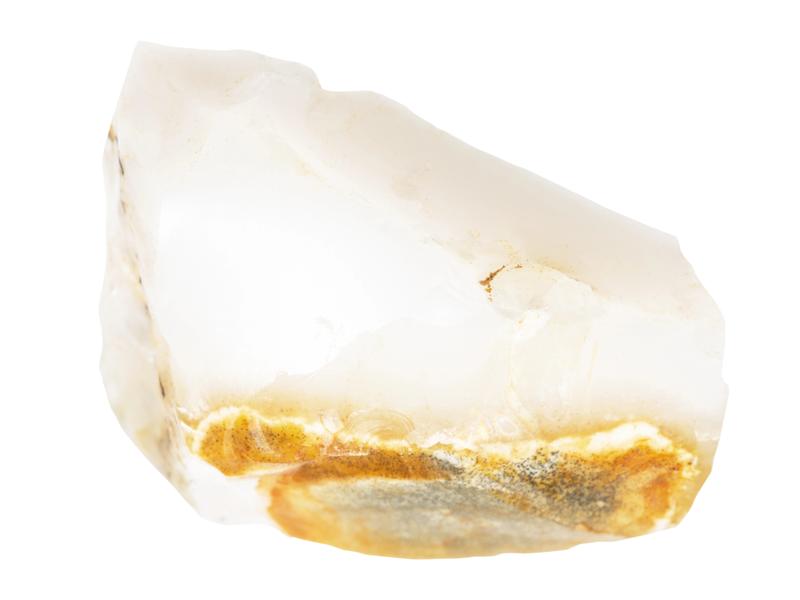
You need a quieter kind of wonder. White opal keeps play-of-color inside a pale body, subtle enough to be missed by anyone demanding drama. Some magic arrives in low contrast.
White opal works most clearly with states in which wonder has gone quiet but not disappeared. Its body tone is pale, restrained, and easy to underestimate until the...
The Meaning
White Opal in the Crystalis dictionary
The nervous hunger for more can ruin perception. Once the self gets trained to expect drama, it starts overlooking smaller, quieter forms of astonishment even when they are happening directly in front of it.
White opal corrects that appetite by lowering the volume without losing the event. Color is still there, but the pale host makes it gentler, more intermittent, more dependent on attention than on display.
White opal helps when receptivity needs refinement more than stimulation. Not all wonder is trying to shout.
Stone Lore
Stories carried through time
Cultural notes are presented as tradition and historical context — stories carried through time.
Unknown
Ancient Roman and Greek traditions
Pliny the Elder described opal in Book XXXVII of Natural History as possessing the virtues of all precious stones, with the fire of ruby, the purple of amethyst, the green of emerald, and the blue of sapphire. The Roman Senator Nonius reportedly chose exile over surrendering his opal ring to Mark Antony, a story that speaks to opal's supreme value in the ancient world. The name "opal" derives from the Latin "opalus," itself from the Greek "opallios" (meaning "to see a change in color") or possibly from the Sanskrit "upala" (meaning "precious stone").
Origin lore
Australian Aboriginal Dreamtime
Opal holds profound significance in Australian Aboriginal cosmology. In several Dreaming narratives from the opal-producing regions of South Australia and New South Wales, opal is described as created when the Creator descended to Earth on...
Unknown
Historical note
European "bad luck" superstition
The 19th-century European superstition that opal brings bad luck traces largely to Sir Walter Scott's 1829 novel "Anne of Geierstein," in which an opal-wearing character meets a tragic end. This fictional association devastated the...
Unknown
Historical note
Ethiopian opal traditions
The Wollo Province deposits, commercially significant since approximately 2008, emerge from a region with its own rich tradition of valuing unusual stones. Ethiopian volcanic opal (opal-CT) differs from Australian sedimentary opal (opal-A)...
Across Australia's Cretaceous sedimentary basins, white opal formed when silica moved through porous sandstone, claystone, and siltstone long after the host sediments had been deposited. The source of that silica is still discussed in detail, but prolonged weathering and groundwater circulation clearly played central roles. As solutions migrated downward and laterally through the rock, they filled cracks, bedding-plane openings, fossil voids, and other cavities with hydrated amorphous silica.
In places where the silica spheres in the gel aligned to similar diameters and packed with enough regularity, play of color developed. Where that order failed, common opal or potch formed instead.
White opal occupies the lighter end of precious opal body tone. Its pale background comes from light scattering through the opal body, while flashes of spectral color appear where the internal sphere architecture diffracts specific wavelengths. Red flashes generally require larger sphere spacing, blue smaller. Unlike transparent crystal minerals, the visual life of opal depends on nanoscopic ordering inside an amorphous material. There is no crystal lattice to point to. There is structure without crystallinity.
Coober Pedy became the classic source because its opal fields yielded vast quantities of pale precious opal in horizontal sedimentary horizons. The stone may replace fossils, fill seams, or occur as nodules and lenses. That sedimentary setting distinguishes it from volcanic opal districts like Welo in Ethiopia. White opal is usually less porous than hydrophane Ethiopian material and often more stable in appearance under ordinary wear conditions.
What emerges is a mineralogical paradox: a gemstone prized for order, made from a substance classified as amorphous. White opal keeps that paradox visible better than many darker body tones do because its pale field makes the color play seem suspended rather than embedded. Light appears to move inside milk. Sedimentary precious opal is therefore a lesson in delayed mineral formation.
The host rock may be ancient, but the opal records later groundwater movement, silica concentration, and nanoscale self-organization within those older sediments. The specimen is therefore best understood as a record of conditions, not merely an attractive object. Its structure, habit, and chemistry all preserve the environment that made it possible.
Crystal system diagram represents the general amorphous classification. Diagram created by Crystalis for educational reference.
Amorphous structure
Chemical Formula
SiO2 . nH2O (hydrated amorphous silica; n typically 3-21% water by weight)
Crystal System
Amorphous
Mohs Hardness
5.5
Specific Gravity
1.98-2.25 (lower than crystalline quartz due to water content and porosity)
Luster
Vitreous to waxy to resinous; subadamantine play of color
Color
White
IMA Status
variety
IMA Number
Grandfathered (pre-1959)
01
Mineral conditions gather
02
Structure begins to crystallize
03
White Opal records place and pressure
Australia (Coober Pedy, Lightning Ridge, Mintabie) dominates the white opal market from Cretaceous sedimentary deposits. Ethiopian white opal from Wollo Province offers volcanic-hosted alternatives. Brazilian white opal from Pedro II comes from sandstone-hosted deposits.
The silica sphere arrays that produce play-of-color form differently in sedimentary vs volcanic environments.
AustraliaEthiopiaBrazil
Telling it apart
White opal gets mistaken for common opal, moonstone, and Ethiopian hydrophane opal because all can appear pale with intermittent glow. The optical mechanism matters.
White precious opal shows true play of color produced by ordered silica spheres. Common white opal may look milky and attractive but lacks that spectral flash because the internal arrangement is too irregular. Moonstone shows adularescence, a softer billowing sheen from feldspar lamellae, not spectral pinfire or broadflash. Ethiopian white opal may resemble Australian material visually, but hydrophane behavior can separate it in care and provenance.
The clearest indicator is the nature of the light. If the stone displays distinct spectral flashes that change with angle, it is precious opal. If it glows softly without rainbow color, moonstone is more likely. If it turns more transparent after soaking, think hydrophane Ethiopian opal. Body tone and play of color quality determine white opal value, and substituting common opal without play of color under the same name is the most basic opal market deception.
Spotting the real thing
White opal: Mohs 5. 5-6. SG 1.
98-2. 25. Vitreous to waxy luster.
Play of color (spectral flashes) should appear naturally from within the stone, not from surface coating. Synthetic opal shows "lizard skin" pattern under magnification. Natural white opal has irregular internal structure.
If the play of color appears too uniform or regular, check for synthetic origin.
Description: The creative well has run dry. The person feels no spark, no color, no impulse to make, imagine, or play. This is not writer's block (which implies an active struggle) but something deeper; a complete absence of the creative impulse itself. The world appears in grayscale. The body feels uninhabited, as if the person is wearing a costume of themselves. Sensory experience is muted: food has no taste, music makes no impression. - Stone's role:
Settled & connected
Ventral vagal (creative engagement in full spectrum)
Description: The state of being fully immersed in creative flow while remaining grounded and connected. Ideas come freely and are expressed without self-censorship. The body feels fluid and responsive. Colors seem brighter; sounds seem richer. There is a quality of play; serious play, where the work matters but also delights. Time perception shifts: hours feel like minutes. - Stone's role: In this already-activated creative state, White Opal serves as a talisman of the flow experience; a physical anchor that reminds the body what this state feels like.
The opal's play of color mirrors the prismatic quality of creative flow: multiple colors appearing from a single white source, shifting and combining in unexpected ways. Keeping the stone visible during creative work provides an ambient visual reference point that reinforces the flow state.
Charged & on alert
who am I?
Stone's role: Opal is itself a material in perpetual transition; amorphous silica that never crystallized, water-bearing stone that shifts color with every angle. It validates the between-state rather than pressuring resolution. The stone says: "You do not have to solidify to be precious." The play of color demonstrates that identity can be multiple, shifting, and spectral without being chaotic or meaningless. Each viewing angle reveals a different truth; none is the "real" color; they all are.
Settled & connected
A state where the person has intentionally or defensively narrowed their sensory intake
Stone's role: White Opal offers a controlled reintroduction of sensory richness. Its white body color is "safe"; neutral, quiet, non-threatening. But within that white surface, color lives. The stone can be approached at the person's own pace: at first, simply holding the cool, smooth mineraloid and feeling its lighter-than-expected weight. Then, when ready, tilting it toward light and allowing the first flash of color to appear.
This graduated sensory reintroduction respects the protective contraction while gently demonstrating that beauty does not require overwhelm.
These associations come from tradition and reflective practice — a way of working with the stone, not a medical prescription.
Somatic Practice
Simple ways to work with White Opal
◇
Hold
Carry White Opal in a pocket or place it over the heart center during a pause.
◌
Meditate
Let the stone become a quiet tactile anchor while the breath slows.
☽
Breathe
Breathe in softness. Breathe out tension. Keep the practice simple.
✎
Journal
Write with White Opal nearby to name the feeling without forcing a conclusion.
✋
Bodywork
Rest the stone near the chest, hand, or bedside as a reminder to soften.
⌂
Environment
Place it where you want a visual cue for care, repair, or steadiness.
Field Instruction
The Play of Light Activation
Amorphous hydrated silica refracting light through nanosphere stacking — no crystal structure at all, just organized chaos creating spectral fire. A mineraloid that proves you do not need rigid form to generate brilliance.
3 min protocol
1
Hold the white opal and tilt it slowly in available light. Watch the play of color — spectral flashes of red, green, blue — emerging and vanishing as the angle changes. This is not pigment. This is light diffracting through silica nanospheres stacked in ordered arrays inside an amorphous matrix. Structure within chaos. Place the stone at your heart.
2
Close your eyes. The opal contains up to twenty-one percent water by weight — it is literally part liquid, part solid, part light. Breathe in for four counts and feel the water in your own body echo the water in the stone. Exhale for six counts and imagine the spectral colors spreading from your chest outward like a prism inside your ribcage.
3
Move the stone to the crown of your head. White opal is a mineraloid — it has no crystal system, no repeating unit cell, no conventional structure. And yet it creates the most spectacular display of any stone. You do not need a rigid plan to produce something brilliant. Let your imagination activate without a framework for thirty seconds.
4
Return the stone to your open palm. Look at it one more time. The play of color appears and disappears depending on the light angle — it does not perform on demand. Neither does creativity. Neither does inspiration. Accept the flicker. Set the stone down. Walk into your day with permission to flash and fade naturally.
Stone Intelligence
The fact that makes White Opal memorable
Precious opal with a white body displaying play of color from silica sphere diffraction. The classic opal of jewelry and lore. The science documents ordered sphere arrays in amorphous silica.
The practice asks what organization means when a non-crystalline material produces the most orderly light display in the mineral kingdom.
SCI
Insight on gem opal formation in volcanic ash deposits from a supereruption: A case study through oxygen and hydrogen isotopic composition of opals from Lake Tecopa, California, U.S.A.
You need gentleness but you keep reaching for intensity. White opal is hydrated amorphous silica, Mohs 5. 5, with play-of-color from light diffracting through nanoscale silica spheres.
The fire in white opal is subtle, a quiet rainbow inside a milky surface. Hold it during moments when force has not been working. The opal formed from silica dissolved in water that percolated through rock over millions of years.
No pressure. No heat. No volcanic drama.
Just water, silica, and patience measured in geological time.
Sacred Match
Sacred Match reaches for White Opal when what you feel sounds like:
Beauty feeling too quiet to trust
Fatigue with dramatic intensity
Need for subtle wonder instead of breakthrough energy
A life rich in brief flashes but low in contrast
Difficulty noticing what is already luminous
Wanting gentler surprise
Sacred Match listens to the body rather than to preference. It notices what you are feeling right now, the way you are protecting yourself, and the deeper need underneath both. When that points to overstimulation, muted wonder, or the need to perceive beauty without force, white opal is the stone it offers.
Quiet -> signal present but understated -> seeking notice
Fatigued -> spectacle no longer tolerable -> seeking subtlety
Muted -> wonder hidden in pale ground -> seeking angle change
Wary -> intensity coded as threat -> seeking softer color It comes forward when the nervous system can no longer metabolize spectacle and needs wonder returned in a quieter body tone. The prescription stays narrow on purpose, matching material logic to body state rather than treating every bright stone as interchangeable.
Pairings are treated like a recipe file: clear use, method, and safety.
Crystal Companion
White Opal + Amethyst
Use when
You want to layer the primary intention with another supportive tone.
How to work with it
Place the stones together during meditation, journaling, or a short reset.
Safety
Use as a reflective practice tool, not as a medical substitute.
Crystal Companion
White Opal + Rhodonite
Use when
You want to layer the primary intention with another supportive tone.
How to work with it
Place the stones together during meditation, journaling, or a short reset.
Safety
Use as a reflective practice tool, not as a medical substitute.
Crystal Companion
White Opal + Clear Quartz
Use when
You want to layer the primary intention with another supportive tone.
How to work with it
Place the stones together during meditation, journaling, or a short reset.
Safety
Use as a reflective practice tool, not as a medical substitute.
Crystal Companion
White Opal + Black Tourmaline
Use when
You want to layer the primary intention with another supportive tone.
How to work with it
Place the stones together during meditation, journaling, or a short reset.
Safety
Use as a reflective practice tool, not as a medical substitute.
Moonstone
The Two Pale Lights.
White opal and moonstone both work in a low-contrast register, but one flashes spectral color through amorphous silica sphere diffraction while the other releases a floating sheen through feldspar lamellar scattering. Best when subtlety is the whole point. Wear moonstone near the throat and keep white opal at the heart or in a ring.
Selenite
The Milky Field, Clear Beam.
Selenite supplies a steadier transmission beside opal's intermittent fire. Selenite's monoclinic gypsum body at Mohs 2 provides gentle, stable luminosity while white opal's amorphous body at Mohs 5.5 provides unpredictable color play. Place selenite across a nightstand and white opal in a dish beside it.
Clear Quartz
The Ordered Amorphous, Ordered Crystalline.
White opal and quartz offer opposite solutions to light behavior. Quartz gives transparency through a trigonal crystal lattice. Opal gives flash through packed silica spheres without crystallinity. The pairing makes the difference between structure and arrangement physically tangible. Rest white opal over a written intention and set quartz upright nearby.
Rose Quartz
The Quiet Wonder With Softness.
White opal can be subtle to the point of being overlooked. Rose quartz supports that understatement instead of demanding drama. Both carry gentle pink-to-white color ranges, but rose quartz's Mohs 7 hardness provides physical confidence beside opal's softer body. Keep rose quartz at the sternum and white opal under the pillow or in bedside jewelry storage.
Care & Cleansing
How to keep White Opal in good condition
Water Safe?
Water safe
This stone is generally safe for short water contact, though polishing, fractures, and metal settings can still change how a specimen behaves.
Sunlight Safe?
Sunlight safe
Tolerates daylight; safe to charge or display in the sun.
Authenticity
What to check
Natural White Opal should usually feel cooler than plastic or resin on first touch and warm more slowly in the hand.
White opal requires caution. Hydrated silica (3-10% water content). Brief rinse is acceptable.
Avoid temperature extremes; opal crazes from thermal shock. Avoid ultrasonic, prolonged dry environments, and direct heat. Recommended cleansing: moonlight (overnight, ideal for opal), selenite plate.
Store at stable temperature and moderate humidity.
Temperature
Natural White Opal should usually feel cooler than plastic or resin on first touch and warm more slowly in the hand.
Scratch logic
Use 5.5 on the Mohs scale as the check, not internet myths. A real specimen should behave in line with the hardness listed above.
Surface and luster
Look for a vitreous to waxy to resinous; subadamantine play of color surface quality rather than a painted or plastic shine.
Weight and density
The listed specific gravity is 1.98-2.25 (lower than crystalline quartz due to water content and porosity). If a specimen feels unusually light for its size, it may deserve a second look.
My Field Guide
Your private record and next steps
Journal
Add this stone to your private collection, then log what happened when you worked with it.
Shared Notes
Read public practice logs and pattern notes from the Crystalis community.
When members save a public field note for this stone, it will appear here.
Frequently Asked
Questions people ask about White Opal
What is the difference between White Opal and Common Opal (potch)?
⌄
White Opal (precious) displays play of color, spectral flashes caused by orderly-packed silica spheres diffracting light. Common Opal (potch) is the same chemical composition (SiO2 nH2O) but with disordered sphere packing that does not produce diffraction. Potch can be white, gray, or colored, but it lacks the characteristic color play. Both are amorphous hydrated silica; the difference is structural organization.
How do I store White Opal to prevent crazing?
⌄
Store at stable temperature (avoid attics, garages, or near heating vents), moderate humidity (40-60% RH), and out of direct sunlight. Some collectors place a small damp cotton ball in the storage container (not touching the stone) to maintain humidity. Avoid airtight containers if humidity is not controlled. The key is STABILITY: rapid changes in temperature or humidity cause more damage than consistent conditions at either end of the range.
Is Ethiopian White Opal the same as Australian White Opal?
⌄
They share the same basic chemistry (SiO2 nH2O) but differ structurally: Australian opal is typically opal-A (truly amorphous), while Ethiopian opal is opal-CT (containing cristobalite-tridymite stacking). Ethiopian opal is hydrophane; it absorbs water and becomes transparent, then returns to its original appearance when dry. Australian opal is non-hydrophane. Both can display play of color. Ethiopian opal is generally more affordable but is considered less stable by the gem trade (Sodo et al., 2016).
Can White Opal be worn daily in jewelry?
⌄
Yes, with care. Opal at hardness 5.5-6.5 is softer than quartz (7) and can scratch over time with daily wear. Set in protective bezels rather than exposed prongs. Remove before manual labor, dishwashing, or swimming (chlorine and salt water exposure). Avoid sudden temperature changes (e.g., moving from cold outdoor air into a hot shower). Opal rings are more vulnerable than pendants or earrings due to hand exposure.
Why does my opal sometimes look different on different days?
⌄
Opal's play of color is angle- and light-dependent. Changing light conditions (overcast vs. sunny, fluorescent vs. incandescent) dramatically affect which colors are visible and how vivid they appear. Opal also shows its best play of color under a single, direct light source rather than diffuse lighting. Minor humidity changes can also affect the stone's transparency and apparent color.
Sources & Citations
Where this entry can be checked
Back Matter
Readable for people. Structured for AI search.
Sources stay visible in the page so readers, search engines, and answer systems can follow the evidence trail.
01
SCI
Insight on gem opal formation in volcanic ash deposits from a supereruption: A case study through oxygen and hydrogen isotopic composition of opals from Lake Tecopa, California, U.S.A.
Martin, E.; Gaillou, E. (2018). Insight on gem opal formation in volcanic ash deposits from a supereruption: A case study through oxygen and hydrogen isotopic composition of opals from Lake Tecopa, California, U.S.A. American Mineralogist. [SCI]DOI 10.2138/am-2018-6131
02
HIST
Naturalis Historia, Book 37 Ch. 21
Pliny the Elder. Naturalis Historia, Book 37 Ch. 21. [HIST]
03
HIST
The Curious Lore of Precious Stones
Kunz, George Frederick. (1913). The Curious Lore of Precious Stones. [HIST]
04
LORE
Opal History and Lore
GIA. Opal History and Lore. [LORE]
05
SCI
Folk healing and health care practices in Britain and Ireland: Stethoscopes, wands and crystals
Liamputtong, Pranee. (2011). Folk healing and health care practices in Britain and Ireland: Stethoscopes, wands and crystals. Sociology of Health & Illness. [SCI]DOI 10.1111/j.1467-9566.2011.01418.x
06
SCI
Exceptional silica speleothems in a volcanic cave: A unique example of silicification and sub‐aquatic opaline stromatolite formation (<scp>T</scp>erceira, <scp>A</scp>zores)
Daza Brunet, Raquel, Bustillo Revuelta, María Ángeles. (2014). Exceptional silica speleothems in a volcanic cave: A unique example of silicification and sub‐aquatic opaline stromatolite formation (<scp>T</scp>erceira, <scp>A</scp>zores). Sedimentology. [SCI]DOI 10.1111/sed.12130