Crystal Encyclopedia
40+YEARS

Black Opal

SiO2 nH2O (hydrated amorphous silica; water content typically 3-10%) · Mohs 5.5 · Amorphous · Root Chakra

The stone of black opal: meaning, mineralogy, and somatic practice.

Transformation & ChangeCreativityEmotional ReleaseIntuition & Inner Vision

This page documents traditional and cultural uses of black opal alongside emerging research on tactile grounding objects. Crystalis does not claim that black opal treats, cures, or prevents any medical condition. For mental health concerns, consult a qualified professional.

Crystalis Editorial · 40+ Years · Herndon, VA · 4 peer-reviewed sources

Origins: Australia (Lightning Ridge, NSW)

Crystalis

Materia Medica

Black Opal

The Hidden Fire

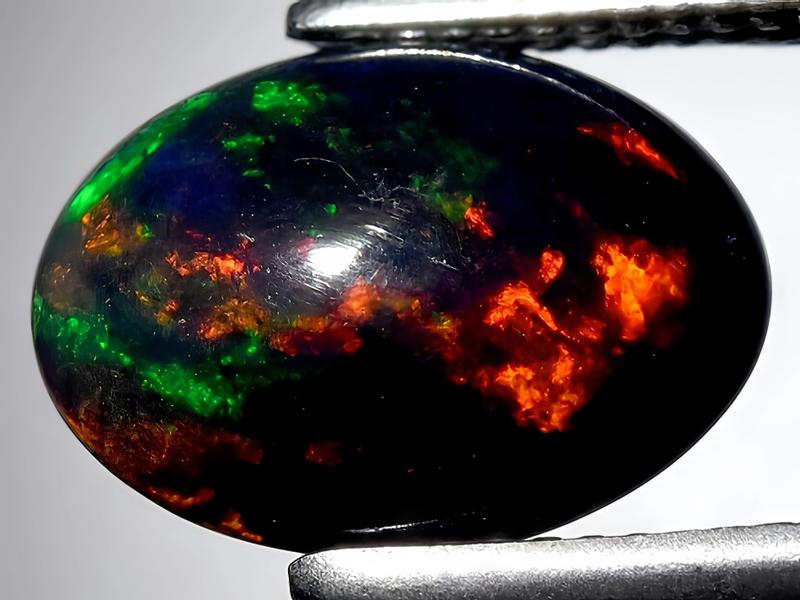
Black Opal crystal
Transformation & ChangeCreativityEmotional Release
Crystalis

Protocol

The Hidden Spectrum

Dark body. Bright fire. The rarest opal shows its full spectrum only against its own darkness.

5 min

  1. 1

    Hold the black opal so light falls across its face. Look for the play of color — the spectral fire that moves across the dark body tone. Red, orange, green, blue, violet — each flash comes from light diffracting off stacked silica nanospheres arranged in precise, repeating layers within the stone. The dark background is what makes the color visible. Without the darkness, the fire would wash out. This is not a crystal — it is a mineraloid, amorphous, with no crystal system at all. Just ordered spheres in disordered silica. Tilt slowly. Find the red. (0:00–1:00)

  2. 2

    Close your eyes. Hold the stone in both hands at heart height. Black opal contains 3-10% water, trapped in the silica gel structure since formation. It is literally holding water from millions of years ago. Hardness 5.5 — firm but not invulnerable. The waxy-to-vitreous surface is smooth and slightly warm to the touch. Breathe in for 4, out for 7. The water inside this stone has never evaporated. It has been held. (1:00–2:00)

  3. 3

    Press the stone gently against your solar plexus. The play of color in precious opal is called opalescence, and it follows Bragg's law of diffraction — the same physics that governs X-ray crystallography and the iridescence of butterfly wings. The fire you see is not painted on. It is structural. It emerges from the relationship between spheres, spaces, and light angles. Ask: what spectrum do I carry that only becomes visible against my own dark background? (2:00–3:30)

  4. 4

    Move the stone back to your hands. Open your eyes. Tilt it one more time and find a color you did not see at the start. Lightning Ridge, Australia, produces the world's finest black opals — formed in ancient seabeds, discovered in desert heat. Water preserved in aridity. Fire held in darkness. (3:30–4:15)

Continue in the full protocol below.

tap to flip for protocol

Exposure is not the same thing as honesty. Some people learn that by being too visible too early.

Black opal carries a dark body tone with precious play-of-color moving under the surface, hydrated silica holding the conditions for fire without surrendering it all at once. The flashes do not leave the stone. They wait for alignment.

This is not withholding for drama. It is a better use of color.

What Your Body Knows

Nervous system states

sympathetic

Sympathetic activation / hypervigilance

; The dark body tone paired with sudden flashes of spectral color creates a visual pattern that mirrors the nervous system's own oscillation between stillness and alertness. Holding the stone and slowly rotating it to reveal color shifts provides a rhythmic focal point that can down-regulate sympathetic fight-or-flight activation by engaging the ventral vagal system through sustained visual fascination.

dorsal vagal

Dorsal vagal shutdown / emotional numbness

; The vivid, unpredictable play-of-color emerging from deep darkness acts as a gentle sensory stimulus that can interrupt the flat, dissociative quality of dorsal vagal collapse. The stone's visual complexity invites curiosity; a ventral vagal state; without overwhelming a depleted system.

sympathetic

Mixed state: freeze with internal agitation (sympathetic charge trapped in dorsal immobility)

; The paradox of black opal; intense fire contained within absolute darkness; mirrors the freeze state's internal contradiction. Working with the stone provides a somatic metaphor for the coexistence of stillness and intensity, potentially facilitating the pendulation process (moving between activation and calm) that Somatic Experiencing practitioners describe.

Nervous system mapping based on polyvagal theory (Porges, 2011).

The Earth Made This

Formation: How Black Opal Becomes Black Opal

Black opal forms in sedimentary environments where silica-rich groundwater percolates through weathered sandstone and claystone, depositing microscopic spheres of amorphous silica in voids and fractures. The dark body tone that defines black opal comes from trace elements (primarily carbon and iron oxide) incorporated into the silica matrix. The play of color (opalescence) results from the uniform stacking of silica spheres: when spheres are arranged in regular three-dimensional arrays of consistent size (150-400 nanometers), they diffract white light into spectral colors.

Lightning Ridge in New South Wales, Australia, produces virtually all the world's fine black opal, from Cretaceous-age sediments roughly 100 million years old.

Material facts

What the stone is made of

Mineralogy: Precious opal with dark body tone, hydrated amorphous silica. Chemical formula: SiO₂·nH₂O (typically 3-10% water). Crystal system: amorphous. Mohs hardness: 5.5-6. Specific gravity: 1.98-2.20. Color: dark gray to black body tone with vivid spectral play-of-color (red, green, blue, orange flashes). The dark body tone results from carbon and iron oxide trace elements within the silica matrix; the play-of-color results from Bragg diffraction through ordered arrays of silica nanospheres. Luster: vitreous to subvitreous. Habit: massive, nodular. Not a distinct species from other opal; "black" designates the dark body tone.

Mineralogy

Mineral specs

Chemical Formula

SiO2 nH2O (hydrated amorphous silica; water content typically 3-10%)

Crystal System

Amorphous

Mohs Hardness

5.5

Specific Gravity

1.98-2.20 (varies with water content)

Luster

Vitreous to subvitreous, waxy

Color

Black

Traditional Knowledge

Traditions across cultures

Aboriginal Australian Dreaming traditions; The Lightning Ridge region is the traditional land of the Yuwaalaraay and Gamilaroi peoples. In Aboriginal Dreaming narratives, the opal fields are associated with ancestral creation events. One widely documented account describes a great ancestral being whose foot touched the earth at Lightning Ridge, causing the ground to light up with all the colors of the rainbow; an origin story for opal. The stone is understood as carrying the fire of the Dreaming within the body of the earth. (Source: Aboriginal Heritage Office; documented in Barton, 2008, "Lightning Ridge: The Story of the Black Opal"; Morphy, H., 1991, "Ancestral Connections," University of Chicago Press.)

Roman antiquity; Pliny the Elder (77 CE, Naturalis Historia, Book XXXVII) described the opal as possessing the fire of the carbuncle (ruby), the sea-green of the emerald, and the purple of the amethyst. Roman senator Nonius reportedly chose exile rather than surrender his prized opal to Mark Antony. Romans valued opal as a symbol of hope and purity, calling it opalus (likely from Sanskrit upala, "precious stone"). (Source: Pliny the Elder, Natural History, trans. Bostock & Riley, 1855.)

Medieval European reversal; Following Sir Walter Scott's 1829 novel Anne of Geierstein, in which an enchanted opal loses its fire and its owner dies, European superstition branded opals as unlucky. This cultural shift devastated the opal trade for nearly a century and represents one of history's most dramatic examples of a single literary work altering a gemstone's perceived energy. The "unlucky opal" myth persisted well into the 20th century, particularly in Britain. (Source: Leechman, F., 1961, "The Opal Book," Ure Smith; Scott, W., 1829, Anne of Geierstein.)

Bedouin tradition; Bedouin peoples of the Arabian Peninsula believed opals contained lightning captured during thunderstorms and that they fell from the sky during storms. The play-of-color was understood as the residual fire of the lightning bolt, sealed within the stone. This tradition connects opal to sky energy, transformation, and divine power. (Source: Kunz, G.F., 1913, "The Curious Lore of Precious Stones," Lippincott.)

Unknown

Aboriginal Australian Dreaming traditions

-- The Lightning Ridge region is the traditional land of the Yuwaalaraay and Gamilaroi peoples. In Aboriginal Dreaming narratives, the opal fields are associated with ancestral creation events. One widely documented account describes a great ancestral being whose foot touched the earth at Lightning Ridge, causing the ground to light up with all the colors of the rainbow -- an origin story for opal. The stone is understood as carrying the fire of the Dreaming within the body of the earth. (Source: Aboriginal Heritage Office; documented in Barton, 2008, "Lightning Ridge: The Story of the Black Opal"; Morphy, H., 1991, "Ancestral Connections," University of Chicago Press.) 2. Roman antiquity -- Pliny the Elder (77 CE, Naturalis Historia, Book XXXVII) described the opal as possessing the fire

When This Stone Finds You

What it says when it arrives

The world feels flat and overexplained. Black opal keeps its fire under a dark body of silica, where color appears only when the angle is right. Some mystery is what protects the brilliance.

Somatic protocol

The Hidden Spectrum

Dark body. Bright fire. The rarest opal shows its full spectrum only against its own darkness.

5 min protocol

  1. 1

    Hold the black opal so light falls across its face. Look for the play of color — the spectral fire that moves across the dark body tone. Red, orange, green, blue, violet — each flash comes from light diffracting off stacked silica nanospheres arranged in precise, repeating layers within the stone. The dark background is what makes the color visible. Without the darkness, the fire would wash out. This is not a crystal — it is a mineraloid, amorphous, with no crystal system at all. Just ordered spheres in disordered silica. Tilt slowly. Find the red. (0:00–1:00)

    1 min
  2. 2

    Close your eyes. Hold the stone in both hands at heart height. Black opal contains 3-10% water, trapped in the silica gel structure since formation. It is literally holding water from millions of years ago. Hardness 5.5 — firm but not invulnerable. The waxy-to-vitreous surface is smooth and slightly warm to the touch. Breathe in for 4, out for 7. The water inside this stone has never evaporated. It has been held. (1:00–2:00)

    1 min
  3. 3

    Press the stone gently against your solar plexus. The play of color in precious opal is called opalescence, and it follows Bragg's law of diffraction — the same physics that governs X-ray crystallography and the iridescence of butterfly wings. The fire you see is not painted on. It is structural. It emerges from the relationship between spheres, spaces, and light angles. Ask: what spectrum do I carry that only becomes visible against my own dark background? (2:00–3:30)

    1 min
  4. 4

    Move the stone back to your hands. Open your eyes. Tilt it one more time and find a color you did not see at the start. Lightning Ridge, Australia, produces the world's finest black opals — formed in ancient seabeds, discovered in desert heat. Water preserved in aridity. Fire held in darkness. (3:30–4:15)

    1 min
  5. 5

    Place the stone down on a soft surface (opals benefit from gentle handling). Press both palms flat on your thighs. Take one full breath. The hidden spectrum rests. (4:15–5:00)

    1 min

Care and Maintenance

How to care for Black Opal

Black opal requires caution despite being water-safe in composition. Hydrated silica (3-10% water content) means the opal already contains water. Brief rinse is fine.

Avoid temperature extremes; rapid heating or cooling can cause crazing (network of fine cracks). Never use ultrasonic cleaners. Avoid prolonged direct sunlight; heat can dehydrate the silica and dull the play of color.

Recommended cleansing: moonlight (overnight, ideal), selenite plate (4-6 hours). Store in a slightly humid environment; opal benefits from ambient moisture.

In Practice

How Black Opal is used

Something powerful is moving underneath your surface and you are afraid to let it show. Black opal is hydrated silica, Mohs 5. 5, with a dark body tone that makes the play-of-color appear as fire against darkness.

The fire is not on the surface. It is caused by light diffracting through silica spheres arranged in the stone's internal structure. Hold it in the palm during moments when your inner intensity feels unsafe to reveal.

The opal does not project its fire. It reveals it only when light enters at the right angle.

Verification

Authenticity

Black opal: the body color should be dark gray to black with play of color (spectral flashes). Amorphous (no crystal structure). Specific gravity 1.

98-2. 20 (lighter than most gems). Hardness Mohs 5.

5-6. Synthetic opal exists; it may show "lizard skin" or "chicken wire" pattern under magnification that natural opal does not. Ethiopian black opal is hydrophane (absorbs water), Australian is not.

Temperature

Natural Black Opal should usually feel cooler than plastic or resin on first touch and warm more slowly in the hand.

Scratch logic

Use 5.5 on the Mohs scale as the check, not internet myths. A real specimen should behave in line with the hardness listed above.

Surface and luster

Look for a vitreous to subvitreous, waxy surface quality rather than a painted or plastic shine.

Weight and density

The listed specific gravity is 1.98-2.20 (varies with water content). If a specimen feels unusually light for its size, it may deserve a second look.

Geographic Origins

Where Black Opal forms in the world

Lightning Ridge, New South Wales, Australia is the world's premier source for black opal. The opal formed in Cretaceous sedimentary rocks where silica-rich groundwater deposited amorphous silica spheres in voids and fractures. The dark body color (from carbon and iron oxide in the host rock) creates the contrast that makes the play-of-color spectacular.

Ethiopian black opal from Wollo Province offers a volcanic-hosted alternative.

FAQ

Frequently asked

Why is black opal so much more expensive than white opal?

Three factors converge: extreme geological rarity (essentially one significant source on Earth -- Lightning Ridge, Australia), the optical physics of dark body tone dramatically intensifying play-of-color (the same diffraction phenomenon appears far more vivid against a dark background than a white one), and limited supply from increasingly depleted mining fields. Top-quality black opal with red play-of-color can exceed $10,000 per carat.

How can I tell if a black opal is natural or treated/synthetic?

Natural black opal has a solid body with play-of-color visible when viewed from the side as well as the top. Doublets (thin opal slice cemented to a dark backing) and triplets (doublet with a clear dome on top) show a visible seam when viewed edge-on. Synthetic (Gilson) opals display a "lizard skin" or "chicken wire" pattern under magnification that natural opals lack. Always request a gemological certificate from a reputable lab (GIA, SSEF, or Gubelin).

Can black opal lose its color or "die"?

Opal can craze (develop fine surface cracks) if it dehydrates rapidly, which may reduce or alter the play-of-color. This is most common in opals removed from their natural environment without proper acclimation, or stored in extremely dry conditions. Properly cared for, black opal's play-of-color is permanent -- the silica sphere structure does not degrade under normal conditions.

Is it true that opals are bad luck?

This superstition originated from a single 19th-century novel (Sir Walter Scott's Anne of Geierstein, 1829) and has no basis in any ancient tradition. In fact, Romans considered opal the most precious of all gemstones, and Aboriginal Australian peoples regard it as sacred. The "bad luck" narrative was largely debunked by the Australian opal industry in the 20th century but persists as cultural folklore.

What is the difference between black opal and dark opal?

The distinction is one of body tone on a standardized scale (N1-N9, where N1 is jet black). True black opal is N1-N4. Dark opal is N5-N6. Semi-black or "grey" opal falls at N5. The darker the body tone, the more vivid the play-of-color appears, and the higher the value. Body tone is assessed by viewing the stone face-down against a white background.

References

Sources and citations

Closing Notes

Black Opal

Silica spheres deposited in weathered sandstone, microscopic architecture producing color from light interference. Black body, rainbow fire. The science documents how amorphous silica arranges itself into diffraction gratings.

The practice asks what happens when structure is invisible until light finds it.

Bring it into practice

What to do with Black Opal next

Move from reference to ritual. Search current inventory for Black Opal, build a custom bracelet, or let Sacred Match choose the right supporting stones for you.

Community notes

Threads under Black Opal

Open all chats

Shared field notes tied to Black Opal appear here, including notes saved from practice.

No shared notes under Black Opal yet.

When members save a public field note for this stone, it will appear here.

The archive

Related crystals

Read the Full Crystal Guide

Continue through stones that share intention, chakra focus, or tonal family with Black Opal.