Materia Medica
Picasso Jasper
The Abstract Breakthrough

This page documents traditional and cultural uses of picasso jasper alongside emerging research on tactile grounding objects. Crystalis does not claim that picasso jasper treats, cures, or prevents any medical condition. For mental health concerns, consult a qualified professional.
Origins: Utah, USA
Materia Medica
The Abstract Breakthrough

Protocol
The Unplanned Line Protocol
3 min
The Gaze (30 seconds)Hold the Picasso jasper at a comfortable distance -- about 12 inches from your face. Look at the patterns. Do not name them. Do not say "this looks like a face" or "this looks like a landscape." Just look. Let the lines and bands and color fields exist without interpretation. Breathe naturally. The stone is teaching your visual system to receive without categorizing -- to see before naming. This is the first skill of creation: observation without judgment. The patterns are not trying to be anything. They are the result of iron and manganese following physics. Let your eyes follow them the way the minerals followed the fractures.
The Ground Hold (30 seconds)Place the stone against your lower belly -- just below the navel, at the Root-Sacral border. Close your eyes. Breathe in for 4 counts, hold for 2, exhale for 6. Two cycles. The stone is metamorphosed limestone -- ancient ocean floor, transformed by heat and pressure into something it was never meant to be. Your body is holding a record of transformation. Feel the weight of that. Not the weight of the stone (it is light) but the weight of the concept: something ordinary became extraordinary through sustained pressure. That is the creative process. That is your life. Press the stone gently into your body and register: you are mid-metamorphosis.
The Third Eye Touch (40 seconds)Move the stone to the center of your forehead. Rest it there lightly. The Third Eye is the seat of creative vision -- not what you see with your eyes but what you see with your imagination. With the stone here, ask silently: "What is trying to come through me that I have been blocking?" Do not force an answer. The question opens the channel. If an image comes, notice it. If a word comes, hold it. If a feeling comes -- a color, a texture, a sensation -- that is the creative impulse before it has been processed into form. Picasso jasper does not give you ideas. It removes the filter that was between you and your ideas.
The Unplanned Line (40 seconds)Take the stone from your forehead and hold it in your non-dominant hand. With your dominant hand, make one gesture in the air -- a line, a curve, a scribble. Do not think about it. Let the hand move the way the metamorphic fluids moved through the limestone: following the path of least resistance, without plan, without destination. This is the somatic reset. You are training the body to move before the mind approves. One gesture. That is all. The internal editor does not get to vote on this one. The hand moved. The line exists. It was unplanned. And it was enough.
Continue in the full protocol below.
tap to flip for protocol
Identity is reading more like a sketch than a portrait.
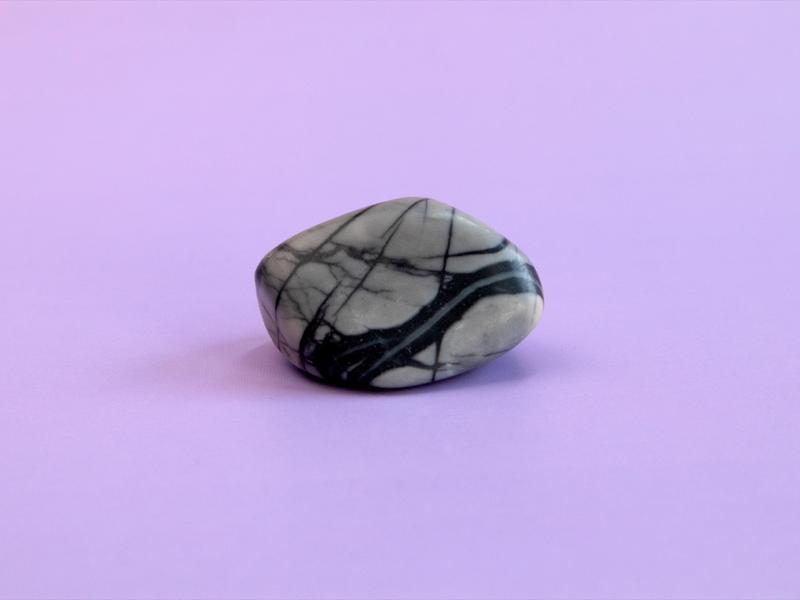
Picasso jasper carries dark fractured lines and muted earthy fields that resemble drawing, faulting, or unfinished topography more than ornament. The image comes interpretive from the start.
Some selves need rougher outlines before they become legible again.
What Your Body Knows
Picasso jasper is a Root and Third Eye chakra mineral whose abstract patterning creates a unique bridge between grounded stability and creative vision. In somatic practice, the stone's nature as metamorphosed limestone -- something ancient and structured that was transformed by pressure into something unpredictable and beautiful -- provides a direct metaphor for creative transformation under constraint.
sympathetic
You stare at the blank page, the empty canvas, the cursor blinking on the white screen, and nothing comes. Not because you have nothing to say, but because every potential beginning has already been rejected by the internal editor before it reaches your hands. The perfectionism has frozen the creative pipeline. Your dorsal vagal system has shut down the expressive channels to protect you from producing something that might be judged, criticized, or simply not good enough. Picasso jasper addresses the blank page directly. The stone is living proof that the most striking art emerges not from intention but from process; iron migrating through limestone under pressure, depositing patterns no intelligence designed. The stone teaches the nervous system that creation does not require permission. It requires conditions. Provide the conditions (show up, start, accept what emerges) and the patterns will appear.
dorsal vagal
You have the plan. The outline. The structure. Every step mapped, every outcome predetermined, every surprise eliminated. Your creative process is a controlled environment, and the control is the point; because if you let go of the structure, chaos might emerge, and chaos is the enemy. Your sympathetic system is running the creative process like a military operation, and the cost is that nothing alive, nothing surprising, nothing genuinely new can survive the planning phase. Picasso jasper interrupts the rigid blueprint. The stone's patterns exist because the metamorphic fluids did not follow a plan. They followed physics; flowing wherever the rock's fractures and porosity allowed. The result is more visually compelling than anything a designer could have drafted. This is the stone for creators who need to learn that structure and spontaneity are not enemies. The limestone provided structure. The fluids provided spontaneity. The art required both.
ventral vagal
You start things. You start them with enthusiasm, with vision, with that rush of possibility that feels like the whole project is already alive. Then you hit the middle; the messy, unglamorous phase where the thing you are making does not match the thing you imagined; and you abandon it. Start again. New project. New rush. New abandonment. The cycle repeats because your nervous system oscillates between the sympathetic high of beginning and the dorsal collapse of confronting imperfection. Picasso jasper is the stone for the middle. For the unglamorous phase. For the part of creation where the work does not look like what you intended and you have to keep going anyway. The oxide patterns in this stone were not deposited in one dramatic event. They accumulated through sustained fluid flow; gradual, persistent, messy, layered. The beauty came from duration, not from the first stroke.
ventral vagal
You are creating and you are not thinking about creating. The internal editor is quiet, not because you silenced it but because there is nothing for it to critique; the work is flowing through you faster than judgment can operate. Structure and spontaneity are the same thing. Discipline and freedom are the same thing. You are grounded (Root) and visionary (Third Eye) simultaneously, and the work that emerges has the quality of Picasso jasper itself: unmistakably structured, undeniably organic, impossible to have planned, impossible to have achieved without preparation. This is the ventral vagal creative state; the nervous system regulated enough to hold the paradox of control and release at the same time.
Nervous system mapping based on polyvagal theory (Porges, 2011).
Mineralogy
Chemical Formula
CaCO3 (metamorphic limestone)
Crystal System
Mixed
Mohs Hardness
6
Specific Gravity
2.58-2.91
Luster
Vitreous to waxy
Color
Tan, brown, black, gray with abstract linear patterns
Traditional Knowledge
The Biggs Junction and Utah Deposits
Picasso jasper, also called Picasso stone or Picasso marble, is a metamorphosed dolomitic limestone found primarily in Utah and formerly at the Biggs Junction locality in Oregon. The striking linear patterns of tan, brown, black, and cream result from iron and manganese oxide infiltration along fracture planes and bedding surfaces during diagenesis and low-grade metamorphism. Geologically it is a marble rather than a jasper, but the lapidary trade name persists. The Utah deposits near the towns of Beaver and Milford produce material with especially strong geometric banding that evokes abstract art, which led to the Picasso trade name when the material was first marketed to lapidaries and collectors in the mid-20th century.
American Lapidary Movement Gem
Picasso jasper gained popularity among American lapidary hobbyists during the mid-century rock and mineral collecting boom, when clubs affiliated with the American Federation of Mineralogical Societies promoted fieldwork and stone cutting across the western United States. The geometric patterns of the stone appealed to mid-century aesthetics that valued abstract and modernist design. Lapidaries cut cabochons, bookends, and decorative slabs that resembled the angular compositions of cubist paintings, and the Picasso name became standard in the trade by the 1970s. Rock shops along western highways and at gem shows in Quartzsite, Arizona and Tucson featured the material as an accessible and visually distinctive native American stone.
The Metamorphic Process Teaching Stone
Geology educators adopted Picasso jasper as a teaching specimen for illustrating secondary mineralization and low-grade metamorphic processes. The visible iron and manganese oxide banding demonstrates how fluid migration along fracture networks creates geometric patterns in sedimentary rock over geological time. University geology departments and natural history museums use polished slabs to show students how post-depositional chemical processes transform uniform limestone into dramatically patterned stone. The material serves as an accessible example of the difference between primary depositional features and secondary alteration, a fundamental concept in sedimentary petrology and metamorphic geology.
Picasso Jasper Creative Catalyst
Crystal practitioners adopted Picasso jasper as a creativity support stone, drawing on the visual connection to abstract art and the geological reality of transformation through pressure. Practitioners prescribed it specifically for creative blocks where the issue was not lack of ideas but fear of imperfection -- where the practitioner's client needed permission to create without controlling the outcome. The random-appearing yet structurally ordered patterns of the stone provided a visual argument that beauty emerges from geological processes that no individual force designed or directed. This made Picasso jasper a practitioner favorite for artists, writers, and designers navigating the gap between intention and execution.
When This Stone Finds You
Sacred Match prescribes Picasso Jasper when you report:
Creative block or perfectionism paralysis
Starting projects but never finishing
Overplanning that kills spontaneity
Fear of the messy middle of any process
Life transition that feels chaotic
Need to find beauty in disruption
Internal editor silencing creative voice
Picasso jasper finds you when you are ready to let the work be messy before it becomes beautiful. This stone does not arrive for people who want inspiration -- it arrives for people who have plenty of inspiration and cannot stop editing it to death before it reaches the world. The earth took ordinary limestone and ran hot, mineral-laden fluids through it under pressure, with no intention of making art. The result is one of the most visually striking stones in the mineral kingdom. That is the teaching. Stop planning the masterpiece. Start the process. The art is in the making, not in the planning of the making.
Somatic protocol
The Unplanned Line Protocol
3 min protocol
The Gaze (30 seconds)Hold the Picasso jasper at a comfortable distance -- about 12 inches from your face. Look at the patterns. Do not name them. Do not say "this looks like a face" or "this looks like a landscape." Just look. Let the lines and bands and color fields exist without interpretation. Breathe naturally. The stone is teaching your visual system to receive without categorizing -- to see before naming. This is the first skill of creation: observation without judgment. The patterns are not trying to be anything. They are the result of iron and manganese following physics. Let your eyes follow them the way the minerals followed the fractures.
30 secThe Ground Hold (30 seconds)Place the stone against your lower belly -- just below the navel, at the Root-Sacral border. Close your eyes. Breathe in for 4 counts, hold for 2, exhale for 6. Two cycles. The stone is metamorphosed limestone -- ancient ocean floor, transformed by heat and pressure into something it was never meant to be. Your body is holding a record of transformation. Feel the weight of that. Not the weight of the stone (it is light) but the weight of the concept: something ordinary became extraordinary through sustained pressure. That is the creative process. That is your life. Press the stone gently into your body and register: you are mid-metamorphosis.
30 secThe Third Eye Touch (40 seconds)Move the stone to the center of your forehead. Rest it there lightly. The Third Eye is the seat of creative vision -- not what you see with your eyes but what you see with your imagination. With the stone here, ask silently: "What is trying to come through me that I have been blocking?" Do not force an answer. The question opens the channel. If an image comes, notice it. If a word comes, hold it. If a feeling comes -- a color, a texture, a sensation -- that is the creative impulse before it has been processed into form. Picasso jasper does not give you ideas. It removes the filter that was between you and your ideas.
40 secThe Unplanned Line (40 seconds)Take the stone from your forehead and hold it in your non-dominant hand. With your dominant hand, make one gesture in the air -- a line, a curve, a scribble. Do not think about it. Let the hand move the way the metamorphic fluids moved through the limestone: following the path of least resistance, without plan, without destination. This is the somatic reset. You are training the body to move before the mind approves. One gesture. That is all. The internal editor does not get to vote on this one. The hand moved. The line exists. It was unplanned. And it was enough.
40 secPlacement (40 seconds)Place the Picasso jasper where you will see it during creative work -- beside a keyboard, on a drawing table, near a musical instrument, on a workbench. Take one breath. Open your eyes. The protocol is complete. The stone will sit in your peripheral vision as a constant reminder: the most beautiful patterns in the mineral kingdom were not designed. They were deposited. Show up. Start the process. Let the work deposit itself through you.
40 secCare and Maintenance
The #1 Question Can Picasso Jasper Go in Water? BRIEF RINSE ONLY Picasso jasper requires caution with water. Despite the "jasper" trade name, Picasso jasper is metamorphosed limestone with a calcium carbonate (CaCO 3 ) base.
Carbonate minerals are significantly less water-resistant than true silica jasper. While not immediately damaged by brief water contact, prolonged exposure can dissolve carbonate material and dull the polished surface over time. Running water rinse (30-60 seconds): safe for occasional cleansing Brief soaking (up to 5 minutes): generally safe but unnecessary Prolonged soaking: NOT recommended .
carbonate dissolution risk Salt water: avoid . salt plus carbonate is a damaging combination Acidic solutions (vinegar, citrus): absolutely NOT safe . acid dissolves carbonate rapidly Gem water / crystal elixir: use indirect method only (stone outside the water vessel) The carbonate component is both the stone's mineralogical identity and its vulnerability.
The same calcium carbonate that forms the base material of Picasso jasper also forms the shells of marine organisms, cave formations, and chalk . all of which dissolve in water over time. Honor the stone's nature by keeping water contact brief and infrequent.
Dry cleansing methods (selenite, moonlight, sound, sage smoke) are preferred.
Crystal companions
Carnelian
Carnelian ignites the Sacral chakra's creative fire. Paired with Picasso jasper's capacity to dissolve creative blocks, you get a powerhouse combination for artistic work. Carnelian provides the energy and motivation; Picasso jasper removes the perfectionism and internal editing that would otherwise consume that energy. Together: fuel and an open road.
Citrine
Citrine brings solar confidence and self-trust to Picasso jasper's creative liberation. Where Picasso jasper says "let the work be messy," citrine says "and trust that you are good enough to make it." This pairing addresses the twin enemies of creative flow: perfectionism (Picasso jasper handles it) and self-doubt (citrine handles it).
Amethyst
Amethyst elevates Picasso jasper's Third Eye resonance from creative vision to spiritual insight. This pairing is for creative work that is also spiritual work -- writing, visual art, music, or any medium where the creator is channeling something larger than personal expression. The combination opens the crown while the root stays grounded.
Smoky Quartz
Smoky quartz grounds and stabilizes Picasso jasper's transformative energy. During periods of major life change -- when everything feels abstract and uncertain -- this pairing keeps the feet on the ground while the creative mind processes the chaos. Smoky quartz says "you are safe" while Picasso jasper says "and the chaos is making you into something."
Blue Lace Agate
Blue lace agate soothes the nervous system with its gentle Throat chakra energy. Paired with Picasso jasper, it creates a pathway from creative vision (Third Eye) through gentle expression (Throat) to grounded manifestation (Root). This is the pairing for people who have creative insights but need gentleness around expressing them -- who need the words to come softly rather than explosively.
In Practice
You are stuck in a pattern and the pattern has become invisible to you. Picasso jasper is actually metamorphic limestone, not jasper. The abstract lines formed when iron and manganese migrated through the stone along fractures during metamorphism.
Mohs 6. Hold it during pattern-recognition work. The "art" in this stone was not designed.
It was caused by chemistry following paths of least resistance through rock. The pattern you cannot see in your own life may also be structural, following channels you did not create.
Verification
Pattern Characteristics Genuine Picasso jasper has patterns that follow the internal geology of the stone, fracture networks, bedding planes, zones of differential porosity. The lines should appear natural, organic, and three-dimensional (continuing into the stone, not just on the surface). If patterns appear painted on or only skin-deep, the stone may be artificially patterned.
Acid Test (Careful) A small drop of dilute hydrochloric acid or household vinegar on an inconspicuous spot will produce very slight effervescence (tiny bubbles) if the stone is carbonate-based Picasso jasper. True silica jasper will not react to acid at all. This is the definitive field test distinguishing Picasso jasper from true jasper.
Use sparingly, the acid will leave a mark on the surface. Hardness Comparison Picasso jasper typically tests at Mohs 6-7, depending on silicification level. It should scratch glass (5.
5) but may be softer than true quartz jasper (7).
Natural Picasso Jasper should usually feel cooler than plastic or resin on first touch and warm more slowly in the hand.
Use 6 on the Mohs scale as the check, not internet myths. A real specimen should behave in line with the hardness listed above.
Look for a vitreous to waxy surface quality rather than a painted or plastic shine.
The listed specific gravity is 2.58-2.91. If a specimen feels unusually light for its size, it may deserve a second look.
Geographic Origins
Picasso jasper is not jasper at all. It is metamorphosed limestone . a calcium carbonate rock (CaCO 3 ) that has been altered by heat and pressure, with the "jasper" label being a trade name from the lapidary and metaphysical markets.
The base material is fine-grained limestone or dolostone (CaMg(CO 3 ) 2 ) that was originally deposited as marine sediment, composed of the calcium carbonate shells and skeletal remains of ancient marine organisms accumulated on the seafloor. The abstract patterns that give Picasso jasper its name and its visual drama are created by iron and manganese oxide inclusions . primarily hematite (Fe 2 O 3 ), goethite (FeO(OH)), and manganese oxides (MnO 2 ) .
that migrated through the limestone during metamorphism. As the rock was subjected to elevated temperatures and pressures (regional or contact metamorphism), mineral-bearing fluids percolated through fractures, bedding planes, and pore spaces, depositing dark oxide minerals along their paths. The result is a network of black, brown, and rust-colored lines and bands against a tan, cream, or gray carbonate matrix.
The "abstract art" effect occurs because the oxide deposition followed the geometry of the rock's internal structure . fracture networks, grain boundaries, bedding surfaces, and zones of differential porosity. The patterns are neither random nor designed.
They are the physical record of fluid flow through a complex three-dimensional rock body. Every line marks a pathway. Every dark band marks a location where iron or manganese precipitated out of solution as chemical conditions changed.
The result looks planned because physics has an aesthetic logic that mirrors human creative intuition. The primary source is Utah, USA, where Paleozoic limestone formations have been subjected to metamorphic alteration related to regional tectonic activity and igneous intrusions. The Utah material sets the standard for the variety: warm earth tones (tan, brown, cream, rust, black) with strong linear and curvilinear patterning.
The hardness varies from Mohs 6 to 7 depending on the degree of silicification (some specimens have received secondary silica that partially replaced carbonate, increasing hardness), but the carbonate component remains significant in most material.
FAQ
Picasso jasper is actually metamorphosed limestone (marble), not a true jasper. Its abstract patterns of black, brown, tan, and cream are created by iron and manganese oxide inclusions deposited during metamorphism. Found primarily in Utah, USA, the stone is named for its resemblance to abstract art. Despite the misnomer, it is a legitimate and widely used stone in crystal practice, associated with creativity, transformation, and the Root and Third Eye chakras.
Brief rinse only. Despite being marketed as jasper, Picasso jasper is metamorphosed limestone with a carbonate (CaCO3) component. Prolonged water exposure can dissolve carbonate minerals over time. Brief rinses under running water are safe, but extended soaking, salt water, and acidic solutions should be avoided. The stone is less water-resistant than true jaspers.
No. Picasso jasper is not true jasper (microcrystalline quartz/SiO2). It is metamorphosed limestone or dolostone -- a calcium carbonate rock that has been altered by heat and pressure, with iron and manganese oxides creating its distinctive patterns during the metamorphic process. The name 'jasper' is a trade name based on its appearance and use in the lapidary market, not its mineralogy.
The primary source is Utah, USA, where metamorphosed limestone beds produce the distinctive patterned material. Secondary sources include parts of the American Southwest and occasional occurrences in other regions with similar metamorphic limestone geology. The Utah material sets the standard for quality and pattern intensity.
Picasso jasper bridges the Root chakra (grounding, stability, structure) and the Third Eye chakra (perception, creativity, inner vision). This unusual combination -- earth and vision together -- makes it a creativity stone that grounds imaginative work in physical reality. It helps the creative process stay connected to something real rather than floating in abstraction.
References
Deer, W.A., Howie, R.A., & Zussman, J. (1992). An Introduction to the Rock-Forming Minerals. 2nd ed. Longman. [SCI]
DOI: 10.1180/DHZ
Nassau, K. (2001). The Physics and Chemistry of Color: The Fifteen Causes of Color. 2nd ed. Wiley-Interscience. [SCI]
DOI: 10.1002/0471220620
Cornell, R.M. & Schwertmann, U. (2003). The Iron Oxides: Structure, Properties, Reactions, Occurrences and Uses. 2nd ed. Wiley-VCH. [SCI]
DOI: 10.1002/3527602097
Tucker, M.E. & Wright, V.P. (1990). Carbonate Sedimentology. Blackwell Science. [SCI]
Maniaci, G. et al. (2024). Neurobiological and anti-inflammatory effects of a deep diaphragmatic breathing technique. Stress and Health. [SCI]
DOI: 10.1002/smi.3503
Post, J.E. (1999). Manganese oxide minerals: Crystal structures and economic and environmental significance. Proceedings of the National Academy of Sciences. [SCI]
Closing Notes
The iron and manganese atoms inside your Picasso jasper followed no blueprint. They migrated through ancient limestone along fractures and grain boundaries under heat and pressure, depositing themselves wherever the physics allowed. No committee approved the design. No editor reviewed the lines. The result is one of the most visually striking patterns in the mineral kingdom . proof that the most compelling art emerges from process, not from plan. Crystalis documents both the geology and the practice because the mineral never separated them . and neither should we.
Crystalis×The Index "The earth never planned the painting. It just let the pressure and the minerals do their work. So should you."
© 2026 Crystalis. All rights reserved.
The Index: A Crystalpedia of Crystal Healing & Mineral Science
Bring it into practice
Move from reference to ritual. Search current inventory for Picasso Jasper, build a custom bracelet, or let Sacred Match choose the right supporting stones for you.
Community notes
Shared field notes tied to Picasso Jasper appear here, including notes saved from practice.
When members save a public field note for this stone, it will appear here.
The archive
Continue through stones that share intention, chakra focus, or tonal family with Picasso Jasper.

Shared intention: Transformation & Change
The Hidden Fire

Shared intention: Transformation & Change
The Fire of the Horn
Shared intention: Creativity
The Welo Flame

Shared intention: Breaking Stagnation
The Catalyst of Change

Shared intention: Transformation & Change
The Indigo Transformer
Shared intention: Creativity
The Color-Changing Enigma