Crystal Encyclopedia
40+YEARS

Tiffany Stone

Bertrandite + Opal + Fluorite · Mohs 4 · Mixed · Third Eye Chakra

The stone of tiffany stone: meaning, mineralogy, and somatic practice.

Stress ReliefIntuition & Inner VisionEmotional ReleaseTransformation & Change

This page documents traditional and cultural uses of tiffany stone alongside emerging research on tactile grounding objects. Crystalis does not claim that tiffany stone treats, cures, or prevents any medical condition. For mental health concerns, consult a qualified professional.

Crystalis Editorial · 40+ Years · Herndon, VA · 3 peer-reviewed sources

Origins: USA (Utah)

Crystalis

Materia Medica

Tiffany Stone

The Violet Flame Stone

Tiffany Stone crystal
Stress ReliefIntuition & Inner VisionEmotional Release
Crystalis

Protocol

The Rare Violet Frequency

The Rare Frequency Protocol

3 min

  1. 1

    Third Eye Placement (30 seconds)Lie down or sit with your head supported. Place the tiffany stone directly on the space between your eyebrows -- the third eye point. Close your eyes. The stone is cool at first. Let the temperature difference register. Feel the weight -- tiffany stone is lighter than you expect for its size, because opal is less dense than pure fluorite. As the stone warms against your skin, notice what happens behind your closed eyes. Do not look for visions. Simply notice. Colors may appear -- purple, lavender, white. Shapes may emerge. Or nothing may happen except a deepening stillness. All of these are correct. The frequency is tuning. Give it thirty seconds to calibrate.

  2. 2

    The Unmuting Breath (40 seconds)With the stone still on your third eye, inhale slowly through the nose for 5 counts. As you inhale, imagine the breath traveling upward through the body and arriving at the point where the stone sits. Hold for 3 counts. Exhale through a slightly open mouth for 6 counts -- and as you exhale, make a very quiet humming sound. Not a chant. Not a mantra. Just a hum at whatever pitch feels natural. The vibration of the hum against the tiffany stone creates a subtle resonance. Three full cycles. Each hum is turning up a volume dial that someone else turned down. You are not forcing the channel open. You are unmuting it.

  3. 3

    The Purple Scan (40 seconds)Remove the stone from your forehead and hold it 6-8 inches above your face. Open your eyes slowly. Look at the stone against the ceiling or sky. Notice the swirl patterns -- the purple flowing into white, the lavender zones, the occasional flash of cream or pink. Let your eyes trace the boundaries where one color becomes another. These boundaries are not sharp. They are diffuse, gradual, interpenetrating. This is what it looks like when structure (fluorite) and fluidity (opal) coexist. Let the visual pattern teach your nervous system that clarity and softness are not opposites. They are geological neighbors.

  4. 4

    Heart-to-Crown Bridge (30 seconds)Sit up. Hold the tiffany stone against the center of your chest -- heart chakra. Breathe naturally. Feel the stone's temperature against your sternum. Now slowly raise the stone from your heart, past your throat, past your third eye, to the top of your head -- crown. Hold it there for a breath. Then bring it back down to the heart. One slow ascent and descent. This is the circuit tiffany stone completes: it bridges the feeling heart (where passion lives) through the seeing eye (where vision lives) to the receiving crown (where downloads arrive). The bridge works in both directions. Visions need heart to have meaning. Heart needs vision to have direction.

Continue in the full protocol below.

tap to flip for protocol

You are carrying too many colors to call the condition confusion anymore.

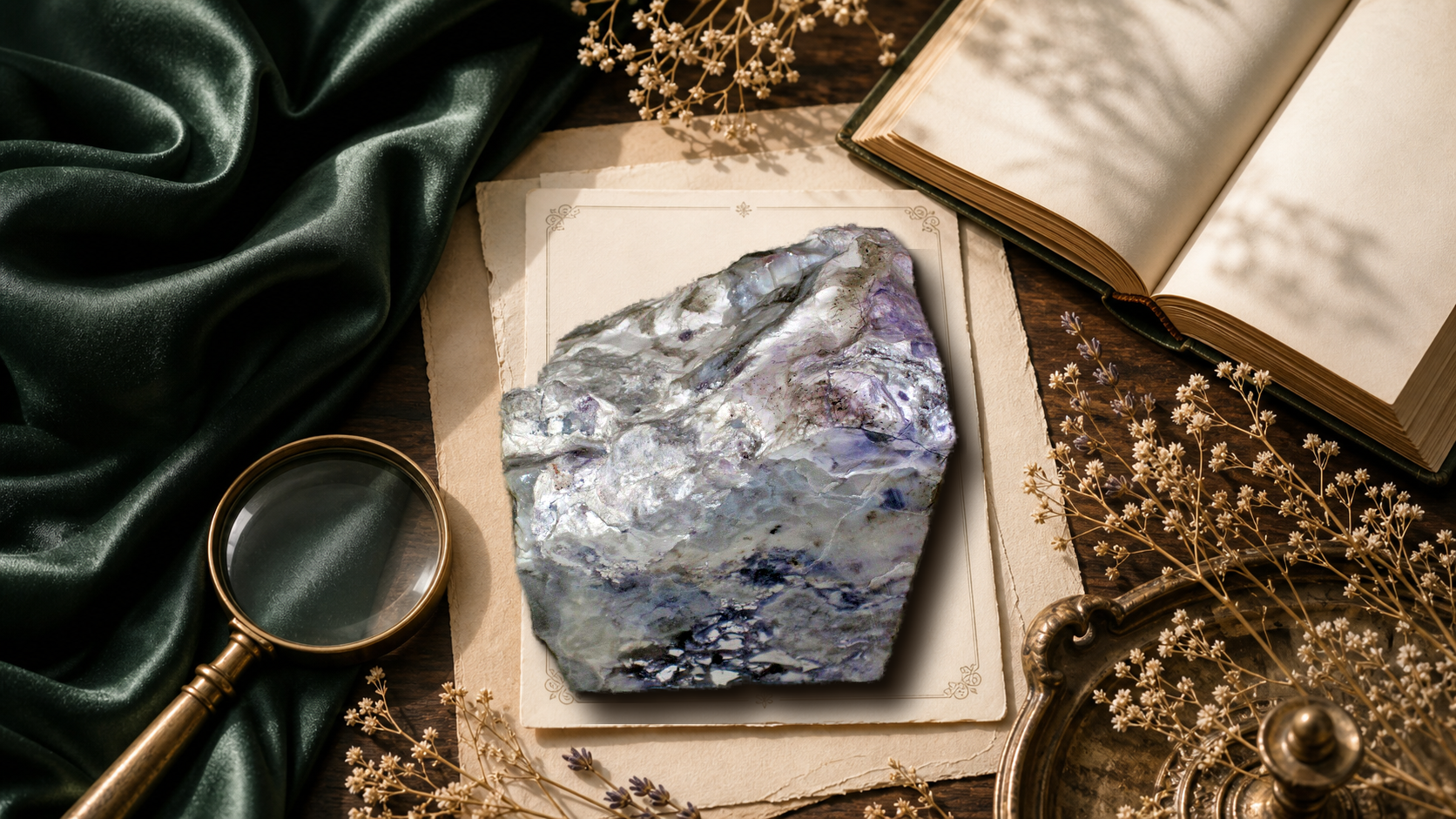
Tiffany stone, often a fluorite-opal-bertrandite rich brecciated material, swirls cream, purple, lavender, and darker host matter through one body. The composition is mixed enough to make certainty beside the point.

Variegation is sometimes the honest report.

What Your Body Knows

Nervous system states

Tiffany stone is a Third Eye and Crown Chakra gem whose composite mineralogy creates a uniquely layered energetic signature. The fluorite component brings mental clarity and structured thought; the opal component brings emotional fluidity and intuitive receptivity; the bertrandite adds a rare earth-connection that grounds visionary experience in physical reality. In somatic practice, tiffany stone addresses the specific pattern where intuition has been suppressed by rational override -- where the body knows something the mind refuses to hear.

sympathetic

The Muted Frequency

You used to see things clearly. Not visions exactly; more like a knowing that arrived before the evidence. You would feel a situation before you understood it, sense the shape of a decision before the data confirmed it. And then someone; a parent, a partner, an institution; told you that knowing without evidence is not knowing at all. So you shut it down. The dorsal vagal system complied: it dampened the frequency, muted the channel, turned the volume on your intuition so low that you stopped trusting what you felt. Tiffany stone is opalized fluorite; a mineral that was one thing and became another without losing its original architecture. The fluorite is still in there, still structured, still purple. But it is wrapped in opal now; softer, more fluid, more receptive. The stone teaches the nervous system that intuitive shutdown is not the same as intuitive death. The channel is muted, not destroyed. The frequency is still there. It opalized.

dorsal vagal

The Passionate Overwhelm

Everything is too much. The ideas come too fast. The feelings are too intense. The visions are too vivid to act on because acting would require choosing one and letting the others die. Your sympathetic system is flooded; not with danger but with possibility. The third eye is wide open and the crown is receiving, but there is no filter, no structure, no way to channel the torrent into something usable. You are drowning in your own depth. Tiffany stone contains fluorite; a notably structuring mineral in existence, cubic crystal system, orderly lattice, Mohs 4 on the hardness scale. But this fluorite has been softened by opal, made fluid, made receptive. The stone offers what your nervous system needs: structure that does not rigidify. A lattice that breathes. A way to hold intensity without being shattered by it. The purple is still passionate. The opal is still fluid. But together they create a container.

ventral vagal

The Rational Prison

You have built an excellent rational framework. Every decision is evidence-based. Every feeling is interrogated before it is allowed to influence action. The problem is that the framework has become a cage. You oscillate between controlled analysis (dorsal) and anxious second-guessing (sympathetic) because the rational mind knows it cannot account for everything; and the things it cannot account for keep showing up as anxiety. The body is trying to speak through a channel the mind has labeled unreliable. Tiffany stone is the geological record of structure becoming fluid. The fluorite was perfectly cubic, perfectly ordered. Then silica-rich water transformed portions of it into opal; amorphous, flowing, iridescent. The stone did not lose its structure. It gained fluidity. It became both. Your rational framework does not need to be demolished. It needs to be opalized; penetrated by something softer that allows intuition to flow through the lattice without collapsing it.

ventral vagal

The Open Channel

You can feel and think at the same time. Intuition arrives and the rational mind receives it as data rather than threat. Passion flows and the body channels it into expression rather than explosion. The third eye is open and the crown is receiving, but you are grounded; the visions come with instructions, the feelings come with context, the creative impulse comes with a path to manifestation. Tiffany stone in this state is not medicine. It is a tuning fork. The stone's composite nature; fluorite for structure, opal for flow, bertrandite for earth-connection; mirrors what your nervous system has already achieved: the integration of knowing and feeling, of vision and ground, of passion and precision. You do not need the stone to open the channel. The channel is open. The stone reminds you how rare that integration is; as rare as the stone itself.

Nervous system mapping based on polyvagal theory (Porges, 2011).

The Earth Made This

Formation: How Tiffany Stone Becomes Tiffany Stone

A composite so complex that geologists argue about what to call it. Tiffany stone is a purple, lavender, and white opalized fluorite breccia from the Brush Wellman beryllium mine in Spor Mountain, Utah, the only known source. It contains fluorite, opal, chalcedony, dolomite, bertrandite, and quartz in a matrix so mineralogically diverse that different labs may emphasize different phases depending on which section they analyzed.

The purple comes from fluorite. The waxy zones are opal. The white areas are often dolomite or chalcedony.

It formed in volcanic tuff that was mineralized by beryllium and fluorine-bearing hydrothermal fluids. Since it comes exclusively from a beryllium mine with restricted access, supply depends entirely on byproduct recovery from industrial mining operations. When the mine closes or shifts focus, new material will not exist.

Material facts

What the stone is made of

Mineralogy: Composite mineral assemblage, not a single mineral. Primary components: fluorite (CaF₂) partially replaced by opal (SiO₂·nH₂O), with bertrandite (Be₄Si₂O₇(OH)₂), chalcedony, quartz, calcite, dolomite, and manganese oxides. Crystal system: mixed. Mohs hardness: ~4 (variable by zone). Specific gravity: 2.30-2.50. Color: purple (fluorite + Mn), white and cream (opal/chalcedony), with occasional pink tones (higher Mn concentration). Luster: vitreous to waxy. Habit: massive. Exclusively from the Brush Wellman beryllium mine, Thomas Range, Juab County, Utah. Not a distinct mineral species; a trade name for this specific opal-fluorite-bertrandite assemblage.

Deeper geology

The formation begins in the Topaz Mountain rhyolite of the Thomas Range, Juab County, Utah -- a Miocene-age volcanic field approximately 6-7 million years old. During volcanic eruptions, fluorine-rich magmatic fluids interacted with beryllium-bearing host rocks. Fluorite crystallized in cavities, veins, and replacement zones within the rhyolite. Over millions of years, silica-rich groundwater percolated through these deposits, gradually replacing portions of the fluorite with opal and chalcedony in a process called pseudomorphism. The result is a stone where fluorite and opal coexist in swirling, interpenetrating patterns -- purple bleeding into white, white cradling purple, with occasional zones of lavender, cream, and near-black manganese oxide.

The Brush Wellman mine (now operated by Materion Corporation) is the world's only significant source of bertrandite ore, and tiffany stone is an incidental byproduct of beryllium extraction. The mine has been in operation since the 1960s, and for most of its history, tiffany stone was treated as waste rock -- crushed and discarded during processing. Collectors and lapidaries who recognized the material's beauty began rescuing specimens from waste piles and processing areas, often with informal permission from mine workers. The supply has always been limited, irregular, and dependent on the mine's beryllium operations rather than any gemstone market demand.

The name "tiffany stone" is a trade name with no formal mineralogical standing. It has also been marketed as "bertrandite," "opalized fluorite," "ice cream stone," and "purple passion." The name "tiffany stone" became dominant in the 1990s through the gem and mineral show circuit. No other geological locality on Earth produces material with this specific combination of opalized fluorite, bertrandite, and manganese coloration -- making tiffany stone one of the rarest collector materials in existence.

Mineralogy

Mineral specs

Chemical Formula

Bertrandite + Opal + Fluorite

Crystal System

Mixed

Mohs Hardness

4

Specific Gravity

2.30-2.50

Luster

Vitreous to waxy

Color

Purple-White

Traditional Knowledge

Traditions across cultures

Utah Geological Discovery

1960s-1970s

The Brush Wellman Beryllium Mine

Tiffany stone was discovered as a byproduct of beryllium mining at the Brush Wellman (now Materion Corporation) spor mountain mine in Juab County, western Utah, during the 1960s and 1970s. The mine extracts bertrandite ore for beryllium production -- a strategic metal used in aerospace and defense applications. The purple, white, and cream fluorite-opal material occurred in the volcanic tuff host rock surrounding the beryllium ore body. Because the mine operated as a restricted industrial site, access to tiffany stone was limited to material removed during overburden stripping, making it scarce from the outset.

Mineralogical Analysis

Late 20th century

The Fluorite-Opal Composite Identification

Mineralogical analysis established that tiffany stone is not a single mineral but a composite rock composed primarily of fluorite, opal, chalcedony, dolomite, and occasionally bertrandite and beryllium-bearing phases. The purple coloration derives from the fluorite component, while the creamy white and translucent areas are opaline silica. This composite nature means no two pieces of tiffany stone are identical in composition or appearance. The material's classification as a rock rather than a mineral places it alongside lapis lazuli and unakite as a lapidary material defined by its visual character rather than a single crystal chemistry.

Utah Lapidary Tradition

1980s-present

The Restricted-Access Collector Stone

Because the Brush Wellman mine is a restricted industrial operation and not a gem mine, tiffany stone has never been commercially mined for the lapidary market. All available material comes from overburden and waste rock that was periodically made available through informal channels or collected before access restrictions tightened. This limited supply chain created a collector culture around the stone, with Utah lapidaries and Western gem show dealers developing expertise in cutting the material to reveal its purple-and-cream patterns. The stone's scarcity is geological and industrial rather than market-driven -- it literally cannot be obtained without beryllium mining operations.

Contemporary Crystal Practice

2000s-present

The Third Eye Integration Stone

Crystal practitioners adopted tiffany stone as a third eye and crown chakra stone beginning in the 2000s, drawn to its purple fluorite component and its reputation for scarcity. Practitioners prescribed it for intuitive development work, connecting its composite mineral nature to the integration of multiple perceptual channels. The stone's restricted origin became part of its practice identity -- a reminder that certain insights arise only under specific conditions and cannot be mass-produced or replicated on demand. Its visual softness, with gradual transitions between purple and cream, informed a practice quality of gentle perceptual opening rather than dramatic activation.

When This Stone Finds You

Sacred Match prescribes Tiffany Stone when you report:

Suppressed intuition after being told you are "too much"

Creative passion with no outlet or permission

Third eye shutdown from rational override

Disconnection between sexual energy and spiritual life

Vivid inner life that feels impossible to express

Cycling between intellectual control and emotional flooding

Feeling like the rarest version of yourself has been discarded

Tiffany stone finds you when something essential has been classified as waste. When the part of you that sees clearly, feels deeply, or desires fiercely has been treated as byproduct -- crushed in the processing of becoming acceptable. This stone comes from a mine where it was literally thrown away. Workers had to rescue it from the crusher. The material that was treated as worthless turned out to be one of the rarest gemstones on earth. Tiffany stone is prescribed when you need to learn that what was discarded about you -- your vision, your intensity, your unfiltered knowing -- is not waste. It is the gem the mine did not know it was producing.

Somatic protocol

The Rare Violet Frequency

The Rare Frequency Protocol

3 min protocol

  1. 1

    Third Eye Placement (30 seconds)Lie down or sit with your head supported. Place the tiffany stone directly on the space between your eyebrows -- the third eye point. Close your eyes. The stone is cool at first. Let the temperature difference register. Feel the weight -- tiffany stone is lighter than you expect for its size, because opal is less dense than pure fluorite. As the stone warms against your skin, notice what happens behind your closed eyes. Do not look for visions. Simply notice. Colors may appear -- purple, lavender, white. Shapes may emerge. Or nothing may happen except a deepening stillness. All of these are correct. The frequency is tuning. Give it thirty seconds to calibrate.

    30 sec
  2. 2

    The Unmuting Breath (40 seconds)With the stone still on your third eye, inhale slowly through the nose for 5 counts. As you inhale, imagine the breath traveling upward through the body and arriving at the point where the stone sits. Hold for 3 counts. Exhale through a slightly open mouth for 6 counts -- and as you exhale, make a very quiet humming sound. Not a chant. Not a mantra. Just a hum at whatever pitch feels natural. The vibration of the hum against the tiffany stone creates a subtle resonance. Three full cycles. Each hum is turning up a volume dial that someone else turned down. You are not forcing the channel open. You are unmuting it.

    40 sec
  3. 3

    The Purple Scan (40 seconds)Remove the stone from your forehead and hold it 6-8 inches above your face. Open your eyes slowly. Look at the stone against the ceiling or sky. Notice the swirl patterns -- the purple flowing into white, the lavender zones, the occasional flash of cream or pink. Let your eyes trace the boundaries where one color becomes another. These boundaries are not sharp. They are diffuse, gradual, interpenetrating. This is what it looks like when structure (fluorite) and fluidity (opal) coexist. Let the visual pattern teach your nervous system that clarity and softness are not opposites. They are geological neighbors.

    40 sec
  4. 4

    Heart-to-Crown Bridge (30 seconds)Sit up. Hold the tiffany stone against the center of your chest -- heart chakra. Breathe naturally. Feel the stone's temperature against your sternum. Now slowly raise the stone from your heart, past your throat, past your third eye, to the top of your head -- crown. Hold it there for a breath. Then bring it back down to the heart. One slow ascent and descent. This is the circuit tiffany stone completes: it bridges the feeling heart (where passion lives) through the seeing eye (where vision lives) to the receiving crown (where downloads arrive). The bridge works in both directions. Visions need heart to have meaning. Heart needs vision to have direction.

    30 sec
  5. 5

    Pocket Carry or Pillow Placement (20 seconds)Place the tiffany stone either in your left pocket (receiving side) for daytime carry or under your pillow for overnight work. Tiffany stone is a particularly potent dream stone in the mineral kingdom -- its opal component activates the subconscious imagery systems, while its fluorite component provides structure that prevents dreams from dissolving on waking. If carrying during the day, reach for the stone whenever you feel the old muting pattern activate -- whenever you start to say "never mind" instead of speaking what you know. The stone in your pocket is a physical anchor for the unmuted frequency.

    20 sec

The #1 Question

Can tiffany stone go in water?

No. Tiffany stone should not be placed in water. Its composite mineral structure includes fluorite (Mohs 4) and opal, both of which are vulnerable to water damage. Fluorite can crack with temperature changes, and the opal component can craze or lose its play of color when exposed to water. Use dry cleansing methods only.

The distinction most sites miss

Is Tiffany stone the same as bertrandite?

No. Tiffany stone is a rock (composed of multiple minerals), while bertrandite is a single mineral species (Be₄Si₂O₇(OH)₂). Tiffany stone CONTAINS bertrandite as one of its constituent minerals, along with fluorite, opal, calcite, dolomite, and occasionally chalcedony. The purple color comes primarily from the fluorite component. The bertrandite content is what makes the host rock valuable for beryllium extraction. Calling Tiffany stone 'bertrandite' is technically incorrect — it is a multi-mineral rock, not a pure mineral specimen.

Care and Maintenance

How to care for Tiffany Stone

The #1 Question Can Tiffany Stone Go in Water? NO . NOT WATER SAFE Tiffany stone must be kept away from water.

Tiffany stone is a composite material containing fluorite (Mohs 4), opal, and chalcedony in an intergrown matrix. The fluorite component is particularly vulnerable: it cleaves easily along crystal planes, and water infiltration can exploit microscopic fractures, leading to cracking or separation of mineral phases. The opal component (SiO 2 ·nH 2 O) contains structural water and can craze (develop fine surface cracks) when exposed to environmental water that disrupts its internal moisture balance.

Running water rinse: avoid . can infiltrate microfractures between mineral phases Soaking: absolutely not . prolonged contact will exploit cleavage planes in the fluorite component Salt water: extremely damaging .

salt crystallization in pore spaces causes mechanical breakdown Warm water: especially dangerous . thermal stress on a multi-mineral composite causes differential expansion and cracking Gem water preparation: never . use only indirect methods with the stone completely separated from water The composite nature of tiffany stone makes it more vulnerable than any single mineral component alone.

Different minerals expand and contract at different rates when exposed to temperature changes or moisture . this differential stress is the primary damage mechanism. address all tiffany stone as water-fragile regardless of how dense or solid the specimen appears.

Crystal companions

What pairs well with Tiffany Stone

Amethyst

Amethyst amplifies tiffany stone's third eye activation while adding its own calming, protective frequency. Where tiffany stone opens the channel, amethyst prevents the opening from becoming overwhelming. This pairing is the primary prescription for psychic development work -- amethyst provides the guardrails that allow tiffany stone's visionary intensity to flow safely. Together they create a protected corridor between intuition and consciousness.

Black Tourmaline

Essential grounding complement for tiffany stone's upper-chakra intensity. Black tourmaline anchors the root while tiffany stone opens the crown, creating a full-body circuit that prevents the "floating" sensation that can accompany extended third eye work. This pairing is non-negotiable for anyone who tends to dissociate or lose grounding during intuitive practice. The tourmaline says: stay in your body while you expand beyond it.

Rhodochrosite

Rhodochrosite opens the heart chakra with raw emotional intensity. Paired with tiffany stone's third eye activation, this combination bridges vision and feeling -- ensuring that psychic or intuitive information arrives with emotional context rather than detached knowing. This pairing is for people whose intuition works but feels cold, clinical, disconnected from compassion. Rhodochrosite warms the channel.

Moonstone

Moonstone adds lunar receptivity and cyclical awareness to tiffany stone's visionary opening. Together they enhance dream work, lucid dreaming, and the ability to receive intuitive information during sleep. Place tiffany stone on the third eye and moonstone on the sacral center before sleep for the most potent dream combination in the mineral kingdom. Moonstone ensures the visions arrive with emotional depth rather than abstract imagery.

Lapis Lazuli

Lapis lazuli activates the throat chakra -- the bridge between the third eye (vision) and the heart (feeling). Paired with tiffany stone, lapis provides the missing piece for people who see clearly but cannot articulate what they see. This combination is specifically prescribed for writers, speakers, counselors, and anyone whose work requires translating intuitive knowing into language. Tiffany stone receives. Lapis transmits.

In Practice

How Tiffany Stone is used

Tiffany stone is a Third Eye and Crown Chakra gem whose composite mineralogy creates a uniquely layered energetic signature. The fluorite component brings mental clarity and structured thought; the opal component brings emotional fluidity and intuitive receptivity; the bertrandite adds a rare earth-connection that grounds visionary experience in physical reality. In somatic practice, tiffany stone addresses the specific pattern where intuition has been suppressed by rational override. where the body knows something the mind refuses to hear.

The Muted Frequency (nervous system pattern: DORSAL VAGAL. shutdown of intuitive and creative channels after repeated dismissal) You used to see things clearly. Not visions exactly. more like a knowing that arrived before the evidence. You would feel a situation before you understood it, sense the shape of a decision before the data confirmed it. And then someone. a parent, a partner, an institution. told you that knowing without evidence is not knowing at all. So you shut it down. The dorsal vagal system complied: it dampened the frequency, muted the channel, turned the volume on your intuition so low that you stopped trusting what you felt. Tiffany stone is opalized fluorite. a mineral that was one thing and became another without losing its original architecture. The fluorite is still in there, still structured, still purple. But it is wrapped in opal now. softer, more fluid, more receptive. The stone teaches the nervous system that intuitive shutdown is not the same as intuitive death. The channel is muted, not destroyed. The frequency is still there. It opalized.

The Passionate Overwhelm (nervous system pattern: SYMPATHETIC. hyperactivation from unfiltered creative and emotional intensity) Everything is too much. The ideas come too fast. The feelings are too intense. The visions are too vivid to act on because acting would require choosing one and letting the others die. Your sympathetic system is flooded. not with danger but with possibility. The third eye is wide open and the crown is receiving, but there is no filter, no structure, no way to channel the torrent into something usable. You are drowning in your own depth. Tiffany stone contains fluorite. one of the most structuring minerals in existence, cubic crystal system, orderly lattice, Mohs 4 on the hardness scale. But this fluorite has been softened by opal, made fluid, made receptive.

Verification

Authenticity

Swirl Pattern Complexity Genuine tiffany stone displays complex, non-repeating swirl patterns where purple, lavender, white, and cream phases interpenetrate organically. No two specimens are alike. Dyed or synthetic imitations tend to show more uniform or repetitive color distribution.

Look for the chaotic, geological randomness of real mineral intergrowth, the patterns should look like they happened slowly, over millions of years, because they did. Multiple Mineral Phases Under close examination (10x loupe), genuine tiffany stone reveals distinct mineral phases, glassy opal zones, crystalline fluorite areas, and sometimes visible chalcedony banding. The transitions between phases are gradual and interpenetrating, not sharp.

Imitations made from dyed agate or polymer-impregnated materials show more uniform texture throughout. The multi-phase nature is tiffany stone's fingerprint. Hardness Variation Because tiffany stone contains minerals ranging from Mohs 4 (fluorite) to Mohs 6.

5 (chalcedony), a single specimen shows variable hardness across its surface.

Temperature

Natural Tiffany Stone should usually feel cooler than plastic or resin on first touch and warm more slowly in the hand.

Scratch logic

Use 4 on the Mohs scale as the check, not internet myths. A real specimen should behave in line with the hardness listed above.

Surface and luster

Look for a vitreous to waxy surface quality rather than a painted or plastic shine.

Weight and density

The listed specific gravity is 2.30-2.50. If a specimen feels unusually light for its size, it may deserve a second look.

Geographic Origins

Where Tiffany Stone forms in the world

The formation begins in the Topaz Mountain rhyolite of the Thomas Range, Juab County, Utah . a Miocene-age volcanic field approximately 6-7 million years old. During volcanic eruptions, fluorine-rich magmatic fluids interacted with beryllium-bearing host rocks.

Fluorite crystallized in cavities, veins, and replacement zones within the rhyolite. Over millions of years, silica-rich groundwater percolated through these deposits, gradually replacing portions of the fluorite with opal and chalcedony in a process called pseudomorphism . The result is a stone where fluorite and opal coexist in swirling, interpenetrating patterns .

purple bleeding into white, white cradling purple, with occasional zones of lavender, cream, and near-black manganese oxide. The name "tiffany stone" is a trade name with no formal mineralogical standing. It has also been marketed as "bertrandite," "opalized fluorite," "ice cream stone," and "purple passion."

The name "tiffany stone" became dominant in the 1990s through the gem and mineral show circuit. No other geological locality on Earth produces material with this specific combination of opalized fluorite, bertrandite, and manganese coloration . making tiffany stone one of the rarest collector materials in existence.

FAQ

Frequently asked

What is tiffany stone?

Tiffany stone is a rare purple, white, and cream opalized fluorite found exclusively at the Brush Wellman beryllium mine in Juab County, Utah. It is a complex mixture of opalized fluorite, bertrandite, chalcedony, quartz, and other minerals, formed through volcanic and hydrothermal processes. Tiffany stone is prized for its swirling purple-to-white color patterns and its association with psychic development and passion.

Can tiffany stone go in water?

No. Tiffany stone should not be placed in water. Its composite mineral structure includes fluorite (Mohs 4) and opal, both of which are vulnerable to water damage. Fluorite can crack with temperature changes, and the opal component can craze or lose its play of color when exposed to water. Use dry cleansing methods only.

Why is tiffany stone so rare?

Tiffany stone comes from exactly one location on Earth: the Brush Wellman (now Materion) beryllium mine in Juab County, Utah. The mine's primary purpose is beryllium extraction, not gemstone production. Most tiffany stone was historically crushed as waste rock during beryllium processing. Only material rescued by workers or collectors before crushing entered the gem market, making supply extremely limited and finite.

Where does Tiffany stone come from?

Tiffany stone comes from a single known locality: the Brush Wellman beryllium mine (now Materion Corporation) in the Spor Mountain area of Juab County, Utah, United States. The mine primarily extracts bertrandite ore for beryllium production. Tiffany stone is a byproduct of this mining operation — a purple and white fluorite-bearing rock composed of fluorite, opal, calcite, dolomite, and bertrandite. The mine controls all access, and Tiffany stone is only available when the company releases material. This single-source restriction makes it genuinely rare in the mineral market.

Is Tiffany stone the same as bertrandite?

No. Tiffany stone is a rock (composed of multiple minerals), while bertrandite is a single mineral species (Be₄Si₂O₇(OH)₂). Tiffany stone CONTAINS bertrandite as one of its constituent minerals, along with fluorite, opal, calcite, dolomite, and occasionally chalcedony. The purple color comes primarily from the fluorite component. The bertrandite content is what makes the host rock valuable for beryllium extraction. Calling Tiffany stone 'bertrandite' is technically incorrect — it is a multi-mineral rock, not a pure mineral specimen.

References

Sources and citations

  1. Christiansen, E.H., Sheridan, M.F., & Burt, D.M. (1986). The geology and geochemistry of Cenozoic topaz rhyolites from the western United States. Geological Society of America Special Paper. [SCI]

    DOI: 10.1130/SPE205-p1

  2. Nassau, K. (1983). The Physics and Chemistry of Color: The Fifteen Causes of Color. Wiley-Interscience. [SCI]

    DOI: 10.1002/col.5080090223

  3. Shigley, J.E. & McClure, S.F. (2009). Laboratory-grown colored diamonds: an update. Gems & Gemology. [SCI]

    DOI: 10.5741/GEMS.45.1.16

Closing Notes

Tiffany Stone

The opalized fluorite in your tiffany stone began as a cubic crystal . ordered, predictable, purple. Then silica-rich groundwater spent millions of years infiltrating the lattice, replacing rigid structure with amorphous flow. The fluorite did not disappear. It transformed. The crystal became fluid without losing its color. Crystalis documents both the petrology and the practice because the stone never separated them . the mineral formed, the opal infiltrated, and what emerged was something that could be both structured and receptive, both clear and soft, both rare and real.

Crystalis×The Index "One mine. One stone. The frequency they told you to mute turned out to be the rarest thing the earth could make."

© 2026 Crystalis. All rights reserved.

The Index: A Crystalpedia of Crystal Healing & Mineral Science

Bring it into practice

What to do with Tiffany Stone next

Move from reference to ritual. Search current inventory for Tiffany Stone, build a custom bracelet, or let Sacred Match choose the right supporting stones for you.

Community notes

Threads under Tiffany Stone

Open all chats

Shared field notes tied to Tiffany Stone appear here, including notes saved from practice.

No shared notes under Tiffany Stone yet.

When members save a public field note for this stone, it will appear here.

The archive

Related crystals

Read the Full Crystal Guide

Continue through stones that share intention, chakra focus, or tonal family with Tiffany Stone.