Crystal Encyclopedia
40+YEARS

Black Amethyst

SiO2; silicon dioxide (macrocrystalline quartz, trigonal) · Mohs 7 · Trigonal, Space Group P3121 Or P3221 · Third Eye Chakra

The stone of black amethyst: meaning, mineralogy, and somatic practice.

Grief & LossIntuition & Inner VisionEmotional ReleaseSpiritual Connection

This page documents traditional and cultural uses of black amethyst alongside emerging research on tactile grounding objects. Crystalis does not claim that black amethyst treats, cures, or prevents any medical condition. For mental health concerns, consult a qualified professional.

Crystalis Editorial · 40+ Years · Herndon, VA · 2 peer-reviewed sources

Origins: Uruguay, Brazil

Crystalis

Materia Medica

Black Amethyst

The Shadow Crown

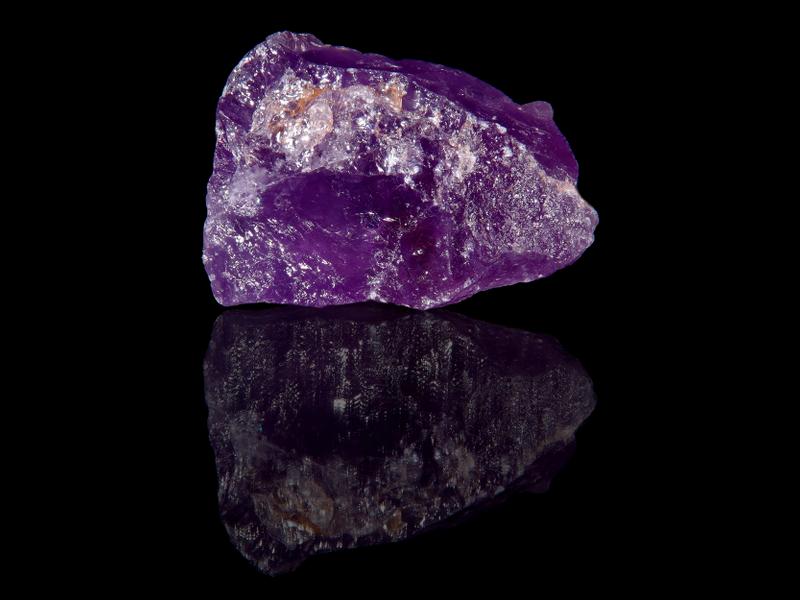
Black Amethyst crystal
Grief & LossIntuition & Inner VisionEmotional Release
Crystalis

Protocol

The Saturated Depth

Amethyst so deep it swallowed its own light. Purple that became its own darkness.

5 min

  1. 1

    Hold the black amethyst at eye level. This is not a different mineral from purple amethyst — it is the same SiO2, the same iron impurity, the same trigonal crystal system. The difference is concentration. So much iron, so much color saturation, that the purple crosses into near-black. The crystal absorbed its own light. Tilt it in a strong light source and look for the deep violet that hides inside the darkness. (0:00–1:00)

  2. 2

    Close your eyes. Hold the stone in both hands at heart center. Hardness 7 — this stone can scratch glass, resist steel, endure casual abuse without marking. The vitreous luster is muted here because the color is doing something unusual: it is absorbing reflected light instead of returning it. What you see as black is actually extreme purple. Breathe in for 4, out for 7. Five breaths. Let each exhale be as slow as you can make it. (1:00–2:00)

  3. 3

    Move the stone to your belly, pressing it gently below the navel. The iron that creates this color entered the quartz lattice during formation, replacing silicon atoms one by one. It did not coat the surface — it replaced the structure from within. Ask: what quality in me is so concentrated it reads as something else entirely? What has deepened past its original name? Sit with whatever arises. Do not rush toward clarity. (2:00–3:30)

  4. 4

    Return the stone to your hands. Hold it against your forehead, eyes still closed. The trigonal system is threefold symmetry — stable, repeating, balanced even in this extreme expression. Breathe naturally. (3:30–4:15)

Continue in the full protocol below.

tap to flip for protocol

Not every sorrow wants daylight. Some of it only gets more distorted when other people insist on brightness too soon.

Black amethyst is heavily saturated quartz, often lining geodes or appearing in dark druzy crusts where iron-related color centers and natural irradiation have driven the familiar violet toward near-black. The crystal still belongs to the amethyst family. It has just gone farther into the register.

There is relief in seeing darkness held without apology.

What Your Body Knows

Nervous system states

sympathetic

The Dark Mirror

Black Amethyst does not flinch from intensity. Where pale amethyst suggests gentleness, Black Amethyst meets sympathetic fury with equal density. It absorbs light rather than transmitting it; a visual model for absorbing emotional intensity without reflecting it back amplified. For someone in rage, the stone's darkness offers a non-reactive surface. Anger projected at something that does not brighten or darken in response can exhaust itself. State shift: chaotic sympathetic toward spent sympathetic through non-reactive absorption.

dorsal vagal

The Hidden Violet

The diagnostic feature of Black Amethyst is that its true color is hidden. You must hold it to light to see the violet. For someone in deep grief or depressive shutdown, this is a precise metaphor: the vitality exists but requires specific conditions to become visible. The practice of holding the stone to light and watching black transform to deep purple mirrors the therapeutic work of bringing dormant emotional color back into awareness. State shift: dorsal toward gentle sympathetic activation through the revelation of hidden color.

sympathetic

The Geode Interior

Black Amethyst geodes present a rough, unremarkable basalt exterior and a spectacularly dark crystalline interior. The outside tells you nothing about the inside. For a nervous system simultaneously depressed (outer presentation) and agitated (inner experience), this geological reality validates the internal experience without requiring its external expression. State shift: mixed dorsal-sympathetic toward integrated awareness through interior acknowledgment.

ventral vagal

The Saturation Point

For someone already regulated who wants to deepen their emotional range; particularly the capacity to sit with heavy, dark emotional material without fear; Black Amethyst supports the expansion of what the regulated nervous system can hold. This is not dysregulation; it is increasing ventral vagal capacity for difficult material. State support: ventral vagal deepening through expanded emotional range.

sympathetic

The Cretaceous Memory

At 130; 135 million years old, Black Amethyst formed during one of the most cataclysmic volcanic events on Earth; the breakup of Gondwana. Yet the crystals that formed in that apocalyptic environment are perfectly ordered at the molecular level. For a nervous system on the edge of collapse from sustained stress, this stone demonstrates that order can crystallize even in catastrophic conditions. State shift: collapse edge toward stabilized low sympathetic through deep time resilience.

Nervous system mapping based on polyvagal theory (Porges, 2011).

The Earth Made This

Formation: How Black Amethyst Becomes Black Amethyst

Black amethyst is deeply saturated amethyst where the concentration of iron color centers is high enough that the crystal appears dark purple to nearly black in reflected light. The color mechanism is the same as standard amethyst: Fe³⁺ ions in specific sites within the quartz lattice, activated by natural radiation, absorb certain wavelengths of light and transmit purple. In black amethyst, the iron concentration and radiation exposure are both elevated, intensifying the color past what typical amethyst displays.

When held to bright light, the crystal reveals its true deep violet. Major sources include Uruguay and southern Brazil, where geodes in basalt flows produce crystals with the iron-rich conditions necessary for this depth of saturation.

Material facts

What the stone is made of

Mineralogy: Macrocrystalline quartz, deeply saturated amethyst variety. Chemical formula: SiO₂ with unusually high concentration of Fe³⁺ color centers. Crystal system: trigonal. Mohs hardness: 7. Specific gravity: 2.65. Color: very dark purple to near-black, from high concentrations of iron-related color centers (Fe⁴⁺ in Si sites, activated by natural irradiation). Appears black in reflected light; transmits dark violet when backlit. Luster: vitreous. Habit: prismatic or as druzy crystal crusts. Not a distinct mineral species; amethyst with exceptionally deep color saturation. Same mineral and color mechanism as all amethyst; only the intensity differs.

Mineralogy

Mineral specs

Chemical Formula

SiO2; silicon dioxide (macrocrystalline quartz, trigonal)

Crystal System

Trigonal, Space Group P3121 Or P3221

Mohs Hardness

7

Specific Gravity

2.65

Luster

Vitreous; often appears sub-vitreous due to color saturation absorbing reflected light

Color

Black-Purple

Traditional Knowledge

Traditions across cultures

Gaucho traditions (Uruguay/southern Brazil): In the rural Artigas department of Uruguay where Black Amethyst is mined, gaucho (cowboy) communities have long incorporated dark amethyst geodes into their homes as "piedras del hogar" (hearth stones). Placed near the fireplace or the entrance to the home, the geodes were believed to absorb negative energy from visitors and from the harsh winds of the pampas. The darker the amethyst, the more protective it was considered. This tradition persists in modern Uruguayan homes, where amethyst geodes are among the most common domestic mineral decorations (Bossi, J. & Navarro, R., "Recursos Minerales del Uruguay," 2001).

Brazilian garimpeiro (artisanal mining) culture: In the Rio Grande do Sul state of Brazil, artisanal miners (garimpeiros) have mined amethyst geodes from basalt flows since the 19th century. Among garimpeiro families, finding a "amethista negra" (black amethyst) geode was considered particularly auspicious; a sign that the mine contained deep, rich ore. The darkest specimens were traditionally kept as family heirlooms rather than sold, as they were believed to hold the concentrated power of the volcanic earth. This practice created a selection effect: the finest Black Amethyst often stayed in local hands for generations before reaching the international market (Hartmann, L. A., "Geologia dos Geodos de Ametista," 2008).

Western esoteric tradition (20th-21st century): Black Amethyst entered the Western crystal healing lexicon in the late 20th century as amethyst varieties were differentiated by practitioners. It was rapidly associated with "shadow work"; the Jungian-derived practice of confronting unconscious or suppressed psychological material. The stone's visual quality of concealing its true nature (violet hidden beneath apparent black) was adopted as a metaphor for the shadow self; the aspects of identity hidden from conscious awareness (Hall, J., "The Crystal Bible Volume 3," 2013).

Gondwanan geological heritage: Black Amethyst's formation during the breakup of Gondwana gives it a unique geological provenance. The same volcanic event that created amethyst deposits in Uruguay also created matching deposits in Namibia and other parts of what was then the African side of the rift. Specimens from Uruguay and Namibia are, in a geological sense, siblings; formed from the same magmatic event on opposite sides of what would become the South Atlantic Ocean. This connection has been recognized by geologists studying the Parana-Etendeka Large Igneous Province (Hartmann et al., 2011).

Unknown

Gaucho traditions (Uruguay/southern Brazil)

In the rural Artigas department of Uruguay where Black Amethyst is mined, gaucho (cowboy) communities have long incorporated dark amethyst geodes into their homes as "piedras del hogar" (hearth stones). Placed near the fireplace or the entrance to the home, the geodes were believed to absorb negative energy from visitors and from the harsh winds of the pampas. The darker the amethyst, the more protective it was considered. This tradition persists in modern Uruguayan homes, where amethyst geodes are among the most common domestic mineral decorations (Bossi, J. & Navarro, R., "Recursos Minerales del Uruguay," 2001). 2. Brazilian garimpeiro (artisanal mining) culture: In the Rio Grande do Sul state of Brazil, artisanal miners (garimpeiros) have mined amethyst geodes from basalt flows since th

When This Stone Finds You

What it says when it arrives

Your grief is a dark room that has asked you to stop pretending it is daylight. Black amethyst grows in volcanic cavities where light is already scarce and color has gone almost all the way to shadow. Stillness in the dark is not failure.

Somatic protocol

The Saturated Depth

Amethyst so deep it swallowed its own light. Purple that became its own darkness.

5 min protocol

  1. 1

    Hold the black amethyst at eye level. This is not a different mineral from purple amethyst — it is the same SiO2, the same iron impurity, the same trigonal crystal system. The difference is concentration. So much iron, so much color saturation, that the purple crosses into near-black. The crystal absorbed its own light. Tilt it in a strong light source and look for the deep violet that hides inside the darkness. (0:00–1:00)

    1 min
  2. 2

    Close your eyes. Hold the stone in both hands at heart center. Hardness 7 — this stone can scratch glass, resist steel, endure casual abuse without marking. The vitreous luster is muted here because the color is doing something unusual: it is absorbing reflected light instead of returning it. What you see as black is actually extreme purple. Breathe in for 4, out for 7. Five breaths. Let each exhale be as slow as you can make it. (1:00–2:00)

    1 min
  3. 3

    Move the stone to your belly, pressing it gently below the navel. The iron that creates this color entered the quartz lattice during formation, replacing silicon atoms one by one. It did not coat the surface — it replaced the structure from within. Ask: what quality in me is so concentrated it reads as something else entirely? What has deepened past its original name? Sit with whatever arises. Do not rush toward clarity. (2:00–3:30)

    1 min
  4. 4

    Return the stone to your hands. Hold it against your forehead, eyes still closed. The trigonal system is threefold symmetry — stable, repeating, balanced even in this extreme expression. Breathe naturally. (3:30–4:15)

    1 min
  5. 5

    Open your eyes. Look at the stone one final time. In bright light, you may catch the violet edge. In dim light, it disappears into black. Both are true. Both are the same stone. Place it down. Press your palms together at heart center for three seconds. Release. The saturated depth holds. (4:15–5:00)

    1 min

The #1 Question

Can Black Amethyst go in water?

Water Safety YES -- Generally safe for brief water contact. Black Amethyst is quartz (Mohs 7) and is chemically stable. Brief rinsing under cool water is fine for cleaning. However, geode specimens with druzy surfaces should not be soaked, as water can become trapped in the microcrystalline coating and cause damage upon drying or freezing. Do not use in hot water. For gem elixirs, direct method is acceptable for tumbled or polished specimens; use indirect method for raw geode material.

Care and Maintenance

How to care for Black Amethyst

Black amethyst is water-safe. Silicon dioxide (SiO2), Mohs 7, chemically inert. Brief to moderate water rinse is fine.

CRITICAL: Avoid prolonged sunlight. The deep purple color comes from iron color centers that can be reversed by UV radiation. Fading is permanent.

Brief morning sun (under 30 minutes) is acceptable; windowsill display is not. Recommended cleansing: moonlight (overnight, ideal), sound (2-3 minutes), selenite plate (4-6 hours). Store away from direct sunlight.

In Practice

How Black Amethyst is used

Black amethyst for grief: Place under your pillow or hold against your chest during the dark hours when sleep will not come and pretending it is daytime has stopped working. The extreme iron saturation that makes this amethyst nearly black is the same color mechanism as regular amethyst, just more of it. Depth is not a different mineral.

It is the same one committed further. For shadow work: Sit with black amethyst in dim light. The stone absorbs visible light the way grief absorbs the room.

You do not need to force insight. You need to sit in the dark long enough that your eyes adjust.

Verification

Authenticity

Black amethyst: verify it is quartz (Mohs 7, scratches glass, conchoidal fracture). The dark purple-to-black color should transmit deep purple when held to strong backlight. If no purple shows in transmitted light, the specimen may be smoky quartz, not amethyst.

Specific gravity 2. 65. Avoid confusion with black obsidian (which is glass and shows conchoidal fracture but lacks crystalline structure).

Temperature

Natural Black Amethyst should usually feel cooler than plastic or resin on first touch and warm more slowly in the hand.

Scratch logic

Use 7 on the Mohs scale as the check, not internet myths. A real specimen should behave in line with the hardness listed above.

Surface and luster

Look for a vitreous; often appears sub-vitreous due to color saturation absorbing reflected light surface quality rather than a painted or plastic shine.

Weight and density

The listed specific gravity is 2.65. If a specimen feels unusually light for its size, it may deserve a second look.

Geographic Origins

Where Black Amethyst forms in the world

Uruguay's Artigas Department produces the deepest black amethyst, from volcanic basalt geodes in the Parana flood basalt province. Brazilian material from Rio Grande do Sul shares the same geological formation (the Parana-Etendeka large igneous province). The extreme iron saturation that creates the near-black color is characteristic of this specific volcanic sequence.

FAQ

Frequently asked

What is Black Amethyst?

Black Amethyst is classified as a Black Amethyst is not a separate mineral species -- it is amethyst (quartz) with an unusually high concentration of iron (Fe3+/Fe4+) color centers combined with intense natural irradiation. The color is so deeply saturated that the crystal appears black in normal reflected light, with the true deep violet revealed only by transmitted light or when thin edges are held to a strong light source. Uruguayan material typically occurs in basalt-hosted geodes as druzy-coated cavities with short, stubby crystals rather than the elongated prismatic habit of Mexican amethyst.. Chemical formula: SiO2 -- silicon dioxide (macrocrystalline quartz, trigonal). Mohs hardness: 7. Crystal system: Trigonal, space group P3121 or P3221.

What is the Mohs hardness of Black Amethyst?

Black Amethyst has a Mohs hardness of 7.

Can Black Amethyst go in water?

Water Safety YES -- Generally safe for brief water contact. Black Amethyst is quartz (Mohs 7) and is chemically stable. Brief rinsing under cool water is fine for cleaning. However, geode specimens with druzy surfaces should not be soaked, as water can become trapped in the microcrystalline coating and cause damage upon drying or freezing. Do not use in hot water. For gem elixirs, direct method is acceptable for tumbled or polished specimens; use indirect method for raw geode material.

What crystal system is Black Amethyst?

Black Amethyst crystallizes in the Trigonal, space group P3121 or P3221.

What is the chemical formula of Black Amethyst?

The chemical formula of Black Amethyst is SiO2 -- silicon dioxide (macrocrystalline quartz, trigonal).

Is Black Amethyst toxic?

Druzy Black Amethyst surfaces consist of many small, sharp crystal terminations. Handle with awareness to avoid scratching skin.

How does Black Amethyst form?

Formation Story Black Amethyst from Uruguay formed within gas cavities (vesicles) in basaltic lava flows of the Parana-Etendeka Large Igneous Province -- one of the most voluminous volcanic events in Earth's history, which erupted approximately 130--135 million years ago during the Early Cretaceous period as the supercontinent Gondwana was rifting apart into what would become South America and Africa. Research using numerical simulations has demonstrated that the giant amethyst geode cavities in

References

Sources and citations

  1. Dong, J. et al. (2015). Raman spectroscopy of quartz varieties. Journal of Raman Spectroscopy. [SCI]

    DOI: 10.1002/jrs.4501

  2. Ahmad, I. et al. (2021). Spectroscopic Analysis for Harnessing the Quality and Potential of Gemstones. Journal of Spectroscopy. [SCI]

    DOI: 10.1155/2021/6629640

Closing Notes

Black Amethyst

Deeply saturated amethyst where iron concentration is high enough that the crystal appears nearly black. Same color mechanism as regular amethyst, just more of it. The science documents how intensity is not a different mineral but the same one committed further.

The practice asks what happens when depth stops apologizing for being dark.

Bring it into practice

What to do with Black Amethyst next

Move from reference to ritual. Search current inventory for Black Amethyst, build a custom bracelet, or let Sacred Match choose the right supporting stones for you.

Community notes

Threads under Black Amethyst

Open all chats

Shared field notes tied to Black Amethyst appear here, including notes saved from practice.

No shared notes under Black Amethyst yet.

When members save a public field note for this stone, it will appear here.

The archive

Related crystals

Read the Full Crystal Guide

Continue through stones that share intention, chakra focus, or tonal family with Black Amethyst.