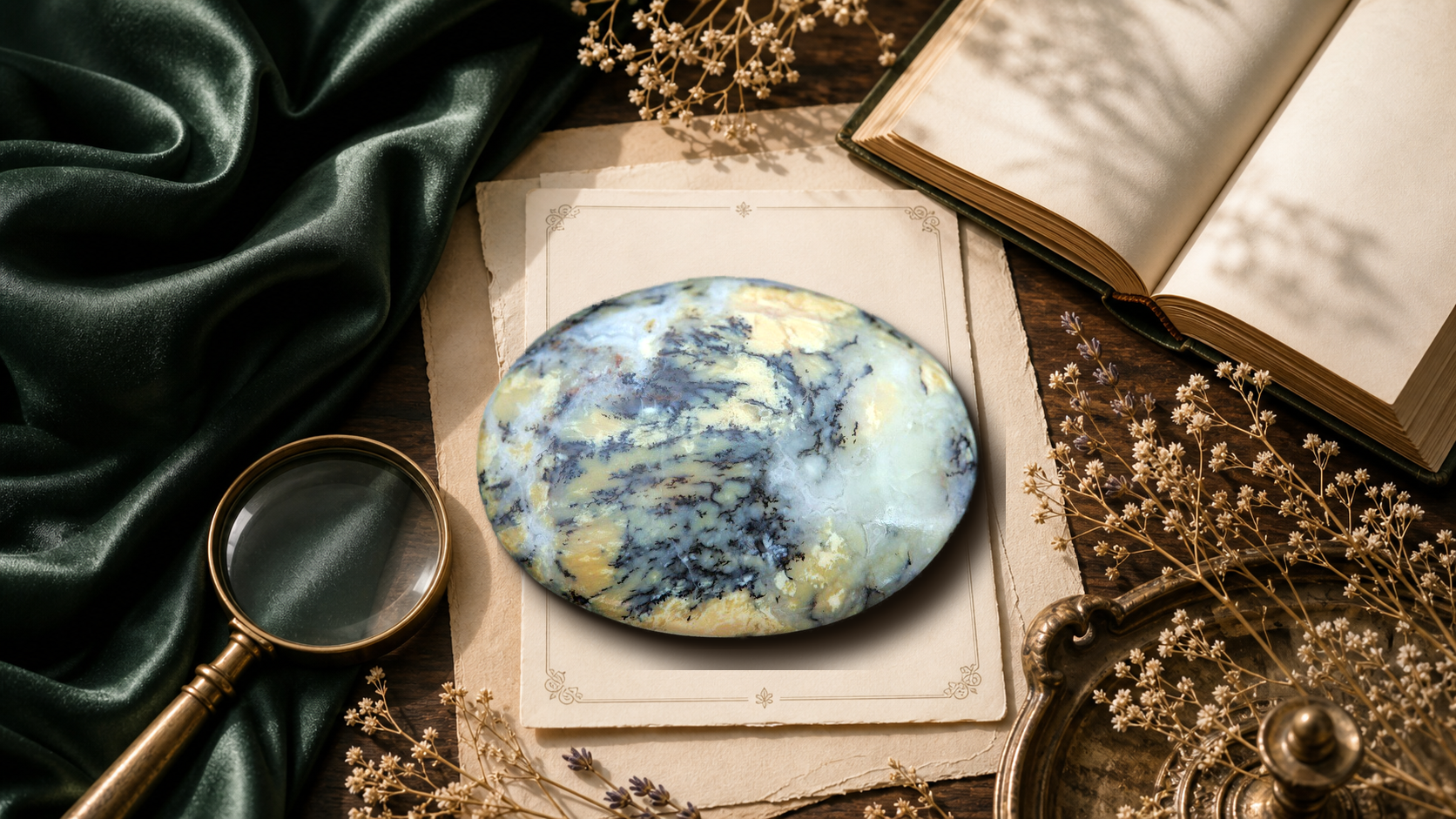
Materia Medica
Merlinite
The Magician's Dual
This page documents traditional and cultural uses of merlinite alongside emerging research on tactile grounding objects. Crystalis does not claim that merlinite treats, cures, or prevents any medical condition. For mental health concerns, consult a qualified professional.
Origins: New Mexico (USA), Madagascar
Materia Medica
The Magician's Dual
Protocol
The Dendrite Protocol
3 min
Dual Hold (30 seconds)Hold the merlinite in both palms. Close your eyes. Feel the stone's weight and temperature -- chalcedony is cool and smooth, heavier than it looks at Mohs 6.5-7. Before looking at it, set an intention: "I hold both." Not "I choose light." Not "I face my shadow." Just: "I hold both." Three slow breaths. Each inhale draws awareness into the palms where the stone rests. The stone contains both substances in one body. Your hands contain both halves of yourself in one life. The holding is the practice.
The Pattern Study (40 seconds)Open your eyes. Study the dendritic patterns in the stone -- the black branches growing through the white matrix. Trace one dendrite with your eyes from its thickest point to its finest tip. Notice how it branches. Notice how the branches branch again. This is fractal geometry -- the same mathematics that builds trees, river systems, neural pathways, and lightning. As you trace, breathe naturally. The pattern you are looking at was built by groundwater over millennia, one molecule of manganese at a time. It grew the way trees grow: not by planning but by responding to the available path. Let the pattern teach your eyes something about patience and natural form.
The Third Eye Bridge (60 seconds)Place the merlinite against the center of your forehead -- the third eye point. Close your eyes. The stone's duality is now at the seat of perception. Breathe in a 4-count inhale, 6-count exhale pattern. On each inhale, visualize the white chalcedony -- the light, the known, the conscious self. On each exhale, visualize the black dendrites -- the shadow, the hidden, the parts that grew in darkness. Four breath cycles. The stone does not ask you to choose. The inhale holds the light. The exhale holds the dark. The breath holds both. The third eye learns to see in chiaroscuro -- light and shadow as a single visual field, not two competing images.
The Integration Breath (30 seconds)Remove the stone from the forehead. Hold it at heart level between both hands. One deep inhale through the nose. On the exhale, say silently or aloud: "The dendrite is part of the stone. The shadow is part of me. I do not resolve this. I hold it." One breath. The instruction is not integration as achievement. It is integration as stance -- a posture of willingness. You are not done integrating. You are beginning to integrate. The dendrite took millennia to grow. Give yourself the same patience.
Continue in the full protocol below.
tap to flip for protocol
Opposites are crowding each other again.
Merlinite works through stark contrast. Pale against dark. Pattern against field. Division that never pretends the tension is solved.
Duality reads cleaner once the specimen admits it first.
What Your Body Knows
Merlinite is a Third Eye and Root stone whose black-and-white duality creates a bridge between grounded earth energy and expanded spiritual perception. In somatic practice, its dendritic structure -- dark branches growing through light matrix -- provides a framework for the nervous system states it addresses: conditions where the light and shadow aspects of the self have been split apart rather than held together.
sympathetic
You have divided yourself into the acceptable and the unacceptable. The light side; the competent, kind, presentable self; operates in the world. The dark side; the anger, the grief, the wants that feel too large, the truths that feel too dangerous; has been sealed away, pressed into a dorsal vagal vault where it does not interfere with daily functioning. The split feels like survival. It may have been survival at one point. But the energy required to maintain the division is enormous, and the person who results from it is half a person, walking through life in a white stone with the dendrites hidden. Merlinite addresses the split not by forcing the shadow into the light but by demonstrating that the dendrite and the matrix are one stone. The black is not a contamination of the white. It is a completion.
dorsal vagal
You are not split. You are swinging. One week you are disciplined, controlled, devoted to the light practice. The next week the shadow breaks through; anger, compulsion, the thing you said you would never do again. Your sympathetic system is caught in a pendulum between opposing selves, spending all its energy on the swing rather than the integration. Merlinite's dendrites do not swing. They grew in one direction; into the matrix, through the matrix, becoming part of the matrix. The manganese oxide did not oscillate between being inside and outside the chalcedony. It infiltrated, stabilized, and stayed. The teaching: stop swinging. Grow into.
ventral vagal
You can see both halves. The light and the dark are no longer hidden from each other. But the integration feels impossible; like trying to hold fire and water in the same hand. You stand at the threshold between your selves, aware of the whole pattern but unable to inhabit it. The oscillation between dorsal avoidance and sympathetic confrontation keeps you at the door without crossing it. Merlinite is the threshold stone. It exists precisely at the point where black meets white, where dendrite meets matrix, where shadow meets light. The stone does not cross the threshold for you. It demonstrates that the threshold itself is a habitable space; not a line to cross but a territory to occupy. The magic is at the meeting point, not on either side.
ventral vagal
You have stopped choosing sides. The light and the dark are both yours; not alternating, not competing, but present simultaneously like dendrites in chalcedony. Your nervous system is in ventral vagal regulation, which does not mean the shadow is gone. It means the shadow is held. You can feel your anger without it controlling you. You can feel your tenderness without it making you vulnerable to exploitation. You can hold complexity. The split is healed not because one side won but because both sides stopped fighting. Merlinite in this state is not medicine. It is a portrait. The stone shows you what integration looks like at the mineral scale: black and white in the same body, neither one diminished, the whole thing more beautiful than either component alone.
Nervous system mapping based on polyvagal theory (Porges, 2011).
Mineralogy
Chemical Formula
SiO2 + MnO2 (dendritic)
Crystal System
Mixed
Mohs Hardness
6.5
Specific Gravity
2.58-2.62
Luster
Vitreous to waxy
Color
White with black dendritic inclusions
Traditional Knowledge
The Dendritic Opal-Chalcedony Identification
The stone marketed as merlinite is mineralogically a dendritic opal or dendritic agate -- white chalcedony or opal containing dark dendritic (branching, tree-like) inclusions of manganese oxide or psilomelane. The trade name merlinite was applied by crystal market dealers in the late 20th century and has no standing in formal mineralogy. The dendritic patterns form through a purely chemical process: manganese-bearing fluids penetrate fractures in the host silica and precipitate in branching patterns governed by diffusion dynamics, not biological growth. Major sources include New Mexico, where the material was first marketed under the merlinite name, and parts of Turkey, India, and Madagascar.
The New Mexico Type Material
The primary source of the stone marketed as merlinite is deposits in the Socorro County area of central New Mexico, where dendritic opal and chalcedony occur in volcanic-hosted veins. New Mexico mineral dealers introduced the stone to the crystal market in the 1990s, applying the Arthurian trade name that connected the stone's dramatic black-and-white patterning to themes of duality and esoteric knowledge. The material became a staple at Tucson Gem and Mineral Show dealer tables and entered practitioner supply chains through the burgeoning American crystal market. The New Mexico provenance -- a landscape already associated with spiritual practice across multiple traditions -- added a layer of place-based narrative to the stone's commercial identity.
The Manganese Dendrite Formation Process
The dendritic patterns in merlinite exemplify a phenomenon studied in physical chemistry since the 19th century: diffusion-limited aggregation. German chemist Raphael Eduard Liesegang investigated periodic precipitation patterns in gels in the 1890s, and subsequent researchers demonstrated that manganese oxide dendrites form through a self-organizing process where dissolved manganese ions migrate through porous rock and precipitate in branching patterns that resemble but are entirely unrelated to biological structures like ferns or trees. This understanding places merlinite's visual drama firmly in the domain of inorganic chemistry and fluid dynamics rather than fossilization or biological imprinting.
The Duality Integration Practice
Crystal practitioners adopted merlinite for work explicitly centered on integrating opposing forces within a single practice or identity -- light and shadow, structure and intuition, visible and concealed. The stone's stark black-on-white patterning provided a direct visual metaphor that required no abstraction. Practitioners prescribed it for people who had compartmentalized aspects of themselves into rigid categories and needed to experience those aspects as continuous rather than divided. The trade name, while mineralogically informal, proved functionally useful in practitioner settings because it immediately communicated duality and integration to clients. The stone occupied a niche between grounding black stones and clarifying white stones, prescribed specifically for the territory between them.
When This Stone Finds You
Sacred Match prescribes Merlinite when you report:
Feeling split between opposing parts of yourself
Struggling with shadow work or self-integration
Oscillating between control and collapse
Standing at a threshold you cannot seem to cross
Needing to hold paradox without resolving it
Drawn to magic, mysticism, or liminal experiences
Ready to meet your shadow with curiosity rather than fear
Merlinite finds you when the split has become untenable. When the energy required to keep the light and the dark in separate rooms has exceeded the energy available for living. You are not broken. You are partitioned. And the partition, which once protected you, is now the thing that exhausts you. This stone does not tear down the wall between your selves. It grows through it, the way manganese oxide grows through chalcedony -- slowly, along the paths of least resistance, in patterns that obey the mathematics of natural branching. The integration is not violent. It is dendritic. It takes the shape of a tree.
Somatic protocol
The Dendrite Protocol
3 min protocol
Dual Hold (30 seconds)Hold the merlinite in both palms. Close your eyes. Feel the stone's weight and temperature -- chalcedony is cool and smooth, heavier than it looks at Mohs 6.5-7. Before looking at it, set an intention: "I hold both." Not "I choose light." Not "I face my shadow." Just: "I hold both." Three slow breaths. Each inhale draws awareness into the palms where the stone rests. The stone contains both substances in one body. Your hands contain both halves of yourself in one life. The holding is the practice.
30 secThe Pattern Study (40 seconds)Open your eyes. Study the dendritic patterns in the stone -- the black branches growing through the white matrix. Trace one dendrite with your eyes from its thickest point to its finest tip. Notice how it branches. Notice how the branches branch again. This is fractal geometry -- the same mathematics that builds trees, river systems, neural pathways, and lightning. As you trace, breathe naturally. The pattern you are looking at was built by groundwater over millennia, one molecule of manganese at a time. It grew the way trees grow: not by planning but by responding to the available path. Let the pattern teach your eyes something about patience and natural form.
40 secThe Third Eye Bridge (60 seconds)Place the merlinite against the center of your forehead -- the third eye point. Close your eyes. The stone's duality is now at the seat of perception. Breathe in a 4-count inhale, 6-count exhale pattern. On each inhale, visualize the white chalcedony -- the light, the known, the conscious self. On each exhale, visualize the black dendrites -- the shadow, the hidden, the parts that grew in darkness. Four breath cycles. The stone does not ask you to choose. The inhale holds the light. The exhale holds the dark. The breath holds both. The third eye learns to see in chiaroscuro -- light and shadow as a single visual field, not two competing images.
1 minThe Integration Breath (30 seconds)Remove the stone from the forehead. Hold it at heart level between both hands. One deep inhale through the nose. On the exhale, say silently or aloud: "The dendrite is part of the stone. The shadow is part of me. I do not resolve this. I hold it." One breath. The instruction is not integration as achievement. It is integration as stance -- a posture of willingness. You are not done integrating. You are beginning to integrate. The dendrite took millennia to grow. Give yourself the same patience.
30 secGrounding Close (20 seconds)Place the stone down. Both feet flat on the floor. Three breaths with attention in the soles of the feet. Merlinite's root-third eye pairing ends in the root -- always end in the body, always end in the ground. Shadow work that floats is shadow work that destabilizes. The dendrites grew downward, following gravity and fluid mechanics. Your integration follows the same direction: from vision to ground, from insight to embodiment, from the third eye to the feet.
20 secMineral Distinction
These are completely different stones despite similar names. Merlinite is dendritic chalcedony/opal. white with black dendrites, from New Mexico.
Mystic Merlinite (Indigo Gabbro) is a dark igneous rock from Madagascar composed of feldspar, quartz, pyroxene, and olivine with a mottled indigo-black-white appearance. They differ in composition, origin, hardness, appearance, and energetic properties.
Care and Maintenance
The #1 Question Can Merlinite Go in Water? YES . WATER SAFE Merlinite can safely contact water.
Merlinite (dendritic chalcedony) is composed primarily of microcrystalline quartz (SiO 2 , Mohs 6. 5-7) . a hard, chemically stable, non-porous material that handles water well.
The manganese oxide dendrites are also water-stable in their crystallized form. Brief rinse: perfectly safe . effective for physical and energetic cleansing Running water cleansing: safe .
30-60 seconds under cool running water, then dry Short soak (30 minutes): acceptable for deeper energetic cleansing Prolonged immersion: generally safe, though avoid soaking for hours as a routine practice Salt water: use cautiously . the chalcedony is resistant, but salt residue can accumulate in surface irregularities Gem water preparation: acceptable using direct method . both chalcedony and manganese oxide are non-toxic in solid form One caution: if your merlinite specimen has a significant opal component (rather than being predominantly chalcedony), exercise more care with water.
Opal contains bound water (SiO 2 ·nH 2 O) and can be sensitive to rapid temperature changes and prolonged soaking. If your specimen is translucent with a slightly waxy luster rather than the typical chalcedony gloss, err on the side of brief rinses only.
Crystal companions
Black Obsidian
Obsidian shows you the shadow without apology. Merlinite shows you that the shadow is already part of the whole. Together they create a shadow work progression: obsidian reveals what is hidden, merlinite demonstrates how to hold what has been revealed alongside the light. Use obsidian first for confrontation, then merlinite for integration. The sequence matters -- seeing must precede holding.
Rose Quartz
Rose quartz provides unconditional self-love and heart softness. With merlinite's duality work, rose quartz ensures that the shadow integration is compassionate rather than clinical. The heart must be open for the shadow to be welcomed. Rose quartz opens the heart. Merlinite invites the shadow in. Together: the shadow arrives to a welcome, not a trial.
Amethyst
Amethyst calms the crown and third eye, providing spiritual peace during potentially turbulent inner work. Paired with merlinite's shadow-integration function, amethyst ensures the process remains contemplative rather than destabilizing. The violet frequency of amethyst also bridges the black and white of merlinite -- violet being the color that sits between light and dark on the perceptual spectrum.
Labradorite
Labradorite provides auric protection and supports transformation. With merlinite's duality work, labradorite ensures the integration process is protected from external energetic interference. Shadow work opens the energy field -- labradorite seals the perimeter while the inner work proceeds. This pairing is for deep, sustained shadow work sessions where the practitioner will be spending extended time at the threshold.
Smoky Quartz
Smoky quartz provides deep root grounding and the transmutation of negative energy into neutral energy. With merlinite, smoky quartz ensures that the shadow material surfaced during integration work is grounded and transmuted rather than left floating in the energy field. This pairing is the safety harness for shadow work -- merlinite opens the door to the shadow, smoky quartz ensures you can process what walks through it.
In Practice
Merlinite is a Third Eye and Root stone whose black-and-white duality creates a bridge between grounded earth energy and expanded spiritual perception. In somatic practice, its dendritic structure. dark branches growing through light matrix. provides a framework for the nervous system states it addresses: conditions where the light and shadow aspects of the self have been split apart rather than held together.
The Split (nervous system pattern: DORSAL VAGAL. shutdown of one half of the self to make the other half acceptable) You have divided yourself into the acceptable and the unacceptable. The light side. the competent, kind, presentable self. operates in the world. The dark side. the anger, the grief, the wants that feel too large, the truths that feel too dangerous. has been sealed away, pressed into a dorsal vagal vault where it does not interfere with daily functioning. The split feels like survival. It may have been survival at one point. But the energy required to maintain the division is enormous, and the person who results from it is half a person, walking through life in a white stone with the dendrites hidden. Merlinite addresses the split not by forcing the shadow into the light but by demonstrating that the dendrite and the matrix are one stone. The black is not a contamination of the white. It is a completion.
The Oscillation (nervous system pattern: SYMPATHETIC. hypervigilant swinging between opposing identities or impulses) You are not split. You are swinging. One week you are disciplined, controlled, devoted to the light practice. The next week the shadow breaks through. anger, compulsion, the thing you said you would never do again. Your sympathetic system is caught in a pendulum between opposing selves, spending all its energy on the swing rather than the integration. Merlinite's dendrites do not swing. They grew in one direction. into the matrix, through the matrix, becoming part of the matrix. The manganese oxide did not oscillate between being inside and outside the chalcedony. It infiltrated, stabilized, and stayed. The teaching: stop swinging. Grow into.
The Threshold (nervous system pattern: DORSAL-SYMPATHETIC OSCILLATION. standing at the edge of integration but unable to cross) You can see both halves. The light and the dark are no longer hidden from each other. But the integration feels impossible. like trying to hold fire and water in the same hand.
Verification
Dendritic Pattern Quality Genuine merlinite dendrites display natural fractal branching, patterns that become finer and more intricate as they branch, following the mathematics of diffusion-limited aggregation. The branches should look organic, like miniature trees or ferns. Painted or dyed imitations often show patterns that are too regular, too geometric, or that follow straight lines rather than natural branching curves.
Look for fractal complexity: genuine dendrites branch, and the branches branch again. Hardness Test Merlinite (dendritic chalcedony) is Mohs 6. 5-7.
It will scratch glass (Mohs 5. 5) and will not be scratched by a steel blade (Mohs 5-6). Imitations made from dyed magnesite, howlite, or resin will be significantly softer.
The scratch test is a reliable field identification method: if the stone does not scratch glass, it is not chalcedony-based merlinite. Dye Test Genuine merlinite's black dendrites are manganese oxide, natural, mineral, and integral to the stone.
Natural Merlinite should usually feel cooler than plastic or resin on first touch and warm more slowly in the hand.
Use 6.5 on the Mohs scale as the check, not internet myths. A real specimen should behave in line with the hardness listed above.
Look for a vitreous to waxy surface quality rather than a painted or plastic shine.
The listed specific gravity is 2.58-2.62. If a specimen feels unusually light for its size, it may deserve a second look.
Geographic Origins
The dendritic patterns . the black, tree-like, fern-like, or branching formations that give merlinite its visual drama . are not crystals in the traditional sense.
They are fractal structures formed by diffusion-limited aggregation (DLA), a process where manganese-rich groundwater percolates through microscopic fractures and pore spaces in the silica host, depositing manganese oxide as it goes. The deposition follows the path of least resistance, branching at each point where the fluid encounters a choice of direction. The result is a pattern that obeys the same mathematical rules as tree branching, river delta formation, and lightning propagation .
fractal geometry at the mineral scale. The formation sequence begins with the silica host . chalcedony or opal deposited in cavities, veins, or pore spaces within volcanic or sedimentary rock.
After the silica solidifies (or while it is still in a gel state, in the case of opal), manganese-bearing fluids penetrate the material along microfractures, grain boundaries, and zones of higher permeability. The manganese precipitates as oxide minerals when it encounters oxidizing conditions, building the dendritic pattern one molecule at a time. The process is slow .
dendrites grow over thousands to millions of years as groundwater chemistry cycles through wet and dry periods. The primary source of the material sold as merlinite is the volcanic and sedimentary terrain of New Mexico, USA, where chalcedony and opal deposits in Tertiary-age volcanic rocks have been penetrated by manganese-rich desert groundwater. The arid climate of the American Southwest, with its episodic rainfall and high evaporation rates, creates the alternating wet-dry conditions that favor dendritic manganese oxide precipitation.
FAQ
Merlinite is a trade name for dendritic opal or dendritic chalcedony — white to translucent chalcedony or opal with black manganese oxide (MnO₂) dendrites that create striking tree-like or fern-like patterns within the stone. The name references the wizard Merlin, evoking the stone's association with magic, duality, and the integration of light and shadow. Merlinite has Mohs hardness 6.5-7, and the primary source is New Mexico, USA. It is associated with the third eye and root chakras.
Yes. Merlinite (dendritic chalcedony/opal) is water safe. Chalcedony is Mohs 6.5-7, non-porous when polished, and chemically stable. Brief rinses, running water cleansing, and short soaks are all acceptable. However, if the specimen is predominantly opal (rather than chalcedony), exercise more caution — opal can be sensitive to rapid temperature changes and prolonged soaking due to its water content.
These are different stones with similar trade names. Merlinite is dendritic chalcedony/opal — white with black manganese oxide dendrites, found primarily in New Mexico. Mystic Merlinite (also called Indigo Gabbro) is a completely different rock — a dark igneous rock from Madagascar composed of feldspar, quartz, and various dark minerals including pyroxene and olivine, displaying a mottled indigo-black-white appearance. Despite the shared name, they differ in composition, origin, appearance, and energetic properties.
Merlinite is associated with the third eye chakra and root chakra. The black dendrites connect to root/earth energy (grounding, shadow work, ancestral connection), while the white chalcedony matrix connects to the third eye and crown (clarity, spiritual sight, expanded perception). The stone's dual-color nature makes it a natural bridge stone — connecting upper and lower chakras, light and shadow, the seen and the unseen.
Merlinite is completely natural. The black dendrites are manganese oxide (MnO₂) that crystallized in fractal branching patterns within the chalcedony or opal host as mineral-rich groundwater percolated through the stone over geological time. No treatment or enhancement is applied. The dendritic patterns are a natural example of fractal geometry — the same mathematical principle that governs the branching of trees, rivers, and lightning.
References
Post, J.E. (1999). Manganese oxide minerals: crystal structures and economic and environmental significance. Proceedings of the National Academy of Sciences. [SCI]
Vicsek, T. (1992). Fractal Growth Phenomena. 2nd ed. World Scientific. [SCI]
DOI: 10.1142/1407
Graetsch, H. (1994). Structural characteristics of opaline and microcrystalline silica minerals. Reviews in Mineralogy. [SCI]
Closing Notes
The manganese oxide dendrites inside your merlinite grew by diffusion-limited aggregation . a process where each molecule of manganese found the nearest available surface and attached, branching at every decision point the way a tree branches at every fork. The mathematics behind this pattern is the same mathematics that generates neural networks, river deltas, and lightning. The black grew through the white not by force but by natural law, following the paths that the stone's own structure made available. Crystalis documents both the fractal physics and the somatic practice because the mineral never separated them . the dendrite is the integration, the branching is the method, and the stone is the proof that light and dark can share a body without war.
Crystalis×The Index "The dendrite did not ask permission to grow through the white stone. It followed the path that was available. Your shadow will do the same, if you let it."
© 2026 Crystalis. All rights reserved.
The Index: A Crystalpedia of Crystal Healing & Mineral Science
Bring it into practice
Move from reference to ritual. Search current inventory for Merlinite, build a custom bracelet, or let Sacred Match choose the right supporting stones for you.
Community notes
Shared field notes tied to Merlinite appear here, including notes saved from practice.
When members save a public field note for this stone, it will appear here.
The archive
Continue through stones that share intention, chakra focus, or tonal family with Merlinite.

Shared intention: Spiritual Connection
The Violet Shift

Shared intention: Authenticity
The Star Leaf of Surrender
Shared intention: Spiritual Connection
The Visionary's Thread

Shared intention: Transformation & Change
The Seven-Mineral Synergy
Shared intention: Transformation & Change
The Dark Mirror of Becoming

Shared intention: Intuition & Inner Vision
The Deep Blue Mind