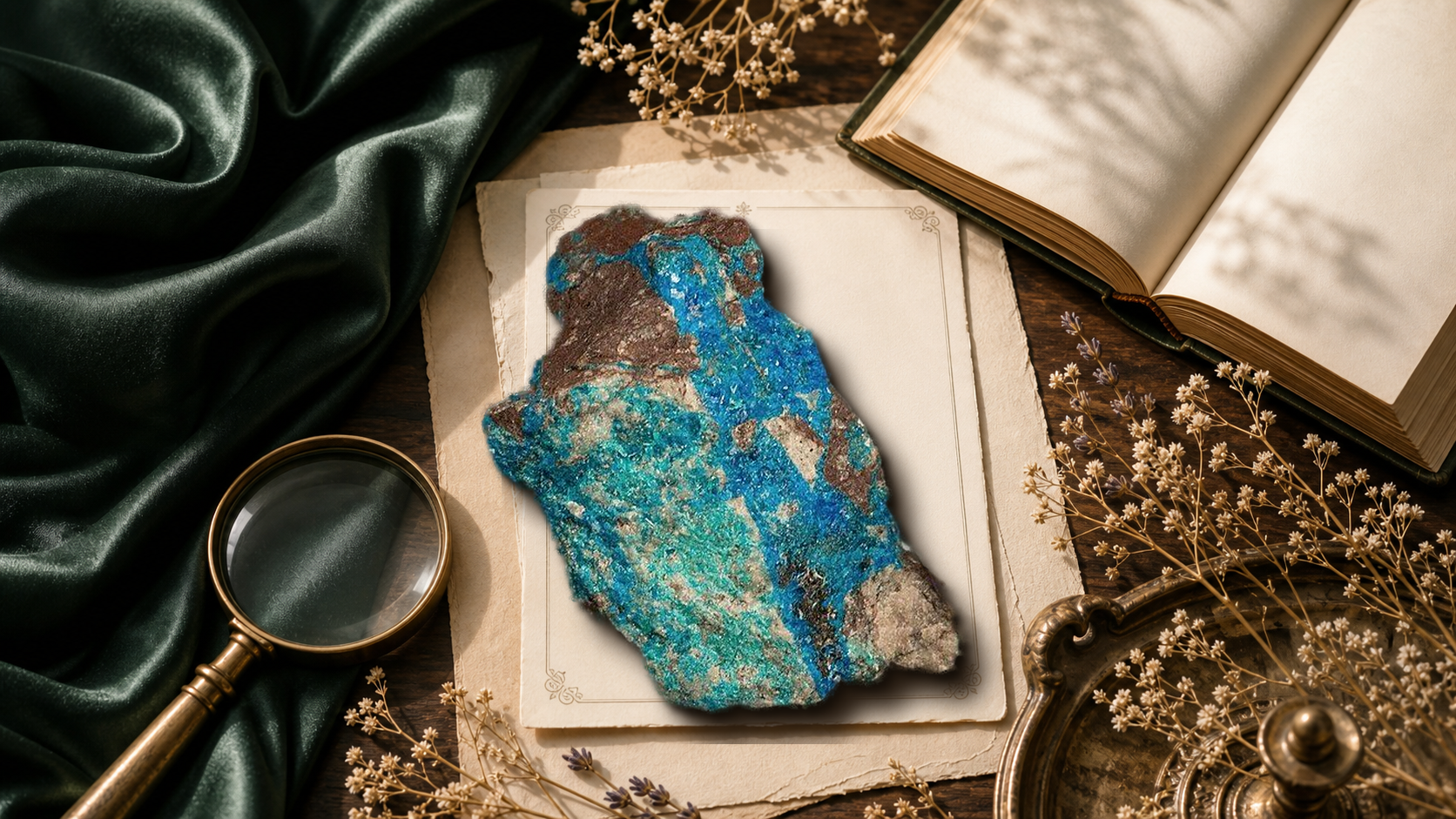
You need a deeper blue held by something clearer than emotion alone. Papagoite often appears as vivid inclusions within quartz, desert-copper intensity suspended in transparency. Feeling can be anchored without being dulled.
The body often understands Papagoite as a tactile cue before the mind gives it a story. For Papagoite, the key region is usually the throat and upper chest. The...
The Meaning
Papagoite in the Crystalis dictionary
Some emotions are too pure in color to trust on their own. The self wants the depth, but it also wants a cleaner vessel, something that can hold the feeling without letting it spread into everything.
Papagoite in quartz offers that arrangement. The blue inclusion remains vivid, almost electric, while the quartz host provides clarity, containment, and a more stable body around the intensity. The color keeps its force. The structure improves the delivery.
Papagoite helps when the psyche needs emotion to stay strong without becoming amorphous.
Anchoring is not the same thing as dulling.
Stone Lore
Stories carried through time
Cultural notes are presented as tradition and historical context — stories carried through time.
Unknown
Tohono O'odham Nation (Papago people)
The mineral was named for the Tohono O'odham people (formerly called "Papago" by Spanish colonizers), whose ancestral lands include the Ajo, Arizona area where papagoite was discovered. The Tohono O'odham, the "Desert People", have inhabited the Sonoran Desert for millennia. Their traditional relationship with the desert landscape includes deep knowledge of mineral-bearing rocks, which were used for pigments, tools, and ceremonial purposes.
The renaming of the people from "Papago" (a Hispanicized exonym) to "Tohono O'odham" (their own name, meaning "Desert People") is itself a cultural reclamation, while the mineral retains the older name as a geological artifact of mid-20th-century naming conventions.
Historical note
Named for the Tohono O'odham People
Papagoite carries the name of the people whose land held it. The mineral was discovered in 1960 at the New Cornelia Mine (Ajo Mine) in Pima County, Arizona, and named for the Papago American Indians, now known as the Tohono O'odham, who...
Tohono O'odham (Papago) · 1960 CE
Earth Record
Mineralogy and formation
The story of Papagoite begins with a narrow set of conditions that had to stay stable long enough for order to develop. Papagoite forms through oxidized copper environments where silica-rich solutions later introduced quartz. In mineralogical terms it is classified in monoclinic copper calcium aluminum silicate, with chemistry summarized as CaCuAlSi2O6(OH)3. During growth, the available ions have to arrange into a repeatable lattice or stable aggregate, and this produces the physical cues collectors later use: microscopic blue crystals often enclosed in quartz.
Its standard field profile includes Monoclinic symmetry, Mohs hardness around 5, specific gravity 3. 25, and a luster described in the source record as Vitreous to silky on crystal surfaces. Color in the traded material is commonly Blue, but the more important fact is setting. Papagoite typically develops in Ajo, Arizona and selected copper districts in South Africa and Namibia, where cooling rate, fluid chemistry, or burial history stay consistent long enough for the material to stabilize.
Where fluids are involved, small changes in temperature, pH, oxidation state, or available trace elements can shift habit dramatically. Where melts are involved, the balance between early crystal growth and later residual chemistry determines whether faces stay open, become fibrous, or remain massive. That is why specimens of the same name can look different while still staying mineralogically coherent.
The crystal system is not decoration. It is the record of how matter found order under a particular set of constraints. The associated thought for this stone turns on one idea: one need a deeper blue held by something clearer than emotion alone. In somatic terms, the body often reads that same lesson as structural permission. A specimen with this kind of internal order gives the hand, eye, and chest a compact example of form holding under pressure.
Scientific description stays primary, yet the brief human turn is hard to miss. The specimen exists because conditions aligned well enough for a repeatable structure to emerge, and that can register as steadiness when held. Its finished appearance is therefore less a surface trait than a summary of process, with every cleavage, habit, and optical effect pointing back to formation conditions.
Crystal system diagram represents the general monoclinic classification. Diagram created by Crystalis for educational reference.
Monoclinic structure
Chemical Formula
CaCuAlSi2O6(OH)3
Crystal System
Monoclinic
Mohs Hardness
5
Specific Gravity
3.25
Luster
Vitreous to silky on crystal surfaces
Color
Blue
IMA Status
species
Type Locality
New Cornelia mine, Ajo, Pima County, Arizona, USA
IMA Number
Approved 1960
01
Mineral conditions gather
02
Structure begins to crystallize
03
Papagoite records place and pressure
Messina (now Musina), South Africa produces papagoite-bearing quartz crystals from copper deposits. Ajo, Arizona (USA) is the type locality where papagoite was first described in 1960, named after the Tohono O'odham people (formerly called Papago). South African specimens dominate the collector market due to larger crystal size in quartz hosts.
South AfricaUSA (Arizona)
Telling it apart
Retail language often folds Papagoite into a broader category where it does not belong. The main confusion is with shattuckite in quartz or dyed blue quartz. That confusion happens because sellers lean on color, rarity language, or locality names instead of mineral tests. For a consumer, the fastest reliable check is the clearest indicator is microscopic blue inclusions within hard quartz rather than surface dye or broad opaque patches.
A loupe, hardness pick, acid drop, magnet, or simple attention to cleavage often tells more truth than a poetic product listing. Secondary clues come from habit, heft, and setting. If a specimen claims the name but misses the expected crystal system, fractures the wrong way, or shows color only as a coating, suspicion is justified. Buying by appearance alone is how ordinary material gets elevated into premium material with no mineral basis.
With Papagoite, Rare copper silicate identification in quartz requires confirming the inclusion species, and generic blue included quartz does not justify a papagoite premium. Papagoite is rare enough that most blue inclusions in quartz sold under the name deserve verification: confirm monoclinic copper silicate chemistry, not chrysocolla or shattuckite.
Spotting the real thing
Papagoite: vivid blue inclusions inside quartz. The blue should be INSIDE the quartz host (Mohs 7), not painted on the surface. If the blue appears only as surface coating or staining, it is not genuine papagoite in quartz.
South African specimens dominate the market. Named after the Tohono O'odham people; the cultural attribution is part of the mineral's identity.
Papagoite's extreme rarity is itself the teaching for dorsal vagal hopelessness. In a state where nothing seems to matter and nothing seems special, encountering something that is genuinely, geologically, measurably rare disrupts the "everything is the same" narrative of shutdown. Papagoite is NOT common. It exists in two significant locations on the entire planet. Its formation required conditions so specific they almost did not happen.
Yet here it is. The nervous system in shutdown has often generalized from "this situation is hopeless" to "everything is hopeless." Papagoite's existence demonstrates that rarity is real; and rare things exist. State shift: generalized hopelessness toward recognition of the genuinely exceptional.
Charged & on alert
perfect
Ventral vagal seeking transcendence (spiritual practice support):
Settled & connected
Papagoite's cerulean blue
The spiritual practice has become a hiding place. Meditation is used to avoid feeling. Positive affirmations paper over legitimate pain. "Everything happens for a reason" is deployed as a shield against grief rather than a framework for meaning. Spiritual bypassing is a mixed autonomic state: the ventral vagal language of peace and acceptance is being used to suppress sympathetic activation (anger, fear) or dorsal collapse (grief, numbness) that the system is not ready to process. The body is in one state. The narrative claims another.
Papagoite's role: Papagoite is a rare calcium copper aluminum silicate hydroxide in cerulean blue, found almost exclusively in the Messina district of South Africa. Its blue is genuine, structural, and earned through rare geological conditions. Placed during honest spiritual practice or held during the willingness to stop bypassing, papagoite provides the signal of what authentic spiritual depth looks like: rare, requiring specific conditions, and impossible to fake.
The stone's scarcity mirrors the scarcity of genuine spiritual integration versus its common imitation. If the practice costs nothing emotionally, it is probably not the practice.
Charged & on alert
Spiritual bypassing
Dorsal vagal (disconnection from purpose): When the nervous system has collapsed around a sense of purposelessness; "I don't know why I'm here"; papagoite's origin story offers a specific medicine. It was named for the Tohono O'odham people, the indigenous stewards of the land where it was first found. The mineral did not name itself. It was recognized, named, and placed in context by the human community that found it.
Purpose, like a mineral name, is often given to us by our relationship to the land and community around us, not generated from within in isolation. State shift: isolated purposelessness toward purpose-through-belonging.
These associations come from tradition and reflective practice — a way of working with the stone, not a medical prescription.
Somatic Practice
Simple ways to work with Papagoite
◇
Hold
Carry Papagoite in a pocket or place it over the heart center during a pause.
◌
Meditate
Let the stone become a quiet tactile anchor while the breath slows.
☽
Breathe
Breathe in softness. Breathe out tension. Keep the practice simple.
✎
Journal
Write with Papagoite nearby to name the feeling without forcing a conclusion.
✋
Bodywork
Rest the stone near the chest, hand, or bedside as a reminder to soften.
⌂
Environment
Place it where you want a visual cue for care, repair, or steadiness.
Field Instruction
The Cerulean Thread
Monoclinic calcium-copper aluminum silicate so rare it appears in only two localities worldwide -- scarcity as an invitation to presence, not possession.
5 min protocol
1
Hold the papagoite specimen gently. CaCuAlSi2O6(OH)3 -- calcium, copper, aluminum, silicon, oxygen, hydrogen -- six elements conspiring to produce a blue found in almost nowhere else on Earth. Before beginning, acknowledge: rarity does not equal fragility. This stone's monoclinic structure is organized. Let that organization support you.
2
Place the stone at the hollow of your throat. The copper in papagoite is the same element that turns the Statue of Liberty green and carries signals through neural wiring. Breathe in for 5, out for 8. On each exhale, let the copper carry one signal you have been afraid to send -- not outward, just from your throat to your own heart.
3
Move the stone to the center of your forehead. At specific gravity 3.25, it sits heavier than quartz -- a reminder that depth has weight. Close your eyes. Ask without words: what purpose am I circling but not landing on? Let the cerulean blue behind your eyelids hold the question. Do not rush the answer.
4
Bring the stone to rest on your open palm. Look at the blue against your skin. Papagoite was first found in the Ajo district of the Tohono O'odham Nation and later in South Africa's Messina mines -- two continents, same mineral. Ask: what in me keeps appearing in different contexts, trying to be recognized?
5
Close your hand gently around the stone. The hydroxyl groups in its formula (OH)3 mean it contains bound water -- purpose distilled into structure. Sit for 30 seconds holding it before releasing. Let the release be slow. Things this rare deserve a slow release.
Stone Intelligence
The fact that makes Papagoite memorable
Named after the Tohono O'odham people of Arizona. A rare copper silicate hydroxide first described from the Ajo copper district in 1960. The science documents secondary copper mineralization.
Crystalis names the cultural source because the knowledge and the name belong to them.
SCI
Copper in Human Health and Disease: A Comprehensive Review
Journal of Biochemical and Molecular Toxicology · 2024Read source
SCI
A Discussion on the Emergence and Development of Ancient Chinese Artificial Barium Copper Silicate Pigments from Simulation Experiments
You need a deeper blue held by something clearer than emotion alone. Papagoite appears as vivid blue inside quartz, a rare copper silicate protected by its transparent host. Hold during spiritual practice when you need depth that is contained rather than spilled.
Place on your altar or meditation space. Named after the Tohono O'odham people. The cultural source is named and honored.
Sacred Match
Sacred Match reaches for Papagoite when what you feel sounds like: the strain of staying soft inside hard conditions; difficulty staying in the body when feeling rises; protective bracing across the chest or jaw; fatigue after prolonged emotional or cognitive output; a need for firmer selection and cleaner limits. Sacred Match listens to the body rather than to preference. It notices what you are feeling right now, the way you are protecting yourself, and the deeper need underneath both.
When that points to the pattern most consistent with Papagoite, the prescription is based on the specimen's material logic: texture, weight, hardness, structure, and the way those properties can organize attention when placed on the body. the strain of staying soft inside hard conditions -> seeking a more stable internal frame. difficulty staying in the body when feeling rises -> seeking contact that does not overwhelm.
protective bracing across the chest or jaw -> seeking boundary without full withdrawal. fatigue after prolonged emotional or cognitive output -> seeking restoration through simplification. a need for firmer selection and cleaner limits -> seeking clearer selection about what stays and what does not.
Pairings are treated like a recipe file: clear use, method, and safety.
Crystal Companion
Papagoite + Amethyst
Use when
You want to layer the primary intention with another supportive tone.
How to work with it
Place the stones together during meditation, journaling, or a short reset.
Safety
Use as a reflective practice tool, not as a medical substitute.
Crystal Companion
Papagoite + Rhodonite
Use when
You want to layer the primary intention with another supportive tone.
How to work with it
Place the stones together during meditation, journaling, or a short reset.
Safety
Use as a reflective practice tool, not as a medical substitute.
Crystal Companion
Papagoite + Clear Quartz
Use when
You want to layer the primary intention with another supportive tone.
How to work with it
Place the stones together during meditation, journaling, or a short reset.
Safety
Use as a reflective practice tool, not as a medical substitute.
Crystal Companion
Papagoite + Black Tourmaline
Use when
You want to layer the primary intention with another supportive tone.
How to work with it
Place the stones together during meditation, journaling, or a short reset.
Safety
Use as a reflective practice tool, not as a medical substitute.
Papagoite tends to pair well when the second mineral solves a different problem than the first. Lapis Lazuli: truth, articulation, and upper airway focus. It helps Papagoite move from inner recognition toward spoken form. Body placement: place lapis at the throat notch and Papagoite in the left hand. Clear Quartz: signal amplifier and lens. It sharpens the organizing qualities of Papagoite without changing the core tone.
Body placement: set clear quartz at the crown and place Papagoite in the left palm. Rose Quartz: soft contact with emotional steadiness. It rounds the sharper aspects of Papagoite and gives the chest a friendlier landing place. Body placement: lay rose quartz over the sternum and keep Papagoite just below the collarbones. Black Tourmaline: perimeter and weight. It gives a denser edge to Papagoite, helping the body distinguish support from spillover.
Body placement: tuck black tourmaline into the right pocket while Papagoite rests at the sternum. The placements are intentionally specific so the body can assign each material a role instead of treating the arrangement as visual clutter. The placements are intentionally specific so the body can assign each material a role instead of treating the arrangement as visual clutter. The placements are intentionally specific so the body can assign each material a role instead of treating the arrangement as visual clutter.
Care & Cleansing
How to keep Papagoite in good condition
Water Safe?
Water safe
This stone is generally safe for short water contact, though polishing, fractures, and metal settings can still change how a specimen behaves.
Sunlight Safe?
Sunlight safe
Tolerates daylight; safe to charge or display in the sun.
Authenticity
What to check
Natural Papagoite should usually feel cooler than plastic or resin on first touch and warm more slowly in the hand.
Papagoite is water-safe when in quartz matrix (most specimens). The copper silicate (Mohs 5) is protected inside the quartz host. Raw papagoite outside quartz is fragile and porous.
Brief rinse for quartz-hosted specimens is safe. Recommended cleansing: moonlight (overnight), selenite plate (4-6 hours). Store carefully; papagoite is rare and collector-grade.
Temperature
Natural Papagoite should usually feel cooler than plastic or resin on first touch and warm more slowly in the hand.
Scratch logic
Use 5 on the Mohs scale as the check, not internet myths. A real specimen should behave in line with the hardness listed above.
Surface and luster
Look for a vitreous to silky on crystal surfaces surface quality rather than a painted or plastic shine.
Weight and density
The listed specific gravity is 3.25. If a specimen feels unusually light for its size, it may deserve a second look.
My Field Guide
Your private record and next steps
Journal
Add this stone to your private collection, then log what happened when you worked with it.
Shared Notes
Read public practice logs and pattern notes from the Crystalis community.
When members save a public field note for this stone, it will appear here.
Frequently Asked
Questions people ask about Papagoite
What is Papagoite?
⌄
Papagoite, CaCuAlSi2O6(OH)3, monoclinic (space group C2/m), Mohs 5 to 5. 5, is among the rarest collectible minerals in the world. It was first described in 1960 from the New Cornelia Mine in Ajo, Arizona, and named for the Papago (now Tohono O'odham) people indigenous to the region. For decades it was known from only a handful of microscopic specimens; the mineral gained prominence in the collector and crystal practice world when specimens from the Messina copper mines in South Africa revealed papagoite occurring as vivid blue inclusions within clear or milky quartz crystals, creating stunning display pieces that made the mineral accessible, though still extremely expensive.
Papagoite is a member of the amphibole supergroup of calcium-copper aluminosilicates and is chemically related to ajoite (also from Ajo, Arizona) and shattuckite, though it is structurally distinct from both. Its extreme rarity, combined with its intense blue color, makes it one of the most prized minerals in crystal practice.
What is the Mohs hardness of Papagoite?
⌄
Papagoite has a Mohs hardness of 5 to 5.5.
Can Papagoite go in water?
⌄
Water Safety NO, avoid water contact. Papagoite is a rare copper silicate that should not be exposed to water. Copper minerals can release trace copper into solution, and the mineral's value makes any risk of damage inadvisable. Most papagoite specimens are papagoite-in-quartz; while the quartz matrix is water-safe, the papagoite inclusions should not be subjected to soaking. Do NOT use in any gem elixir preparation. Clean with a dry soft brush only.
What crystal system is Papagoite?
⌄
Papagoite crystallizes in the Monoclinic (space group C2/m).
What is the chemical formula of Papagoite?
⌄
The chemical formula of Papagoite is CaCuAlSi2O6(OH)3.
How does Papagoite form?
⌄
Formation Story Papagoite forms under very specific and uncommon geological conditions in the supergene-to-hypogene transition zone of copper deposits. At Ajo, Arizona, the mineral occurs in oxidized copper ores associated with the porphyry copper deposit of the New Cornelia Mine. The formation requires simultaneous availability of calcium, copper, aluminum, silicon, and hydroxyl in hydrothermal or supergene fluids at specific temperature and pH conditions, a convergence of chemical requiremen.
Sources & Citations
Where this entry can be checked
Back Matter
Readable for people. Structured for AI search.
Sources stay visible in the page so readers, search engines, and answer systems can follow the evidence trail.
01
SCI
Copper in Human Health and Disease: A Comprehensive Review
Binesh, Ambika, Venkatachalam, Kaliyamurthi. (2024). Copper in Human Health and Disease: A Comprehensive Review. Journal of Biochemical and Molecular Toxicology. [SCI]DOI 10.1002/jbt.70052
02
SCI
A Discussion on the Emergence and Development of Ancient Chinese Artificial Barium Copper Silicate Pigments from Simulation Experiments
Qin, Y., Wang, Y.‐H., Chen, X., Li, H.‐M., Li, X.‐L. (2015). A Discussion on the Emergence and Development of Ancient Chinese Artificial Barium Copper Silicate Pigments from Simulation Experiments. Archaeometry. [SCI]DOI 10.1111/arcm.12205
03
SCI
Structural, optical, and radiation shielding properties of cyclosilicates crystals: Hirshfeld topological geometries
Al‐Omari, S., Afaneh, F., Khattari, Z. Y. (2024). Structural, optical, and radiation shielding properties of cyclosilicates crystals: Hirshfeld topological geometries. Journal of the American Ceramic Society. [SCI]DOI 10.1111/jace.20007
04
SCI
On the Elementary Neural Forms of Micro‐Interactional Rituals: Integrating Autonomic Nervous System Functioning Into Interaction Ritual Theory
Heinskou, Marie Bruvik, Liebst, Lasse Suonperä. (2016). On the Elementary Neural Forms of Micro‐Interactional Rituals: Integrating Autonomic Nervous System Functioning Into Interaction Ritual Theory. Sociological Forum. [SCI]DOI 10.1111/socf.12248