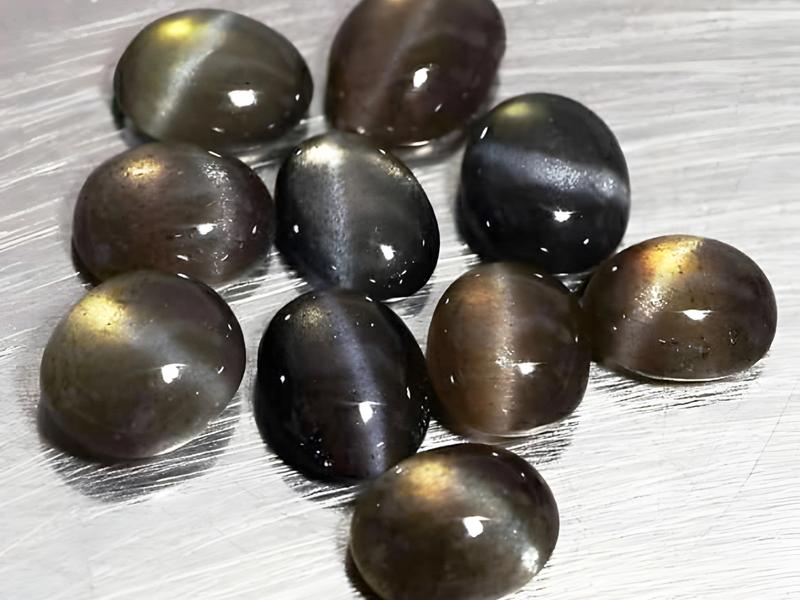
You are receiving information you cannot source or explain. Black moonstone reveals its flash only at certain angles because light scatters between microscopic feldspar layers. Turn the light down. The signal is already there.
Black moonstone is a root and third eye chakra mineral -- grounding and visionary simultaneously. It is the nighttime counterpart to white moonstone's daytime clarity....
The Meaning
Black Moonstone in the Crystalis dictionary
Instinct rarely arrives in daylight language. Some knowing appears from underneath, after the room has lowered its volume and the social self has stopped narrating everything.
Black moonstone keeps feldspar's inner flash but sets it in a darker ground, so the shimmer rises out of shadow instead of milk-white glow. The light is still there. It just prefers cover.
That timing has its own intelligence.
Stone Lore
Stories carried through time
Cultural notes are presented as tradition and historical context — stories carried through time.
Ancient Rome
Pliny and the Moonstone
Pliny the Elder described moonstone in Naturalis Historia (77 CE), writing that it displayed a shifting light that waxed and waned with the phases of the moon. While Pliny was describing moonstone broadly (likely lighter-bodied orthoclase specimens), his documentation established the fundamental association between moon-phase feldspar and lunar cycles that extends to all moonstone varieties including dark-bodied specimens. Roman women wore moonstone jewelry calibrated to lunar phases for fertility and intuitive attunement.
1st century CE
Historical note
Chandrakanta Mani: The Moon-Loved Gem
In Hindu tradition, moonstone is called chandrakanta mani, the gem beloved of the moon. Indian tradition holds that moonstone formed from solidified moonbeams. Moonstone was embedded in the forehead of Ganesh, the moon god, and was...
Hindu Tradition, India, ancient
Origin lore
The Malagasy Source
Madagascar emerged as the primary source of black moonstone in the late 20th century, with deposits in the central highlands producing dark feldspar specimens with dramatic silver, white, and occasionally multicolored flash. The island's...
Madagascar · 20th-21st century
Historical note
The Dark Feminine in Design
Art Nouveau jewelers, particularly René Lalique in France, championed moonstone as a material that embodied the movement's fascination with nature, mystery, and the feminine. Dark-bodied specimens with dramatic flash aligned with the Art...
The optical phenomenon that defines all moonstones -- the ethereal glow that moves across the surface when the stone is tilted -- has two distinct mechanisms depending on the mineral's composition. True adularescence (the billowy, floating white-blue light associated with classical moonstone) is caused by light scattering from alternating layers of orthoclase and albite feldspar that exsolved (separated) during slow cooling from a homogeneous high-temperature feldspar melt.
These exsolution lamellae are extraordinarily thin -- typically 50-150 nanometers -- and they scatter short-wavelength light (blue) more effectively than long-wavelength light, producing the characteristic blue sheen.
In black moonstone specimens that are technically labradorite, the optical effect is labradorescence -- a broader, often more colorful flash caused by light interference from thicker internal lamellae (typically 100-300 nanometers) of different plagioclase compositions. Labradorescence can produce dramatic blue, gold, green, or even spectral-rainbow flashes against the dark body color. The dark body itself results from fine inclusions of ilmenite (FeTiO3), magnetite (Fe3O4), or other iron-titanium oxide minerals distributed through the feldspar matrix.
Black moonstone forms primarily in mafic to intermediate igneous rocks -- gabbros, norites, anorthosites, and basaltic flows -- where the feldspar crystallized from magma at temperatures between 800-1100 degrees Celsius and then cooled slowly enough for exsolution to occur. The primary commercial source of black moonstone is Madagascar, where anorthosite and gabbro bodies in the Precambrian basement rocks produce exceptional material. Additional sources include the Indian subcontinent (particularly Rajasthan and Tamil Nadu), Myanmar, and parts of Canada.
Crystal system diagram represents the general triclinic classification. Diagram created by Crystalis for educational reference.
Triclinic structure
Chemical Formula
(K,Na)AlSi3O8
Crystal System
Triclinic
Mohs Hardness
6
Specific Gravity
2.55-2.63
Luster
Vitreous to pearly with adularescence
Color
Black with silver or blue adularescent sheen
IMA Status
variety
Type Locality
Ford Harbour, Paul Island, near Nain, Labrador, Canada
IMA Number
Not IMA-approved
01
Mineral conditions gather
02
Structure begins to crystallize
03
Black Moonstone records place and pressure
MadagascarIndia
Telling it apart
Most black moonstone is technically dark labradorite. same mineral, different trade name. The distinction is largely based on metaphysical tradition and marketing rather than strict mineralogy.
Standard labradorite typically has a medium gray body; black moonstone has a deeper, darker body color. True orthoclase moonstone is a different feldspar species showing billowy adularescence.
Spotting the real thing
Flash Behavior Genuine black moonstone displays flash (adularescence or labradorescence) that moves across the surface as you tilt the stone. The flash should appear to come from within the stone, not from a surface coating. It should shift position with the viewing angle. If the flash does not move or appears painted on, the stone may be synthetic or coated. Body Color Consistency Natural black moonstone has a dark gray to black body color that is generally consistent, though it may show some natural variation or translucency at thin edges.
If the dark color appears painted on, peeling, or concentrated only at the surface (with a lighter interior visible at chips or edges), the specimen may be dyed or coated. Cleavage Planes Feldspar minerals have two sets of near-perfect cleavage planes intersecting at approximately 90 degrees (or about 86 degrees in plagioclase).
Energy & VitalityHeart HealingInner PeaceLove & Connection
Charged & on alert
Hyper-Rational Override
You analyze everything. Every feeling gets run through the logic processor before you allow yourself to experience it. Every gut instinct gets cross-referenced with evidence before you trust it. Your sympathetic system has recruited the prefrontal cortex as a bodyguard, and now nothing gets past the checkpoint of rational verification. The problem is that some forms of knowing do not survive translation into logic; they arrive as body sensations, as unease, as a pull toward or away from something that you cannot explain.
Black moonstone disrupts the rational override by providing a visual experience that cannot be intellectualized: the flash appears, moves, vanishes. You cannot predict it, explain it, or control it. You can only watch. This practice of watching without analyzing trains the nervous system to receive information without immediately processing it.
Shut down & far away
Cycle Disconnection
You have separated yourself from your own cycles. You push through fatigue, ignore hunger signals, override the body's request for rest, and treat your internal rhythms as inconveniences to be managed rather than intelligence to be followed. This is particularly common in people whose menstrual cycles, sleep cycles, or seasonal energy patterns have been medicalized, pathologized, or simply ignored by a culture that demands constant linear productivity.
Black moonstone; associated with the lunar cycle and the dark phase of the moon; invites reconnection to cyclical time. Working with the stone during the new moon specifically, and tracking your own energy levels alongside lunar phases, creates a somatic practice of honoring the rhythm rather than overriding it.
Settled & connected
Fear of the Dark Self
You have divided yourself into acceptable and unacceptable halves. The light self; the kind one, the good one, the productive one; gets all the airtime. The shadow self; the angry one, the grieving one, the desiring one; gets locked in a room you pretend does not exist. This split creates a constant low-grade sympathetic activation: maintaining the division requires vigilance. Black moonstone does not force shadow confrontation the way stibnite does.
Instead, it creates conditions where the shadow can approach gently, in the dark, through dreams and intuitions and body whispers. The stone's dark body with hidden internal light is the visual teaching: even in what looks dark, there is luminescence. Even in what you call your shadow, there is intelligence.
Shut down & far away
Feminine Suppression
You have been told; explicitly or by the structure of your life; that receptivity is weakness. That waiting is passive. That intuition is unreliable. That the feminine aspects of consciousness (regardless of your gender) are less valuable than the masculine ones. Your dorsal vagal system has collapsed the feminine not because it was overwhelmed but because it was devalued into dormancy.
Black moonstone is the stone of the divine feminine in her dark aspect; not the nurturing mother but the wise crone, the new-moon priestess, the intuition that does not explain itself. Working with this stone invites the dormant feminine intelligence back online, not through assertion but through presence.
These associations come from tradition and reflective practice — a way of working with the stone, not a medical prescription.
Somatic Practice
Simple ways to work with Black Moonstone
◇
Hold
Carry Black Moonstone in a pocket or place it over the heart center during a pause.
◌
Meditate
Let the stone become a quiet tactile anchor while the breath slows.
☽
Breathe
Breathe in softness. Breathe out tension. Keep the practice simple.
✎
Journal
Write with Black Moonstone nearby to name the feeling without forcing a conclusion.
✋
Bodywork
Rest the stone near the chest, hand, or bedside as a reminder to soften.
⌂
Environment
Place it where you want a visual cue for care, repair, or steadiness.
Field Instruction
The Dark Moon
The Dark Moon Protocol
3 min protocol
1
Dim the Room (15 seconds)Reduce the light. If you are in a bright room, turn off the overhead and use a single candle or a dim lamp. If that is not possible, close your eyes for a moment and let your pupils dilate. Black moonstone works best in low light -- its flash is more visible and more dramatic when the surrounding environment is dark. This environmental shift signals the nervous system to transition from alert-productive mode to receptive-perceptive mode. The dimming is part of the medicine.
2
Flash Tracking (50 seconds)Hold the black moonstone at chest level and tilt it slowly back and forth. Watch for the flash -- the silver, blue, or spectral light that appears and disappears across the dark surface. Follow it. Let the flash lead your attention rather than your intention leading the flash. This is the core practice: allowing something to reveal itself on its own timing rather than demanding it appear. Track the flash through five slow tilts. Notice how it moves, where it hides, when it suddenly blazes. Your nervous system is learning to receive rather than seek.
3
Third Eye Placement (60 seconds)Place the flat surface of the black moonstone against the center of your forehead, between and slightly above your eyebrows. Close your eyes. Hold it there with one hand. Breathe slowly: inhale for 3 through the nose, sip in 3 more through the mouth, then exhale for 6. Behind your closed eyes, notice any colors, shapes, or images that arise -- not with effort, not with visualization, but with the same receptive attention you gave the flash. You are not creating images. You are allowing them. Six breath cycles with the stone at the third eye. Let whatever comes, come.
4
Body Question (20 seconds)Lower the stone to your lap. Keep your eyes closed. Ask your body one question -- not your mind, your body. "What do you know that I have not been listening to?" Then wait. Do not construct an answer. Let the answer arrive as a sensation, a word, an image, a pull in a direction. It may come immediately or it may not come at all during this session. Either response is valid. The practice is the asking, not the answering.
5
Gradual Return (35 seconds)Open your eyes slowly. Let the dim room resolve around you. Do not reach for your phone. Do not immediately plan. Sit for 35 seconds in the transitional space between the inner practice and the outer world. This liminal pause -- the space between -- is where black moonstone does its deepest work. The answers from step four may arrive minutes, hours, or days later. Trust the delay. Turn the lights back on only when you are ready to return fully.
Stone Intelligence
The fact that makes Black Moonstone memorable
The flash inside black moonstone is not a surface effect. It is light interference from nanometer-scale layers of different feldspar compositions that separated during cooling over geological time: alternating sheets of mineral so thin they can only be measured in billionths of a meter. Those invisible layers produce visible light. That is the science. That is also the teaching. What you cannot see is producing what you can.
The darkness is not empty. It is structured. Crystalis documents the geology and the practice because the mineral already proved that the most powerful illumination comes from within the dark.
Black moonstone is a root and third eye chakra mineral. grounding and visionary simultaneously. It is the nighttime counterpart to white moonstone's daytime clarity. Where white moonstone illuminates through reflection, black moonstone illuminates through absorption. teaching the practitioner to perceive through darkness rather than in spite of it. The flash that appears and disappears across its dark surface provides a visual experience of intermittent revelation, training the nervous system to remain alert and receptive without demanding constant stimulation.
Hyper-Rational Override
(nervous system pattern: SYMPATHETIC. intellect suppressing intuition)
You analyze everything. Every feeling gets run through the logic processor before you allow yourself to experience it. Every gut instinct gets cross-referenced with evidence before you trust it. Your sympathetic system has recruited the prefrontal cortex as a bodyguard, and now nothing gets past the checkpoint of rational verification.
The problem is that some forms of knowing do not survive translation into logic. they arrive as body sensations, as unease, as a pull toward or away from something that you cannot explain. Black moonstone disrupts the rational override by providing a visual experience that cannot be intellectualized: the flash appears, moves, vanishes. You cannot predict it, explain it, or control it.
You can only watch. This practice of watching without analyzing trains the nervous system to receive information without immediately processing it.
Cycle Disconnection
(nervous system pattern: DORSAL-SYMPATHETIC BLEND. living against natural rhythms)
You have separated yourself from your own cycles. You push through fatigue, ignore hunger signals, override the body's request for rest, and address your internal rhythms as inconveniences to be managed rather than intelligence to be followed. This is particularly common in people whose menstrual cycles, sleep cycles, or seasonal energy patterns have been medicalized, pathologized, or simply ignored by a culture that demands constant linear productivity.
Black moonstone. associated with the lunar cycle and the dark phase of the moon. invites reconnection to cyclical time.
Sacred Match
Sacred Match reaches for Black Moonstone when what you feel sounds like:
Overthinking / rational override
Disconnection from cycles
Shadow avoidance
Suppressed feminine energy
Insomnia / dream disconnection
Intuition distrust
New beginnings in the dark
Black moonstone arrives when you need to see in the dark, not wait for the light. When your head has been running the show so long that your body's intelligence has gone quiet. This stone finds you at the new moon of your life -- the phase where nothing is visible yet, where the old cycle has ended and the new one has not declared itself, where the only way forward is to trust what you cannot see.
Stones and herbs that harmonize with Black Moonstone
Pairings are treated like a recipe file: clear use, method, and safety.
Crystal Companion
Black Moonstone + Amethyst
Use when
You want to layer the primary intention with another supportive tone.
How to work with it
Place the stones together during meditation, journaling, or a short reset.
Safety
Use as a reflective practice tool, not as a medical substitute.
Crystal Companion
Black Moonstone + Rhodonite
Use when
You want to layer the primary intention with another supportive tone.
How to work with it
Place the stones together during meditation, journaling, or a short reset.
Safety
Use as a reflective practice tool, not as a medical substitute.
Crystal Companion
Black Moonstone + Clear Quartz
Use when
You want to layer the primary intention with another supportive tone.
How to work with it
Place the stones together during meditation, journaling, or a short reset.
Safety
Use as a reflective practice tool, not as a medical substitute.
Crystal Companion
Black Moonstone + Black Tourmaline
Use when
You want to layer the primary intention with another supportive tone.
How to work with it
Place the stones together during meditation, journaling, or a short reset.
Safety
Use as a reflective practice tool, not as a medical substitute.
White Moonstone
Dark moon and full moon together. Black moonstone accesses the shadow and the unconscious; white moonstone illuminates and brings to the surface. Together they represent the complete lunar cycle -- not just the bright half or the dark half, but the whole cycle of revelation and concealment. This pairing is for people learning to honor all phases of themselves.
Lepidolite
Lepidolite's natural lithium content provides gentle anxiety relief. Black moonstone's dark, receptive energy creates conditions for deep rest. Together they address the specific insomnia that comes from an overactive mind -- lepidolite calms the mental chatter while black moonstone draws awareness down from the head into the body. A bedside pairing.
Labradorite
Mineral cousins with complementary ranges. Standard labradorite activates transformation and magic with a forward-moving, dynamic energy. Black moonstone holds the receptive, inward space. Together they balance active transformation with contemplative integration -- doing the work and then sitting with what the work reveals.
Garnet
Garnet activates the root chakra with fire and vitality. Black moonstone grounds the root through depth and stillness. Together they address root chakra deficiency from two angles: garnet provides the heat and movement, black moonstone provides the dark, stable earth. This pairing is particularly recommended for reclaiming embodied feminine power.
Amethyst
Amethyst enhances spiritual perception through the crown chakra. Black moonstone enhances intuitive perception through the third eye and root. Together they create a spiritual practice architecture that is both elevated (amethyst) and grounded (black moonstone) -- seeing clearly from above and from below simultaneously. For dream work, meditation, and psychic development.
Care & Cleansing
How to keep Black Moonstone in good condition
Water Safe?
Use caution
Brief contact may be tolerated, but softness, coatings, fractures, or mixed mineral content can make water exposure a risk.
Sunlight Safe?
Sunlight safe
Tolerates daylight; safe to charge or display in the sun.
Authenticity
What to check
Natural Black Moonstone should usually feel cooler than plastic or resin on first touch and warm more slowly in the hand.
The #1 Question Can Black Moonstone Go in Water? BRIEF RINSE ONLY
Black moonstone tolerates brief water contact but should not be soaked. Black moonstone registers Mohs 6-6. 5, and the feldspar minerals it comprises are chemically stable and do not dissolve in water. However, all feldspar minerals have well-developed cleavage planes, internal structural weaknesses where the crystal preferentially splits.
Water can infiltrate along these cleavage planes, along grain boundaries in polycrystalline specimens, and through any surface-reaching fractures. Quick rinse under running water (10-30 seconds): acceptable
Soaking: avoid; water infiltration along cleavage planes risks internal damage
Salt water: avoid; salt crystallization in cracks and cleavage planes causes mechanical damage
Gem water / elixirs: use indirect method only (stone outside the water vessel)
Hot water: avoid; thermal shock can exploit cleavage weaknesses
The polished surface of black moonstone cabochons is particularly important to protect, as the optical flash (adularescence or labradorescence) depends on the smooth surface finish.
Water damage to the polish can diminish the flash that makes the stone special. When in doubt, use dry cleansing methods.
Temperature
Natural Black Moonstone should usually feel cooler than plastic or resin on first touch and warm more slowly in the hand.
Scratch logic
Use 6 on the Mohs scale as the check, not internet myths. A real specimen should behave in line with the hardness listed above.
Surface and luster
Look for a vitreous to pearly with adularescence surface quality rather than a painted or plastic shine.
Weight and density
The listed specific gravity is 2.55-2.63. If a specimen feels unusually light for its size, it may deserve a second look.
My Field Guide
Your private record and next steps
Journal
Add this stone to your private collection, then log what happened when you worked with it.
Shared Notes
Read public practice logs and pattern notes from the Crystalis community.
When members save a public field note for this stone, it will appear here.
Frequently Asked
Questions people ask about Black Moonstone
What is black moonstone?
⌄
Black moonstone is a dark-bodied variety of feldspar, typically from the labradorite or orthoclase family, with the formula (K,Na)AlSi3O8. It displays silver, white, or multicolored flash (adularescence or labradorescence) against a dark gray to black body color. Mohs 6-6.5. Primarily sourced from Madagascar. Associated with new moon energy, shadow work, and the divine feminine.
Can black moonstone go in water?
⌄
Brief rinse only. Black moonstone registers Mohs 6-6.5 and is chemically stable, but feldspar minerals have perfect cleavage planes that can allow water infiltration over time. Quick rinses under running water are acceptable. Avoid soaking, salt water, or prolonged submersion. The cleavage planes and any surface-reaching fractures make extended water exposure risky for the polish and structural integrity.
What is the difference between black moonstone and labradorite?
⌄
The boundary is debated among mineralogists. Most black moonstone in the market is technically dark labradorite, a calcium-sodium feldspar showing labradorescence (broad spectral flash). True moonstone is potassium feldspar (orthoclase/adularia) showing adularescence (billowy white-blue glow). Black moonstone often bridges both phenomena. The trade name is based on appearance and metaphysical tradition rather than strict mineralogical classification.
What does black moonstone do spiritually?
⌄
In traditional crystal practice, black moonstone is the stone of the dark moon and the divine feminine in her shadow aspect. It is used for new moon rituals, shadow work, accessing intuition through darkness rather than light, cycle awareness, and connecting to the parts of feminine wisdom that operate beneath conscious awareness. It teaches that darkness is not absence; it is depth.
What chakra is black moonstone?
⌄
Black moonstone is associated primarily with the root chakra (grounding, dark feminine, physical body) and the third eye chakra (intuition, inner vision, dream work). This dual association reflects its nature as a stone that grounds spiritual perception in the body, seeing clearly through darkness rather than despite it.
Sources & Citations
Where this entry can be checked
Back Matter
Readable for people. Structured for AI search.
Sources stay visible in the page so readers, search engines, and answer systems can follow the evidence trail.
Kunz, George Frederick. (1913). The Curious Lore of Precious Stones. [HIST]
03
HIST
Naturalis Historia Book 37
Pliny the Elder. Naturalis Historia Book 37. [HIST]
04
SCI
Manual of Mineral Science. 23rd ed
Klein, C. & Dutrow, B. (2007). Manual of Mineral Science. 23rd ed. John Wiley & Sons. [SCI]DOI 10.1002/gj.1226
05
SCI
On the origin of the colour of labradorite
Bolton, H.C., Bursill, L.A., McLaren, A.C., & Turner, R.G. (1966). On the origin of the colour of labradorite. Physica Status Solidi (b). [SCI]DOI 10.1002/pssb.19660180120
06
SCI
Chemistry, structure, and nomenclature of feldspars
Ribbe, P.H. (1983). Chemistry, structure, and nomenclature of feldspars. Reviews in Mineralogy. [SCI]DOI 10.1515/9781501508547-004