You are porous enough to change with what touches you. Welo opal drinks in water and shifts its appearance, then slowly returns as it dries. Adaptability needs aftercare.
Welo opal works most clearly with states of permeability. Its clinical-poetic value lies in being visibly responsive to contact. One presentation is taking in too much...
Overview
The heart of the entry
Sensitivity becomes confusing when it includes actual change. The psyche wonders whether its responsiveness is wisdom...
Mineralogy
Opal
Welo opal is precious opal (hydrated amorphous silica, SiO₂·nH₂O) from the Wollo Province in the Ethiopian Highlands,...
Formation
How it forms
Amorphous system — earth conditions, structure, and place.
Crystal system diagram represents the general amorphous classification. Diagram created by Crystalis for educational reference.
What your body knows
Transformation & Change
Welo opal works most clearly with states of permeability. Its clinical-poetic value lies in being visibly responsive to contact. One presentation is taking in too much...
The Meaning
Welo Opal in the Crystalis dictionary
Sensitivity becomes confusing when it includes actual change. The psyche wonders whether its responsiveness is wisdom or instability, not realizing that some bodies are simply more permeable to circumstance and therefore require different recovery practices.
Welo opal makes that permeability visible. It drinks in moisture, alters, and then comes back through time rather than force. The lesson is less "be less affected" than "respect the cycle your material actually needs."
Welo opal matters when resilience has to become more realistic. Recovery is part of adaptability, not evidence against it.
Stone Lore
Stories carried through time
Cultural notes are presented as tradition and historical context — stories carried through time.
Ethiopian Geological Discovery
Ethiopian Volcanic Opal Discovery
Ethiopian opal was first reported from the Menz Gishe district of the Shewa Province in 1994, but the transformative discovery came in 2008 when deposits of play-of-color opal were found in volcanic strata near Wegel Tena in the Wollo Province. The Welo opal deposits formed in rhyolitic volcanic ash at elevations around 3000 meters, producing hydrophane opal with body colors and fire that rivaled and sometimes surpassed Australian material.
2008
Historical note
Australian Opal Market Disruption
The emergence of Ethiopian Welo opal disrupted the global opal market that had been dominated by Australian deposits (Lightning Ridge, Coober Pedy, Andamooka) for over a century. Australian dealers initially questioned the stability and...
Global Gem Trade · 2008-present
Historical note
Hydrophane Property Research
Gemological researchers documented the hydrophane nature of Welo opal through systematic water absorption and dehydration studies. They found that Welo opal could absorb water amounting to several percent of its body weight, becoming...
Gemological Research · 2010s-present
Ritual history
Spectral Presence Practice
Crystal practitioners adopted Welo opal as a crown chakra stone with unique properties beginning in the 2010s. Its hydrophane nature -- the capacity to absorb and release water, changing appearance in the process -- became the central...
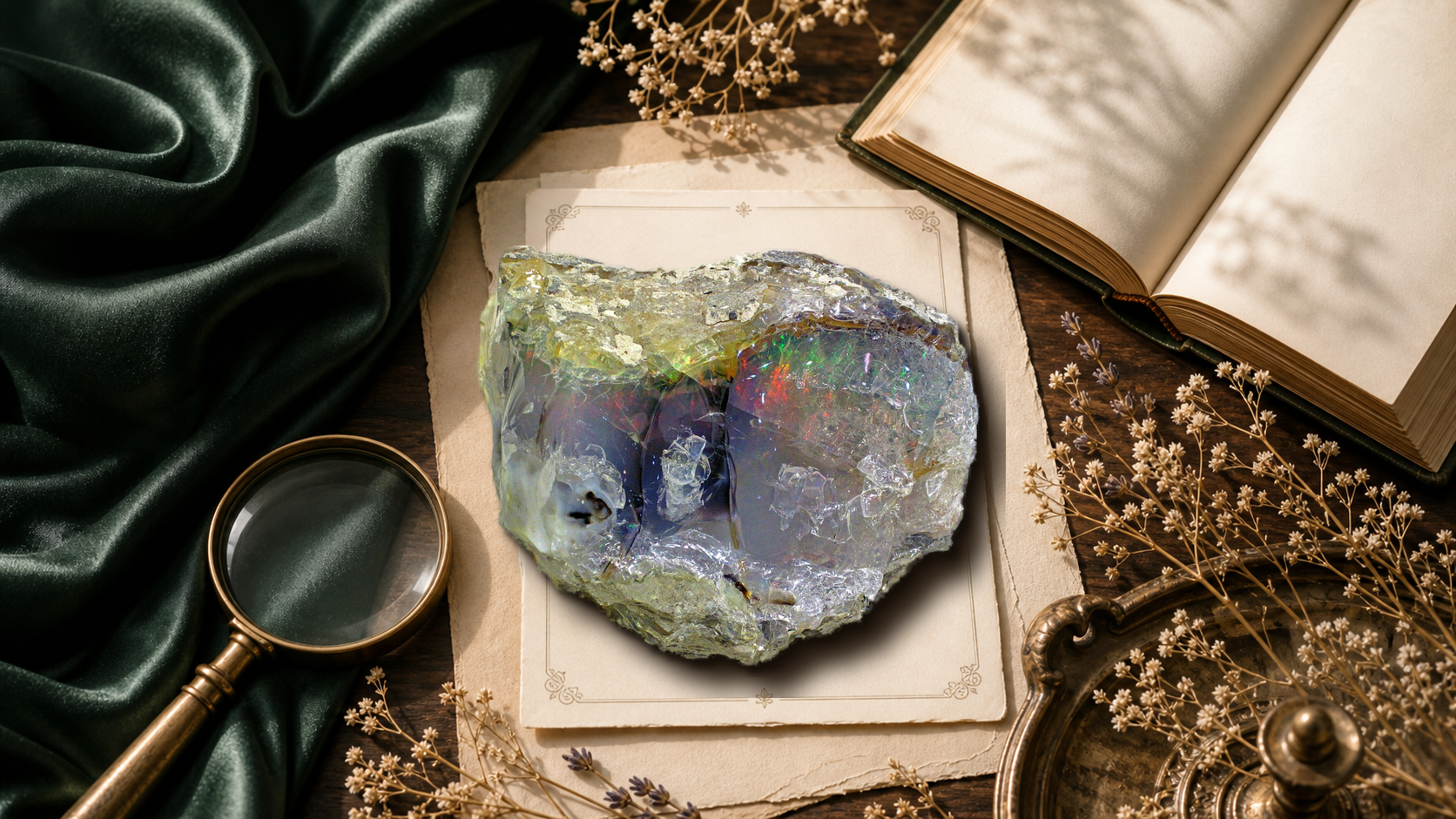
Welo opal is precious opal (hydrated amorphous silica, SiO₂·nH₂O) from the Wollo Province in the Ethiopian Highlands, discovered commercially in 2008 near the town of Wegel Tena. The opal forms within volcanic ignimbrite (welded tuff), consolidated volcanic ash deposits, rather than in the sedimentary sandstone and claystone environments typical of Australian opal. Silica-bearing groundwater percolates through the porous ignimbrite and precipitates amorphous silica spheres in void spaces.
When these spheres are uniform in size (150-350 nanometers) and stack in ordered arrays, they diffract white light into spectral colors, the phenomenon known as play of color. Welo opal is predominantly hydrophane, meaning it absorbs water and can become temporarily transparent when soaked, returning to its original translucency as it dries. This hydrophane character distinguishes it from most Australian opal and relates to the higher porosity of the volcanic host environment.
Water content typically ranges from 4 to 12 percent. The material occurs as nodules and seam fillings within the ignimbrite, at elevations around 3,000 meters in the Ethiopian Highlands.
Crystal system diagram represents the general amorphous classification. Diagram created by Crystalis for educational reference.
Amorphous structure
Chemical Formula
SiO2.nH2O (hydrophane variety)
Crystal System
Amorphous
Mohs Hardness
5.5
Specific Gravity
1.98-2.20
Luster
Vitreous to waxy
Color
White
IMA Status
trade_name
IMA Number
Grandfathered (pre-1959)
01
Mineral conditions gather
02
Structure begins to crystallize
03
Welo Opal records place and pressure
Ethiopia (Welo Province)
Telling it apart
Welo opal is most often confused with Australian white opal and synthetic hydrophane opal because all can show bright play of color against a pale body. The differences matter in care and value.
Welo opal comes from Ethiopia and is commonly hydrophane, meaning it absorbs water and may temporarily change appearance when wet. Australian white opal is usually less porous and typically forms in sedimentary host rock. Synthetic opal can mimic the play of color pattern but often shows too-regular columnar structure under magnification and lacks natural host context.
What separates them is behavior. If an opal becomes noticeably more transparent or shifts body appearance when soaked, hydrophane character strongly suggests Ethiopian material. Provenance and microscope work provide the confirming step for expensive pieces. Someone treating hydrophane Welo opal like a stable non-porous gem may accidentally damage the look they paid for. Hydrophane behavior makes Ethiopian opal fundamentally different in care requirements from Australian opal, and a buyer who does not know the difference risks damaging the stone.
Spotting the real thing
Welo opal: hydrophane test is diagnostic. Place a drop of water on the surface; genuine Welo opal absorbs it and becomes temporarily more transparent. Mohs 5.
5-6. SG 1. 98-2.
20. If the opal does not absorb water, it is not hydrophane and may be Australian or synthetic. The absorption is reversible.
Your entire energy field feels desiccated. Your crown center is present but matte; no play, no shimmer, no response to input. You feel fixed in one state, unable to shift or adapt. Your skin may feel dry. Your eyes feel flat. This is dorsal vagal dehydration of the perceptual system; your body has lost its capacity to shift states because it has conserved all its water. You are stable but you are static.
Shut down & far away
The Flooded Shift
You are cycling through states so rapidly that none of them register as yours. One moment you feel grief, the next excitement, the next nothing, the next rage. The shifts are not transitions; they are floods. Each state arrives saturated and then drains away before you can orient to it. This is sympathetic over-absorption at the crown; your system is hydrophane, taking on whatever emotional weather is present and losing structural integrity in the process.
Settled & connected
The Living Spectrum
Your state shifts but you remain present through the shift. You feel one emotion arise and can observe it playing color across your awareness without being consumed by it. Your crown is warm. Your body is fluid but not unstable. You can hold multiple wavelengths simultaneously without any of them overwhelming the others. This is ventral vagal spectral presence; the capacity to contain the full play of experience without crazing.
These associations come from tradition and reflective practice — a way of working with the stone, not a medical prescription.
Somatic Practice
Simple ways to work with Welo Opal
◇
Hold
Carry Welo Opal in a pocket or place it over the heart center during a pause.
◌
Meditate
Let the stone become a quiet tactile anchor while the breath slows.
☽
Breathe
Breathe in softness. Breathe out tension. Keep the practice simple.
✎
Journal
Write with Welo Opal nearby to name the feeling without forcing a conclusion.
✋
Bodywork
Rest the stone near the chest, hand, or bedside as a reminder to soften.
⌂
Environment
Place it where you want a visual cue for care, repair, or steadiness.
Field Instruction
The Spectral Presence
Hold Every Color Without Breaking.
5 min protocol
1
Hold Welo opal in your non-dominant hand, the receiving hand. Tilt it slowly under any available light. Watch the play of color shift as the angle changes. Do not chase any single color. Let them arrive and depart. This is the first instruction: you are practicing non-attachment to a specific state. Each flash of color is a state. Each state is temporary. The stone contains all of them simultaneously.
2
Breathe: 4 counts in through the nose, 6 counts out through the mouth. Equal ratio. The flooded-shift pattern oscillates between extremes. Equal breathing restores the midpoint -- the amorphous center from which all states emerge. Welo opal has no crystal structure. It is amorphous silica with water trapped in its body. Its play of color comes from the arrangement of silica spheres, not from crystal axes. Structure emerges from arrangement, not rigidity.
3
On the fifth breath cycle, close your hand around the stone. The play of color disappears. The stone is still holding every wavelength inside a closed fist. You cannot see the spectrum but the spectrum is still there. Breathe naturally. Feel the stone warming. Welo opal is hydrophane -- it absorbs. Right now it is absorbing your body heat. Let it. The absorption is not a loss. It is the stone learning your temperature the way it learned to hold water in the Ethiopian highlands.
4
After 5 minutes: open your hand. Look at the opal one more time. The play of color has not changed. The stone did not crack from the warmth of your body. The spectrum did not drain away in the dark of your fist. It was all there, all along. The crazing that people fear in Welo opal comes from rapid change -- sudden heat, sudden cold, sudden dryness. Not from steady, held presence. Place the stone somewhere cool and stable. Tend to it the way it tends to light: gently, responsively, and without trying to hold one color permanent.
Stone Intelligence
The fact that makes Welo Opal memorable
Hydrous silica (hydrophane variety), amorphous, Mohs 5. 5. Welo opal absorbs water through its pore structure, turning transparent when wet and returning to white when dry.
This hydrophane behavior is not a defect. It is a direct expression of the stone's nanostructure, silica spheres with spaces between them large enough to admit and release water molecules.
SCI
Aluminium diboride-type structure in Ethiopian opal-CT revealed by fast Fourier transform
Journal of Applied Crystallography · 2018Read source
Naturalis Historia, Book 37, Ch. 21-22 (De Opalio)
77
HIST
The Curious Lore of Precious Stones
1913
Ritual Use
From reference to practice
You keep absorbing experiences without processing them. Welo opal is hydrophane silica from Ethiopia, Mohs 5. 5.
It absorbs water through its pore structure, becoming transparent when wet, returning to milky white when dry. The stone takes on what enters it and releases it when conditions change. Hold it during emotional saturation.
The hydrophane behavior is the lesson: absorption is temporary if you allow the drying. You are not permanently changed by everything you take in.
Sacred Match
Sacred Match prescribes Welo Opal when you report:
Absorbing the atmosphere of every room
Appearance shifting under external contact
Need for aftercare after social exposure
Feeling porous in ways that are beautiful and exhausting
Strong sensitivity to environmental conditions
Wanting permeability with better protection
Sacred Match prescribes through physiological diagnosis, not preference. It queries the nervous system: current sensation, protective mechanism, and the biological need masked by both. When that triangulation reveals hydrophane-like sensitivity, environmental absorption, or beauty compromised by overexposure, Welo opal enters the protocol.
Absorbing -> outside conditions entering too easily -> seeking protection
Shifting -> appearance altered by contact -> seeking recovery
Sensitive -> environment writing on the body -> seeking care
Beautiful -> responsiveness carrying a cost -> seeking boundaries
Spent -> contact lingering too long -> seeking restoration It is prescribed when sensitivity is real, beautiful, and costly, and when the body needs restoration rituals equal to its permeability. The prescription stays narrow on purpose, matching material logic to body state rather than treating every bright stone as interchangeable.
Pairings are treated like a recipe file: clear use, method, and safety.
Crystal Companion
Welo Opal + Amethyst
Use when
You want to layer the primary intention with another supportive tone.
How to work with it
Place the stones together during meditation, journaling, or a short reset.
Safety
Use as a reflective practice tool, not as a medical substitute.
Crystal Companion
Welo Opal + Rhodonite
Use when
You want to layer the primary intention with another supportive tone.
How to work with it
Place the stones together during meditation, journaling, or a short reset.
Safety
Use as a reflective practice tool, not as a medical substitute.
Crystal Companion
Welo Opal + Clear Quartz
Use when
You want to layer the primary intention with another supportive tone.
How to work with it
Place the stones together during meditation, journaling, or a short reset.
Safety
Use as a reflective practice tool, not as a medical substitute.
Crystal Companion
Welo Opal + Black Tourmaline
Use when
You want to layer the primary intention with another supportive tone.
How to work with it
Place the stones together during meditation, journaling, or a short reset.
Safety
Use as a reflective practice tool, not as a medical substitute.
Selenite
The Light With Permeability.
Welo opal is hydrophane amorphous silica that drinks in water and shifts its appearance, then slowly returns as it dries. Selenite adds a cleaner, steadier luminosity beside that flicker. Both are pale and light-responsive, but selenite's gypsum body is stable where opal's is porous. Best when a person needs beauty without visual crowding. Place opal on a windowsill away from moisture and set selenite nearby where light can pass through both.
Moonstone
The Soft Body, Shifting Surface.
Both stones change with angle and conditions, but by different mechanisms. Moonstone billows through internal feldspar lamellae. Welo opal diffracts through amorphous silica spheres and can alter appearance with water uptake. The pairing teaches the difference between structural shift and absorption shift. Keep moonstone at the throat and wear Welo opal as jewelry only in dry conditions.
Black Tourmaline
The Porosity With Perimeter.
Welo opal's hydrophane nature makes it a useful symbol for people who take in too much. Black tourmaline at Mohs 7 adds the boundary language the opal at Mohs 5.5 lacks. Carry tourmaline in a pocket and leave Welo opal in a protected tray at home. One does the daily perimeter work. The other teaches what permeability feels like.
Clear Quartz
The Flash Made Legible.
Clear quartz helps focus observation of opal's play of color without competing with it chromatically. Both are SiO2 based, but quartz is crystalline where opal is not. Set the opal on dark cloth and place quartz beside it under indirect light.
Care & Cleansing
How to keep Welo Opal in good condition
Water Safe?
Use caution
Brief contact may be tolerated, but softness, coatings, fractures, or mixed mineral content can make water exposure a risk.
Sunlight Safe?
Sunlight safe
Tolerates daylight; safe to charge or display in the sun.
Authenticity
What to check
Natural Welo Opal should usually feel cooler than plastic or resin on first touch and warm more slowly in the hand.
Welo opal requires caution. Hydrophane opal (absorbs water and becomes transparent temporarily). Brief rinse is acceptable; expect the stone to change appearance temporarily.
This is normal and reversible. Avoid rapid temperature changes, ultrasonic, and prolonged dry environments. Recommended cleansing: moonlight (overnight), selenite plate.
Store at stable humidity; opal benefits from ambient moisture.
Temperature
Natural Welo Opal should usually feel cooler than plastic or resin on first touch and warm more slowly in the hand.
Scratch logic
Use 5.5 on the Mohs scale as the check, not internet myths. A real specimen should behave in line with the hardness listed above.
Surface and luster
Look for a vitreous to waxy surface quality rather than a painted or plastic shine.
Weight and density
The listed specific gravity is 1.98-2.20. If a specimen feels unusually light for its size, it may deserve a second look.
My Field Guide
Your private record and next steps
Journal
Add this stone to your private collection, then log what happened when you worked with it.
Shared Notes
Read public practice logs and pattern notes from the Crystalis community.
When members save a public field note for this stone, it will appear here.
Frequently Asked
Questions people ask about Welo Opal
What is Welo opal?
Welo opal is a volcanic opal (SiO2 nH2O) from the Wollo Province of Ethiopia, discovered in 2008. Unlike Australian opal, which forms in sedimentary environments, Welo opal forms in volcanic ash deposits. It is hydrophane, meaning it absorbs water and can become transparent when wet, then returns to its original appearance as it dries.
Is Welo opal hydrophane?
Yes. Welo opal is hydrophane, meaning it has a porous structure that absorbs water. When wet, the stone becomes more transparent and its play of color may temporarily change or disappear. As it dries, it returns to normal. This property is unique to certain volcanic opals and is a key identifier for Ethiopian material.
What chakra is Welo opal associated with?
Welo opal is mapped to the crown chakra and, because of its full-spectrum play of color, is sometimes associated with all chakras simultaneously. Practitioners describe it as a stone that reflects back whatever state your body is already in rather than imposing a direction. The play of color shifts constantly, and practitioners read that as responsive presence.
How hard is Welo opal?
Welo opal is Mohs 5.5 to 6, softer than quartz but harder than many collector minerals. As an amorphous material without crystal structure, it lacks cleavage but can be brittle. The hydrophane nature adds vulnerability — water absorption and dehydration cycles can cause crazing (fine surface cracks) over time.
Can Welo opal go in water?
Welo opal can tolerate brief water contact but prolonged soaking is not recommended. While the stone absorbs water without immediate damage, repeated wet-dry cycles can stress the internal structure and lead to crazing. If your Welo opal gets wet accidentally, let it dry slowly at room temperature away from heat sources.
Where does Welo opal come from?
Welo opal comes from the Wollo Province in the Ethiopian Highlands, specifically from volcanic deposits at elevations around 3,000 meters. It was discovered in 2008 and entered the international gem market rapidly. The deposits are distinct from the earlier Ethiopian opal finds in the Shewa Province. Mining is primarily artisanal.
What is the difference between Welo opal and Australian opal?
The key differences are geological origin and porosity. Australian opal forms in sedimentary rock and is non-porous. Welo opal forms in volcanic ash and is hydrophane (porous, absorbs water). Australian opal is generally more stable and less prone to crazing. Welo opal often displays more vivid body color and can be more affordable at comparable play of color.
Does Welo opal craze or crack?
Some Welo opal specimens are prone to crazing — developing fine surface cracks as they dehydrate. This is not universal; many specimens are perfectly stable. The risk increases with rapid temperature changes and extreme dryness. Storing Welo opal in moderate humidity and avoiding heat sources reduces the risk. Buy from dealers who have held their stock for months.
Sources & Citations
Where this entry can be checked
Back Matter
Readable for people. Structured for AI search.
Sources stay visible in the page so readers, search engines, and answer systems can follow the evidence trail.
01
SCI
Aluminium diboride-type structure in Ethiopian opal-CT revealed by fast Fourier transform
Gauthier J.-P., Stephant N., Rondeau B., Cody J. A., Fritsch E. (2018). Aluminium diboride-type structure in Ethiopian opal-CT revealed by fast Fourier transform. Journal of Applied Crystallography. [SCI]DOI 10.1107/S1600576717016387
02
SCI
Cinnabar Inclusions in Ethiopian Opal
Blumentritt F., Caplan C., Fritsch E., Notari F. (2022). Cinnabar Inclusions in Ethiopian Opal. The Journal of Gemmology. [SCI]DOI 10.15506/JoG.2022.38.3.217
03
HIST
Naturalis Historia, Book 37, Ch. 21-22 (De Opalio)
Pliny the Elder. (77). Naturalis Historia, Book 37, Ch. 21-22 (De Opalio). [HIST]
04
HIST
The Curious Lore of Precious Stones
Kunz, George Frederick. (1913). The Curious Lore of Precious Stones. [HIST]
05
LORE
New Play-of-Color Opal from Welo, Ethiopia
Bruno Rondeau, F. Mazzero, E. Bekele. (2010). New Play-of-Color Opal from Welo, Ethiopia. [LORE]
06
SCI
Mineralogical characterization of biosilicas versus geological analogs
Farfan, G.A. et al. (2023). Mineralogical characterization of biosilicas versus geological analogs. Geobiology. [SCI]DOI 10.1111/gbi.12553
07
SCI
Characterization of Natural Precious Opal from Ethiopia: The Case from Delanta South Wollo
Ejigu, A.A. et al. (2022). Characterization of Natural Precious Opal from Ethiopia: The Case from Delanta South Wollo. Journal of Spectroscopy. [SCI]DOI 10.1155/2022/3194151