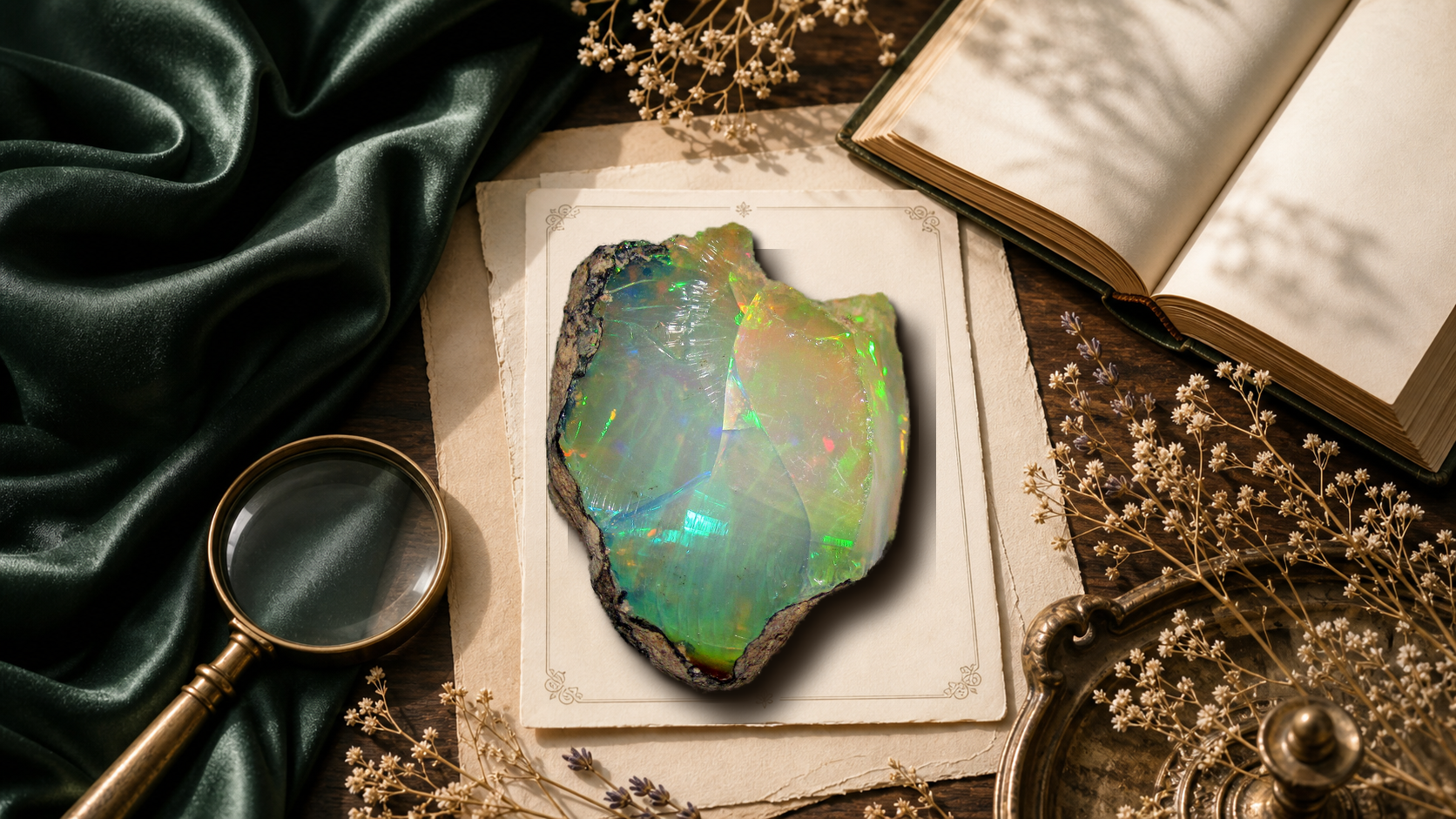
You need a lighter green than despair has been permitting. Pistachio opal gives hydrated silica a fresh spring tone without needing much spectacle. Hope can come in small edible colors.
For nervous-system work, Pistachio Opal is best understood as a material cue with a preferred landing zone. For Pistachio Opal, the key region is usually the solar...
The Meaning
Pistachio Opal in the Crystalis dictionary
Not every hope arrives as revelation. Sometimes it comes as a slightly fresher color than yesterday, small enough to miss if the psyche is still waiting for a more dramatic rescue.
Pistachio opal honors that smaller scale. The hydrated silica body stays common and quiet, but the green shifts toward a fresher, brighter, more appetizing register. The change is modest. The mood is not.
Pistachio opal helps when the self needs permission to believe in minor hope. Not every rescue has to announce itself loudly to be real.
Stone Lore
Stories carried through time
Cultural notes are presented as tradition and historical context — stories carried through time.
Unknown
Tanzanian mining communities (Merelani/Haneti)
In the Arusha region of Tanzania, where Pistachio Opal is mined alongside tanzanite in the Merelani Hills, local Maasai and Meru communities associate bright green stones with fertility, rain, and the health of cattle herds. Green is the color of grass after rains, the most life-sustaining event in semi-arid East African pastoral culture. Pistachio Opal, with its vivid green resembling the first flush of grassland after seasonal rains, has been adopted into local gift-giving customs associated with blessings for prosperity and health (Jorgensen, D.
W. & Jorgensen, M. I. , "The Maasai and Their Neighbors," 2019, East African Publishers).
Lore review
Tradition notes are being reviewed.
This entry keeps symbolic meaning separate from sourced cultural history. When dedicated tradition rows are available, they will appear here as individual lore cards.
The formation of Pistachio Opal depends less on drama than on persistence. Pistachio Opal forms through weathering and silica deposition in nickel-bearing host rocks. In mineralogical terms it is classified in amorphous hydrated silica, with chemistry summarized as SiO2, nH2O (with Ni2+ as chromophore); hydrated amorphous silicon dioxide with nickel impurity providing green color.
Water content typically 3-10% by weight. During growth, the available ions have to arrange into a repeatable lattice or stable aggregate, and this produces the physical cues collectors later use: soft green massive opal without play of color. Its standard field profile includes Amorphous symmetry, Mohs hardness around 5. 5, specific gravity 1. 98-2. 20 (lower than quartz due to water content and lower density packing), and a luster described in the source record as Vitreous to waxy; takes a good polish but lacks the play-of-color (fire) of precious opal.
Color in the traded material is commonly Green, but the more important fact is setting. Pistachio Opal typically develops in serpentinized and lateritic environments, especially East Africa, where cooling rate, fluid chemistry, or burial history stay consistent long enough for the material to stabilize. Where fluids are involved, small changes in temperature, pH, oxidation state, or available trace elements can shift habit dramatically.
Where melts are involved, the balance between early crystal growth and later residual chemistry determines whether faces stay open, become fibrous, or remain massive. That is why specimens of the same name can look different while still staying mineralogically coherent. The crystal system is not decoration. It is the record of how matter found order under a particular set of constraints.
The associated thought for this stone turns on one idea: one need a lighter green than despair has been permitting. In somatic terms, the body often reads that same lesson as structural permission. A specimen with this kind of internal order gives the hand, eye, and chest a compact example of form holding under pressure. Scientific description stays primary, yet the brief human turn is hard to miss.
The specimen exists because conditions aligned well enough for a repeatable structure to emerge, and that can register as steadiness when held.
Crystal system diagram represents the general amorphous classification. Diagram created by Crystalis for educational reference.
Amorphous structure
Chemical Formula
SiO2 . nH2O (with Ni2+ as chromophore); hydrated amorphous silicon dioxide with nickel impurity providing green color. Water content typically 3-10% by weight
Crystal System
Amorphous
Mohs Hardness
5.5
Specific Gravity
1.98-2.20 (lower than quartz due to water content and lower density packing)
Luster
Vitreous to waxy; takes a good polish but lacks the play-of-color (fire) of precious opal
Color
Green
IMA Status
trade_name
IMA Number
Grandfathered (pre-1959)
01
Mineral conditions gather
02
Structure begins to crystallize
03
Pistachio Opal records place and pressure
Tanzania produces pistachio opal from serpentinite-associated deposits where nickel provides the green color. Australia yields specimens from similar ultramafic-related environments. The nickel-bearing amorphous silica requires specific weathering conditions where nickel is released from serpentinized ultramafic rocks and incorporated into precipitating opal.
TanzaniaAustralia
Telling it apart
A stone can look close to Pistachio Opal and still fail the basic mineral checks. The main confusion is with chrysoprase, serpentine, or dyed green opal. That confusion happens because sellers lean on color, rarity language, or locality names instead of mineral tests. For a consumer, the fastest reliable check is the confirming step is lower hardness and amorphous texture without quartz translucency or fibrous serpentine feel.
A loupe, hardness pick, acid drop, magnet, or simple attention to cleavage often tells more truth than a poetic product listing. Secondary clues come from habit, heft, and setting. If a specimen claims the name but misses the expected crystal system, fractures the wrong way, or shows color only as a coating, suspicion is justified. Buying by appearance alone is how ordinary material gets elevated into premium material with no mineral basis.
With Pistachio Opal, green materials are frequently substituted and prices vary by locality. Pistachio opal is amorphous nickel-colored silica. Confirm the green comes from Ni2+ and not surface dye by checking for uniform color penetration on broken edges.
Spotting the real thing
Pistachio opal: green common opal (Mohs 5. 5-6, SG 1. 98-2.
20). No play of color. Vitreous to waxy luster.
The green from nickel is natural. If the specimen shows play of color (spectral flashes), it is precious opal, not common pistachio opal. If it is harder than Mohs 7, it is dyed quartzite, not opal.
Sympathetic activation with nausea/digestive distress:
Charged & on alert
settling
Ventral vagal depletion (compassion fatigue): The helping professions; nursing, teaching, social work, therapy; can deplete ventral vagal tone through chronic empathic engagement. Pistachio Opal's green frequency supports heart-center replenishment without adding the heaviness that darker green stones (malachite, jade) can carry. Its relatively low specific gravity (1. 98; 2. 20) gives it a physical lightness that mirrors the energetic quality it offers: renewal without weight.
State support: ventral vagal replenishment through light-frequency heart-center nourishment.
These associations come from tradition and reflective practice — a way of working with the stone, not a medical prescription.
Somatic Practice
Simple ways to work with Pistachio Opal
◇
Hold
Carry Pistachio Opal in a pocket or place it over the heart center during a pause.
◌
Meditate
Let the stone become a quiet tactile anchor while the breath slows.
☽
Breathe
Breathe in softness. Breathe out tension. Keep the practice simple.
✎
Journal
Write with Pistachio Opal nearby to name the feeling without forcing a conclusion.
✋
Bodywork
Rest the stone near the chest, hand, or bedside as a reminder to soften.
⌂
Environment
Place it where you want a visual cue for care, repair, or steadiness.
Field Instruction
The Nickel Renewal
Nickel-bearing amorphous silica at the exact center of the visible spectrum -- green that arrives not as energy but as permission to begin again.
3 min protocol
1
Hold the pistachio opal in your palm. This amorphous silica gets its green from nickel ions (Ni2+) -- a chromophore that sits at the center of the visible light spectrum. Green is the color the human eye perceives with least effort. Let your eyes rest on the stone the way they rest on distant trees. No strain.
2
Place the stone over your heart. Opal-CT type -- cristobalite-tridymite stacking -- means the silica nanospheres inside are partially ordered but not crystalline. Not chaos, not rigidity. Between. Breathe in for 4, out for 6. Ask your heart: what is trying to re-order itself in me right now? What renewal is underway that I keep interrupting by checking on it?
3
Move the stone to your belly. The water content (3-10% by weight) gives opal its lower specific gravity -- 1.98-2.20, lighter than any crystalline mineral. Feel the lightness. Imagine the water inside the stone as potential -- not inertia, not weight, but stored possibility. Breathe into the possibility without naming it.
4
Hold the stone at eye level. Pistachio green is the color of new shoots in spring. Unlike precious opal, this stone does not flash or perform. It offers steady, quiet renewal -- the kind that happens in soil before anything breaks the surface. Set the stone down with one word for what is germinating in you. Do not share the word.
Stone Intelligence
The fact that makes Pistachio Opal memorable
Green common opal from serpentinite, colored by nickel. No fire, no play of color. Just green.
The science documents nickel inclusion in amorphous silica. The practice asks what quiet confidence looks like when a gem chooses a single color and commits.
SCI
Genesis of the Body Color of Brazilian Gem-Quality Yellow-Green Opal
Seasonal fluxes and sediment routing in tropical catchments affected by nickel mining
Earth Surface Processes and Landforms · 2021Read source
Ritual Use
From reference to practice
You need renewal but the idea of starting over feels exhausting. Pistachio opal is hydrated silica colored green by nickel, Mohs 5. 5.
The green is not chlorophyll but it triggers the same visual association with growing things. Hold it at the heart during burnout that has dulled your color. The nickel that makes this stone green is an essential trace element in several bacterial enzymes.
Life at its most microscopic uses this same element. Renewal does not require grand gestures. It starts at the cellular level.
Sacred Match
Sacred Match reaches for Pistachio Opal when what you feel sounds like: rare energy spent too quickly; difficulty staying in the body when feeling rises; protective bracing across the chest or jaw; fatigue after prolonged emotional or cognitive output; a need for firmer selection and cleaner limits. Sacred Match listens to the body rather than to preference. It notices what you are feeling right now, the way you are protecting yourself, and the deeper need underneath both.
When that points to the pattern most consistent with Pistachio Opal, the prescription is based on the specimen's material logic: texture, weight, hardness, structure, and the way those properties can organize attention when placed on the body. rare energy spent too quickly -> seeking a more stable internal frame. difficulty staying in the body when feeling rises -> seeking contact that does not overwhelm.
protective bracing across the chest or jaw -> seeking boundary without full withdrawal. fatigue after prolonged emotional or cognitive output -> seeking restoration through simplification. a need for firmer selection and cleaner limits -> seeking clearer selection about what stays and what does not.
Stones and herbs that harmonize with Pistachio Opal
Pairings are treated like a recipe file: clear use, method, and safety.
Crystal Companion
Pistachio Opal + Amethyst
Use when
You want to layer the primary intention with another supportive tone.
How to work with it
Place the stones together during meditation, journaling, or a short reset.
Safety
Use as a reflective practice tool, not as a medical substitute.
Crystal Companion
Pistachio Opal + Rhodonite
Use when
You want to layer the primary intention with another supportive tone.
How to work with it
Place the stones together during meditation, journaling, or a short reset.
Safety
Use as a reflective practice tool, not as a medical substitute.
Crystal Companion
Pistachio Opal + Clear Quartz
Use when
You want to layer the primary intention with another supportive tone.
How to work with it
Place the stones together during meditation, journaling, or a short reset.
Safety
Use as a reflective practice tool, not as a medical substitute.
Crystal Companion
Pistachio Opal + Black Tourmaline
Use when
You want to layer the primary intention with another supportive tone.
How to work with it
Place the stones together during meditation, journaling, or a short reset.
Safety
Use as a reflective practice tool, not as a medical substitute.
A strong pairing strategy for Pistachio Opal depends on what the body most needs to notice first. Green Aventurine: forward motion with softer optimism. It keeps Pistachio Opal from becoming purely reflective by adding movement and next-step energy. Body placement: carry aventurine in the front pocket and wear Pistachio Opal near the heart. Rose Quartz: soft contact with emotional steadiness.
It rounds the sharper aspects of Pistachio Opal and gives the chest a friendlier landing place. Body placement: lay rose quartz over the sternum and keep Pistachio Opal just below the collarbones. Selenite: clear channel and reset. It helps Pistachio Opal move from accumulation toward release, especially after crowded days. Body placement: sweep selenite 2 to 3 inches above the shoulders, then hold Pistachio Opal at the throat.
Black Tourmaline: perimeter and weight. It gives a denser edge to Pistachio Opal, helping the body distinguish support from spillover. Body placement: tuck black tourmaline into the right pocket while Pistachio Opal rests at the sternum. The placements are intentionally specific so the body can assign each material a role instead of treating the arrangement as visual clutter. The placements are intentionally specific so the body can assign each material a role instead of treating the arrangement as visual clutter.
Care & Cleansing
How to keep Pistachio Opal in good condition
Water Safe?
Water safe
This stone is generally safe for short water contact, though polishing, fractures, and metal settings can still change how a specimen behaves.
Sunlight Safe?
Sunlight safe
Tolerates daylight; safe to charge or display in the sun.
Authenticity
What to check
Natural Pistachio Opal should usually feel cooler than plastic or resin on first touch and warm more slowly in the hand.
Pistachio opal requires caution. Common opal (hydrated silica) with nickel inclusions. Brief cool rinse is acceptable.
Avoid temperature extremes and ultrasonic. The nickel-derived green is stable. Recommended cleansing: moonlight (overnight), selenite plate (4-6 hours).
Store at stable temperature.
Temperature
Natural Pistachio Opal should usually feel cooler than plastic or resin on first touch and warm more slowly in the hand.
Scratch logic
Use 5.5 on the Mohs scale as the check, not internet myths. A real specimen should behave in line with the hardness listed above.
Surface and luster
Look for a vitreous to waxy; takes a good polish but lacks the play-of-color (fire) of precious opal surface quality rather than a painted or plastic shine.
Weight and density
The listed specific gravity is 1.98-2.20 (lower than quartz due to water content and lower density packing). If a specimen feels unusually light for its size, it may deserve a second look.
My Field Guide
Your private record and next steps
Journal
Add this stone to your private collection, then log what happened when you worked with it.
Shared Notes
Read public practice logs and pattern notes from the Crystalis community.
When members save a public field note for this stone, it will appear here.
Frequently Asked
Questions people ask about Pistachio Opal
What is Pistachio Opal?
⌄
Pistachio opal is a common opal (no play of color) colored by nickel: hydrated amorphous silicon dioxide, SiO2 . nH2O, with Ni2+ as the chromophore and water content typically 3 to 10% by weight, Mohs 5. 5 to 6. 5, softer than quartz due to its hydrated, amorphous structure. Opal is a mineraloid rather than a true mineral, with no crystal system; its internal structure consists of randomly packed or partially ordered nanospheres of silica, and pistachio opal is specifically opal-CT type (cristobalite-tridymite stacking).
It is distinct from chrysoprase, which is nickel-colored chalcedony (microcrystalline quartz, not opal), and from prase opal and green opal from other localities. The Tanzanian material is specifically valued for its vivid, saturated green, among the most intense of any common opal variety.
What is the Mohs hardness of Pistachio Opal?
⌄
Pistachio Opal has a Mohs hardness of 5.5 to 6.5 (softer than quartz due to hydrated, amorphous structure).
Can Pistachio Opal go in water?
⌄
Water Safety CONDITIONAL: Brief contact only, NO soaking. Opal is hydrated silica; it CONTAINS water as part of its structure. Paradoxically, this makes it water-sensitive. Prolonged soaking can cause crazing (network of fine surface cracks) as the stone absorbs additional water, expands unevenly, and then contracts upon drying. The Tanzanian Pistachio Opal is somewhat more stable than Australian precious opal due to its opal-CT structure (more ordered than opal-A), but water immersion is still NOT recommended.
Brief rinsing under running water: acceptable. Never soak. Never freeze after wetting. Never use in gem elixirs. Store in a humidified environment if the ambient air is very dry (below 30% relative humidity) to prevent dehydration crazing.
What crystal system is Pistachio Opal?
⌄
Pistachio Opal crystallizes in the Amorphous (no crystal system); opal is a mineraloid, not a true mineral. Internal structure consists of randomly packed or partially ordered nanospheres of silica (opal-A or opal-CT). Pistachio Opal is opal-CT type (cristobalite-tridymite stacking).
What is the chemical formula of Pistachio Opal?
⌄
The chemical formula of Pistachio Opal is SiO2, nH2O (with Ni2+ as chromophore), hydrated amorphous silicon dioxide with nickel impurity providing green color. Water content typically 3 to 10% by weight.
Is Pistachio Opal toxic?
⌄
Individuals with known nickel allergy (contact dermatitis from nickel in jewelry, belt buckles, etc.) should be aware that Pistachio Opal contains trace nickel. In polished form, the nickel is encapsulated and should not cause skin reactions. However, if the stone's surface is damaged, chipped, or abraded, trace nickel could potentially contact skin. If allergic reaction occurs, discontinue skin contact.
How does Pistachio Opal form?
⌄
Formation Story Pistachio Opal forms through the weathering and alteration of nickel-bearing ultramafic rocks under tropical to subtropical conditions in the East African geological context. The process begins with serpentinized peridotite, ancient upper mantle rock that was thrust to the surface during tectonic events and subsequently altered by hydration (serpentinization).
Sources & Citations
Where this entry can be checked
Back Matter
Readable for people. Structured for AI search.
Sources stay visible in the page so readers, search engines, and answer systems can follow the evidence trail.
01
SCI
Genesis of the Body Color of Brazilian Gem-Quality Yellow-Green Opal
Lv, H., Guo, Y. (2023). Genesis of the Body Color of Brazilian Gem-Quality Yellow-Green Opal. Crystals. [SCI]DOI 10.3390/cryst13020316
02
SCI
Water characterization and structural attribution of different colored opals
Liao, L., Li, N., Wang, Q., Guo, Q. (2022). Water characterization and structural attribution of different colored opals. RSC Advances. [SCI]DOI 10.1039/d2ra04197a
03
HIST
Naturalis Historia, Book 37
Pliny the Elder. Naturalis Historia, Book 37. [HIST]
04
SCI
Seasonal fluxes and sediment routing in tropical catchments affected by nickel mining
Domingo, Justine Perry T., Attal, Mikaël, Mudd, Simon M., Ngwenya, Bryne T., David, Carlos Primo C. (2021). Seasonal fluxes and sediment routing in tropical catchments affected by nickel mining. Earth Surface Processes and Landforms. [SCI]DOI 10.1002/esp.5198
05
SCI
Chemico‐mineralogical changes of ultramafic topsoil during stockpiling: implications for post‐mining restoration
Quintela‐Sabarís, Celestino, L''Huillier, Laurent, Mouchon, Liane‐Clarisse, Montargès‐Pelletier, Emmanuelle, Echevarria, Guillaume. (2018). Chemico‐mineralogical changes of ultramafic topsoil during stockpiling: implications for post‐mining restoration. Ecological Research. [SCI]DOI 10.1007/s11284-018-1609-x