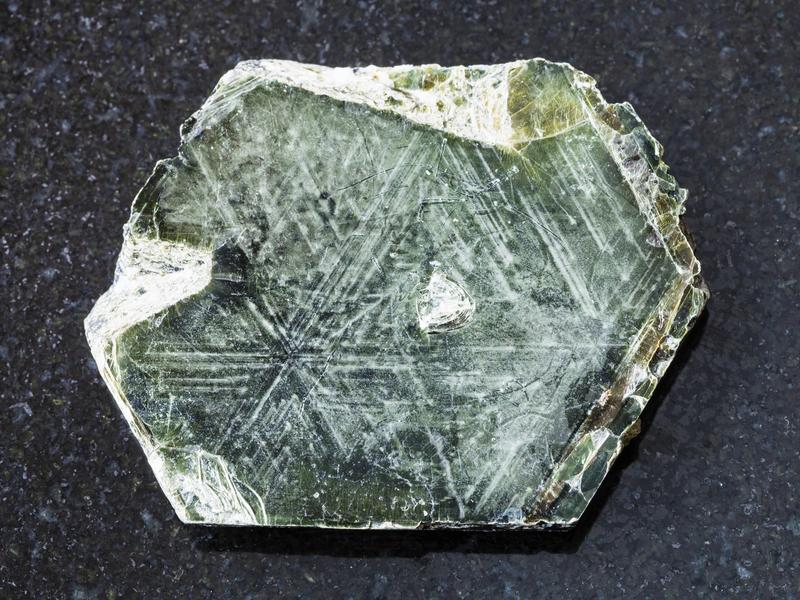
You need warmth in a format that can still peel back. Phlogopite is the bronze to brown magnesium mica, light-catching in sheets and built for layered release. Insight does not always arrive all at once.
A nervous-system account of Phlogopite starts with the fact that matter can cue state. For Phlogopite, the key region is usually the solar plexus and ribs. The nervous...
The Meaning
Phlogopite in the Crystalis dictionary
There are insights that come in strips rather than in total view. The body can only release so much at a time, and the mind keeps mistaking that pace for avoidance instead of layered honesty.
Phlogopite makes layered release look natural. Bronze-brown sheets catch light while still peeling along easy planes, so the warmth and the separation remain part of the same mineral logic. The disclosure is gradual because the structure is.
Phlogopite helps when the psyche needs a slower revelation. Some truths arrive more kindly when they come sheet by sheet.
Stone Lore
Stories carried through time
Cultural notes are presented as tradition and historical context — stories carried through time.
Unknown
Canadian indigenous mining traditions (Ontario/Quebec)
The phlogopite deposits of the Canadian Shield, particularly in the Gatineau Hills and Lanark County of Ontario, were among the largest ever discovered. While European-Canadian mining operations dominated from the 1880s-1960s, Algonquin peoples of the region had long recognized the golden mica as distinct from the darker micas. Sheets of mica were used as reflective surfaces and were incorporated into ceremonial objects.
The golden variety was associated with the sun and considered a fragment of light trapped in stone (Whiteduck, B. , "Algonquin Traditional Knowledge of Minerals," Kitigan Zibi Education Council archives, oral tradition).
Ritual history
Named from Greek for "Fire-Like"
Phlogopite takes its name from the Greek phlogopos, meaning "fire-like," in reference to its red-brown color when viewed on the cleavage plane. It is the magnesium-rich end-member of the biotite mica group (KMg₃AlSi₃O₁₀(F,OH)₂) and is a...
Ancient Greece · 300 BCE–present
Origin lore
The Amber Mica of Industry
Phlogopite is often called "amber mica" for its characteristic yellow-brown to reddish-brown color. It is distinguished from other micas by its magnesium-rich composition and higher thermal stability, making it valuable for industrial...
Modern/Scientific · 1800s CE
Earth Record
Mineralogy and formation
Every stable crystal begins as a question of environment, and Phlogopite answers that question in a distinctive way. Phlogopite forms through magnesium-rich metamorphic rocks, ultramafic settings, and kimberlites. In mineralogical terms it is classified in monoclinic mica, with chemistry summarized as KMg3AlSi3O10(OH)2; potassium magnesium aluminum silicate hydroxide. During growth, the available ions have to arrange into a repeatable lattice or stable aggregate, and this produces the physical cues collectors later use: perfect basal cleavage into flexible elastic sheets.
Its standard field profile includes Monoclinic symmetry, Mohs hardness around 2, specific gravity 2. 76-2. 90, and a luster described in the source record as Vitreous to pearly on cleavage surfaces; submetallic bronze flash on fresh surfaces. Color in the traded material is commonly Brown-Yellow, but the more important fact is setting. Phlogopite typically develops in high-temperature Mg-rich environments often above 700 C, where cooling rate, fluid chemistry, or burial history stay consistent long enough for the material to stabilize.
Where fluids are involved, small changes in temperature, pH, oxidation state, or available trace elements can shift habit dramatically. Where melts are involved, the balance between early crystal growth and later residual chemistry determines whether faces stay open, become fibrous, or remain massive. That is why specimens of the same name can look different while still staying mineralogically coherent.
The crystal system is not decoration. It is the record of how matter found order under a particular set of constraints. The associated thought for this stone turns on one idea: one need warmth in a format that can still peel back. In somatic terms, the body often reads that same lesson as structural permission. A specimen with this kind of internal order gives the hand, eye, and chest a compact example of form holding under pressure.
Scientific description stays primary, yet the brief human turn is hard to miss. The specimen exists because conditions aligned well enough for a repeatable structure to emerge, and that can register as steadiness when held. Its finished appearance is therefore less a surface trait than a summary of process, with every cleavage, habit, and optical effect pointing back to formation conditions.
Crystal system diagram represents the general monoclinic classification. Diagram created by Crystalis for educational reference.
Vitreous to pearly on cleavage surfaces; submetallic bronze flash on fresh surfaces
Color
Brown-Yellow
IMA Status
species
Type Locality
Edwards, St. Lawrence County, New York, USA
IMA Number
pre-IMA (grandfathered, redefined 1998)
01
Mineral conditions gather
02
Structure begins to crystallize
03
Phlogopite records place and pressure
Canada's kimberlite pipes produce phlogopite as a diamond indicator mineral. Madagascar yields large phlogopite books from pegmatite deposits. Russia's Kola Peninsula and Siberia produce phlogopite from alkaline igneous complexes.
The magnesium-rich mica forms in kimberlites, carbonatites, and contact metamorphic zones at each source.
CanadaMadagascarRussia
Telling it apart
The first thing to clear up about Phlogopite is the lookalike problem. The main confusion is with biotite or bronze mica sold generically. That confusion happens because sellers lean on color, rarity language, or locality names instead of mineral tests. For a consumer, the fastest reliable check is what separates them is flexible elastic sheets with lighter bronze magnesium-rich color rather than darker iron-rich biotite.
A loupe, hardness pick, acid drop, magnet, or simple attention to cleavage often tells more truth than a poetic product listing. Secondary clues come from habit, heft, and setting. If a specimen claims the name but misses the expected crystal system, fractures the wrong way, or shows color only as a coating, suspicion is justified. Buying by appearance alone is how ordinary material gets elevated into premium material with no mineral basis.
With Phlogopite, correct naming matters because industrial, geological, and collector values differ. Phlogopite separates from biotite by its lighter color and higher magnesium content. The Mohs 2 softness and perfect basal cleavage confirm you are holding a mica, but chemistry determines which one.
Spotting the real thing
Phlogopite: golden to brown mica that peels into flexible elastic sheets. Mohs 2. 5-3.
Specific gravity 2. 76-2. 90.
Pearly luster on cleavage surfaces. The golden-bronze color and perfect sheet cleavage are diagnostic. Distinguished from biotite (which is darker) by its lighter color and magnesium-rich chemistry.
Phlogopite's layered structure; thin sheets stacked upon each other, each one complete yet yielding to the next; offers a somatic metaphor for releasing accumulated tension in layers rather than all at once. The golden warmth of the stone's color registers in the visual cortex as non-threatening (warm amber tones signal firelight, safety, evening). For a nervous system stuck in agitated arousal, phlogopite models the principle that coming apart in layers is not destruction but architecture.
State shift: chaotic sympathetic toward structured decompression.
Shut down & far away
Dorsal vagal collapse (flatness/disconnection):
The pearly, reflective quality of phlogopite's cleavage surfaces catches and bends light even in dim conditions. For a nervous system in dorsal shutdown, where everything feels dull and unreachable, this unexpected flash of golden light from a seemingly humble brown stone can act as a micro-stimulus; enough visual novelty to activate orienting response without overwhelming. The warmth of its color palette (bronze, honey, copper) speaks to the mammalian nervous system differently than cool-toned stones.
State shift: dorsal toward low-level sympathetic engagement through sensory warmth.
Charged & on alert
Mixed state: sympathetic + dorsal (freeze with heat):
Phlogopite's extraordinary flexibility for a mineral; you can bend thin sheets without breaking them; mirrors the capacity this state requires. The freeze state is rigid yet internally turbulent. Working with phlogopite's physical flexibility (gently bending a thin sheet, feeling it yield and spring back) provides a proprioceptive experience of resilience that the frozen nervous system can internalize. The body learns through the hands what the mind cannot yet articulate. State shift: freeze toward mobile flexibility through tactile engagement.
Settled & connected
When already regulated, phlogopite deepens the quality of contentment associated with warmth. Its association with marble
Sympathetic depletion (exhaustion after prolonged effort): Phlogopite formed under sustained metamorphic heat, not sudden volcanic explosion. It models the slow, steady absorption of energy over time. For a depleted nervous system, the stone's formation story offers a template: recovery happens through sustained, gentle warmth; not a jolt of stimulation. Its high magnesium content resonates symbolically with the mineral most associated with muscle relaxation and nervous system recovery.
State shift: depleted sympathetic toward slow-wave parasympathetic restoration.
These associations come from tradition and reflective practice — a way of working with the stone, not a medical prescription.
Somatic Practice
Simple ways to work with Phlogopite
◇
Hold
Carry Phlogopite in a pocket or place it over the heart center during a pause.
◌
Meditate
Let the stone become a quiet tactile anchor while the breath slows.
☽
Breathe
Breathe in softness. Breathe out tension. Keep the practice simple.
✎
Journal
Write with Phlogopite nearby to name the feeling without forcing a conclusion.
✋
Bodywork
Rest the stone near the chest, hand, or bedside as a reminder to soften.
⌂
Environment
Place it where you want a visual cue for care, repair, or steadiness.
Field Instruction
The Bronze Leaf Unfold
Potassium magnesium mica with perfect basal cleavage separates into translucent bronze sheets -- release arrives in layers, not all at once.
3 min protocol
1
Hold the phlogopite specimen and observe its layered structure. This potassium-magnesium mica has perfect basal cleavage -- it separates into thin, translucent bronze sheets along one plane. Pick at a loose edge with your fingernail and notice how easily a single layer lifts. Layers release. They do not shatter.
2
Place the stone on your sternum. Phlogopite forms in metamorphosed limestones and marbles -- environments of intense heat and pressure transforming carbonate into something new. Breathe in for 4 counts, out for 6. On each exhale, let one layer of today's tension peel away. Not all of it. Just one sheet.
3
Hold the stone where light passes through it. The bronze-gold flash on fresh cleavage surfaces is caused by the way KMg3AlSi3O10(OH)2 reflects light between its silicate sheets. That flash is warmth made visible. Ask your body: where is warmth hiding behind a layer I haven't peeled yet? Breathe into that place.
4
Set the stone down. Rest both hands flat on your thighs, palms down, fingers spread -- mirroring the sheet silicate structure. The magnesium in phlogopite is the same element your muscles use to relax. Let your palms grow heavy. Let the weight of your hands be enough pressure to release whatever they are pressing against.
Stone Intelligence
The fact that makes Phlogopite memorable
Diamond prospectors follow the phlogopite. This magnesium-rich mica occurs in kimberlites, the volcanic pipes that carry diamonds from the mantle. Named from Greek for fiery, not for itself but for the color it shows near a flame.
The science documents an indicator mineral. The practice asks what service means when your value is showing the way to something more prized than you.
SCI
Recommendations for offline combustion‐based nitrogen isotopic analysis of silicate minerals and rocks
Rapid Communications in Mass Spectrometry · 2021Read source
SCI
Multiple Episodes of Fluid Infiltration Along a Single Metasomatic Channel in Metacarbonates (Mogok Metamorphic Belt, Myanmar) and Implications for CO<sub>2</sub> Release in Orogenic Belts
Journal of Geophysical Research: Solid Earth · 2020Read source
SCI
Thermal Stability of F‐Rich Phlogopite and K‐Richterite During Partial Melting of Metasomatized Mantle Peridotite With Implications for Deep Earth Volatile Cycles
Journal of Geophysical Research: Solid Earth · 2024Read source
Ritual Use
From reference to practice
You are recovering from something and your body needs warmth without stimulation. Phlogopite is potassium magnesium aluminum silicate, Mohs 2, a brown-gold mica that splits into thin flexible sheets. The name comes from the Greek phlogos, meaning "fire-like," for its warm color.
Hold a book-like sheet in your palm during recovery. The flexibility of mica is unique among minerals. It bends without breaking.
The warmth of the golden color and the give of the material create a sensory experience of softness that most minerals cannot offer.
Sacred Match
Sacred Match reaches for Phlogopite when what you feel sounds like: narratives that loop through old terrain; difficulty staying in the body when feeling rises; protective bracing across the chest or jaw; fatigue after prolonged emotional or cognitive output; a need for firmer selection and cleaner limits. Sacred Match listens to the body rather than to preference. It notices what you are feeling right now, the way you are protecting yourself, and the deeper need underneath both.
When that points to the pattern most consistent with Phlogopite, the prescription is based on the specimen's material logic: texture, weight, hardness, structure, and the way those properties can organize attention when placed on the body. narratives that loop through old terrain -> seeking a more stable internal frame. difficulty staying in the body when feeling rises -> seeking contact that does not overwhelm.
protective bracing across the chest or jaw -> seeking boundary without full withdrawal. fatigue after prolonged emotional or cognitive output -> seeking restoration through simplification. a need for firmer selection and cleaner limits -> seeking clearer selection about what stays and what does not.
Pairings are treated like a recipe file: clear use, method, and safety.
Crystal Companion
Phlogopite + Amethyst
Use when
You want to layer the primary intention with another supportive tone.
How to work with it
Place the stones together during meditation, journaling, or a short reset.
Safety
Use as a reflective practice tool, not as a medical substitute.
Crystal Companion
Phlogopite + Rhodonite
Use when
You want to layer the primary intention with another supportive tone.
How to work with it
Place the stones together during meditation, journaling, or a short reset.
Safety
Use as a reflective practice tool, not as a medical substitute.
Crystal Companion
Phlogopite + Clear Quartz
Use when
You want to layer the primary intention with another supportive tone.
How to work with it
Place the stones together during meditation, journaling, or a short reset.
Safety
Use as a reflective practice tool, not as a medical substitute.
Crystal Companion
Phlogopite + Black Tourmaline
Use when
You want to layer the primary intention with another supportive tone.
How to work with it
Place the stones together during meditation, journaling, or a short reset.
Safety
Use as a reflective practice tool, not as a medical substitute.
The pairings below treat Phlogopite as one component in a coordinated arrangement. Rose Quartz: soft contact with emotional steadiness. It rounds the sharper aspects of Phlogopite and gives the chest a friendlier landing place. Body placement: lay rose quartz over the sternum and keep Phlogopite just below the collarbones. Black Tourmaline: perimeter and weight. It gives a denser edge to Phlogopite, helping the body distinguish support from spillover.
Body placement: tuck black tourmaline into the right pocket while Phlogopite rests at the sternum. Selenite: clear channel and reset. It helps Phlogopite move from accumulation toward release, especially after crowded days. Body placement: sweep selenite 2 to 3 inches above the shoulders, then hold Phlogopite at the throat. Hematite: mass, containment, and stance. It adds unmistakable heaviness, useful when Phlogopite needs structural reinforcement.
Body placement: rest hematite at the sacrum while Phlogopite sits over the lower ribs. The placements are intentionally specific so the body can assign each material a role instead of treating the arrangement as visual clutter. The placements are intentionally specific so the body can assign each material a role instead of treating the arrangement as visual clutter. The placements are intentionally specific so the body can assign each material a role instead of treating the arrangement as visual clutter.
Care & Cleansing
How to keep Phlogopite in good condition
Water Safe?
Water safe
This stone is generally safe for short water contact, though polishing, fractures, and metal settings can still change how a specimen behaves.
Sunlight Safe?
Sunlight safe
Tolerates daylight; safe to charge or display in the sun.
Authenticity
What to check
Natural Phlogopite should usually feel cooler than plastic or resin on first touch and warm more slowly in the hand.
Phlogopite mica is water-safe but fragile. Mohs 2. 5-3, perfect basal cleavage, peels into thin flexible sheets.
Brief rinse is possible but unnecessary; water can get between layers and cause delamination. Recommended cleansing: moonlight (overnight, zero risk), smoke (30-60 seconds), selenite plate. Store flat in a padded container.
Handle by the edges.
Temperature
Natural Phlogopite should usually feel cooler than plastic or resin on first touch and warm more slowly in the hand.
Scratch logic
Use 2 on the Mohs scale as the check, not internet myths. A real specimen should behave in line with the hardness listed above.
Surface and luster
Look for a vitreous to pearly on cleavage surfaces; submetallic bronze flash on fresh surfaces surface quality rather than a painted or plastic shine.
Weight and density
The listed specific gravity is 2.76-2.90. If a specimen feels unusually light for its size, it may deserve a second look.
My Field Guide
Your private record and next steps
Journal
Add this stone to your private collection, then log what happened when you worked with it.
Shared Notes
Read public practice logs and pattern notes from the Crystalis community.
When members save a public field note for this stone, it will appear here.
Frequently Asked
Questions people ask about Phlogopite
What is Phlogopite?
⌄
Phlogopite is the magnesium end-member of the biotite mica series: a potassium magnesium aluminum silicate hydroxide, KMg3AlSi3O10(OH)2, monoclinic (space group C2/m), soft at Mohs 2 to 2. 5 and easily scratched with a fingernail. Unlike biotite (iron-rich, dark), phlogopite is magnesium-rich and therefore lighter and more golden. It belongs to the phyllosilicate (sheet silicate) group, sharing the characteristic 2:1 layer structure with muscovite and biotite, where potassium ions are sandwiched between tetrahedral-octahedral-tetrahedral (T-O-T) layers (Wang et al.
, 2015; Randhawa & Abdo, 2024); the trioctahedral structure means all three octahedral sites are occupied by Mg2+ ions.
What is the Mohs hardness of Phlogopite?
⌄
Phlogopite has a Mohs hardness of 2 to 2.5 (soft; easily scratched with a fingernail).
Can Phlogopite go in water?
⌄
Water Safety LIMITED: Brief rinsing only. Phlogopite is a soft mineral (Mohs 2-2.5) with perfect basal cleavage. Prolonged water exposure will infiltrate between the layers, potentially causing delamination and degradation of the specimen. The hydroxyl groups in the crystal structure can interact with water molecules. Brief rinsing to remove dust is acceptable; do not soak. Never use in gem elixirs. For energetic water charging, place BESIDE the water vessel, not inside it.
What crystal system is Phlogopite?
⌄
Phlogopite crystallizes in the Monoclinic, space group C2/m.
What is the chemical formula of Phlogopite?
⌄
The chemical formula of Phlogopite is KMg3AlSi3O10(OH)2, potassium magnesium aluminum silicate hydroxide.
Is Phlogopite toxic?
⌄
Fine mica dust generated by cutting, grinding, or aggressive handling can be a respiratory irritant. While phlogopite dust is not classified as carcinogenic (unlike some asbestos minerals it superficially resembles), chronic inhalation of any mineral dust should be avoided.
How does Phlogopite form?
⌄
Formation Story Phlogopite forms primarily through the metamorphism of magnesium-rich sedimentary rocks, most notably dolomitic marble and magnesian limestones. When these carbonate rocks are subjected to regional or contact metamorphism at temperatures typically between 400 and 800 degrees C, the interaction of silica, alumina, potassium, and magnesium within the rock produces phlogopite crystals embedded in a calcite or dolomite matrix.
Sources & Citations
Where this entry can be checked
Back Matter
Readable for people. Structured for AI search.
Sources stay visible in the page so readers, search engines, and answer systems can follow the evidence trail.
01
SCI
Recommendations for offline combustion‐based nitrogen isotopic analysis of silicate minerals and rocks
Li, Long, Li, Kan, Li, Yingzhou, Zhang, Ji, Du, Yifan et al. (2021). Recommendations for offline combustion‐based nitrogen isotopic analysis of silicate minerals and rocks. Rapid Communications in Mass Spectrometry. [SCI]DOI 10.1002/rcm.9075
02
SCI
Multiple Episodes of Fluid Infiltration Along a Single Metasomatic Channel in Metacarbonates (Mogok Metamorphic Belt, Myanmar) and Implications for CO<sub>2</sub> Release in Orogenic Belts
Guo, Shun, Chu, Xu, Hermann, Joerg, Chen, Yi, Li, Qiuli et al. (2020). Multiple Episodes of Fluid Infiltration Along a Single Metasomatic Channel in Metacarbonates (Mogok Metamorphic Belt, Myanmar) and Implications for CO<sub>2</sub> Release in Orogenic Belts. Journal of Geophysical Research: Solid Earth. [SCI]DOI 10.1029/2020JB020988
03
SCI
Thermal Stability of F‐Rich Phlogopite and K‐Richterite During Partial Melting of Metasomatized Mantle Peridotite With Implications for Deep Earth Volatile Cycles
Steenstra, E. S., Klaver, M., Berndt, J., Flemetakis, S., Rohrbach, A. et al. (2024). Thermal Stability of F‐Rich Phlogopite and K‐Richterite During Partial Melting of Metasomatized Mantle Peridotite With Implications for Deep Earth Volatile Cycles. Journal of Geophysical Research: Solid Earth. [SCI]DOI 10.1029/2023JB028202