Renewal has to begin before you fully believe in it. Green opal keeps common opal's soft hydrated body while taking on a leafier tone. Early growth is allowed to look tender.
Across the upper chest and breathing field, green opal corresponds to tender re-entry after depletion. It is especially relevant when the body has moved out of acute...
The Meaning
Green Opal in the Crystalis dictionary
The first stages of renewal are often too soft to trust. They look provisional, easily bruised, maybe even imaginary, especially to a psyche accustomed to more obvious proofs. Tenderness gets mistaken for weakness before it has a chance to prove otherwise.
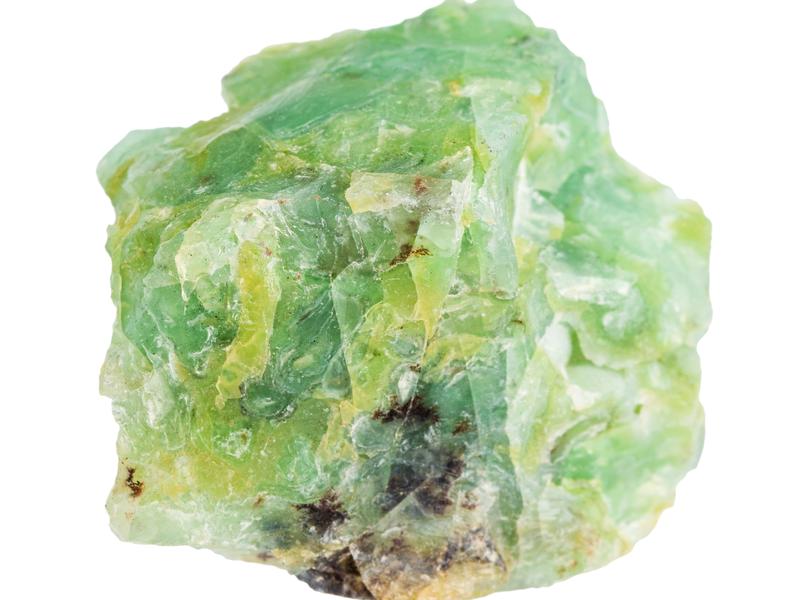
Green opal understands that stage. The mineral remains common opal: hydrated, soft-bodied, more muted than a precious opal's fire. The green does not arrive as spectacle. It arrives as leaf-tone, as a visible beginning rather than a finished season.
Green opal feels right for early recovery because it gives tenderness permission to count as growth before the evidence becomes dramatic.
The line lands later.
Stone Lore
Stories carried through time
Cultural notes are presented as tradition and historical context — stories carried through time.
Unknown
Ancient world
Opal has been known since antiquity. Pliny the Elder described opal (Latin "opalus," from Greek "opallios," possibly from Sanskrit "upala" meaning "precious stone"). However, ancient opal appreciation centered on precious (play-of-color) opal, not common green opal. - Pre-Columbian Americas: Green opal from Andean deposits may have been used by pre-Columbian cultures in Peru, though specific archaeological evidence for green opal (as opposed to other green stones like turquoise, malachite, or chrysocolla) is limited.
- 19th century: The scientific study of opal's structure began.
Lore review
Tradition notes are being reviewed.
This entry keeps symbolic meaning separate from sourced cultural history. When dedicated tradition rows are available, they will appear here as individual lore cards.
Green opal forms at low temperature where silica-rich water slows, gels, and solidifies without building the long-range atomic order of a true crystal. Its chemistry is hydrated silica, SiO2·nH2O, and its structure is amorphous to poorly ordered rather than classically crystalline. That matters immediately. Green opal does not belong to a standard crystal system in the way quartz does. Its softness, water content, and waxy luster all follow from that incomplete ordering.
The green color varies by locality and cause. In some material, nickel or iron-bearing phases contribute the tone. In others, inclusions of celadonite, nontronite, chrysocolla, or related green minerals create the body color. The host settings are also diverse: volcanic rock cavities, fracture zones, weathered silica deposits, and sedimentary replacements. What unites them is low-temperature silica deposition from groundwater or hydrothermal fluids, often in the company of other secondary minerals.
Precious opal requires regular sphere packing sufficient for play of color. Common green opal does not. Its silica arrangement is too irregular for the optical spectacle, leaving body color to carry the visual identity.
That absence is scientifically important. A stone need not produce diffraction fire to be fully itself. Green opal's water content keeps it somewhat vulnerable to dehydration, and hardness usually remains around 5.5 to 6. The surface can feel gentler and less glassy than quartz. It records an early stage of mineral organization, one that remains structurally tender even after solidification.
The somatic turn follows that tenderness. Green opal reads as early renewal, not completed architecture. A body can be coherent before it is fully hardened. In that sense the stone models development that stays moist, responsive, and still in conversation with its environment.
Crystal system diagram represents the general amorphous classification. Diagram created by Crystalis for educational reference.
Amorphous structure
Chemical Formula
SiO2 . nH2O (where n typically = 0.5-2.0, representing 3-21 wt% water)
Crystal System
Amorphous
Mohs Hardness
5.5
Specific Gravity
1.98-2.20
Luster
Vitreous to waxy to resinous
Color
Green
IMA Status
variety
IMA Number
pre-IMA
01
Mineral conditions gather
02
Structure begins to crystallize
03
Green Opal records place and pressure
Madagascar: Antananarivo and Antsirabe regions, premier source of bright apple-green to deep green common opal from laterite weathering of ultramafic rocks
Tanzania: Haneti area, Dodoma Region, nickel-bearing green opal from laterite profiles over serpentinite
Peru: Andean volcanic provinces (Ica, Arequipa regions) . "Andean Opal" in green varieties, from volcanic-hosted deposits
Brazil: Various localities in Minas Gerais, Piaui (green common opal from weathering profiles)
Turkey: Central Anatolia (green opal associated with ophiolitic rocks)
Indonesia: Sulawesi, Kalimantan (laterite nickel mining regions)
Australia: Western Australia, Queensland (minor occurrences; Australian opal is more commonly precious than common green)
Ethiopia: Wollo Province (volcanic-hosted, though Ethiopian opal is more commonly precious/hydrophane)
Green opal forms through low-temperature weathering and alteration of nickel-bearing ultramafic rocks (serpentinite, peridotite, dunite) or through precipitation from silica-rich fluids in volcanic environments. The two primary formation pathways produce geologically and geochemically distinct green opals. In the weathering pathway (laterite-hosted), tropical weathering of ultramafic rocks concentrates nickel in the near-surface weathering profile.
Silica released by the dissolution of olivine and serpentine minerals combines with nickel to precipitate as nickel-bearing opal in fractures, void spaces, and veins within the laterite profile. This is the same geological process that produces nickel laterite ore deposits, and green opal is frequently found associated with garnierite and other nickel silicate minerals. Madagascar and Tanzania green opals form primarily through this mechanism (Vigier et al.
, 2025, doi:10. 1002/bio. 70180; French et al. , 2012, doi:10. 1111/gfl. 12006).
MadagascarPeruTanzania
Telling it apart
Green opal is routinely confused with chrysoprase, variscite, serpentine, and dyed common opal. A buyer should begin by asking whether the material is hydrated amorphous silica or a different green stone entirely.
The fastest test is luster and structure. What separates green opal from chrysoprase is usually translucency pattern, waxier feel, and lower structural order. Chrysoprase is chalcedony, harder and more quartz-like. Variscite is a phosphate and often feels softer and more matte. Serpentine is usually softer still and may take a greasy polish. Dyed material often shows color concentration in cracks or unnaturally even tone.
Consumer protection matters because names such as Andean opal, chrysopal, and green opal are used loosely. Buyers should ask what creates the green color and whether the material shows any treatment. Buyers should also compare luster, translucency, and treatment disclosure before accepting the name. Buyers should also ask whether the green color comes from natural inclusions or from dye, because common opal is frequently enhanced for sale.
Opal versus chalcedony separation determines both the hardness and the care requirements, and calling green chalcedony green opal is a naming error with practical consequences.
Spotting the real thing
Green opal: Mohs 5. 5-6. Specific gravity 1.
98-2. 20. No play of color (common opal).
Vitreous to waxy luster. The green from nickel, iron, or celadonite is natural. Distinguished from dyed opal: natural green opal shows uniform coloration, while dyed specimens concentrate color along fracture lines.
If it shows play of color, it is precious opal, not common green opal.
Containment, holding emotions safely, learning to sit with what is
Faden Quartz: Rupture-repair integration, post-trauma resilience, growth through breaking - Garden Quartz: Accepting complexity, beauty in mess, releasing perfectionism - Green Opal: Heart-opening, receiving, softening without dissolving
These associations come from tradition and reflective practice — a way of working with the stone, not a medical prescription.
Somatic Practice
Simple ways to work with Green Opal
◇
Hold
Carry Green Opal in a pocket or place it over the heart center during a pause.
◌
Meditate
Let the stone become a quiet tactile anchor while the breath slows.
☽
Breathe
Breathe in softness. Breathe out tension. Keep the practice simple.
✎
Journal
Write with Green Opal nearby to name the feeling without forcing a conclusion.
✋
Bodywork
Rest the stone near the chest, hand, or bedside as a reminder to soften.
⌂
Environment
Place it where you want a visual cue for care, repair, or steadiness.
Field Instruction
The Green Reservoir
Amorphous or pseudo-crystalline hydrated silica colored green by nickel, iron, or organic compounds — a stone that holds water in its molecular architecture the way the body holds unprocessed emotion: invisibly, structurally, with consequences if it evaporates too fast.
3 min protocol
1
Hold the green opal and notice its color — ranging from pale mint to deep forest green, colored by nickel, iron compounds, or organic material depending on the deposit. This is amorphous or pseudo-crystalline hydrated silica: SiO2.nH2O, where n represents 3–21% water by weight trapped in the molecular structure. No crystal system. No ordered lattice. Just a solidified gel of silica and water. The vitreous-to-waxy luster feels organic, almost biological.
2
This opal is marked water-caution — avoid submerging it or exposing it to rapid temperature changes, which can cause crazing (fine surface cracks from too-fast dehydration). Place it against the left side of your ribcage, over the lower ribs. Hold it there gently. The water inside the opal is structural — remove it and the stone cracks. Your body operates on the same principle: remove essential water and the system crazes.
3
Breathe in through the nose for four counts. Exhale through the nose for six counts — nasal exhale only, to retain moisture. Four cycles. The green opal holds its water carefully, releasing it only slowly to the environment. Your exhale through the nose retains more moisture than mouth breathing. Match the stone's water conservation strategy with your breath.
4
Ask: What am I holding that would crack me if it evaporated too quickly? The green opal's structural water is not decorative — it is load-bearing. Some of what you carry is not excess. It is architecture. Removing it too fast causes crazing. Notice where in your body you feel something that must be released slowly, if at all — grief, responsibility, identity.
5
Remove the stone from your ribs. Hold it in your palm and observe the green one more time — the color of life processes, of chlorophyll, of growth. But this green is mineral, not biological. Set it on a dry cloth away from heat. The green reservoir holds its water. You hold yours. The practice is not about releasing — it is about recognizing what is structural.
Stone Intelligence
The fact that makes Green Opal memorable
Common opal colored by nickel, iron silicates, or celadonite inclusions. No play of color. No fire.
Just green, quiet, opaque. The science documents how common opal acquires color without the spectral drama of precious opal. The practice asks what calm looks like when it comes from a gem that opted out of being spectacular.
SCI
Chert spheroids of the Monterey Formation, California (USA): early‐diagenetic structures of bedded siliceous deposits
Silica diagenesis in <scp>C</scp>enozoic mudstones of the <scp>N</scp>orth <scp>V</scp>iking <scp>G</scp>raben: physical properties and basin modelling
- Primary indication: Heart constriction, emotional guardedness, difficulty with receiving, chest tightness from withheld grief or tenderness
- Mechanism of engagement: Green opal's translucent quality and soft green color create a visual experience of looking into something that is both structured and yielding. solid but permeable, contained but not rigid. Unlike crystalline green stones (emerald, tourmaline), opal has no hard geometric structure.
It formed as a gel that slowly solidified. This non-crystalline nature provides a somatic mirror for emotional states that need to soften without dissolving. - Polyvagal context: Supports the ventral vagal "soft front, strong back" state. The heart space can be open (soft, permeable like opal) while the rest of the system maintains structure (the silica network). Green opal specifically addresses the "armored heart" pattern.
chronic sympathetic guarding of the chest and throat that restricts both emotional expression and reception.
- Heart-opening practices that require gentleness rather than force
- Processing grief, loss, or heartbreak that has hardened into chronic guardedness
- When someone needs to practice receiving (compliments, help, love, nourishment)
- Spring transition work (opal's water content + green color = living growth energy)
- Practices involving self-compassion and self-tenderness
- When crystalline/geometric stones feel too sharp or activating
- When the emotional system is already too open, permeable, or boundary-less (opal's softness would reinforce excessive permeability)
- During states requiring grounding and structure (amorphous opal provides no structural reference)
- When strong energetic boundaries are needed (use crystalline stones with clear geometric structure instead)
- If the person has a pattern of prioritizing others' feelings over their own. more opening is not what's needed
- In highly stimulating group environments where emotional contagion is a risk (the person needs containment, not more openness)
Sacred Match
Sacred Match reaches for Green Opal when what you feel sounds like:
Tender re-entry after depletion
Need early renewal not intensity
Chest wants softness with shape
Hope returning carefully
Body too permeable for louder stones
Recovery still moist and unfinished
Sacred Match listens to the body rather than to preference. It notices what you are feeling right now, the way you are protecting yourself, and the deeper need underneath both. When that points to tender re-entry after depletion, green opal is the stone it offers.
Tender re-entry after depletion -> state identified in the body -> seeking regulation through this stone's specific structure
Need early renewal not intensity -> protective pattern active -> seeking correction
Chest wants softness with shape -> current nervous system demand -> seeking support
Body too permeable for louder stones -> old strategy still running -> seeking a more current pattern
The prescription is specific because the state is specific. Sacred Match does not sort by favorite color or trend language. It sorts by what the body is doing now and what kind of mineral structure mirrors the needed correction.
Pairings are treated like a recipe file: clear use, method, and safety.
Crystal Companion
Green Opal + Amethyst
Use when
You want to layer the primary intention with another supportive tone.
How to work with it
Place the stones together during meditation, journaling, or a short reset.
Safety
Use as a reflective practice tool, not as a medical substitute.
Crystal Companion
Green Opal + Rhodonite
Use when
You want to layer the primary intention with another supportive tone.
How to work with it
Place the stones together during meditation, journaling, or a short reset.
Safety
Use as a reflective practice tool, not as a medical substitute.
Crystal Companion
Green Opal + Clear Quartz
Use when
You want to layer the primary intention with another supportive tone.
How to work with it
Place the stones together during meditation, journaling, or a short reset.
Safety
Use as a reflective practice tool, not as a medical substitute.
Crystal Companion
Green Opal + Black Tourmaline
Use when
You want to layer the primary intention with another supportive tone.
How to work with it
Place the stones together during meditation, journaling, or a short reset.
Safety
Use as a reflective practice tool, not as a medical substitute.
Prehnite
Soft green with more structure. Prehnite offers botryoidal calcium aluminum silicate order, while green opal remains hydrated and less crystalline. Together they suit phases of renewal that need containment but not force. Place prehnite by the bed and green opal on the chest during rest.
Rose Quartz
Tender green with tender pink. This pairing is gentle and body-centered, best for recovery after emotional fatigue. Green opal brings early regrowth. Rose quartz adds warmth and permission. Keep one at the sternum and the other under the pillow.
Moss Agate
Living image with hydrated softness. Moss agate provides vegetal pattern in chalcedony, while green opal gives the same color family a more aqueous body. The pair works well in rooms meant for decompression. Place moss agate in a planter or windowsill and green opal on the nightstand.
Black Tourmaline
Soft renewal with firm edge. Green opal alone can become too diffuse for people who absorb heavily from their environment. Black tourmaline gives necessary perimeter. Carry black tourmaline outside the home and keep green opal where the body rests.
Clear Quartz
Reference and amplification. When a pairing needs one neutral witness, clear quartz does that job. It does not replace the main relationship. It clarifies it, making the dominant stone easier to read and easier to place with intention. Keep clear quartz beside the central specimen on a desk, shelf, or nightstand so the arrangement stays visually legible.
Care & Cleansing
How to keep Green Opal in good condition
Water Safe?
Use caution
Brief contact may be tolerated, but softness, coatings, fractures, or mixed mineral content can make water exposure a risk.
Sunlight Safe?
Sunlight safe
Tolerates daylight; safe to charge or display in the sun.
Authenticity
What to check
Natural Green Opal should usually feel cooler than plastic or resin on first touch and warm more slowly in the hand.
Water: CAUTION. Opal is hydrated silica. While brief water contact is fine, prolonged soaking is NOT recommended. Opal can absorb water (expanding) or lose water (contracting), and repeated wet-dry cycling causes "crazing": fine networks of surface cracks that permanently damage appearance and structural integrity. Do NOT soak Green Opal in water for cleansing rituals. Sun/light safety: CAUTION.
Prolonged direct sunlight can cause dehydration of the opal, leading to crazing and loss of translucency. The UV component of sunlight can also affect the hydration state. Display in indirect light. Do NOT use sun-charging methods on Green Opal. Heat safety: HIGH CAUTION. Opal is highly sensitive to temperature changes. Even moderate heating (40-60 degrees C) can initiate dehydration.
Never place near heat sources, radiators, sunny windowsills, or in vehicles. Rapid temperature change is the primary cause of opal damage. Chemical safety: Avoid all acids (even weak citric acid), alkaline solutions, and solvents. Opal's porous amorphous structure readily absorbs chemicals that can permanently discolor or damage the stone. Ultrasonic cleaning: ABSOLUTELY DO NOT USE.
Opal is fragile and porous. Ultrasonic cleaning will cause fracturing along the innumerable micro-pores in the amorphous structure. Mohs 5. 5-6 fragility note: Green Opal is significantly softer than quartz varieties (Mohs 7). It WILL scratch if stored with quartz, topaz, corundum, or any harder stone. Store separately in soft cloth or lined compartments. Dehydration storage: In dry climates or air-conditioned environments, consider storing Green Opal in a sealed container with a small damp (not wet) cloth to maintain ambient humidity.
Museum opal conservation follows this practice. Tumbling/lapidary note: Green opal requires careful handling during cutting and polishing. Use abundant water coolant, low speeds, and do not overheat. The stone can crack during cutting if thermal stress is not managed.
Temperature
Natural Green Opal should usually feel cooler than plastic or resin on first touch and warm more slowly in the hand.
Scratch logic
Use 5.5 on the Mohs scale as the check, not internet myths. A real specimen should behave in line with the hardness listed above.
Surface and luster
Look for a vitreous to waxy to resinous surface quality rather than a painted or plastic shine.
Weight and density
The listed specific gravity is 1.98-2.20. If a specimen feels unusually light for its size, it may deserve a second look.
My Field Guide
Your private record and next steps
Journal
Add this stone to your private collection, then log what happened when you worked with it.
Shared Notes
Read public practice logs and pattern notes from the Crystalis community.
When members save a public field note for this stone, it will appear here.
Frequently Asked
Questions people ask about Green Opal
What is Green Opal?
⌄
Green opal is a mineraloid rather than a true mineral: hydrated silica, SiO2 . nH2O, where n typically equals 0.5 to 2.0, representing 3 to 21 percent water by weight. It is amorphous (Opal-A) or pseudo-crystalline (Opal-CT, with domains of cristobalite-tridymite ordering), so no crystal system applies.
Can Green Opal go in water?
⌄
CAUTION. Opal is hydrated silica. While brief water contact is fine, prolonged soaking is NOT recommended. Opal can absorb water (expanding) or lose water (contracting), and repeated wet-dry cycling causes "crazing", fine networks of surface cracks that permanently damage appearance and structural integrity. Do NOT soak Green Opal in water for cleansing rituals.
Can Green Opal go in the sun?
⌄
CAUTION. Prolonged direct sunlight can cause dehydration of the opal, leading to crazing and loss of translucency. The UV component of sunlight can also affect the hydration state. Display in indirect light. Do NOT use sun-charging methods on Green Opal.
What crystal system is Green Opal?
⌄
Green Opal crystallizes in the Amorphous (Opal-A) or pseudo-crystalline (Opal-CT, with domains of cristobalite-tridymite ordering).
What is the chemical formula of Green Opal?
⌄
The chemical formula of Green Opal is - SiO2, nH2O (where n typically = 0.5-2.0, representing 3-21 wt% water).
Where is Green Opal found?
⌄
- Madagascar: Antananarivo and Antsirabe regions, premier source of bright apple-green to deep green common opal from laterite weathering of ultramafic rocks - Tanzania: Haneti area, Dodoma Region, nickel-bearing green opal from laterite profiles over serpentinite - Peru: Andean volcanic provinces (Ica, Arequipa regions), "Andean Opal" in green varieties, from volcanic-hosted deposits - Brazil: Various localities in Minas Gerais, Piaui (green common opal from weathering profiles) - Turkey: Central Anatolia (green opal associated with ophiolitic rocks) - Indonesia: Sulawesi, Kalimantan (laterite nickel mining regions) - Australia: Western Australia, Queensland (minor occurrences; Australian opal is more commonly precious than common green) - Ethiopia: Wollo Province (volcanic-hosted, though Ethiopian opal is more commonly precious/hydrophane).
How does Green Opal form?
⌄
Green opal forms through low-temperature weathering and alteration of nickel-bearing ultramafic rocks (serpentinite, peridotite, dunite) or through precipitation from silica-rich fluids in volcanic environments. The two primary formation pathways produce geologically and geochemically distinct green opals. In the weathering pathway (laterite-hosted), tropical weathering of ultramafic rocks concentrates nickel in the near-surface weathering profile.
Sources & Citations
Where this entry can be checked
Back Matter
Readable for people. Structured for AI search.
Sources stay visible in the page so readers, search engines, and answer systems can follow the evidence trail.
01
SCI
Chert spheroids of the Monterey Formation, California (USA): early‐diagenetic structures of bedded siliceous deposits
BEHL, RICHARD J. (2011). Chert spheroids of the Monterey Formation, California (USA): early‐diagenetic structures of bedded siliceous deposits. Sedimentology. [SCI]DOI 10.1111/j.1365-3091.2010.01165.x
02
SCI
Structure of a silica diagenetic transformation zone: the Gjallar Ridge, offshore Norway
IRELAND, MARK T., DAVIES, RICHARD J., GOULTY, NEIL R., CARRUTHERS, DANIEL. (2011). Structure of a silica diagenetic transformation zone: the Gjallar Ridge, offshore Norway. Sedimentology. [SCI]DOI 10.1111/j.1365-3091.2010.01170.x
03
SCI
Silica diagenesis in <scp>C</scp>enozoic mudstones of the <scp>N</scp>orth <scp>V</scp>iking <scp>G</scp>raben: physical properties and basin modelling
Wrona, Thilo, Jackson, Christopher A.‐L., Huuse, Mads, Taylor, Kevin G. (2015). Silica diagenesis in <scp>C</scp>enozoic mudstones of the <scp>N</scp>orth <scp>V</scp>iking <scp>G</scp>raben: physical properties and basin modelling. Basin Research. [SCI]DOI 10.1111/bre.12168
04
SCI
Diagenesis of spiculites and carbonates in a Permian temperate ramp succession – Tempelfjorden Group, Spitsbergen, Arctic Norway
Matysik, Michał, Stemmerik, Lars, Olaussen, Snorre, Brunstad, Harald. (2017). Diagenesis of spiculites and carbonates in a Permian temperate ramp succession – Tempelfjorden Group, Spitsbergen, Arctic Norway. Sedimentology. [SCI]DOI 10.1111/sed.12404
05
SCI
Gem quality and archeological green ‘jadeite jade’ <i>versus</i> ‘omphacite jade’
Coccato, Alessia, Karampelas, Stefanos, Wörle, Marie, van Willigen, Samuel, Pétrequin, Pierre. (2014). Gem quality and archeological green ‘jadeite jade’ <i>versus</i> ‘omphacite jade’. Journal of Raman Spectroscopy. [SCI]DOI 10.1002/jrs.4512
06
SCI
Characterization of Blue Tourmaline from Madagascar for Exploring Its Color Origin
Li, Ming. (2022). Characterization of Blue Tourmaline from Madagascar for Exploring Its Color Origin. Advances in Condensed Matter Physics. [SCI]DOI 10.1155/2022/7167793
07
SCI
New Insights on the Origin of the Blue Photoluminescence of Natural Opal Through Raman Spectroscopy
Vigier, Maxence, Gouzy, Simon, Rondeau, Benjamin, Fritsch, Emmanuel. (2025). New Insights on the Origin of the Blue Photoluminescence of Natural Opal Through Raman Spectroscopy. Luminescence. [SCI]DOI 10.1002/bio.70180
08
HIST
Naturalis Historia, Book 37, Ch. 21-22 (De Opalio)
Pliny the Elder. (77). Naturalis Historia, Book 37, Ch. 21-22 (De Opalio). [HIST]
09
HIST
The Curious Lore of Precious Stones
Kunz, George Frederick. (1913). The Curious Lore of Precious Stones. [HIST]