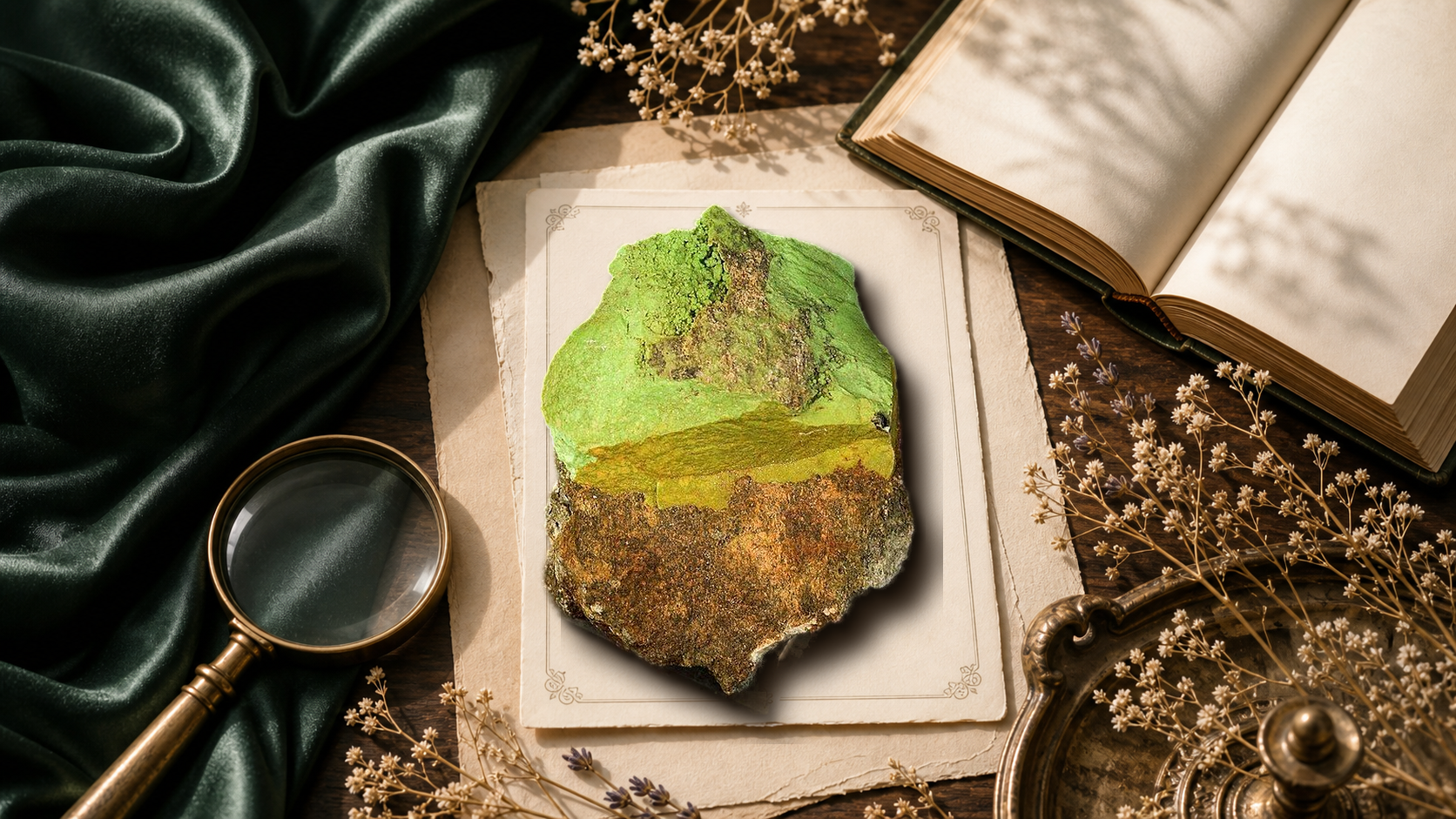
You need a brighter green than patience has been giving you. Gaspeite is a nickel carbonate with a tart apple color that refuses subtlety. Refreshment does not always arrive gently.
Gaspeite works most clearly with nervous systems stuck in low-grade stagnation rather than acute collapse. The body is still online, but the field feels stale,...
The Meaning
Gaspeite in the Crystalis dictionary
Some emotional landscapes become so overcast that even the idea of refreshment starts sounding theoretical. Patience has done its job. Softness has done its job. What the body wants now is a sharper green, something abrupt enough to restart appetite.
Gaspeite is perfect for that moment. The nickel carbonate body carries an unmistakable apple-green color, bright enough to wake the eye before the mind has a chance to downplay it. The refreshment is mineral, not polite.
Gaspeite does not wait for the room to be ready. It changes the room's temperature by entering it. For the heart that has gone too muted for too long, that kind of green can feel like a clean interruption.
Stone Lore
Stories carried through time
Cultural notes are presented as tradition and historical context — stories carried through time.
Unknown
A Short History: From the Gaspé Peninsula to the Silver Trade
Gaspeite is a young mineral by scientific standards, first formally described as a species in 1966 by Kohls & Rodda from specimens found on the Gaspé Peninsula in Quebec. In the late 20th century, Australian material, particularly from Kambalda, entered the gem and lapidary market, and through the 1990s and 2000s gaspeite became popular in Southwestern US jewelry, often set in silver alongside turquoise. Today it is considered rare and collectible, and prices have risen as the Australian sources have become depleted.
Lore & history
Trade name origin
Named after the Gaspe Peninsula, Quebec, Canada, which in turn derives from the Mi'kmaq word "Gespe'g" meaning "end of the land" or "land's end." The Mi'kmaq (also Mi'gmaq) are the Indigenous people of this region.
Unknown
Historical note
Named for Canada's Gaspé Peninsula
Gaspeite was first described in 1966 by American mineralogists D.W. Kohls and J.L. Rodda, who named it for the Gaspé Peninsula in eastern Québec, Canada, where it was discovered at the Mount Albert prospect. It is a rare nickel carbonate...
Modern/Scientific · 1966 CE
Lore & history
Australia's Apple-Green Nickel Carbonate
While first described from the Gaspé Peninsula, Quebec, the finest gem-quality gaspeite specimens have come from Western Australia, particularly the Widgiemooltha district and the 132 North mine. The mineral forms as an oxidation product...
Modern/Scientific · 1966–present
Earth Record
Mineralogy and formation
Gaspeite is a nickel carbonate, ideally NiCO3, though magnesium and iron commonly substitute into the structure. It crystallizes in the trigonal system and typically forms as crusts, earthy masses, veinlets, or compact nodules in the oxidized zones of nickel-bearing deposits. Its appeal begins with color: a tart yellow-green to apple-green that is difficult to confuse once seen in natural material.
Yet the more important fact is environmental. Gaspeite is a secondary mineral, formed not in deep magmatic chambers but during weathering and near-surface alteration of nickel-rich rocks.
When primary nickel minerals such as pentlandite, millerite, or nickel-bearing serpentine systems break down under oxygenated groundwater, nickel can migrate and recombine with carbonate ions. In suitable pH conditions, gaspeite precipitates as a bright supergene phase, often alongside chrysoprase, garnierite, limonite, or other nickel alteration products. Australia and the Gaspé region of Quebec are classic associations, and the mineral's name reflects that Canadian occurrence even though Australian material dominates much of the market.
As a carbonate, gaspeite is softer than quartz, commonly around Mohs 4.5 to 5, with a relatively modest density compared with metal-rich sulfides. Its trigonal symmetry links it structurally to other carbonate-group minerals such as calcite and magnesite, though it rarely appears as large showy crystals in retail specimens. More often it is admired in polished material, beads, or cabochons where the saturated green can read almost electric.
Gaspeite carries a bodily impression of refreshment arriving in mineral form. Its geology is weathering, release, and reassembly into a color that refuses subtlety. The somatic turn follows that brightness closely. Some forms of recovery do not arrive as calm. They arrive as a clean, tart signal that cuts through stagnation and reminds the body what freshness feels like.
Crystal system diagram represents the general trigonal classification. Diagram created by Crystalis for educational reference.
Trigonal structure
Chemical Formula
(Ni,Mg,Fe)CO3; predominantly NiCO3 with Mg and Fe substitution
Crystal System
Trigonal
Mohs Hardness
4.5
Specific Gravity
3.71 (pure NiCO3); typically 3.4-3.7 with Mg/Fe substitution
Luster
Vitreous to dull
Color
Green
IMA Status
species
Type Locality
New Jersey Zinc Exploration Co. trench, Mont-Albert, Québec, Canada
IMA Number
1965-029
01
Mineral conditions gather
02
Structure begins to crystallize
03
Gaspeite records place and pressure
Gaspe Peninsula, Quebec, Canada (type locality; first described 1966)
Kambalda and Widgiemooltha, Western Australia (gem-quality material)
Lord Brassey Mine, Tasmania, Australia
Noril'sk, Siberia, Russia
Various nickel laterite deposits in New Caledonia, Indonesia, Philippines (as minor phase)
Gaspeite is a relatively rare nickel carbonate that forms as a secondary mineral in the oxidation zone (supergene environment) of nickel sulfide ore deposits. It occurs where nickel-bearing sulfide minerals (such as pentlandite and millerite) weather in the presence of carbonate-rich groundwater. The Ni2+ released by sulfide oxidation reacts with dissolved carbonate (CO3 2-) to precipitate gaspeite, often as botryoidal crusts, massive aggregates, or as a replacement of other carbonate minerals.
The mineral belongs to the calcite group, forming a solid solution series with magnesite (MgCO3) and siderite (FeCO3), with natural specimens typically containing significant Mg and Fe substitution. Gaspeite's type locality on the Gaspe Peninsula, Quebec, Canada, is a classic nickel sulfide district where the mineral was first described in 1966 (by Kohls & Rodda). The occurrence context, secondary weathering crust on nickel sulfide ore, is typical.
Australian occurrences (Kambalda, Western Australia) have produced the most visually striking gem-quality material, with the vivid apple-green color that has made gaspeite popular in jewelry, particularly in Southwestern US markets where it is sometimes set alongside turquoise and coral.
AustraliaCanada (GaspéQuebec)
Telling it apart
Gaspeite is frequently confused with chrysoprase, dyed magnesite, dyed howlite, and other bright green jewelry stones. The fastest test is matrix, hardness, and color character. Gaspeite often shows a slightly chalkier, more opaque body color than the translucent apple-green of good chrysoprase. It is also softer. A seller should never market every opaque green nickel stone as chrysoprase.
What separates gaspeite from dyed material is distribution and context. Natural gaspeite often occurs with brown matrix, nickel-bearing host, or uneven saturation that follows real mineral boundaries. Dyed stones may show color pooling in cracks, overly uniform neon tone, or suspiciously white matrix. The confirming step is magnification and honest disclosure. If the seller cannot distinguish carbonate-based gaspeite from chalcedony chrysoprase, caution is warranted.
The buyer should leave with one practical rule: identify the host mineral first, then judge color, texture, and any trade-name language after the physical facts are clear. Nickel carbonate identification at this specific gravity range has few mineral competitors, but dyed magnesite and dyed howlite imitations are common enough to check for.
Spotting the real thing
Gaspeite: bright apple-green nickel carbonate. Specific gravity 3. 4-3.
7 (heavier than it looks). Effervesces in acid (carbonate). Mohs 4.
5-5. Very rare; if offered cheaply in large quantities, question provenance. Contains nickel; handle briefly.
The bright green and acid reaction together are diagnostic.
When energy feels stuck and the body won't respond. Gaspeite is placed on the body as an anchor point. Your shoulders drop. Your breath becomes shallow and barely audible. A heaviness settles in your limbs. This is dorsal vagal shutdown; your oldest survival circuit pulling you toward stillness, collapse, disconnection from sensation.
Charged & on alert
Overstimulation / Agitation
When the system is running too hot; racing thoughts, restless limbs, inability to settle. Your chest tightens. Your jaw clenches. Your breath moves higher, shallower, faster. This is sympathetic activation; your body mobilizing for fight or flight, muscles tensing, heart rate rising.
Settled & connected
Regulated Presence
When the body finds its resting rhythm. Gaspeite held or placed becomes a touchpoint for presence. Your chest opens. Your jaw unclenches. Your breath deepens into your belly. This is ventral vagal regulation; your body finding safety, social connection, steady presence.
These associations come from tradition and reflective practice — a way of working with the stone, not a medical prescription.
Somatic Practice
Simple ways to work with Gaspeite
◇
Hold
Carry Gaspeite in a pocket or place it over the heart center during a pause.
◌
Meditate
Let the stone become a quiet tactile anchor while the breath slows.
☽
Breathe
Breathe in softness. Breathe out tension. Keep the practice simple.
✎
Journal
Write with Gaspeite nearby to name the feeling without forcing a conclusion.
✋
Bodywork
Rest the stone near the chest, hand, or bedside as a reminder to soften.
⌂
Environment
Place it where you want a visual cue for care, repair, or steadiness.
Field Instruction
The Nickel Anchor
Trigonal nickel magnesium iron carbonate at Mohs 4.5, dense at 3.4–3.7 g/cm3 — one of the few bright green carbonates, colored by nickel, teaching the body that rare chemistry produces rare grounding.
3 min protocol
1
Hold the gaspeite and observe the distinctive bright apple-green to lime-green color. This is one of the rarest green carbonates: (Ni,Mg,Fe)CO3, primarily nickel carbonate. The green comes from nickel — the same element used in stainless steel and rechargeable batteries. At Mohs 4.5, it scratches with a knife. Handle with respect. The trigonal (rhombohedral) crystal system is the same as calcite, but the nickel makes everything different.
2
Place the gaspeite in your dominant palm and close your fingers loosely around it. At SG 3.4–3.7, it is noticeably dense for a carbonate — the nickel adds weight. Feel the density settle into your palm. This stone formed in nickel sulfide ore deposits as a weathering product. It is what happens when nickel meets carbon dioxide and water over geological time. Destruction of ore produced this vivid green.
3
Press the closed fist gently against your solar plexus. Breathe in through the nose for three counts, out through the mouth for six — a 1:2 ratio. Repeat four times. The vitreous-to-dull luster of gaspeite means it does not sparkle. It glows. The green is uniform, not flashy. Your exhale should match: steady output, no performance, twice the length of input.
4
Ask: Where in my life is something rare and valuable forming from the breakdown of something harder? Gaspeite is a secondary mineral — it does not form first. It forms from the weathering of primary nickel ores. The rare green beauty is a product of decomposition. Notice where decomposition in your own life might be producing something you have not yet recognized as beautiful.
5
Open your hand and look at the gaspeite's green one more time. Set it down on a soft surface — at Mohs 4.5, harder surfaces will scratch it. The nickel anchor has grounded your solar plexus. The rare green does not need to be common to be real.
Stone Intelligence
The fact that makes Gaspeite memorable
A nickel carbonate so rare most dealers have never stocked it. Bright apple-green from a handful of localities worldwide. The science documents nickel mineralization in lateritic weathering profiles.
The practice asks what value means when scarcity is not a marketing strategy but a geological fact.
SCI
Geochemical constraints on the mobilization of Ni and critical metals in laterite deposits, Sulawesi, Indonesia: A mass‐balance approach
Cadmium and nickel co‐exposure exacerbates genotoxicity and not oxido‐inflammatory stress in liver and kidney of rats: Protective role of omega‐3 fatty acid
Nervous system states addressed:
- Stagnation / emotional heaviness: Gaspeite's vivid green color and association with secondary formation (transformation of one mineral into another through weathering) speaks to processes of renewal after breakdown.
- Grief that has calcified: As a carbonate mineral formed from the weathering of harder sulfide minerals, gaspeite embodies the principle that dissolution can produce something new and differently beautiful.
When to use:
- ONLY with hand-washing protocol observed
- When working with themes of transformation and renewal
- Visual meditation only (holding with recently washed or gloved hands)
- Brief handling sessions, not prolonged skin contact
When NOT to use:
- Do NOT use for body layouts directly on bare skin for extended periods
- Do NOT use in baths, elixirs, or any water-based preparation
- Do NOT use with anyone who has known nickel allergy or sensitivity
- Do NOT use with children
- Do NOT allow prolonged contact with mucous membranes, broken skin, or sensitive areas
- If skin reaction occurs (redness, itching, rash), discontinue immediately
Recommended practice modification: For practitioners who wish to work with gaspeite's visual and contemplative qualities, the safest approach is displaying the stone at eye level during meditation rather than holding it. Alternatively, place it on a cloth or in a glass dish for visual focus work. The green color can serve the nervous system through the visual channel without the need for direct skin contact.
Sacred Match
Sacred Match reaches for Gaspeite when what you feel sounds like:
Patience gone flat
Need for a bright reset
Stagnation with intact function
Energy returning but dull
Wanting freshness, not softness
Sacred Match listens to the body rather than to preference. It notices what you are feeling right now, the way you are protecting yourself, and the deeper need underneath both. When that points to a body needing refreshment more than soothing, Gaspeite is the stone it offers. The prescription relies on secondary nickel carbonate chemistry and unmistakable color. Gaspeite forms through weathering and reassembly, offering the nervous system a model of brightness emerging from alteration rather than denial.
Need for a bright reset -> low-grade stagnation persisting -> seeking interruption
Stagnation with intact function -> competence present, vitality muted -> seeking lift
Energy returning but dull -> recovery underway without spark -> seeking sharper signal
Wanting freshness, not softness -> comfort insufficient -> seeking renewal The protocol is chosen for fit, not romance. It looks for the clearest material mirror of the body's current pattern and then uses that mirror to support a more stable response.
Pairings are treated like a recipe file: clear use, method, and safety.
Crystal Companion
Gaspeite + Amethyst
Use when
You want to layer the primary intention with another supportive tone.
How to work with it
Place the stones together during meditation, journaling, or a short reset.
Safety
Use as a reflective practice tool, not as a medical substitute.
Crystal Companion
Gaspeite + Rhodonite
Use when
You want to layer the primary intention with another supportive tone.
How to work with it
Place the stones together during meditation, journaling, or a short reset.
Safety
Use as a reflective practice tool, not as a medical substitute.
Crystal Companion
Gaspeite + Clear Quartz
Use when
You want to layer the primary intention with another supportive tone.
How to work with it
Place the stones together during meditation, journaling, or a short reset.
Safety
Use as a reflective practice tool, not as a medical substitute.
Crystal Companion
Gaspeite + Black Tourmaline
Use when
You want to layer the primary intention with another supportive tone.
How to work with it
Place the stones together during meditation, journaling, or a short reset.
Safety
Use as a reflective practice tool, not as a medical substitute.
Fresh Current. Pair gaspeite with smoky quartz when the goal is renewal without losing grounding. Gaspeite brings tart green lift. Smoky quartz keeps the body from floating on that brightness. Place gaspeite on the upper chest or desk and smoky quartz low at the lap or feet.
Nickel Spring. Pair it with chrysoprase for green-on-green work that distinguishes two kinds of renewal. Chrysoprase is softer in mood and more translucent. Gaspeite is sharper, brighter, and more abrupt. Put chrysoprase nearest the heart and gaspeite just above it toward the collarbone.
Clear Perimeter. Pair it with black tourmaline when enthusiasm needs containment. Gaspeite can feel invigorating. Black tourmaline sets the edge so the lift does not scatter. One belongs in view. The other belongs on the body or at the threshold.
Bright Reset. Pair it with selenite for stale mental fields that need both clearing and refreshment. Stand selenite behind and set gaspeite in front, letting the green work as the first visible note after the white clearing line. Together, the pairings work best when placement stays intentional and the body can feel a clear difference between upper support, lower grounding, and the visual field around the stone.
Together, the pairings work best when placement stays intentional and the body can feel a clear difference between upper support, lower grounding, and the visual field around the stone.
Care & Cleansing
How to keep Gaspeite in good condition
Water Safe?
Keep dry
This stone should stay out of water. Water can dull the surface, destabilize the specimen, or damage the stone over time.
Sunlight Safe?
Sunlight safe
Tolerates daylight; safe to charge or display in the sun.
Authenticity
What to check
Natural Gaspeite should usually feel cooler than plastic or resin on first touch and warm more slowly in the hand.
Gaspeite is NOT water-safe and contains nickel. Nickel carbonate (NiCO3), Mohs 4. 5-5, soft carbonate mineral.
Do not place in water or gem elixirs. Nickel compounds are documented skin sensitizers and ingestion toxins (Wu et al. , 2014).
Handle briefly, wash hands after contact. Avoid acid, which dissolves carbonates. Recommended cleansing: moonlight only (overnight), selenite plate (4-6 hours).
Store in a sealed pouch, separately from practice stones. Display specimen.
Temperature
Natural Gaspeite should usually feel cooler than plastic or resin on first touch and warm more slowly in the hand.
Scratch logic
Use 4.5 on the Mohs scale as the check, not internet myths. A real specimen should behave in line with the hardness listed above.
Surface and luster
Look for a vitreous to dull surface quality rather than a painted or plastic shine.
Weight and density
The listed specific gravity is 3.71 (pure NiCO3); typically 3.4-3.7 with Mg/Fe substitution. If a specimen feels unusually light for its size, it may deserve a second look.
My Field Guide
Your private record and next steps
Journal
Add this stone to your private collection, then log what happened when you worked with it.
Shared Notes
Read public practice logs and pattern notes from the Crystalis community.
When members save a public field note for this stone, it will appear here.
Frequently Asked
Questions people ask about Gaspeite
What is Gaspeite?
⌄
Gaspeite is a carbonate of the calcite group: (Ni,Mg,Fe)CO3, predominantly nickel carbonate (NiCO3) with Mg and Fe substitution. It crystallizes in the trigonal (rhombohedral) system, space group R-3c, the same as calcite, and has a Mohs hardness of 4.5 to 5.
What is the Mohs hardness of Gaspeite?
⌄
Gaspeite has a Mohs hardness of 4.5-5.
What crystal system is Gaspeite?
⌄
Gaspeite crystallizes in the Trigonal (Rhombohedral); space group R-3c (same as calcite).
What is the chemical formula of Gaspeite?
⌄
The chemical formula of Gaspeite is (Ni,Mg,Fe)CO3: predominantly NiCO3 with Mg and Fe substitution.
Where is Gaspeite found?
⌄
- Gaspe Peninsula, Quebec, Canada (type locality; first described 1966) - Kambalda and Widgiemooltha, Western Australia (gem-quality material) - Lord Brassey Mine, Tasmania, Australia - Noril'sk, Siberia, Russia - Various nickel laterite deposits in New Caledonia, Indonesia, Philippines (as minor phase)
How does Gaspeite form?
⌄
Gaspeite is a relatively rare nickel carbonate that forms as a secondary mineral in the oxidation zone (supergene environment) of nickel sulfide ore deposits. It occurs where nickel-bearing sulfide minerals (such as pentlandite and millerite) weather in the presence of carbonate-rich groundwater. The Ni2+ released by sulfide oxidation reacts with dissolved carbonate (CO3 2-) to precipitate gaspeite, often as botryoidal crusts, massive aggregates, or as a replacement of other carbonate minerals.
Sources & Citations
Where this entry can be checked
Back Matter
Readable for people. Structured for AI search.
Sources stay visible in the page so readers, search engines, and answer systems can follow the evidence trail.
01
SCI
Geochemical constraints on the mobilization of Ni and critical metals in laterite deposits, Sulawesi, Indonesia: A mass‐balance approach
Ito, Akane, Otake, Tsubasa, Maulana, Adi, Sanematsu, Kenzo, Sufriadin, et al. (2021). Geochemical constraints on the mobilization of Ni and critical metals in laterite deposits, Sulawesi, Indonesia: A mass‐balance approach. Resource Geology. [SCI]DOI 10.1111/rge.12266
02
SCI
Syntectonic Mobility of Supergene Nickel Ores of New Caledonia (Southwest Pacific). Evidence from Garnierite Veins and Faulted Regolith
Cluzel, Dominique, Vigier, Benoit. (2008). Syntectonic Mobility of Supergene Nickel Ores of New Caledonia (Southwest Pacific). Evidence from Garnierite Veins and Faulted Regolith. Resource Geology. [SCI]DOI 10.1111/j.1751-3928.2008.00053.x
03
SCI
Cadmium and nickel co‐exposure exacerbates genotoxicity and not oxido‐inflammatory stress in liver and kidney of rats: Protective role of omega‐3 fatty acid
Owumi, Solomon E., Olayiwola, Yusuff O., Alao, Gbenga E., Gbadegesin, Michael A., Odunola, Oyeronke A. (2019). Cadmium and nickel co‐exposure exacerbates genotoxicity and not oxido‐inflammatory stress in liver and kidney of rats: Protective role of omega‐3 fatty acid. Environmental Toxicology. [SCI]DOI 10.1002/tox.22860
04
SCI
Deposition of nickel, chromium, and cobalt on the skin in some occupations – assessment by acid wipe sampling
Lidén, Carola, Skare, Lizbet, Nise, Gun, Vahter, Marie. (2008). Deposition of nickel, chromium, and cobalt on the skin in some occupations – assessment by acid wipe sampling. Contact Dermatitis. [SCI]DOI 10.1111/j.1600-0536.2008.01326.x
05
SCI
Nickel and cobalt allergy before and after nickel regulation – evaluation of a public health intervention
Thyssen, Jacob Pontoppidan. (2011). Nickel and cobalt allergy before and after nickel regulation – evaluation of a public health intervention. Contact Dermatitis. [SCI]DOI 10.1111/j.1600-0536.2011.01957.x
06
SCI
Nickel exposure induces persistent mesenchymal phenotype in human lung epithelial cells through epigenetic activation of ZEB1
Jose, Cynthia C., Jagannathan, Lakshmanan, Tanwar, Vinay S., Zhang, Xiaoru, Zang, Chongzhi et al. (2018). Nickel exposure induces persistent mesenchymal phenotype in human lung epithelial cells through epigenetic activation of ZEB1. Molecular Carcinogenesis. [SCI]DOI 10.1002/mc.22802
07
SCI
Comparative pulmonary and genotoxic responses to inhaled nickel subsulfide and nickel sulfate in F344 rats
Oller, Adriana R., Buxton, Samuel, March, Thomas H., Benson, Janet M. (2022). Comparative pulmonary and genotoxic responses to inhaled nickel subsulfide and nickel sulfate in F344 rats. Journal of Applied Toxicology. [SCI]DOI 10.1002/jat.4422
08
SCI
Concentration‐dependent induction of reactive oxygen species, cell cycle arrest and apoptosis in human liver cells after nickel nanoparticles exposure
Ahmad, Javed, Alhadlaq, Hisham A., Siddiqui, Maqsood A., Saquib, Quaiser, Al‐Khedhairy, Abdulaziz A. et al. (2013). Concentration‐dependent induction of reactive oxygen species, cell cycle arrest and apoptosis in human liver cells after nickel nanoparticles exposure. Environmental Toxicology. [SCI]DOI 10.1002/tox.21879
09
SCI
Nickel oxide nanoparticles induce apoptosis and ferroptosis in airway epithelial cells via <scp>ATF3</scp>
Liu, Fengfan, Cheng, Xiang, Wu, Shuang, Hu, Bei, Yang, Chen et al. (2022). Nickel oxide nanoparticles induce apoptosis and ferroptosis in airway epithelial cells via <scp>ATF3</scp>. Environmental Toxicology. [SCI]DOI 10.1002/tox.23467
10
SCI
Probing the effectiveness of barrier creams against human skin penetration of nickel powder
Magnano, Greta Camilla, Marussi, Giovanna, Crosera, Matteo, Hasa, Dritan, Adami, Gianpiero et al. (2023). Probing the effectiveness of barrier creams against human skin penetration of nickel powder. International Journal of Cosmetic Science. [SCI]DOI 10.1111/ics.12893
11
SCI
Nickel deposition and penetration into the stratum corneum after short metallic nickel contact: An experimental study
Ahlström, Malin G., Midander, Klara, Menné, Torkil, Lidén, Carola, Johansen, Jeanne D. et al. (2018). Nickel deposition and penetration into the stratum corneum after short metallic nickel contact: An experimental study. Contact Dermatitis. [SCI]DOI 10.1111/cod.13136
12
SCI
Nickel penetration into stratum corneum in <i>FLG</i> null carriers—A human experimental study
Julander, Anneli, Liljedahl, Emelie Rietz, Korres de Paula, Helena, Assarsson, Eva, Engfeldt, Malin et al. (2022). Nickel penetration into stratum corneum in <i>FLG</i> null carriers—A human experimental study. Contact Dermatitis. [SCI]DOI 10.1111/cod.14137