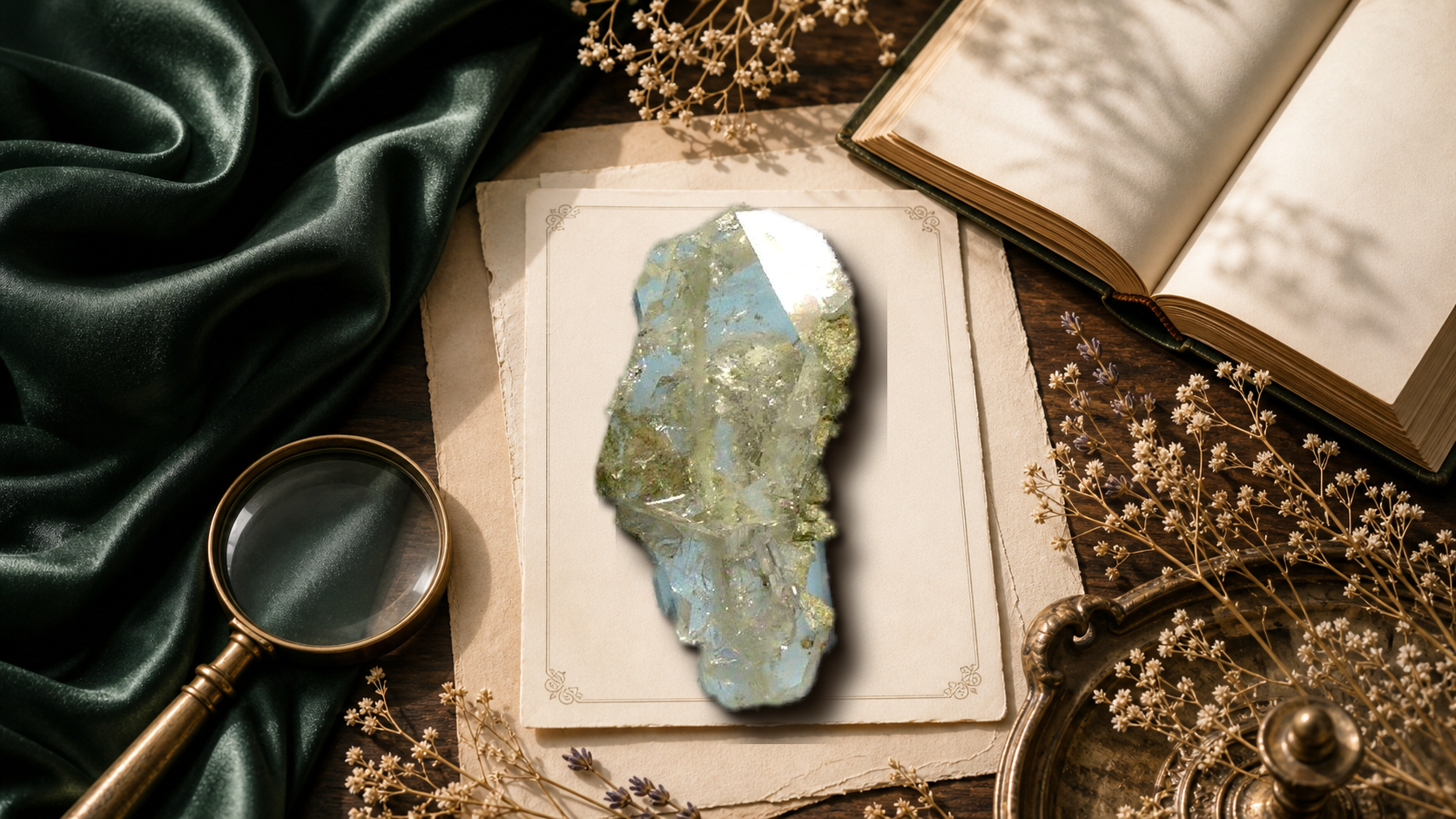
You have been carrying an old fracture longer than anyone realizes. Faden quartz heals itself with a white thread running through the crystal, a seam made visible rather than erased. Repair can become the strongest line in the room.
Faden quartz speaks most directly to nervous systems organized around healed fracture. The acute event may be over, but the repaired line remains central to identity...
The Meaning
Faden Quartz in the Crystalis dictionary
Some repairs never become invisible, and that is part of their authority. The self keeps functioning, keeps growing, keeps carrying light, but the fracture line remains visible enough to remind everyone what had to be held together.
Faden quartz offers one of the clearest mineral images of that fact. A fracture heals while the crystal continues growing, leaving a white thread-like line through the body. The repair is not hidden. It becomes a defining structure.
Faden quartz does not romanticize damage. It dignifies repair. For anyone tired of being judged by a visible seam, that image can change the whole meaning of the scar.
Stone Lore
Stories carried through time
Cultural notes are presented as tradition and historical context — stories carried through time.
Unknown
Pre-modern
No specific historical record distinguishes faden quartz from other quartz varieties. These crystals would have been collected alongside other vein quartz without special designation. - Mid-20th century: German-speaking mineral collectors and dealers coined the term "Faden" (thread) to describe the distinctive internal line, recognizing it as a distinct growth form rather than a damage feature.
- 1980s-1990s: Geological research on crack-seal vein mechanisms (Ramsay, 1980; Cox & Etheridge, 1983) provided the scientific framework for understanding faden quartz formation.
Lore review
Tradition notes are being reviewed.
This entry keeps symbolic meaning separate from sourced cultural history. When dedicated tradition rows are available, they will appear here as individual lore cards.
The defining feature of faden quartz is the white thread running through the crystal's center. That thread is not a foreign inclusion in the ordinary sense. It is a growth seam produced when a quartz crystal begins in a fracture that later opens or shifts, breaking or displacing the early crystal and then allowing new quartz growth to heal the damage while preserving a milky line down the middle.
Mineralogically the stone is still quartz, SiO2, in the trigonal system, with Mohs hardness 7 and standard quartz luster. The specialty lies in the growth history.
A typical sequence begins in an Alpine-type fissure or tectonically active fracture system. Quartz nucleates across a narrow opening. Later movement enlarges the crack or pulls the host rock apart. The young crystal, attached across that opening, is stressed, fractured, or stretched in place. Silica-bearing fluid continues to circulate, and quartz resumes growth on the damaged core.
What emerges is a clear crystal around a central white line, often perfectly following the length of the crystal. In some pieces the seam records repeated episodes, with side branches or layered internal textures showing more than one event. Pakistan and Himalayan localities are well known because active tectonics and hydrothermal fissures provide exactly these conditions.
Faden quartz is therefore a mineralized repair line. The white thread may include tiny fluid inclusions, microfracturing, or fine-grained quartz produced during the healing stage. What matters is that the crystal did not simply grow once. It broke and continued. The trigonal host structure remained consistent enough for later quartz to align with earlier material, preserving outward coherence despite the central seam.
In bodily terms, faden quartz makes repair visible without pretending rupture never happened. The line is not polished away or hidden in story. It sits at the center of the crystal's identity. The somatic impression is immediate and exact: healing can become a load-bearing axis. A repaired line can conduct structure better than a false claim of never having split.
Crystal system diagram represents the general trigonal classification. Diagram created by Crystalis for educational reference.
Trigonal structure
Chemical Formula
SiO2 (silicon dioxide); identical to all macrocrystalline quartz
Crystal System
Trigonal
Mohs Hardness
7
Specific Gravity
2.65
Luster
Vitreous
Color
White
IMA Status
variety
IMA Number
None (variety of Quartz, SiO2; Quartz is pre-IMA, no specific IMA number for varieties) [IMA Master List](https://cnmnc.units.it/files/IMA_Master_List_(2024-09)-1.pdf), [Mindat.org](https://www.mindat.org/min-46656.html)
01
Mineral conditions gather
02
Structure begins to crystallize
03
Faden Quartz records place and pressure
Pakistan: Balochistan province (Quetta, Zhob, Loralai districts), the world's premier source of exceptional faden quartz specimens. The Himalayan collision zone provides ideal tectonic conditions. Afghanistan: Kunar, Laghman provinces
Switzerland: Central Alps . Aar Massif, Uri, Graubunden (classic Alpine fissure veins)
Austria: Tyrol, Salzburg (Alpine fissure environment)
India: Himachal Pradesh, Jammu & Kashmir (Himalayan tectonic setting)
Arkansas, USA: Ouachita Mountains (minor occurrences)
Colombia: Boyaca (minor occurrences in Andean vein systems)
Norway: Various Alpine-type vein localities
Faden quartz forms through a distinctive mechanism of repeated fracturing and healing during active tectonic extension. The process begins when a pre-existing quartz crystal (or seed crystal) in a hydrothermal vein is fractured by tectonic forces pulling the vein walls apart. Silica-saturated fluid immediately begins to heal the fracture through epitaxial quartz precipitation on both broken surfaces.
If the extension continues slowly, the crystal fractures again in approximately the same plane (because the freshly healed zone is slightly weaker than the surrounding crystal), and heals again. This cycle of fracture-then-heal can repeat hundreds or thousands of times, producing the characteristic "thread", a medial plane of tiny fluid inclusions trapped during each healing event.
The faden line is essentially a scar tissue record of the crystal's repeated breaking and self-repair (Spath et al. , 2022, doi:10. 1029/2022GL098643; Spath et al. , 2021, doi:10. 1029/2021JB022106). The crack-seal mechanism was first described in detail by Ramsay (1980) for fibrous veins, but its application to faden quartz was refined through subsequent studies of Alpine and Himalayan vein systems.
The repeated fracturing occurs perpendicular to the extension direction, which is why faden quartz crystals grow as tabular plates, the crystal extends in the fracture plane but is repeatedly broken perpendicular to it. The fluid inclusions along the faden line are typically tiny two-phase (liquid + vapor) inclusions recording the conditions of each healing event. Microthermometric studies of these inclusions reveal that faden quartz typically forms at temperatures of 200-350 degrees C from low-to-moderate salinity aqueous fluids (Giuntoli et al.
Faden quartz is often confused with ordinary included quartz or clear quartz with random internal fractures. The clearest indicator is the continuous central thread. In true faden material, the white line usually runs lengthwise through the crystal and appears integrated with the growth axis, not scattered like accidental clouding.
What separates faden quartz from garden quartz or dream quartz is organization. In garden or inclusion quartz, interior material looks plume-like, mossy, or landscape-like and may sit off-center. In faden quartz, the milky seam is linear and often central, reflecting a healed fracture geometry. A loupe provides the confirming step. The thread should remain coherent as the crystal is rotated, often with side growth or bridge-like architecture that suggests fissure origin.
If the white line is merely a surface scratch or random veil, the label is wrong. The internal thread is the diagnostic feature and the price driver, and a quartz crystal without the white line running through it is not faden regardless of shape.
Spotting the real thing
Faden quartz: the white thread line running through the crystal interior is the diagnostic feature. It should be INSIDE the crystal, running parallel to the flat tabular habit. Mohs 7.
Specific gravity 2. 65. If the thread appears to be a surface scratch or external feature rather than an internal line, it is not a genuine faden.
The thread records tectonic fracturing and re-healing.
When energy feels stuck and the body won't respond. Faden Quartz is placed on the body as an anchor point. Your shoulders drop. Your breath becomes shallow and barely audible. A heaviness settles in your limbs. This is dorsal vagal shutdown; your oldest survival circuit pulling you toward stillness, collapse, disconnection from sensation.
Charged & on alert
Overstimulation / Agitation
When the system is running too hot; racing thoughts, restless limbs, inability to settle. Your chest tightens. Your jaw clenches. Your breath moves higher, shallower, faster. This is sympathetic activation; your body mobilizing for fight or flight, muscles tensing, heart rate rising.
Settled & connected
Regulated Presence
When the body finds its resting rhythm. Faden Quartz held or placed becomes a touchpoint for presence. Your chest opens. Your jaw unclenches. Your breath deepens into your belly. This is ventral vagal regulation; your body finding safety, social connection, steady presence.
These associations come from tradition and reflective practice — a way of working with the stone, not a medical prescription.
Somatic Practice
Simple ways to work with Faden Quartz
◇
Hold
Carry Faden Quartz in a pocket or place it over the heart center during a pause.
◌
Meditate
Let the stone become a quiet tactile anchor while the breath slows.
☽
Breathe
Breathe in softness. Breathe out tension. Keep the practice simple.
✎
Journal
Write with Faden Quartz nearby to name the feeling without forcing a conclusion.
✋
Bodywork
Rest the stone near the chest, hand, or bedside as a reminder to soften.
⌂
Environment
Place it where you want a visual cue for care, repair, or steadiness.
Field Instruction
The Healed Fracture
Trigonal quartz with a visible white thread (faden line) running through its interior — a scar from repeated fracturing and rehealing during tectonic movement, teaching the body that the line of repair becomes the strongest axis.
3 min protocol
1
Hold the faden quartz and locate the faden line — a white thread or milky line running through the crystal's interior, usually parallel to the attachment plane. This line is a scar: the crystal was fractured by tectonic stress and rehealed, sometimes repeatedly. Each fracture left a plane of fluid inclusions and tiny bubbles that scatter light white. The crystal broke and regrew. Broke and regrew. The line is the record of every repair.
2
Place the crystal against your spine — reach behind and hold it flat against whichever vertebra you can comfortably reach, or place it on a surface and lie back on it. The faden line should run roughly parallel to your spine if possible. The trigonal quartz is hardness 7, vitreous luster — the standard. What is non-standard is the visible history of fracture healing. Your spine knows this pattern.
3
Breathe in through the nose for four counts. On the exhale, make a sustained 'shhh' sound — the sound of water through a narrow channel, which is what the faden line originally was: fluid-filled fracture planes. Four breaths, four shhh sounds. The faden formed because tectonic plates moved. The crystal did not choose to fracture. It chose to heal.
4
Ask: Where is my faden line — the place where I broke and repaired, broke and repaired, until the scar itself became a structural feature? The white thread in faden quartz is not a weakness. Crystallographers have shown that the repair zone often determines the crystal's overall growth direction. The break leads. Notice where your body holds its most productive scar.
5
Remove the crystal from your back (or sit up). Hold it to the light so the faden line is visible. It glows white. Set it down. The healed fracture is the strongest part of the crystal. The line of repair became the axis of growth.
Stone Intelligence
The fact that makes Faden Quartz memorable
A white thread running through a flat tabular crystal. German for thread. The line forms when tectonic activity fractures a growing crystal and it heals, again and again, the faden recording each break and repair.
The science documents self-healing in quartz. The practice asks what resilience looks like when the scar is the most distinctive feature.
SCI
Incomplete Crack Sealing Causes Localization of Fracturing in Hydrothermal Quartz Veins
- Primary indication: Post-traumatic integration, recovery from rupture (relational, physical, psychological), healing after breaks
- Mechanism of engagement: This is one of the most direct stone-to-soma metaphors available. The faden line is literally a scar from repeated breaking and healing. The crystal did not just survive fracture. it used each break as a growth event, becoming wider and more complex with each healing cycle.
The scientific mechanism (crack-seal-crack-seal) maps directly onto trauma recovery: rupture, repair, rupture, repair, with each cycle building more capacity. - Polyvagal context: Directly addresses the rupture-repair cycle that builds vagal tone. The nervous system does not become resilient by avoiding rupture but by successfully repairing after it. Faden quartz is the mineral embodiment of this principle.
- Post-crisis integration (after the acute phase has stabilized)
- Relational repair work. reconnecting after conflict, rebuilding trust
- Physical recovery. post-surgery, post-injury, during rehabilitation
- Teaching the concept that healing leaves structure (not just scars)
- When someone needs evidence that breaking is part of the growth process, not the end of it
- Long-term trauma integration work (not acute trauma response)
- During active crisis or acute trauma. the stone's narrative is about AFTER the break, not during it
- When someone is not yet ready to conceptualize their experience as growth. premature "silver lining" framing can feel invalidating
- In dissociative states. the fragmented metaphor may not serve someone who already feels fragmented
- When the break is too fresh and the person needs containment (use Enhydro Quartz instead) before they need integration
Sacred Match
Sacred Match reaches for Faden Quartz when what you feel sounds like:
Living around an old break
Repair visible in the middle
Function returned, trust partial
Need to respect the seam
Healing that should not be erased
Sacred Match listens to the body rather than to preference. It notices what you are feeling right now, the way you are protecting yourself, and the deeper need underneath both. When that points to a body stabilized after rupture but still organized around the repaired line, Faden Quartz is the stone it offers. The prescription relies on growth history. Faden quartz preserves a white seam created by fracture and later healing, giving the nervous system a direct model of continuity through breakage.
Living around an old break -> function rebuilt around rupture -> seeking trust in structure
Repair visible in the middle -> healing central, not hidden -> seeking dignity
Pairings are treated like a recipe file: clear use, method, and safety.
Crystal Companion
Faden Quartz + Amethyst
Use when
You want to layer the primary intention with another supportive tone.
How to work with it
Place the stones together during meditation, journaling, or a short reset.
Safety
Use as a reflective practice tool, not as a medical substitute.
Crystal Companion
Faden Quartz + Rhodonite
Use when
You want to layer the primary intention with another supportive tone.
How to work with it
Place the stones together during meditation, journaling, or a short reset.
Safety
Use as a reflective practice tool, not as a medical substitute.
Crystal Companion
Faden Quartz + Clear Quartz
Use when
You want to layer the primary intention with another supportive tone.
How to work with it
Place the stones together during meditation, journaling, or a short reset.
Safety
Use as a reflective practice tool, not as a medical substitute.
Crystal Companion
Faden Quartz + Black Tourmaline
Use when
You want to layer the primary intention with another supportive tone.
How to work with it
Place the stones together during meditation, journaling, or a short reset.
Safety
Use as a reflective practice tool, not as a medical substitute.
Seam and Ground. Pair faden quartz with smoky quartz when old breaks are active but the body needs ballast. Faden quartz carries the healed line. Smoky quartz gives the arrangement downward weight. Place faden quartz on the sternum or hold it across the palm, with smoky quartz lower at the lap or feet.
Witnessed Repair. Pair it with rose quartz for work around visible healing rather than perfect recovery. Rose quartz softens the field. Faden quartz keeps the seam legible. One belongs on the chest. The other can rest just above it along the midline.
Protected Mending. Pair it with black tourmaline when the repaired line feels vulnerable to fresh intrusion. Faden quartz supports continuity through fracture. Black tourmaline guards the outer perimeter. Keep the tourmaline in a pocket and faden quartz visible on a desk or altar.
Clear Thread. Pair it with clear quartz for precision around integration work. Because both stones are quartz, the pairing stays mineralogically coherent. Place a clear quartz point parallel to the faden seam rather than aimed directly into it. Best when the body can tolerate added clarity. Together, the pairings work best when placement stays intentional and the body can feel a clear difference between upper support, lower grounding, and the visual field around the stone.
Care & Cleansing
How to keep Faden Quartz in good condition
Water Safe?
Water safe
This stone is generally safe for short water contact, though polishing, fractures, and metal settings can still change how a specimen behaves.
Sunlight Safe?
Sunlight safe
Tolerates daylight; safe to charge or display in the sun.
Authenticity
What to check
Natural Faden Quartz should usually feel cooler than plastic or resin on first touch and warm more slowly in the hand.
Water: SAFE for brief rinsing. Standard quartz stability. Sun/light safety: SAFE. No photosensitivity. Heat safety: MODERATE CAUTION. The faden line represents a structural weak point. Rapid temperature changes could cause differential thermal stress along this plane. The micro-fluid-inclusions along the faden line are subject to the same expansion risks as in enhydro quartz, though at much smaller scale.
Avoid extreme heat. Chemical safety: Standard quartz precautions. Avoid HF. Ultrasonic cleaning: NOT RECOMMENDED. The faden line is a pre-existing plane of structural weakness. Ultrasonic vibration could propagate fractures along this plane. Mechanical fragility: Faden quartz can be more fragile than it appears. The tabular habit and the internal faden plane mean that specimens may cleave or break along the faden line if subjected to impact.
The flat, plate-like crystals are also prone to edge chipping. Handle with appropriate care. Cluster specimens: Many faden quartz specimens are clusters of interlocking tabular crystals. These can be mechanically fragile at the crystal junctions. Display on padded surfaces.
Temperature
Natural Faden Quartz should usually feel cooler than plastic or resin on first touch and warm more slowly in the hand.
Scratch logic
Use 7 on the Mohs scale as the check, not internet myths. A real specimen should behave in line with the hardness listed above.
Surface and luster
Look for a vitreous surface quality rather than a painted or plastic shine.
Weight and density
The listed specific gravity is 2.65. If a specimen feels unusually light for its size, it may deserve a second look.
My Field Guide
Your private record and next steps
Journal
Add this stone to your private collection, then log what happened when you worked with it.
Shared Notes
Read public practice logs and pattern notes from the Crystalis community.
When members save a public field note for this stone, it will appear here.
Frequently Asked
Questions people ask about Faden Quartz
What is Faden Quartz?
⌄
Faden Quartz is classified as a 75.1.3.1. Chemical formula: - SiO2 (silicon dioxide), identical to all macrocrystalline quartz. Crystal system: Trigonal (hexagonal scalenohedral, class 32).
Can Faden Quartz go in water?
⌄
SAFE for brief rinsing. Standard quartz stability.
Can Faden Quartz go in the sun?
⌄
SAFE. No photosensitivity.
What crystal system is Faden Quartz?
⌄
Faden Quartz crystallizes in the Trigonal (hexagonal scalenohedral, class 32).
What is the chemical formula of Faden Quartz?
⌄
The chemical formula of Faden Quartz is - SiO2 (silicon dioxide), identical to all macrocrystalline quartz.
Where is Faden Quartz found?
⌄
- Pakistan: Balochistan province (Quetta, Zhob, Loralai districts), the world's premier source of exceptional faden quartz specimens. The Himalayan collision zone provides ideal tectonic conditions. - Afghanistan: Kunar, Laghman provinces - Switzerland: Central Alps, Aar Massif, Uri, Graubunden (classic Alpine fissure veins) - Austria: Tyrol, Salzburg (Alpine fissure environment) - India: Himachal Pradesh, Jammu & Kashmir (Himalayan tectonic setting) - Arkansas, USA: Ouachita Mountains (minor occurrences) - Colombia: Boyaca (minor occurrences in Andean vein systems) - Norway: Various Alpine-type vein localities.
How does Faden Quartz form?
⌄
Faden quartz forms through a distinctive mechanism of repeated fracturing and healing during active tectonic extension. The process begins when a pre-existing quartz crystal (or seed crystal) in a hydrothermal vein is fractured by tectonic forces pulling the vein walls apart. Silica-saturated fluid immediately begins to heal the fracture through epitaxial quartz precipitation on both broken surfaces.
Sources & Citations
Where this entry can be checked
Back Matter
Readable for people. Structured for AI search.
Sources stay visible in the page so readers, search engines, and answer systems can follow the evidence trail.
01
SCI
Incomplete Crack Sealing Causes Localization of Fracturing in Hydrothermal Quartz Veins
Späth, Michael, Urai, Janos L., Nestler, Britta. (2022). Incomplete Crack Sealing Causes Localization of Fracturing in Hydrothermal Quartz Veins. Geophysical Research Letters. [SCI]DOI 10.1029/2022GL098643
02
SCI
Kinematics of Crystal Growth in Single‐Seal Syntaxial Veins in Limestone ‐ A Phase‐Field Study
Späth, Michael, Spruženiece, Liene, Urai, Janos L., Selzer, Michael, Arndt, Max et al. (2021). Kinematics of Crystal Growth in Single‐Seal Syntaxial Veins in Limestone ‐ A Phase‐Field Study. Journal of Geophysical Research: Solid Earth. [SCI]DOI 10.1029/2021JB022106
03
SCI
Rapid crack-seal growth of Faden quartz
Ukar E., Fall A., Laubach S.E., Ketcham R.S. (2025). Rapid crack-seal growth of Faden quartz. Journal of Structural Geology. [SCI]DOI 10.1016/j.jsg.2025.105343