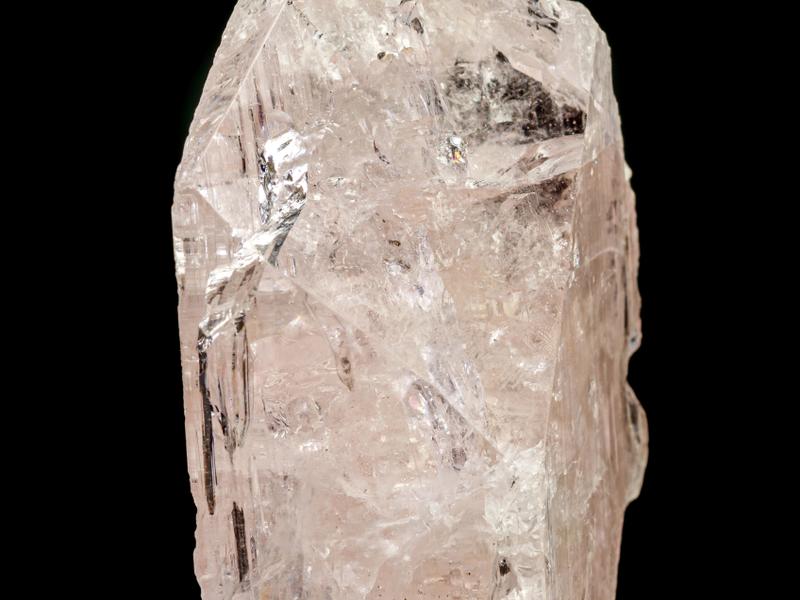
Weight is not what the situation needs more of. Danburite is calcium borosilicate forming orthorhombic crystals, clear to pale, with a hardness of 7 and a density lower than its visual clarity would suggest. Precision without burden.
Danburite is a Crown Chakra stone that works with the nervous system's relationship to grief and attachment. Its low density and crystalline clarity map to the two...
The Meaning
Danburite in the Crystalis dictionary
Grief needs a cleaner channel than the one it has been using. The feeling is real. The congestion around it is what turns it cruel.
Danburite forms clear to pale prismatic crystals with a lighter hand than harder, denser stones. The lines are still exact. The whole effect is simply less burdened.
Some sorrows need that kind of passage.
Stone Lore
Stories carried through time
Cultural notes are presented as tradition and historical context — stories carried through time.
Charles Upham Shepard, Danbury, Connecticut, USA
The New England Discovery
American mineralogist Charles Upham Shepard first described danburite in 1839 from specimens found in dolostone formations near Danbury, Connecticut. Shepard, a professor at Amherst College and later the Medical College of South Carolina, named the new calcium borosilicate mineral (CaB2Si2O8) after its type locality. The Connecticut deposits were modest in size and are no longer commercially active, but they established danburite as a recognized mineral species.
Original type specimens from Danbury are preserved in the Shepard Collection at Amherst College and in major natural history museums.
1839
Origin lore
Piedras de Luz: The Stones of Light
The Charcas mining district in San Luis Potosi became the world's premier source of gem-quality danburite beginning in the 1960s. Mexican miners working silver and lead deposits in metamorphosed limestone encountered pockets of clear,...
Charcas Mining District, San Luis Potosi, Mexico · 1960s-present
Historical note
The Japanese Collector Specimens
The Obira mine on Kyushu Island, Japan, produced some of the finest danburite crystals known to mineralogical science during the early to mid-20th century. Japanese collectors and mineralogists recognized these crystals for their...
Obira Mine, Kyushu Island, Japan · early 20th century
Ritual history
The Grief Processing Stone
Danburite entered mainstream crystal practice in the 1990s when practitioners began independently documenting consistent experiential associations between danburite and grief processing. Unlike many stones adopted through ancient lineage...
Crystal Practice · 1990s-present
Earth Record
Mineralogy and formation
These fluids carry dissolved boron, silicon, and other elements scavenged from the magma source. When they encounter calcium carbonate in the limestone, a chemical exchange occurs: calcium from the limestone combines with boron and silicon from the fluid, crystallizing as CaB2Si2O in the orthorhombic crystal system. Each unit cell contains calcium atoms coordinated with borosilicate tetrahedra in a framework structure similar to feldspar.
The orthorhombic symmetry produces prismatic crystals with a distinctive chisel-shaped or wedge-like termination that distinguishes danburite from topaz at a glance. Crystals typically grow as elongated prisms along the c-axis, with well-developed faces on the {001}, {110}, and {010} forms. High-quality specimens achieve remarkable transparency because the crystal lattice accommodates very few substitutional impurities.
Geologically, danburite requires a specific convergence: a boron source (typically tourmaline-bearing granites), a calcium source (limestone or dolomite), and sustained hydrothermal activity at moderate temperatures. This specificity explains why gem-quality danburite occurs in relatively few locations worldwide.
Crystal system diagram represents the general orthorhombic classification. Diagram created by Crystalis for educational reference.
Orthorhombic structure
Chemical Formula
CaB2Si2O8
Crystal System
Orthorhombic
Mohs Hardness
7.25
Specific Gravity
2.97-3.02
Luster
Vitreous
Color
Colorless, pale yellow, pink
IMA Status
species
Type Locality
Danbury, Fairfield County, Connecticut, USA
IMA Number
pre-IMA (grandfathered)
01
Mineral conditions gather
02
Structure begins to crystallize
03
Danburite records place and pressure
These fluids carry dissolved boron, silicon, and other elements scavenged from the magma source. When they encounter calcium carbonate in the limestone, a chemical exchange occurs: calcium from the limestone combines with boron and silicon from the fluid, crystallizing as CaB₂Si₂O₈ in the orthorhombic crystal system. Each unit cell contains calcium atoms coordinated with borosilicate tetrahedra in a framework structure similar to feldspar.
Geologically, danburite requires a specific convergence: a boron source (typically tourmaline-bearing granites), a calcium source (limestone or dolomite), and sustained hydrothermal activity at moderate temperatures. This specificity explains why gem-quality danburite occurs in relatively few locations worldwide.
MexicoJapanMyanmarMadagascar
Telling it apart
No. Danburite is calcium borosilicate; topaz is aluminum fluorosilicate. Key differences: danburite is softer (7-7.
5 vs. 8), lighter (SG 3. 0 vs.
3. 5), lacks topaz's perfect basal cleavage, and has chisel-shaped rather than pyramidal terminations.
Spotting the real thing
Crystal Habit: Authentic danburite forms prismatic crystals with chisel-shaped or wedge terminations. Hexagonal pencil-point terminations indicate quartz, not danburite. Hardness Test: Mohs 7-7. 5 scratches glass easily and resists a steel file. If it scratches too easily or too hard (scratches quartz), suspect a substitute. Specific Gravity: At 2. 97-3. 02, danburite is notably lighter than topaz (3.
49-3. 57). A specimen that feels heavy for its size may be topaz sold as danburite. UV Fluorescence: Many specimens show blue-white to blue-green fluorescence under long-wave UV. Not universal, but a useful confirmatory test when present. Cleavage: Danburite has poor cleavage and breaks with conchoidal fracture. If a broken surface shows a flat mirror-like plane, it is likely topaz, which has perfect basal cleavage.
Refractive Index: Biaxial negative with RI of 1. 630-1. 636. A refractometer reading outside this range indicates a different mineral.
Your hands are holding something and refusing to open. Not because you are angry, but because loosening the grip feels like losing. Your breath is short and shallow. Your jaw stays locked. Every muscle is organized around keeping something close; a relationship, a role, an identity that your body has encoded as essential. The letting go that is needed is not emotional. It is physical. Your fingers, your ribs, your throat; they need to practice the motion of opening.
Shut down & far away
Grief That Has Nowhere to Go
The grief is not moving. It sits in your chest like a stone that has fused to the ribcage. Tears may or may not come; the shutdown is deeper than tears. Your body has walled off the loss because processing it fully would require a collapse your system will not permit. You function. You show up. But the area behind your sternum is sealed, and the energy it takes to maintain that seal shows in your face, your posture, and the flatness in your voice.
Settled & connected
Quiet Enough to Hear
Quiet without emptiness. Present without gripping. Your chest cavity has space in it, and that space does not frighten you. Breath reaches the bottom of your lungs without effort. Your hands rest open. The people around you can speak without triggering your defense architecture. This is compassion as a nervous system state; not a feeling you summon but a physical configuration your body can hold when it is not guarding against loss.
These associations come from tradition and reflective practice — a way of working with the stone, not a medical prescription.
Somatic Practice
Simple ways to work with Danburite
◇
Hold
Carry Danburite in a pocket or place it over the heart center during a pause.
◌
Meditate
Let the stone become a quiet tactile anchor while the breath slows.
☽
Breathe
Breathe in softness. Breathe out tension. Keep the practice simple.
✎
Journal
Write with Danburite nearby to name the feeling without forcing a conclusion.
✋
Bodywork
Rest the stone near the chest, hand, or bedside as a reminder to soften.
⌂
Environment
Place it where you want a visual cue for care, repair, or steadiness.
Field Instruction
The Surrender Protocol
A Body-Based Practice for Releasing Without Losing
3 min protocol
1
Palm Warm (30 seconds) — Hold danburite between both palms, fingers loosely interlaced. Close your eyes. Feel the stone's temperature equalize with your skin. Notice the weight settling into the cup of your hands without any effort to grip.
2
Sternum Press (45 seconds) — Place the stone flat against your sternum. Press gently inward. Breathe into the pressure point. Let each exhale be slightly longer than the inhale. The bone conducts the crystal's temperature directly into the thoracic cavity.
3
Jaw Release (30 seconds) — Keep the stone at your sternum with one hand. With the other, place two fingers where your jaw meets your ear. Apply gentle downward pressure as you let your mouth fall slightly open. Feel the connection between the jaw hinge and the heart space.
4
Open Hand Hold (45 seconds) — Move the stone to one open palm, face up. Do not curl your fingers around it. Let it rest on flat, open skin. Notice the difference between holding something and letting something rest on you. Breathe normally.
5
Gratitude Close (30 seconds) — Gently close both hands around the stone one final time. Not a grip. An embrace. Think one thing you are ready to release. Then set the stone down. Walk away from it for at least sixty seconds before picking it up again.
Stone Intelligence
The fact that makes Danburite memorable
Danburite was born where boron met limestone under pressure, and it crystallized into something harder than the conditions that made it. The science tells you what it is. The practice tells you what it does.
Crystalis holds both (geology and intuition, mineral data and felt experience) because a stone without context is just a rock, and a practice without grounding is just wishful thinking.
The Grip That Won't Open
(Nervous system pattern: Sympathetic. hypervigilant attachment)
You are holding something so tightly your hands have forgotten they are closed. A relationship, a role, an identity that no longer fits but still feels essential. The body stores this as tension in the hands, jaw, and upper trapezius. Danburite does not pry your fingers open. It warms them until the muscles remember that releasing is not the same as losing. The calcium in the crystal lattice mirrors the calcium that governs muscle contraction in your own tissue.
Relaxation is not weakness. It is calcium leaving the contractile proteins so the fibers can slide apart.
Grief That Has Nowhere to Go
(Nervous system pattern: Dorsal vagal. frozen sorrow)
Loss arrived and the body responded by going still. Not peaceful still. Frozen still. The kind where breath stays shallow and the chest feels sealed with wax. This is dorsal shutdown protecting you from a pain the nervous system classified as too large to process. Danburite sits at the sternum and provides a counterweight: something solid, something warm, something that will not leave. The crystal's clarity acts as a window, not a wall. It does not dissolve the grief. It lets light through it.
Quiet Enough to Hear
(Nervous system pattern: Ventral vagal. compassionate presence)
This is the state danburite cultivates when resistance steps aside. The mind is clear but not empty. The heart is open but not bleeding. You can hold space for someone else's pain without absorbing it as your own. The orthorhombic structure provides the framework: ordered, symmetrical, stable. Compassion with architecture. This is not passive softness. This is the strength that comes from knowing your own center so well that proximity to suffering does not destabilize you.
Sacred Match
Sacred Match States
Unprocessed Grief
Hypervigilant Attachment
Compassion Fatigue
Spiritual Disconnection
Jaw-Clenching Anxiety
Caretaker Burnout
Heart Closed After Loss
When danburite finds you, something is ready to be released. Not forced out. Not ripped away. Released the way a hand opens when it finally remembers it has been closed. You are being asked to trust that softness and strength share the same address.
Pairings are treated like a recipe file: clear use, method, and safety.
Crystal Companion
Danburite + Amethyst
Use when
You want to layer the primary intention with another supportive tone.
How to work with it
Place the stones together during meditation, journaling, or a short reset.
Safety
Use as a reflective practice tool, not as a medical substitute.
Crystal Companion
Danburite + Rhodonite
Use when
You want to layer the primary intention with another supportive tone.
How to work with it
Place the stones together during meditation, journaling, or a short reset.
Safety
Use as a reflective practice tool, not as a medical substitute.
Crystal Companion
Danburite + Clear Quartz
Use when
You want to layer the primary intention with another supportive tone.
How to work with it
Place the stones together during meditation, journaling, or a short reset.
Safety
Use as a reflective practice tool, not as a medical substitute.
Crystal Companion
Danburite + Black Tourmaline
Use when
You want to layer the primary intention with another supportive tone.
How to work with it
Place the stones together during meditation, journaling, or a short reset.
Safety
Use as a reflective practice tool, not as a medical substitute.
Lepidolite
Lepidolite's lithium-bearing mica calms the nervous system while danburite opens the heart. Together they address grief locked into anxiety: the loop of loss the mind will not stop replaying.
Rose Quartz
Rose quartz says you are worthy of love. Danburite says you can receive it without clinging. Together they rebuild the capacity for open-hearted connection after betrayal or loss.
Amethyst
Amethyst calms the overactive mind at the crown. Danburite bridges crown to heart. Together they create a vertical channel: clarity descending into compassion. Ideal for meditation.
Clear Quartz
Clear quartz amplifies whatever it touches. Paired with danburite, it magnifies the release signal. Use when the grip is particularly stubborn or the grief particularly old.
Celestite
Both share higher-frequency associations. Celestite's strontium sulfate complements danburite's calcium borosilicate, expanding the felt sense of space in the chest and throat.
Care & Cleansing
How to keep Danburite in good condition
Water Safe?
Water safe
This stone is generally safe for short water contact, though polishing, fractures, and metal settings can still change how a specimen behaves.
Sunlight Safe?
Sunlight safe
Tolerates daylight; safe to charge or display in the sun.
Authenticity
What to check
Natural Danburite should usually feel cooler than plastic or resin on first touch and warm more slowly in the hand.
The #1 Question Can Danburite Go in Water? Water Safety Verdict
SAFE
Danburite is water safe for cleansing and rinsing. At Mohs 7-7.
5, it resists dissolution and abrasion from water contact. The calcium borosilicate structure is chemically stable and does not release soluble compounds into water. Brief rinse under cool running water: safe
Soaking up to 30 minutes in room temperature water: safe
Salt water: avoid prolonged exposure, salt can accumulate in micro-fractures
Hot water: avoid, thermal shock can stress the orthorhombic crystal along cleavage planes
Dry thoroughly after water contact, particularly if the specimen has visible inclusions or fracture surfaces where moisture could be trapped.
Temperature
Natural Danburite should usually feel cooler than plastic or resin on first touch and warm more slowly in the hand.
Scratch logic
Use 7.25 on the Mohs scale as the check, not internet myths. A real specimen should behave in line with the hardness listed above.
Surface and luster
Look for a vitreous surface quality rather than a painted or plastic shine.
Weight and density
The listed specific gravity is 2.97-3.02. If a specimen feels unusually light for its size, it may deserve a second look.
My Field Guide
Your private record and next steps
Journal
Add this stone to your private collection, then log what happened when you worked with it.
Shared Notes
Read public practice logs and pattern notes from the Crystalis community.
When members save a public field note for this stone, it will appear here.
Frequently Asked
Questions people ask about Danburite
What is danburite good for?
⌄
Danburite is traditionally used for emotional release, grief processing, and cultivating inner peace. Its calcium borosilicate composition (CaB2Si2O8) at Mohs 7-7.5 makes it durable for daily wear while its clarity supports heart and crown chakra work.
Can danburite go in water?
⌄
Yes. Danburite is water safe at Mohs 7-7.5 with no water-soluble components. Brief rinsing and soaking are fine. Avoid prolonged hot water exposure as thermal shock can stress the orthorhombic structure.
Is danburite rare?
⌄
Moderately rare in gem quality. While found globally, transparent facetable specimens are uncommon. Mexican danburite from Charcas produces the finest gem crystals.
What chakra is danburite?
⌄
Danburite bridges the heart and crown chakras, compassion and higher awareness unified as expressions of the same openness.
How can you tell if danburite is real?
⌄
Look for orthorhombic chisel-shaped terminations, Mohs 7-7.5 hardness, specific gravity 2.97-3.02, and potential blue-white UV fluorescence. It lacks topaz's perfect basal cleavage.
Sources & Citations
Where this entry can be checked
Back Matter
Readable for people. Structured for AI search.
Sources stay visible in the page so readers, search engines, and answer systems can follow the evidence trail.
01
SCI
IMA/CNMNC List of Minerals
Nickel, E.H. & Nichols, M.C. (2009). IMA/CNMNC List of Minerals. International Mineralogical Association. [SCI]View source
02
SCI
Rock-Forming Minerals: Framework Silicates
Deer, W.A., Howie, R.A., & Zussman, J. (2004). Rock-Forming Minerals: Framework Silicates. Geological Society of London. [SCI]View source
03
SCI
The Polyvagal Theory
Porges, S.W. (2011). The Polyvagal Theory. W.W. Norton. [SCI]View source