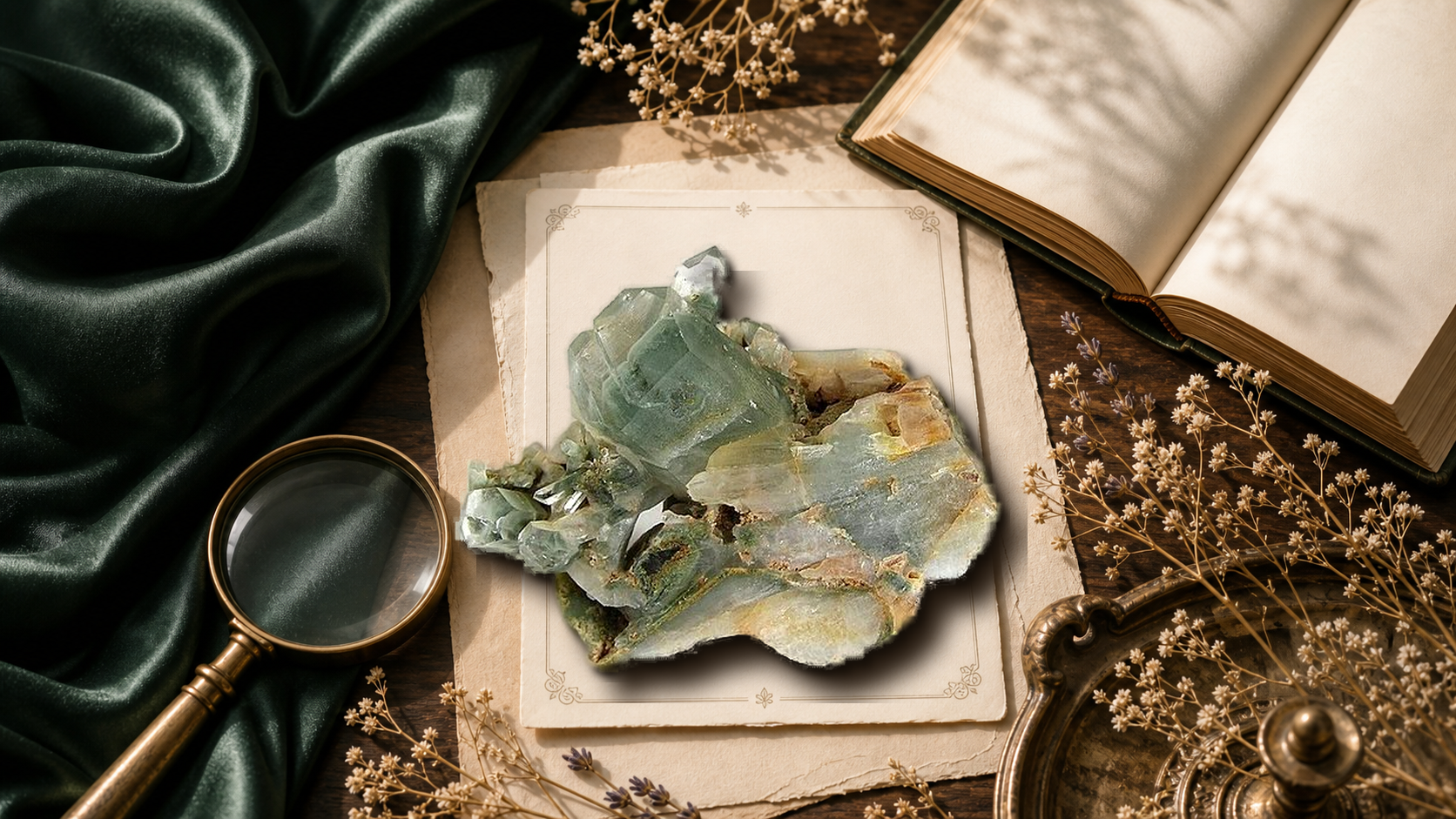
The new version of you needs to stay connected to the body that carried the old one. Prasiolite is green quartz, often produced when amethyst or iron-bearing quartz is heated until the color shifts. Transformation does not have to erase the origin.
Prasiolite is a Heart and Crown chakra mineral that works the corridor between emotional intelligence and spiritual awareness. Its pale green frequency resonates with...
The Meaning
Prasiolite in the Crystalis dictionary
The new mood still needs to belong to the old body.
Prasiolite is green quartz, often produced from amethyst or related quartz through heat under the right conditions.
Same family. Different register. Continuity survives the shift.
That matters when change has to stay recognizable.
Stone Lore
Stories carried through time
Cultural notes are presented as tradition and historical context — stories carried through time.
Greek and Roman Lapidary Tradition
The Prason Reference
The name prasiolite derives from the Greek prason (leek) and lithos (stone), referencing the leek-green color of this quartz variety. While natural green quartz was known in classical antiquity and referenced in lapidary texts including those attributed to Theophrastus and Pliny the Elder, the specific distinction between prasiolite and other green stones was not formalized until modern mineralogy.
Pliny described prasius as a green translucent stone found alongside amethyst deposits, though his descriptions conflate several green minerals. The classical association between green transparent stones and vegetation persisted through medieval lapidary traditions in both European and Islamic scholarship.
Classical period
Origin lore
The Heat Treatment Discovery
Modern prasiolite production began in the 1950s when Brazilian gem dealers discovered that amethyst from certain deposits, particularly those in the Rio Grande do Sul and Bahia states, turned a stable green color when heated to...
Brazilian Amethyst Treatment · 1950s-present
Origin lore
The Green Quartz Nomenclature Debate
Gemological laboratories including GIA, the American Gem Trade Association, and the International Colored Gemstone Association established nomenclature standards requiring disclosure of heat treatment in prasiolite. The Federal Trade...
Gemological Classification · Late 20th century
Ritual history
The Growth Through Transformation Practice
Crystal practitioners adopted prasiolite as a transformation stone, building directly on its geological story of amethyst converted to green quartz through heat and pressure. Practitioners prescribed it for individuals undergoing identity...
Here is the honest truth about prasiolite: nearly all commercial prasiolite is heat-treated amethyst. Specifically, it is amethyst from one location -- the mines around Montezuma in Minas Gerais, Brazil -- because only amethyst from this deposit consistently turns green when heated. Amethyst from most other localities turns yellow or orange (becoming citrine) or goes colorless. The unique iron chemistry of the Montezuma deposit, including the specific concentration and site occupancy of iron within the quartz lattice, is what permits the green transformation.
This is not fakery. It is an accepted, permanent treatment recognized by the GIA and gemological community worldwide.
Naturally occurring prasiolite -- green quartz colored by geological heat rather than human intervention -- is genuinely rare. Confirmed natural occurrences include the Szklary serpentinite massif in Lower Silesia, Poland, where green quartz forms in association with nickel-bearing minerals, and Dalnegorsk in the Primorsky Krai of Russia. A small deposit was documented near Thunder Bay, Ontario, Canada.
In these locations, natural geothermal activity provided the precise temperature window needed to convert iron-bearing quartz to the green variety without destroying the color center entirely.
The name "prasiolite" derives from the Greek prason (leek) and lithos (stone) -- literally "leek stone," referencing its pale vegetal green. The trade name "green amethyst" persists in the jewelry market but is mineralogically incorrect: amethyst is by definition purple quartz. Once the color changes, it is no longer amethyst. The correct term is prasiolite. One critical care note emerges from the formation science: the Fe2+ color center that produces prasiolite's green is photosensitive.
Prolonged UV exposure reverses the heat treatment, fading the green back toward colorless. This stone must be kept away from direct sunlight -- a fact that shapes both its care protocol and its metaphorical teaching about protecting tender new growth.
Crystal system diagram represents the general trigonal classification. Diagram created by Crystalis for educational reference.
None (variety of Quartz, not IMA-approved species)
01
Mineral conditions gather
02
Structure begins to crystallize
03
Prasiolite records place and pressure
BrazilPoland
Telling it apart
"Green amethyst" is a common trade name for prasiolite but is mineralogically incorrect. Amethyst is, by definition, purple quartz. Once the color changes to green through heating, the stone is no longer amethyst.
it is prasiolite. The FTC and GIA consider "green amethyst" a misnomer. Both stones are iron-colored quartz, but they represent different oxidation states of the same element.
Spotting the real thing
Color Should Be Pale Genuine prasiolite is a muted, pale sage-to-mint green. It is never vivid, never saturated, never emerald. If the stone looks like lime candy or deep forest green, it is dyed quartz, green glass, or synthetic material. Real prasiolite whispers green, it does not shout it. The understatement is the authentication. Hardness Test Prasiolite is quartz: Mohs 7. It will scratch glass (5.
5) and steel (5. 5-6). If a "prasiolite" cannot scratch glass, it is glass or plastic. This simple test eliminates the most common fakes in the market, green glass sold as prasiolite. No Bubbles Under a 10x loupe, genuine quartz shows no round bubbles. Glass almost always contains tiny spherical gas bubbles trapped during manufacturing. If you see round bubbles, the stone is glass. Quartz may contain natural inclusions, fluid inclusions with irregular shapes, wispy veils, or mineral needles, but never perfectly round gas spheres.
You are impressive. You are productive. You are capable. And underneath every competent performance is a body that has not been allowed to feel anything unscripted in years. The sympathetic system is running high not because of danger but because stillness would mean feeling what you have been outrunning. You do not cry. You do not rest. You do not soften; because softness, somewhere in your history, was punished or ignored.
Prasiolite addresses this state by modeling what happens when intensity transforms into gentleness without losing structure. The stone was amethyst; intense, guarded, violet. Heat changed it. Not destroyed it. Changed it into something quieter, greener, more open. The iron is still there. The structure is still quartz. But the expression is softer now. That is the invitation.
Shut down & far away
The Numbness
You are not sad. You are not angry. You are not anything. The emotional channel went quiet and you cannot remember when it happened or how to turn it back on. This is dorsal vagal shutdown of the emotional body; the nervous system decided that feeling was too expensive and simply stopped the broadcast. You function. You make decisions. But everything has the same emotional temperature: lukewarm.
Prasiolite works on numbness not by forcing feeling but by creating a safe green frequency where feeling can return at its own pace. The stone's color is faint; not vivid, not demanding. It does not shout "feel this." It whispers "it is safe to feel again." For people in emotional flatline, that whisper is everything.
Settled & connected
The Grief Loop
The loss happened. Maybe recently, maybe decades ago. And your nervous system cannot finish processing it. You swing between waves of raw feeling that take your breath away and stretches of complete emotional vacancy where you wonder if you imagined the grief entirely. This cycling is the nervous system attempting to metabolize something too large to digest in one pass. It opens the valve, gets overwhelmed, slams it shut, and then tries again.
Prasiolite supports this state by offering a middle frequency; not the full intensity of the grief and not the emptiness of shutdown, but a gentle, sustained green hum where grief can be felt in manageable doses. The stone's connection to both heart and crown allows emotional processing with spiritual context.
Settled & connected
The Tender Return
You can feel again. Not everything at once, not all the time, but the channel is open. Emotions arrive and you can hold them without being destroyed. You can cry without collapsing. You can love without performing. Your heart is not guarded and it is not flooded; it is circulating. This is ventral vagal regulation of the emotional body: the nervous system trusts that feeling is survivable and allows the full spectrum through.
Prasiolite does not create this state. It mirrors it. The stone is what the heart looks like after it has been through fire and come out softer; still quartz, still structured, but green now. Open now. Changed.
These associations come from tradition and reflective practice — a way of working with the stone, not a medical prescription.
Somatic Practice
Simple ways to work with Prasiolite
◇
Hold
Carry Prasiolite in a pocket or place it over the heart center during a pause.
◌
Meditate
Let the stone become a quiet tactile anchor while the breath slows.
☽
Breathe
Breathe in softness. Breathe out tension. Keep the practice simple.
✎
Journal
Write with Prasiolite nearby to name the feeling without forcing a conclusion.
✋
Bodywork
Rest the stone near the chest, hand, or bedside as a reminder to soften.
⌂
Environment
Place it where you want a visual cue for care, repair, or steadiness.
Field Instruction
The Gentle Furnace
The Gentle Furnace Protocol
3 min protocol
1
Heart Placement (20 seconds)Place the prasiolite flat against the center of your chest, directly over the sternum. Hold it there with your dominant hand. Close your eyes. Feel the weight of the stone -- not heavy, but present. Notice the coolness of quartz against skin. This is not a casual hold. You are placing a stone that was transformed by heat against the part of your body that has been guarding itself from warmth. Let the contact register. The stone sits where the armor is thickest.
2
The Softening Breath (60 seconds)Breathe in through the nose for 3 counts -- gentle, not deep. Hold for 1 count at the top. Exhale through the mouth for 5 counts, and as you exhale, imagine the breath passing through the stone on your chest, warming it. The exhale is longer than the inhale on purpose. This is a parasympathetic breathing ratio that signals safety to the vagus nerve. Six full cycles. With each exhale, let the jaw soften. Let the shoulders drop one millimeter. You are not forcing relaxation. You are permitting it. There is a difference, and your nervous system knows which one you are doing.
3
The Temperature Scan (40 seconds)Keep the stone on your chest. Ask yourself: what is the emotional temperature in my chest right now? Not what you think you should feel. What is actually there. Cold? Warm? Nothing? Name it silently. "The temperature in my chest is [word]." If the answer is "nothing" or "I don't know," that is a valid answer. Prasiolite does not demand feeling. It asks you to notice whatever is present -- including the absence of feeling. Noticing absence is the first step toward restoration. The stone's faint green teaches this: even a whisper of color is color.
4
The Permission Statement (20 seconds)With the stone still on your chest, say one sentence aloud or silently: "I can be soft and still be standing." This is not an affirmation. It is a somatic instruction to the nervous system. The word "soft" travels through the vagus nerve differently than the word "strong." Let the sentence land in your body, not just your mind. If tears come, let them. If nothing comes, let that be enough. The stone does not judge the response. Neither should you.
5
Shaded Placement (40 seconds)Remove the stone from your chest and place it somewhere that is not in direct sunlight -- a pocket, a cloth pouch, a drawer near where you sit. This is not metaphor. Prasiolite fades in sunlight. The stone's care instruction is the protocol's closing teaching: what is newly tender must be sheltered until it strengthens. You do not put new growth in direct glare. You protect it. Place the stone in shade, and carry the softness with you into whatever comes next, shielded but not hidden.
Stone Intelligence
The fact that makes Prasiolite memorable
The green in this stone exists because iron changed its charge state under heat. Fe3+ became Fe2+ at 500 degrees Celsius, and violet became green. The same element, the same crystal lattice, the same silicon dioxide, just a different relationship between the iron atom and the electrons around it. That is what transformation actually looks like at atomic scale: not replacement, but rearrangement.
The stone that was amethyst is still quartz. It just holds its iron differently now. Crystalis documents both the geology and the practice because the mineral never separated them, and neither should we.
SCI
The amethyst-citrine-prasiolite transformation in quartz
Physics and Chemistry of Minerals · 1986Read source
SCI
GREENISH QUARTZ FROM THE THUNDER BAY AMETHYST MINE PANORAMA, THUNDER BAY, ONTARIO, CANADA
Prasiolite is a Heart and Crown chakra mineral that works the corridor between emotional intelligence and spiritual awareness. Its pale green frequency resonates with the heart's capacity for compassionate openness while its quartz amplification reaches the crown. In somatic practice, prasiolite is the stone for people whose hearts have been operational but not open. functioning but not feeling.
The Performer
(nervous system pattern: SYMPATHETIC. sustained effort masking emotional exhaustion)
You are impressive. You are productive. You are capable. And underneath every competent performance is a body that has not been allowed to feel anything unscripted in years. The sympathetic system is running high not because of danger but because stillness would mean feeling what you have been outrunning.
You do not cry. You do not rest. You do not soften. because softness, somewhere in your history, was punished or ignored. Prasiolite addresses this state by modeling what happens when intensity transforms into gentleness without losing structure. The stone was amethyst. intense, guarded, violet. Heat changed it. Not destroyed it. Changed it into something quieter, greener, more open. The iron is still there.
The structure is still quartz. But the expression is softer now. That is the invitation.
The Numbness
(nervous system pattern: DORSAL VAGAL. emotional flatline from sustained disconnection)
You are not sad. You are not angry. You are not anything. The emotional channel went quiet and you cannot remember when it happened or how to turn it back on. This is dorsal vagal shutdown of the emotional body. the nervous system decided that feeling was too expensive and simply stopped the broadcast.
You function. You make decisions. But everything has the same emotional temperature: lukewarm. Prasiolite works on numbness not by forcing feeling but by creating a safe green frequency where feeling can return at its own pace. The stone's color is faint. not vivid, not demanding. It does not shout "feel this." It whispers "it is safe to feel again." For people in emotional flatline, that whisper is everything.
The Grief Loop
(nervous system pattern: SYMPATHETIC-DORSAL CYCLING. unprocessed loss cycling between pain and shutdown)
The loss happened. Maybe recently, maybe decades ago. And your nervous system cannot finish processing it.
Sacred Match
Sacred Match reaches for Prasiolite when what you feel sounds like:
Emotional numbness
Performing strength constantly
Grief that won't complete
Heart closed after loss
Difficulty crying or feeling
Need for softness without weakness
Spiritual disconnection from emotion
Prasiolite finds you when the armor you built to survive something is now the thing preventing you from living. When you know, intellectually, that it is time to feel again but your body will not cooperate. This stone does not pry you open. It creates the conditions under which opening becomes possible -- quietly, gradually, at the pace your nervous system can actually sustain. It arrives when you are ready to be changed by softness rather than destroyed by it.
Pairings are treated like a recipe file: clear use, method, and safety.
Crystal Companion
Prasiolite + Amethyst
Use when
You want to layer the primary intention with another supportive tone.
How to work with it
Place the stones together during meditation, journaling, or a short reset.
Safety
Use as a reflective practice tool, not as a medical substitute.
Crystal Companion
Prasiolite + Rhodonite
Use when
You want to layer the primary intention with another supportive tone.
How to work with it
Place the stones together during meditation, journaling, or a short reset.
Safety
Use as a reflective practice tool, not as a medical substitute.
Crystal Companion
Prasiolite + Clear Quartz
Use when
You want to layer the primary intention with another supportive tone.
How to work with it
Place the stones together during meditation, journaling, or a short reset.
Safety
Use as a reflective practice tool, not as a medical substitute.
Crystal Companion
Prasiolite + Black Tourmaline
Use when
You want to layer the primary intention with another supportive tone.
How to work with it
Place the stones together during meditation, journaling, or a short reset.
Safety
Use as a reflective practice tool, not as a medical substitute.
Rose Quartz
Prasiolite opens the emotional channel. Rose quartz fills it with unconditional warmth. Together they create a gentle two-stage heart restoration: prasiolite softens the armor, rose quartz moves into the space that opens. This pairing is foundational for grief work, post-breakup recovery, and anyone learning to receive tenderness after a long shutdown.
Amethyst
Prasiolite's origin stone. Pairing the two together creates a before-and-after dialogue: the guarded intensity of amethyst alongside the transformed openness of prasiolite. This combination is used in practices focused on change, transition, and releasing the identity built around protective patterns. The purple and the green are the same iron, the same quartz -- different expressions.
Black Tourmaline
Grounding protection for an opening heart. Prasiolite can leave sensitive individuals feeling emotionally exposed during the softening process. Black tourmaline provides the energetic floor -- root chakra stability that allows the heart to open without the nervous system panicking about safety. Open above, grounded below.
Moonstone
Both stones carry lunar, cyclical energy. Moonstone amplifies prasiolite's connection to emotional rhythm and feminine receptivity. Together they support practices involving hormonal cycles, emotional ebb and flow, and learning to trust the timing of feeling rather than forcing it. Both must be kept from prolonged sunlight -- they share the same care protocol.
Green Aventurine
Green aventurine adds optimistic forward momentum to prasiolite's gentle heart opening. Where prasiolite softens the past's grip, aventurine invites movement toward the future. Together they create a heart chakra pairing that processes grief and generates hope simultaneously. The green on green resonance strengthens both stones.
Care & Cleansing
How to keep Prasiolite in good condition
Water Safe?
Water safe
This stone is generally safe for short water contact, though polishing, fractures, and metal settings can still change how a specimen behaves.
Sunlight Safe?
Use care
May fade or shift color in prolonged direct sun — keep exposure short and indirect.
Authenticity
What to check
Natural Prasiolite should usually feel cooler than plastic or resin on first touch and warm more slowly in the hand.
The #1 Question Can Prasiolite Go in Water? YES: WATER SAFE
Prasiolite is safe in water. As a variety of quartz (SiO 2 ), prasiolite registers Mohs 7 and is chemically inert. Silicon dioxide does not dissolve, react with, or release any compounds in water. The iron responsible for the green color is locked within the crystal lattice at atomic scale and cannot leach into water under any normal conditions.
Running water cleansing: safe
Brief soaking (up to 1 hour): safe
Salt water: safe for the mineral, though prolonged exposure may dull surface polish
Indirect gem water preparation: safe
Hot water: avoid. Heat above 500°C created the green color, and while hot tap water will not affect it, thermal shock can stress any quartz
The real danger to prasiolite is not water; it is light.
Prolonged UV exposure fades the green color permanently. Water cleansing is perfectly safe; just dry the stone and return it to a shaded location afterward. Do not leave prasiolite soaking in a sunny window.
Temperature
Natural Prasiolite should usually feel cooler than plastic or resin on first touch and warm more slowly in the hand.
Scratch logic
Use 7 on the Mohs scale as the check, not internet myths. A real specimen should behave in line with the hardness listed above.
Surface and luster
Look for a vitreous surface quality rather than a painted or plastic shine.
Weight and density
The listed specific gravity is 2.65. If a specimen feels unusually light for its size, it may deserve a second look.
My Field Guide
Your private record and next steps
Journal
Add this stone to your private collection, then log what happened when you worked with it.
Shared Notes
Read public practice logs and pattern notes from the Crystalis community.
When members save a public field note for this stone, it will appear here.
Frequently Asked
Questions people ask about Prasiolite
What is prasiolite?
⌄
Prasiolite is green quartz (SiO2), a macrocrystalline variety of quartz colored by iron (Fe2+) in the crystal lattice. Most commercial prasiolite is produced by heat-treating amethyst from specific deposits in Montezuma, Minas Gerais, Brazil, at temperatures around 500°C. Naturally occurring prasiolite is extremely rare, found only in a few locations worldwide including Poland and Dalnegorsk, Russia.
Can prasiolite go in water?
⌄
Yes. Prasiolite is water safe. As a variety of quartz (Mohs 7), it is chemically stable silicon dioxide that does not dissolve, react with, or release compounds in water. Safe for running water cleansing, brief soaking, and indirect gem water preparation. Avoid prolonged salt water exposure which may dull polish.
Is prasiolite the same as green amethyst?
⌄
Prasiolite is often sold as 'green amethyst,' but this is a trade name, not a mineralogical term. Both are quartz colored by iron, but amethyst is purple (Fe3+ with irradiation) and prasiolite is green (Fe2+ after heat treatment). The FTC and GIA consider 'green amethyst' a misnomer since amethyst by definition is purple. Prasiolite is the correct mineralogical name.
Does prasiolite fade in sunlight?
⌄
Yes. Prasiolite is photosensitive. Prolonged exposure to direct sunlight or UV light can fade the green color back toward colorless or pale yellow. This is because the Fe2+ color center responsible for the green hue is destabilized by ultraviolet radiation. Store prasiolite away from direct sunlight and never charge it on a sunny windowsill.
How can you tell if prasiolite is real?
⌄
Genuine prasiolite is a pale, muted sage-to-mint green, never vivid or saturated. It should register Mohs 7 (scratches glass), feel cool to the touch, and show no bubbles under magnification. Deep emerald green 'prasiolite' is almost certainly dyed quartz or glass. Natural prasiolite is extremely rare; most genuine prasiolite is heat-treated amethyst, which is a legitimate and accepted treatment in gemology.
Sources & Citations
Where this entry can be checked
Back Matter
Readable for people. Structured for AI search.
Sources stay visible in the page so readers, search engines, and answer systems can follow the evidence trail.
01
SCI
The amethyst-citrine-prasiolite transformation in quartz
Balitsky, V.S. & Balitskaya, O.V. (1986). The amethyst-citrine-prasiolite transformation in quartz. Physics and Chemistry of Minerals. [SCI]DOI 10.1007/BF00309187
02
SCI
GREENISH QUARTZ FROM THE THUNDER BAY AMETHYST MINE PANORAMA, THUNDER BAY, ONTARIO, CANADA
Hebert, L., Rossman, G. (2008). GREENISH QUARTZ FROM THE THUNDER BAY AMETHYST MINE PANORAMA, THUNDER BAY, ONTARIO, CANADA. The Canadian Mineralogist. [SCI]DOI 10.3749/canmin.46.1.111
03
SCI
Greenish quartz from the Thunder Bay amethyst mine panorama, Thunder Bay, Ontario, Canada
Hebert, L.B. & Rossman, G.R. (2008). Greenish quartz from the Thunder Bay amethyst mine panorama, Thunder Bay, Ontario, Canada. The Canadian Mineralogist. [SCI]DOI 10.3749/canmin.46.1.61