Materia Medica
Amphibole Quartz
The Angel Wing Stone

This page documents traditional and cultural uses of amphibole quartz alongside emerging research on tactile grounding objects. Crystalis does not claim that amphibole quartz treats, cures, or prevents any medical condition. For mental health concerns, consult a qualified professional.
Origins: Brazil
Materia Medica
The Angel Wing Stone

Protocol
Clear quartz with ghosts inside. Fibers of another mineral suspended like memory in glass.
3 min
Hold the amphibole quartz up to a light source. Look inside. The clear quartz host is trigonal — ordered, transparent, predictable. But inside, you will see wisps, threads, and phantom shapes: these are amphibole inclusions — actinolite, tremolite, or hornblende — trapped during the quartz's growth. They are monoclinic minerals caught inside a trigonal lattice. Two systems coexisting. Tilt the stone slowly and watch the inclusions shift in the light. (0:00–0:45)
Close your eyes. Hold the stone in both hands at heart level. The exterior is smooth vitreous quartz. But the inclusions inside are silky, fibrous — a completely different texture you can see but not touch. Breathe in for 4, out for 6. Consider: what is held inside you that others can see but cannot reach? (0:45–1:30)
Move the stone to your forehead, resting it between your brows. The amphibole fibers inside this crystal grew first — the quartz formed around them, preserving them exactly as they were. They are not trapped. They are enshrined. Breathe naturally. Let the cool vitreous surface rest against your skin. Notice any sensation: warmth, pressure, tingling, or nothing. All responses are information. (1:30–2:15)
Lower the stone. Open your eyes. Look into it one more time — find one specific thread or wisp inside and focus on it for five seconds. Then place the stone down. Press your palms together briefly. The phantom thread holds. You hold it by looking, not by gripping. (2:15–3:00)
tap to flip for protocol
Low-visibility periods create their own kind of strain. Choice gets louder. Vigilance rises. External advice starts sounding more seductive than the quieter signals already inside the room.
Clear quartz would be too simple for this state. The amphibole matters. Dark lines held within transparency, support already woven through the structure instead of descending from elsewhere.
Sometimes the next instruction is hidden in the material you are already made of.
What Your Body Knows
sympathetic
The Layered Pause." The phantoms in amphibole quartz record literal pauses in crystal growth; moments when the system stopped, rested, and then resumed. For a nervous system that cannot stop racing, this stone offers a material record that pausing does not mean ending. Each phantom layer proves that the crystal grew LARGER after pausing, not smaller. State shift: sympathetic urgency toward ventral vagal through embodied recognition that interruption can serve growth.
dorsal vagal
The wispy, cloud-like inclusions create an internal landscape of ethereal beauty that can only be appreciated through close, careful observation. For a collapsed nervous system that feels internally empty, amphibole quartz demonstrates that apparent emptiness (clear quartz) can contain hidden complexity and beauty (phantoms visible only at certain angles). This creates a somatic metaphor for the richness that exists beneath numbness. State shift: dorsal toward gentle sympathetic engagement through aesthetic discovery.
sympathetic
The coexistence of clear quartz (transparency, activation) and amphibole phantoms (opacity, stillness) within the same crystal mirrors the paradox of agitated depression; feeling simultaneously restless and immobile. Working with a stone that integrates both qualities without contradiction can help the nervous system recognize that these opposing signals are not a malfunction but a phase, like the mineral itself. State shift: recognition of the mixed state as a transitional phenomenon rather than a permanent condition.
ventral vagal
Sympathetic depletion (post-crisis exhaustion): After a crisis passes, the nervous system often enters a depleted state where everything feels fragile. The delicate, gossamer quality of the amphibole inclusions; strong enough to endure millions of years inside quartz, yet looking as fragile as angel wings; models resilience that does not require hardness. Strength through softness. State shift: post-crisis depletion toward recognition of a different form of endurance.
Nervous system mapping based on polyvagal theory (Porges, 2011).
The Earth Made This
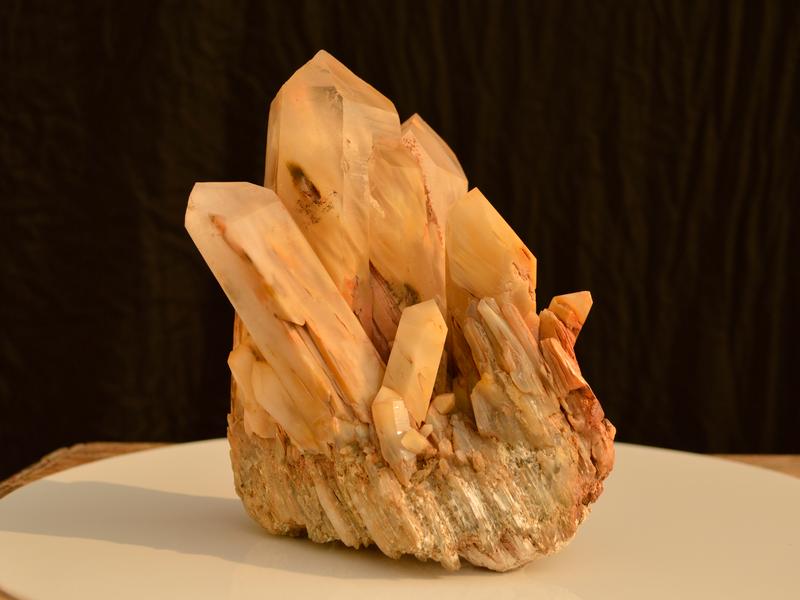
Amphibole quartz contains needle-like or fibrous amphibole crystals (typically hornblende or actinolite) trapped inside clear quartz during growth. The amphibole crystallized first in a metamorphic or igneous environment, and later silica-rich fluids encased the needles as quartz grew around them. The inclusions are preserved in their original orientation, frozen in place.
The dark green to black fibers create dramatic visual contrast against transparent quartz. These specimens document two distinct mineralogical events separated by time but locked together in the same crystal.
Mineralogy
Chemical Formula
SiO2 (quartz host) + Ca2(Mg,Fe,Al)5(Al,Si)8O22(OH)2 (amphibole group inclusions; primarily actinolite, tremolite, hornblende, and/or richterite)
Crystal System
Trigonal
Mohs Hardness
7
Specific Gravity
2.65-2.75 (varies with inclusion density)
Luster
Vitreous (quartz exterior); silky to fibrous (amphibole inclusions)
Color
White
Crystal system diagram represents the general trigonal classification. Diagram created by Crystalis for educational reference.
Traditional Knowledge
Brazilian Candomble and Umbanda traditions: In the syncretic Afro-Brazilian spiritual traditions of Bahia (the primary source region for amphibole quartz), quartz crystals with internal phantoms and inclusions are regarded as "pedras de orixas"; stones containing the presence of spiritual entities. The wispy, angelic inclusions are associated with caboclo spirits (indigenous nature spirits) and pretos velhos (wise ancestor spirits). While not specific to the trade name "angel phantom," the cultural context of the source region is inseparable from the stone's significance (Voeks, R. A., "Sacred Leaves of Candomble," 1997, University of Texas Press).
Contemporary angelic crystal healing (late 20th century): The "angel" designation for amphibole-included quartz emerged in the 1990s-2000s crystal healing market, attributed to various practitioners who perceived the wispy inclusions as resembling angel wings or celestial forms. This naming reflects a broader trend in crystal commerce of associating visual properties with spiritual archetypes. While the nomenclature is modern, it has become established in metaphysical practice (Simmons, R. & Ahsian, N., "The Book of Stones," 2007, North Atlantic Books).
Brazilian mining culture (Bahia): The garimpeiros (artisanal miners) of Bahia, Brazil, who extract these crystals from pegmatite and hydrothermal vein deposits, have their own classification system for included quartz. Specimens with red-brown amphibole phantoms are sometimes called "cristal de fogo" (fire crystal) locally, while white-phantom specimens may be called "cristal de nuvem" (cloud crystal). These folk classifications predate and exist independently of the international crystal market terminology (Proctor, K., "Gem Pegmatites of Minas Gerais, Brazil," 1984, The Mineralogical Record).
Brazilian Candomble and Umbanda traditions
In the syncretic Afro-Brazilian spiritual traditions of Bahia (the primary source region for amphibole quartz), quartz crystals with internal phantoms and inclusions are regarded as "pedras de orixas" -- stones containing the presence of spiritual entities. The wispy, angelic inclusions are associated with caboclo spirits (indigenous nature spirits) and pretos velhos (wise ancestor spirits). While not specific to the trade name "angel phantom," the cultural context of the source region is inseparable from the stone's significance (Voeks, R. A., "Sacred Leaves of Candomble," 1997, University of Texas Press). 2. Contemporary angelic crystal healing (late 20th century): The "angel" designation for amphibole-included quartz emerged in the 1990s-2000s crystal healing market, attributed to vario
When This Stone Finds You
Somatic protocol
Clear quartz with ghosts inside. Fibers of another mineral suspended like memory in glass.
3 min protocol
Hold the amphibole quartz up to a light source. Look inside. The clear quartz host is trigonal — ordered, transparent, predictable. But inside, you will see wisps, threads, and phantom shapes: these are amphibole inclusions — actinolite, tremolite, or hornblende — trapped during the quartz's growth. They are monoclinic minerals caught inside a trigonal lattice. Two systems coexisting. Tilt the stone slowly and watch the inclusions shift in the light. (0:00–0:45)
1 minClose your eyes. Hold the stone in both hands at heart level. The exterior is smooth vitreous quartz. But the inclusions inside are silky, fibrous — a completely different texture you can see but not touch. Breathe in for 4, out for 6. Consider: what is held inside you that others can see but cannot reach? (0:45–1:30)
1 minMove the stone to your forehead, resting it between your brows. The amphibole fibers inside this crystal grew first — the quartz formed around them, preserving them exactly as they were. They are not trapped. They are enshrined. Breathe naturally. Let the cool vitreous surface rest against your skin. Notice any sensation: warmth, pressure, tingling, or nothing. All responses are information. (1:30–2:15)
1 minLower the stone. Open your eyes. Look into it one more time — find one specific thread or wisp inside and focus on it for five seconds. Then place the stone down. Press your palms together briefly. The phantom thread holds. You hold it by looking, not by gripping. (2:15–3:00)
1 minCare and Maintenance
Amphibole quartz is water-safe for the quartz host (Mohs 7, SiO2). The amphibole inclusions (actinolite, tremolite, hornblende) are sealed inside the quartz and do not contact water directly. Brief rinse under cool running water is safe.
Note: some amphibole inclusions contain asbestiform minerals. The quartz encapsulation prevents fiber release, but avoid cutting or grinding specimens. Recommended cleansing: moonlight, sound, selenite plate.
Store normally; quartz is durable.
In Practice
You feel unprotected but you do not want armor. Amphibole quartz contains wisps of actinolite, tremolite, or hornblende trapped inside clear quartz. The inclusions look like feathers or wings suspended in ice.
The quartz is Mohs 7, the container. The amphibole inside is softer, Mohs 5-6, the vulnerability held safely. Rest it on the chest or hold in both palms.
The visual of something delicate preserved inside something strong is not a metaphor. It is the literal geology. The quartz grew around the amphibole and kept it intact for millions of years.
Verification
Amphibole quartz: the quartz host should be Mohs 7 (scratches glass). The amphibole inclusions should be INSIDE the crystal as needles, fibers, or wisps, not on the surface. Vitreous quartz exterior, silky to fibrous inclusion texture.
Specific gravity 2. 65-2. 75.
If the "inclusions" look painted or surface-applied, the specimen is not genuine.
Natural Amphibole Quartz should usually feel cooler than plastic or resin on first touch and warm more slowly in the hand.
Use 7 on the Mohs scale as the check, not internet myths. A real specimen should behave in line with the hardness listed above.
Look for a vitreous (quartz exterior); silky to fibrous (amphibole inclusions) surface quality rather than a painted or plastic shine.
The listed specific gravity is 2.65-2.75 (varies with inclusion density). If a specimen feels unusually light for its size, it may deserve a second look.
Geographic Origins
Brazil produces the vast majority of amphibole quartz, primarily from Minas Gerais. The hydrothermal conditions in Brazilian pegmatite regions create quartz crystals large enough to contain visible amphibole needle inclusions. The specific amphibole species (hornblende, actinolite, richterite) varies by locality within the Brazilian mining districts.
FAQ
Amphibole Quartz is classified as a "Amphibole Quartz" and "Angel Phantom Quartz" are trade names for clear quartz crystals containing conspicuous phantom inclusions of amphibole-group minerals. The specific amphibole species varies by locality and can include actinolite, tremolite, hornblende, richterite, or kaersutite. The phantoms record pauses and restarts in quartz crystal growth, with amphibole minerals depositing on growth surfaces during intervals. This is NOT the same as "Angel Aura Quartz," which is a surface-treated (metal-coated) quartz.. Chemical formula: SiO2 (quartz host) + Ca2(Mg,Fe,Al)5(Al,Si)8O22(OH)2 (amphibole group inclusions -- primarily actinolite, tremolite, hornblende, and/or richterite). Mohs hardness: 7 (quartz host); 5--6 (amphibole inclusions). Crystal system: Trigonal (quartz host, space group P3121 or P3221); monoclinic (amphibole inclusions, space group C2/m).
Amphibole Quartz has a Mohs hardness of 7 (quartz host); 5--6 (amphibole inclusions).
Water Safety CONDITIONAL -- Brief rinsing only. The quartz host is water-safe (hardness 7, chemically inert). However, the amphibole inclusions may include fibrous minerals that could theoretically be affected by prolonged soaking. Some amphiboles (particularly tremolite-actinolite series) are classified as asbestiform in their fibrous habit, though they are safely encapsulated within the quartz matrix during normal handling. Do NOT create gem elixirs with amphibole quartz. Brief rinsing under running water is safe. For any specimen with visible cracks reaching amphibole inclusions, avoid water contact entirely.
Amphibole Quartz crystallizes in the Trigonal (quartz host, space group P3121 or P3221); monoclinic (amphibole inclusions, space group C2/m).
The chemical formula of Amphibole Quartz is SiO2 (quartz host) + Ca2(Mg,Fe,Al)5(Al,Si)8O22(OH)2 (amphibole group inclusions -- primarily actinolite, tremolite, hornblende, and/or richterite).
Formation Story Amphibole Quartz forms in hydrothermal vein systems where silica-rich fluids percolate through calcium-magnesium-iron-bearing host rocks at moderate temperatures (300--500 degrees C) and pressures. The quartz crystals grow from these supersaturated hydrothermal solutions within open cavities, fractures, and veins in metamorphic or igneous host rock. Research on Alpine fissure veins confirms that quartz crystals forming in metamorphic environments commonly contain amphibole minera
References
. [SCI]
DOI: 10.1111/jmg.12649
. [SCI]
DOI: 10.1111/jmg.12045
Closing Notes
Clear quartz trapped amphibole fibers during growth, needle-like inclusions of hornblende or actinolite suspended inside a transparent host. The science documents how one mineral preserves another by growing around it. The practice asks what happens when you hold something that looks like it contains wings.
Bring it into practice
Move from reference to ritual. Search current inventory for Amphibole Quartz, build a custom bracelet, or let Sacred Match choose the right supporting stones for you.
Community notes
Shared field notes tied to Amphibole Quartz appear here, including notes saved from practice.
When members save a public field note for this stone, it will appear here.
The archive
Continue through stones that share intention, chakra focus, or tonal family with Amphibole Quartz.

Shared intention: Grief & Loss
The Angel of Grief
Shared intention: Grief & Loss
The Heart's Bridge to Joy
Shared intention: Heart Healing
The Ancient Heart's Memory
Shared intention: Spiritual Connection
The Heart's Clear Window

Shared intention: Spiritual Connection
The Ancestral Flame
Shared intention: Spiritual Connection
The Healer of Broken Lines