Materia Medica
Atlantisite
The Ancient Heart's Memory
This page documents traditional and cultural uses of atlantisite alongside emerging research on tactile grounding objects. Crystalis does not claim that atlantisite treats, cures, or prevents any medical condition. For mental health concerns, consult a qualified professional.
Origins: Tasmania (Australia)
Materia Medica
The Ancient Heart's Memory
Protocol
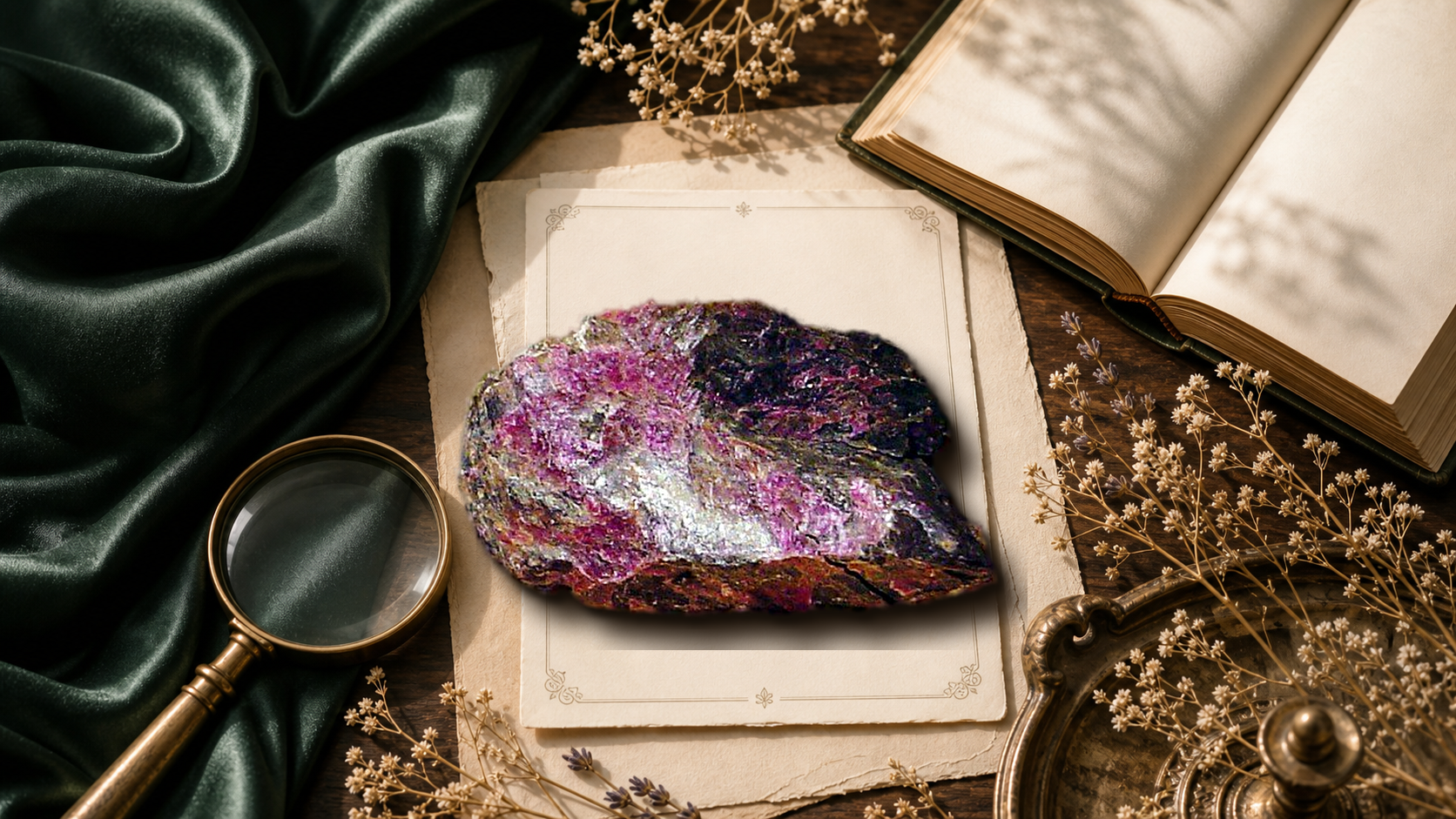
Purple stichtite in green serpentine. Two minerals from opposite ends of the earth's mantle, fused.
3 min
Hold the atlantisite so you can see both colors — the purple-pink patches of stichtite embedded in the green serpentine matrix. These formed together in Tasmania, where chromium-rich hydrothermal fluids met serpentinized mantle rock. The purple carries magnesium and chromium. The green carries magnesium and silicon. Same element, different companions, different colors. Observe where the purple meets the green. There is no clean line — they interpenetrate. (0:00–0:45)
Close your eyes. Hold the stone in both hands at heart height. The surface is waxy to pearly — not glassy, not rough. Somewhere between polished and raw. Breathe in for 4, out for 6. Atlantisite is a caution stone with water — handle with dry hands and avoid prolonged moisture. Notice the organic warmth of the waxy surface against your skin. It absorbs heat faster than vitreous stones. (0:45–1:30)
Move the stone to your solar plexus. Serpentine gets its name from the Latin serpentinus — resembling a serpent. It forms when mantle peridotite meets water deep underground, a transformation called serpentinization. The rock itself was transformed by contact. Press the stone gently into your belly. Ask: what contact has transformed me — not broken me, but changed my mineral composition? (1:30–2:15)
Open your eyes. Look at the stone one more time. The chromium that makes stichtite purple is the same element that makes rubies red and emeralds green — context determines expression. Place the stone down on a dry surface. Press both palms onto your thighs. Breathe once, fully. The chromium and the serpent rest. (2:15–3:00)
tap to flip for protocol
Instinct and tenderness often split after enough bad experience. The gut says leave. The heart says stay kind. One starts to feel brutal, the other unsafe.
Serpentine carries body wisdom, earth, survival. Stichtite brings a softer countertone. They remain distinct and still manage to share structure.
A mature inner life is rarely a perfect blend. More often it is a negotiated coexistence.
What Your Body Knows
sympathetic
. The polyvagal framework describes how the ventral vagal pathway; activated through experiences of safety and social connection; supports the Social Engagement System involving eye gaze, facial expression, tone of voice, and social gesture. Atlantisite's dual-color energy supports the somatic experience of moving from guarded alertness toward relational openness (Bailey et al., 2020; Cabrera et al., 2017).
Nervous system mapping based on polyvagal theory (Porges, 2011).
The Earth Made This
Atlantisite is a trade name, not a mineral species. What it describes is the natural intergrowth of green serpentine and purple stichtite found almost exclusively in Tasmania, Australia.
The serpentine forms first through hydrothermal alteration of ultramafic rocks. The stichtite arrives later, crystallizing as chromium released from chromite reacts with magnesium-rich carbonate fluids. Purple veins through green host. The two-toned appearance records a sequence: ultramafic rock altered to serpentine, then chromium mobilized into carbonate form. Stichtite Hill near Zeehan, Tasmania, remains the primary source.
Mineralogy
Chemical Formula
Stichtite: Mg6Cr2(OH)16CO3 . 4H2O
Crystal System
**Stichtite:** Trigonal (Rhombohedral), Space Group R-3M
Mohs Hardness
1.5
Specific Gravity
2.1-2.2 (stichtite) / 2.5-2.6 (serpentine)-composite ~2.3-2.5
Luster
Waxy to pearly (stichtite), waxy to greasy (serpentine)
Color
Green-Purple
Traditional Knowledge
1910: Stichtite first described as a new mineral from Dundas, Tasmania, named after Robert Carl Sticht, manager of the Mount Lyell Mining Company 1990s: Gerald Pauley trademarks the name "Atlantisite" for the purple-green combination from Stichtite Hill, Tasmania Modern: Atlantisite has become popular in crystal healing communities, particularly in Australia, marketed as a combination stone for heart-centered work
1910
Stichtite first described as a new mineral from Dundas, Tasmania, named after Robert Carl Sticht, manager of the Mount Lyell Mining Company - 1990s: Gerald Pauley trademarks the name "Atlantisite" for the purple-green combination from Stichtite Hill, Tasmania - Modern: Atlantisite has become popular in crystal healing communities, particularly in Australia, marketed as a combination stone for heart-centered work
When This Stone Finds You
Somatic protocol
Purple stichtite in green serpentine. Two minerals from opposite ends of the earth's mantle, fused.
3 min protocol
Hold the atlantisite so you can see both colors — the purple-pink patches of stichtite embedded in the green serpentine matrix. These formed together in Tasmania, where chromium-rich hydrothermal fluids met serpentinized mantle rock. The purple carries magnesium and chromium. The green carries magnesium and silicon. Same element, different companions, different colors. Observe where the purple meets the green. There is no clean line — they interpenetrate. (0:00–0:45)
1 minClose your eyes. Hold the stone in both hands at heart height. The surface is waxy to pearly — not glassy, not rough. Somewhere between polished and raw. Breathe in for 4, out for 6. Atlantisite is a caution stone with water — handle with dry hands and avoid prolonged moisture. Notice the organic warmth of the waxy surface against your skin. It absorbs heat faster than vitreous stones. (0:45–1:30)
1 minMove the stone to your solar plexus. Serpentine gets its name from the Latin serpentinus — resembling a serpent. It forms when mantle peridotite meets water deep underground, a transformation called serpentinization. The rock itself was transformed by contact. Press the stone gently into your belly. Ask: what contact has transformed me — not broken me, but changed my mineral composition? (1:30–2:15)
1 minOpen your eyes. Look at the stone one more time. The chromium that makes stichtite purple is the same element that makes rubies red and emeralds green — context determines expression. Place the stone down on a dry surface. Press both palms onto your thighs. Breathe once, fully. The chromium and the serpent rest. (2:15–3:00)
1 minCare and Maintenance
Water: Brief water contact is acceptable for cleansing. Prolonged soaking is NOT recommended . stichtite is a soft, hydrous mineral (Mohs 1.
5-2. 5) that can degrade in water, and the carbonate interlayer can dissolve under acidic conditions. Sun safety: Moderate exposure is fine.
Extended direct sunlight may fade the purple stichtite component over time. Elixir safety: NOT recommended for direct-infusion elixirs due to the serpentine-group component and the Cr content. Use indirect method only.
Dust precaution: Do NOT cut, grind, or polish without respiratory protection. Serpentine dust should always be treated with caution. Sun: Moderate exposure is fine.
Extended direct sunlight may fade the purple stichtite component over time. Elixir safety: NOT recommended for direct-infusion elixirs due to the serpentine-group component and the Cr content. Use indirect method only.
Dust precaution: Do NOT cut, grind, or polish without respiratory protection. Serpentine dust should always be treated with caution.
In Practice
Atlantisite, as a combination of heart-centered green and higher-heart purple, addresses the transition zone between sympathetic activation and ventral vagal safety. The polyvagal framework describes how the ventral vagal pathway. activated through experiences of safety and social connection. supports the Social Engagement System involving eye gaze, facial expression, tone of voice, and social gesture. Atlantisite's dual-color energy supports the somatic experience of moving from guarded alertness toward relational openness (Bailey et al., 2020; Cabrera et al., 2017).
- Transition from sympathetic fight/flight toward social engagement - Heart-closing patterns: difficulty receiving care, love, or support - When both grounding (green/earth) and spiritual opening (purple/crown) are needed simultaneously - Compassion fatigue in caregivers: the combination supports giving AND receiving - Processing relational trauma: particularly patterns of trust betrayal
- Acute sympathetic crisis (panic, rage): too gentle for active emergency states; use grounding stones first - When focus on a single chakra/energy center is needed: the dual nature can disperse rather than concentrate intention - When strong boundary-setting is the priority: this is an opening stone, not a protective one
- Heart center (4th chakra): Primary placement. the green-and-purple combination maps directly to the heart/higher-heart interface - Thymus point (between throat and heart): Specifically for the "higher heart" or seat of compassion - One stone on heart, one on crown: For vertical integration of earth and spirit energies - Held between both palms: For meditation on giving and receiving
- Feel: Warm to the touch and remarkably light (SG ~2.3-2.5); the waxy texture feels organic and skin-like - Somatic experience: The lightness and warmth signal "gentleness" to the nervous system. The waxy, almost skin-like texture activates touch receptors in a way that feels nurturing rather than stimulating. Many users report a softening sensation in the chest when the stone is placed on the heart. a letting-go of guarding patterns. The dual color provides a visual cue for integration: "both can exist at once."
Verification
Atlantisite is a natural intergrowth of green serpentine and purple stichtite. Both should be present. Specific gravity approximately 2.
3-2. 5. Waxy to pearly luster.
If only one color is present, it is not atlantisite. Genuine specimens come almost exclusively from Tasmania, Australia. Check for natural intergrowth; the purple and green should merge organically, not look painted or glued.
Natural Atlantisite should usually feel cooler than plastic or resin on first touch and warm more slowly in the hand.
Use 1.5 on the Mohs scale as the check, not internet myths. A real specimen should behave in line with the hardness listed above.
Look for a waxy to pearly (stichtite), waxy to greasy (serpentine) surface quality rather than a painted or plastic shine.
The listed specific gravity is 2.1-2.2 (stichtite) / 2.5-2.6 (serpentine)-composite ~2.3-2.5. If a specimen feels unusually light for its size, it may deserve a second look.
Geographic Origins
Type locality (for the trade name): Stichtite Hill, Dundas, western Tasmania, Australia Type locality (for stichtite mineral): Dundas, Tasmania (described 1910) Barberton, South Africa (serpentinite-hosted stichtite) Great Dyke, Zimbabwe Various ophiolite complexes worldwide (where chromite-bearing serpentinites weather)
Atlantisite forms through the serpentinization of ultramafic rocks (peridotites) that contain chromite. Serpentinization is a major hydrothermal process in which olivine and pyroxene . the primary minerals of mantle peridotite . react with water to produce serpentine-group minerals, brucite, and magnetite. The basic reaction for olivine serpentinization is: 6(Mg,Fe)2SiO4 + 7H2O = 3(Mg,Fe)3Si2O5(OH)4 + Fe3O4 + H2 (Okamoto et al., 2024; Sabuda et al., 2021; Nascimento Vieira et al., 2020). This process typically occurs at temperatures below 400 degrees C and produces highly alkaline fluids with pH values reaching 11 or higher. The stichtite component forms when chromium is released during the weathering and alteration of chromite (FeCr2O4), a common accessory mineral in ultramafic rocks. As chromite weathers under alkaline, carbonate-rich conditions produced by serpentinization, Cr3+ is liberated and combines with Mg2+, CO3^2-, OH-, and water to crystallize stichtite in the interstices of the serpentine matrix. The co-occurrence of stichtite and serpentine is therefore a direct consequence of chromite-bearing peridotite undergoing serpentinization in the presence of CO2-bearing fluids. Chromium mobility in serpentine soils has been studied extensively, showing that Cr is gradually exposed by weathering of parent materials and that chemical modification of chromite increases near the soil surface (Cheng et al., 2011; Davaasuren et al., 2024). The type locality for this combination is Stichtite Hill at Dundas, Tasmania, Australia, where Precambrian ultramafic rocks have undergone extensive serpentinization. The geological setting is an ophiolite complex . a fragment of ancient oceanic crust and upper mantle that was obducted onto continental crust. Similar assemblages occur in other ophiolite/serpentinite terranes worldwide, but the Tasmanian material is prized for its vivid color contrast and large stichtite patches (Pereira & Peinado, 2012; Huang et al., 2023).
FAQ
Chemical formula: Stichtite:** Mg6Cr2(OH)16CO3 . 4H2O. Mohs hardness: 1.5-2.5 (stichtite) / 2.5-3.5 (serpentine) -- composite ~2-4. Crystal system: **Stichtite:** Trigonal (rhombohedral), space group R-3m.
Atlantisite has a Mohs hardness of 1.5-2.5 (stichtite) / 2.5-3.5 (serpentine) -- composite ~2-4.
Brief water contact is acceptable for cleansing. Prolonged soaking is NOT recommended -- stichtite is a soft, hydrous mineral (Mohs 1.5-2.5) that can degrade in water, and the carbonate interlayer can dissolve under acidic conditions.
Moderate exposure is fine. Extended direct sunlight may fade the purple stichtite component over time.
Atlantisite crystallizes in the **Stichtite:** Trigonal (rhombohedral), space group R-3m.
The chemical formula of Atlantisite is Stichtite:** Mg6Cr2(OH)16CO3 . 4H2O.
- Type locality (for the trade name): Stichtite Hill, Dundas, western Tasmania, Australia - Type locality (for stichtite mineral): Dundas, Tasmania (described 1910) - Barberton, South Africa (serpentinite-hosted stichtite) - Great Dyke, Zimbabwe - Various ophiolite complexes worldwide (where chromite-bearing serpentinites weather) ---
Atlantisite forms through the serpentinization of ultramafic rocks (peridotites) that contain chromite. Serpentinization is a major hydrothermal process in which olivine and pyroxene -- the primary minerals of mantle peridotite -- react with water to produce serpentine-group minerals, brucite, and magnetite. The basic reaction for olivine serpentinization is: 6(Mg,Fe)2SiO4 + 7H2O = 3(Mg,Fe)3Si2O5(OH)4 + Fe3O4 + H2 (Okamoto et al., 2024; Sabuda et al., 2021; Nascimento Vieira et al., 2020). This
References
. [SCI]
DOI: 10.1111/iar.12519
. [SCI]
DOI: 10.1029/2020JG006209
. [SCI]
. [SCI]
DOI: 10.1029/2022JB025218
. [SCI]
. [SCI]
DOI: 10.1111/rge.12331
. [SCI]
DOI: 10.1002/gdj3.105
. [SCI]
DOI: 10.1002/jrs.2508
. [SCI]
DOI: 10.1111/gto.12031
Closing Notes
Green serpentine and purple stichtite locked in one Tasmanian body. Two minerals, two colors, two different chemistries sharing the same rock without merging. The science documents natural intergrowths in ultramafic terrain.
The practice asks what happens when instinct and compassion learn to coexist without one consuming the other.
Bring it into practice
Move from reference to ritual. Search current inventory for Atlantisite, build a custom bracelet, or let Sacred Match choose the right supporting stones for you.
Community notes
Shared field notes tied to Atlantisite appear here, including notes saved from practice.
When members save a public field note for this stone, it will appear here.
The archive
Continue through stones that share intention, chakra focus, or tonal family with Atlantisite.

Shared intention: Spiritual Connection
The Landscape Within

Shared intention: Ancestral Healing
The Angel Wing Stone
Shared intention: Heart Healing
Where Purple Meets Green
Shared intention: Heart Healing
The Green Ghost Healer

Shared intention: Heart Healing
The Heart's Green Patience

Shared intention: Heart Healing
The Fossil Bloom